Three faces of Violetta
Christopher Corwin surveys the three Traviata casts — led by Lisette Oropesa, Rosa Feola, and Ermonela Jaho — at the Met this spring.
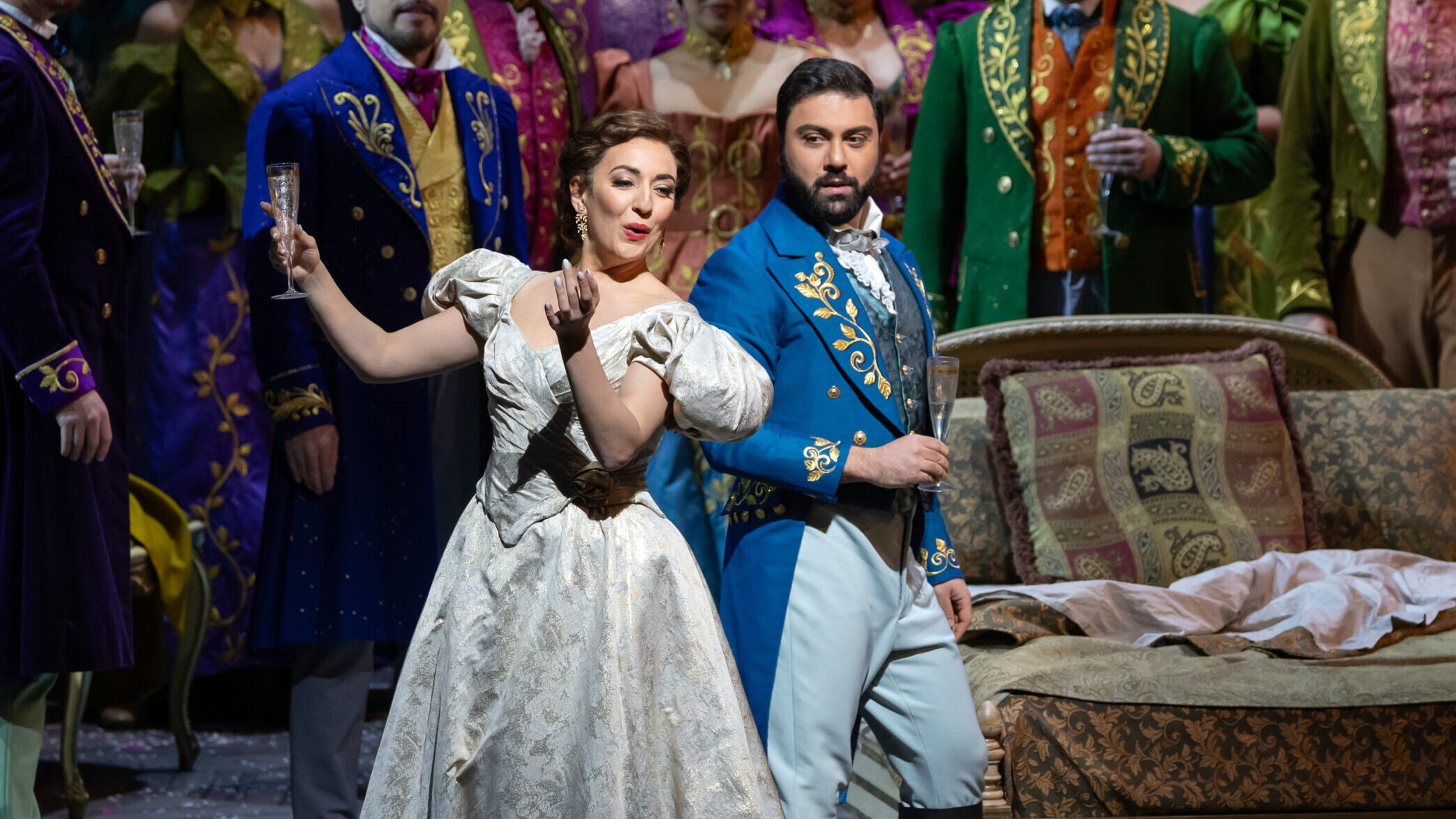
Rosa Feola as Violetta and Liparit Avetisyan as Alfredo in Verdi’s “La Traviata.” Photo: Marty Sohl / Met Opera
La traviata has never been on my most-loved Verdi list; I used to feel similarly about Rigoletto, but it’s lately risen in my estimation. Perhaps there’s also hope for Traviata, thanks in part to the Met’s current system of offering scads of performances of standard works with unusually interesting casts. Last weekend I attended the company’s 1067th and 1068th performances of Traviata, curious to compare the Violettas of Rosa Feola and Ermonela Jaho after having earlier this year also seen Lisette Oropesa’s. This binge resulted in experiencing two very satisfying portrayals of one of opera’s most iconic characters.
Rather like my response to Tosca, I don’t find Violetta the most sympathetic character, but she does offer sopranos an unusually rich opportunity to excel. Despite not being a card-carrying Traviata-lover, I’ve caught a good number of worthwhile Violettas beginning with Edita Gruberová on the 1989 opening night of the first Franco Zeffirelli Met production. Cheryl Studer seems to have been the only other soprano I heard before that production was replaced nine years later. I had a ticket for the opening of the second Zeffirelli but when Reneé Fleming withdrew and Patricia Racette jumped in, I gave mine away.
I did finally hear Fleming in it when she eventually took on the role at the Met. as well as Angela Gheorghiu and Krassimira Stoyanova. I was in the audience when Marina Poplavskaya premiered Willy Decker’s searing staging in place of Anna Netrebko who decided she no longer wanted to perform the opera, a decision which she reversed a number of times since then. Decker’s red dress suited Sonya Yoncheva and Marina Rebeka admirably, Natalie Dessay somewhat less so. I reviewed the premiere of the Met’s current Traviata when it opened in 2018 and found Michael Mayer’s production a vulgar eyesore but Diana Damrau’s Violetta utterly convincing dramatically if erratic vocally; it has proven her last role with the company to date.
Several seasons ago, I thought about comparing Violettas when the Met presented another intriguing trio: Nadine Sierra, Jaho, and Angel Blue, but I never made it to any of them, but this season I followed through. I had thought that Lisette Oropesa had sung more Violettas at the Met than she actually had. Her 2020 run was cut short by the pandemic closure, while additional performances were scheduled then canceled for 2020-21. By her return this past March, her Violetta had evolved into a fully realized portrayal, surely one of the finest before the public today. As I’ve said before, I don’t always respond to her singing on recordings or broadcasts, but in-person Oropesa’s soprano takes on a special beauty and amplitude that were also apparent in her splendid Elvira in this season’s new I Puritani.
Her Violetta was immeasurably helped by the immensely supportive and interestingly detailed conducting of Antonello Manacorda, a frequent Oropesa collaborator. Luca Salsi, who sang Germont at her 2020 performances and was also her over-protective dad in 2022’s Rigolettos, made a much better impression this season than he had with his superficial, blustery jester. Both performers deserved a better lover/son than Piotr Buszewski, miscast in a romantic Italian role.
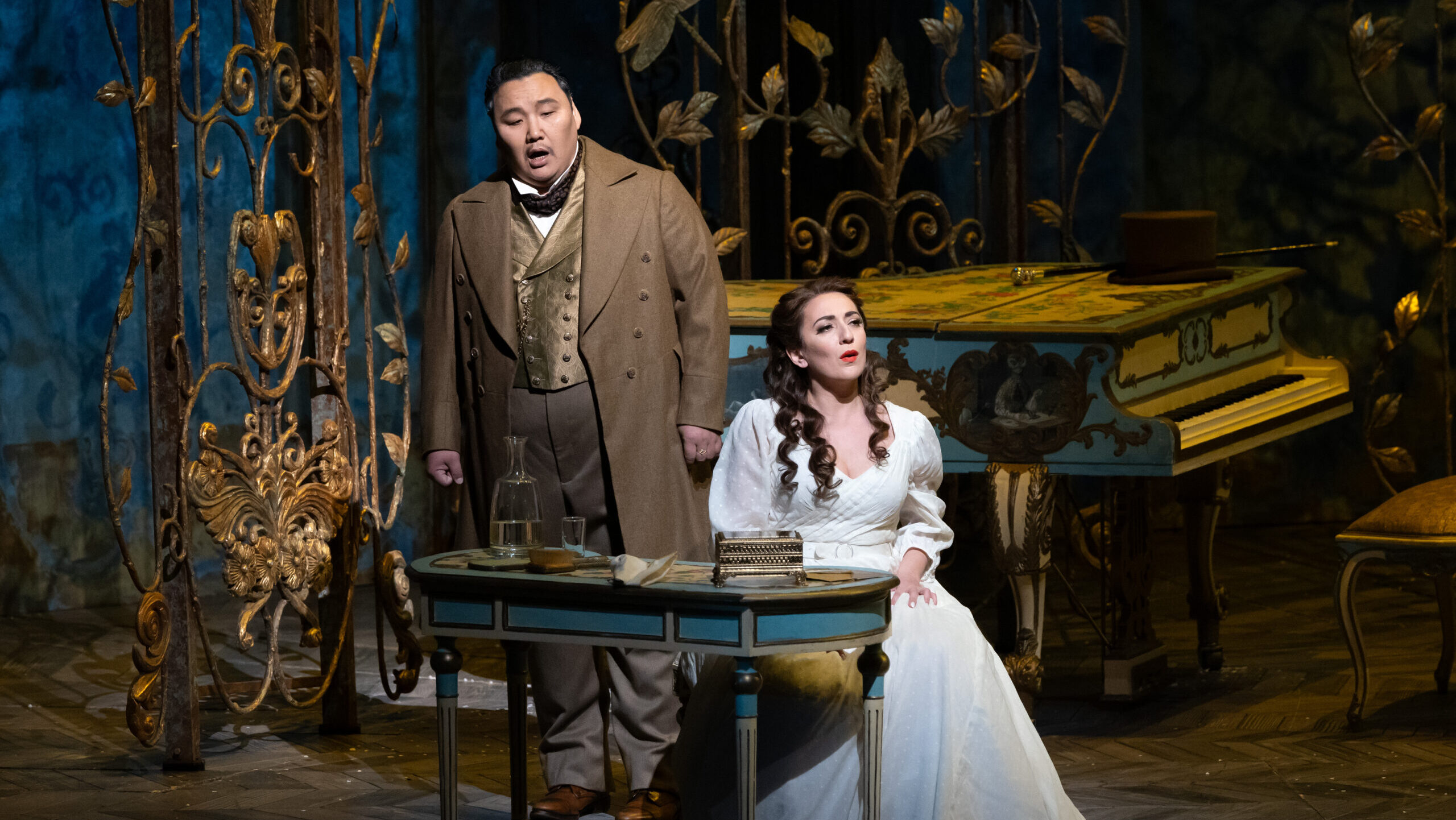
Amartuvshin Enkhbat as Germont and Rosa Feola as Violetta in Verdi’s “La Traviata.” Photo: Marty Sohl / Met Opera
At only her second Met Violetta, Rosa Feola, too, offered a nearly ideal portrayal of Verdi’s lost one, proving she’s as adept at tragedy as she had been with comedy with her delicious Figaro Susanna last year. Her sound has grown in size and richness and filled the house with seemingly effortless ease. Violetta’s early conversational lines in the first-act party were concerningly under-voiced, but by the end of “Libiamo” she was in superb form. One definitely wanted more than a single verse of “Ah, fors’è lui,” and if “Sempre libera” didn’t feature the coloratura dazzle that some have brought to it, she did cap it with a surprising, strongly sustained high E-flat!
Her riveting duet with the immense and implacable Germont of Amartuvshin Enkhbat did full justice to the most wrenching pages of Verdi’s score, as did Feola’s poignantly ardent “Amami Alfredo.” Mayer’s erratic direction did Feola no favors after intermission when she had to wander around aimlessly during the concluding pages of the big gambling-scene finale and then had to silently endure Alfredo’s completely extraneous sister crossing the entire width of the stage dressed as a bride during the third-act prelude. However, both verses of “Addio del passato” were delicately spun out with touching sensitivity and just the right degree of desperation.
She was lucky to be partnered by Liparit Avetisyan with whom she shared palpable romantic chemistry. The Armenian tenor, who was supposed to make his Met debut during the canceled 2020-21 season, channeled eager-otter energy into an Alfredo as unabashedly enamored of Violetta in the first and last acts as he was devastatingly cruel in the gambling scene. An unfortunate stab at an interpolated high C at the end of his cabaletta reportedly marred his debut the previous performance, so he wisely performed it as written for the second. His lovely tenor might be slightly small for the Met and his topmost notes required some effort, but he would certainly be welcome to return.
After Antonello Manacorda’s often-revelatory reading, Marco Armiliato, conductor for both Feola and Jaho, returned to his usual safe routinier mode and drew polished playing from his orchestra and particularly vigorous singing from the chorus for Feola. Lindsay Martin as a particularly vibrant Flora and Eve Gigliotti in Valkyrie-manqué form as Annina stood out among the smaller roles which as a unit were far stronger for Feola than was the crew supporting Jaho the following evening.
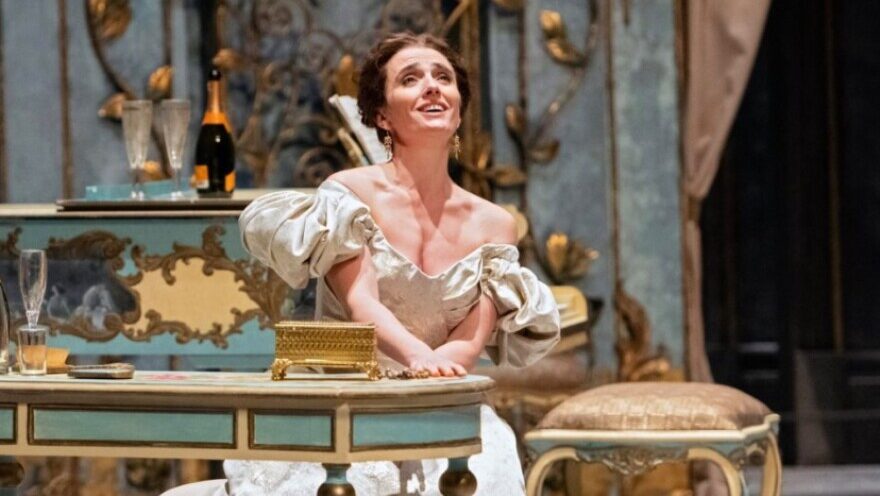
Ermonela Jaho in La traviata at the Metropolitan Opera, 2023 / Photo: Jonathan Tichler
When the Armenian soprano returned to the Met in 2018 after a one-night stand as Violetta a decade earlier, I found Jaho’s intensely moving Butterfly occasionally undercut by her slender voice. The intervening eight years have only further reduced its effectiveness. Much of the first Act sounded very rough with the tone quite raw. There were some strong high notes throughout, and while both she and Feola chose to take the second verse of “Sempre libera” softly and slowly, I would have been surprised if Jaho’s could be heard by listeners seated above the Grand Tier. She still employs a haunting pianissimo, but more often than not it was done quite self-consciously for “effect.” Unlike my evening with Feola where I felt I was experiencing Violetta, with Jaho I was always conscious of a practiced diva carefully negotiating a long-familiar, now-challenging role.
Her portrayal of Violetta had many novel touches, no doubt the result of having sung Violetta over three-hundred times! That astonishing bit of data comes from a fascinating duo-interview of Feola and Jaho included in the Met’s May/June program. Her older, sophisticated, and world-weary courtesan exuded little chemistry with Kang Wang’s enthusiastic if gauche Alfredo sung with forthright earnestness and easy high notes. His nicely done aria and cabaletta (during which he dropped out for measures to prepare for his high C) were undercut by shallow semaphore gestures.
While Enkhbat remains a monumentally stolid stage presence, Lucas Meachem also made Germont more of an impassive stick than is necessary: he displayed almost no concern for the dying Violetta in the final Act. He stiffly lacked Enkhbat’s easy legato and seemed to be biding time until he could pop out startling high notes that rang near-tenorial ease. Only veteran Dwayne Croft as Douphol stood out among that cast’s many smaller roles.
While next season’s casts for long runs of Aida and La Bohème at the Met don’t initially look all that exciting, twenty-six performances of Tosca will feature five (!) intriguing sopranos: Saoia Hernández, Aleksandra Kurzak, Eleonora Buratto, Natalya Romaniw, and Sondra Radvanovsky, along with four Cavaradossis and Scarpias—a variety unseen since the Bing years!

Christopher Corwin
Christopher Corwin began writing for parterre box in 2011 under the pen name “DeCaffarrelli.” His work has also appeared in , The New York Times, Musical America, The Observer, San Francisco Classical Voice and BAMNotes. Like many, he came to opera via the Saturday Met Opera broadcasts which he began listening to at age 11. His particular enthusiasm is 17th and 18th century opera. Since 2015 he has curated the weekly podcast Trove Thursday on parterre box presenting live recordings.
-
Topics: ermonela jaho, lisette oropesa, Metropolitan Opera, Review, rosa feola
-
People: Aleksandra Kurzak, Amartuvshin Enkhbat, Angel Blue, Angela Gheorghiu, Anna Netrebko, Antonello Manacorda, Cheryl Studer, Diana Damrau, Dwayne Croft, Edita Gruberova, Eleonora Buratto, Ermonela Jaho, Eve Gigliotti, Franco Zeffirelli, Kang Wang, Krassimira Stoyanova, Lindsay Martin, Liparit Avetisyan, Lisette Oropesa, Luca Salsi, Lucas Meachem, Marco Armiliato, Marina Poplavskaya, Marina Rebeka, Michael Mayer, Nadine Sierra, Natalie Dessay, Patricia Racette, Piotr Buszewski, Renée Fleming, Rosa Feola, Saioa Hernández, Sondra Radvanovsky, Sonya Yoncheva
-
Works: Aïda, I Puritani, La bohème, La traviata, Le nozze di Figaro, Rigoletto, Tosca
-
Places & Organizations: Metropolitan Opera