Aix tremendae, salva me
Festival d’Aix-en-Provence confronts the living and the dead — and its own future — through audacious productions and an intimate world premiere.
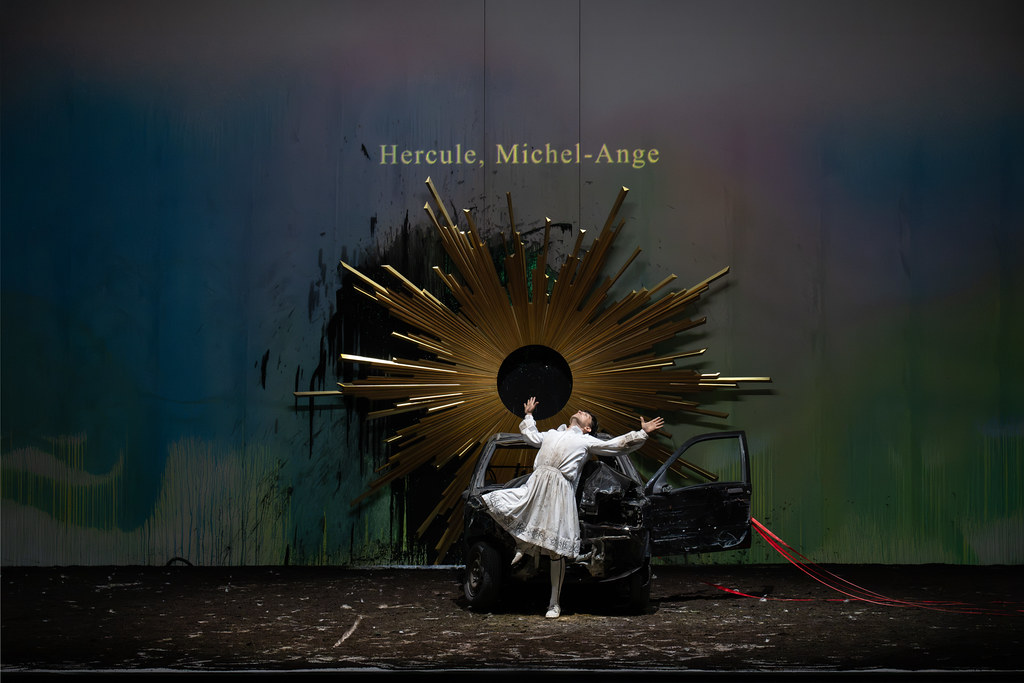
Photo: Monika Rittershaus
The 2026 Festival d’Aix-en-Provence arrived in a period of retrenchment and transition, with fewer new productions than in some recent seasons. Aix’s artistic director, Pierre Audi died suddenly in spring 2025 at the age of 67. Ted Huffman, his American successor, newly in place, is implementing Audi’s 2026 plans and part of the 2027 edition before developing his own vision from 2028 onward.
The four staged works I saw during the opening days arranged themselves into a rough diptych. On one side stood life-affirming operas about the will to struggle and persevere: Die Frau ohne Schatten and Die Zauberflöte. On the other were two works about endings and leave-taking: a revival of Romeo Castellucci’s ritualization of Mozart’s Requiem, first staged here in 2019, and the world premiere of Francesco Filidei’s chamber opera Accabadora.
To be sure, life and death are porous categories. Vitality kept breaking into the works about endings, just as intimations of mortality entered the most life-affirming pieces. Strauss’s fairy tale opera is full of magical transformations and dislocations: a white gazelle that turns into a woman; an emperor who turns to stone; a shadow that loosens itself from the body of a poor woman. Mozart’s fantastical singspiel is either allegorical or nonsensical depending on your point of view. It ends with the triumph of love and reason, but along the way characters contemplate rape, murder, and suicide. Castellucci’s Requiem, for all its catalogues of extinction, turned out to be one of the most bracingly alive things I have seen from the Italian director. Accabadora, about a woman who performs mercy killings in a Sardinian village and her adopted daughter, is also a coming-of-age fable and tale of emancipation.
The undeniable highlight of this year’s festival was Barrie Kosky’s Die Frau ohne Schatten, conducted by Klaus Mäkelä, who becomes chief conductor of the Royal Concertgebouw Orchestra and music director of the Chicago Symphony Orchestra in September 2027. Frau gives a director a surplus of meaning and then dares him not to drown in it. Its symbolic apparatus is so overstocked that a production can spend all evening unpacking it and still never locate its pulse. Kosky, to his credit, trusted the opera’s weirdness. He did not tidy it up or turn it into a psychiatric dossier with orchestral interludes.
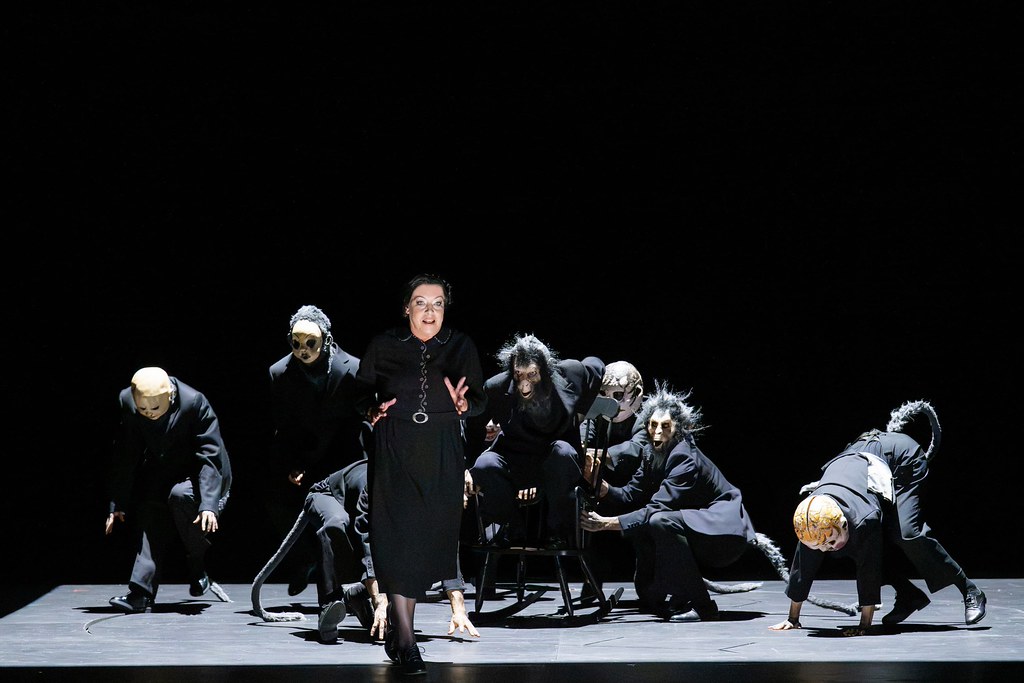
Photo: Monika Rittershaus
From the first image, Kosky made Nina Stemme’s Amme the figure through whose gaze, or consciousness, the opera unfolded. Seated in her rocking chair, she seemed to call the story into being and lingered at its margins even during the rare stretches when she had nothing to sing. The possibility remained that the whole fairy tale was hers to tell – or to dream.
Michael Levine’s set was dominated by a black cube that descended from above, swallowing and releasing bodies and objects like a top hat or box from which a magician might produce a rabbit — or a corpse. The Emperor rode a colossal rocking horse poised over a curved blade, with slaughtered deer below him. Barak’s house was a cluttered assemblage of scaffolding, buckets, rags, and pans. Keikobad, the Empress’s silent father, appeared as an oversized porcelain doll’s head, as surreal and disquieting as a drawing by Roland Topor. A dancer in a sparkly black leotard slipped through the action as both an erotic apparition and a personification of the sought-after shadow.
Kosky interpreted Hofmannsthal’s libretto as not narrowly concerned with fertility; the director did not so much erase the reproductive plot as make room for other resonances. Recalling Chamisso’s tale of Peter Schlemihl, the shadow became a visible mark of human belonging. The Empress’s determination not to barter in shadows meant refusing to purchase her humanity at the expense of another’s misery. Kosky’s most conspicuous revision came at the end of Act II. Instead of responding to her husband’s threats of violence with newfound ardor and devotion, the Färberin did what any modern woman would do: attack the bastard with the nearest hammer. It was a deeply satisfying inversion that fit the score perfectly, even as it cut against the grain of the libretto.
Performances of Frau remain comparatively rare because of its enormous technical, orchestral, and vocal demands. My own attachment to the work began with the Metropolitan Opera’s 2001 production, directed by Herbert Wernicke and conducted by Christian Thielemann.
In 2001, I had recently gotten into the habit of scoring standing-room tickets ($16, if memory serves) to anything and everything at the Met. The evening was one of a handful of performances that helped determine the course of my life. I remember leaning against the back row of the orchestra in utter stupefaction, wondering what in God’s name this gigantic, ravishing, deranged thing was and why I had needed to reach the ripe age of 15 to discover that opera could be this overpowering and sumptuous. Since then, Frau has been one of the few pieces (along with Lulu) that I will travel great distances to see.
Nowadays, Frau is sometimes treated as an orchestral luxury good, all polish and expense. (That was the dismaying impression left by Thielemann’s recent performances in Vienna and Zubin Mehta’s in Berlin.) Mäkelä ensured that the evening never became a bath of Straussian perfume. The Orchestre de Paris kept revealing the score’s joints: the concertante exchanges between voice and instrument; the small instrumental commentaries that seem to listen to and answer the singers; the mournful cello solo during the Emperor’s great Act II scena; and the violin meditation preceding the Empress’s confession before Keikobad in Act III.
Mäkelä understood that the human voice in Frau is often less a melody placed above the orchestra than another brilliant instrument within an unusually rich chamber texture. His tempi could be daring. Some stretches were held back to the edge of stillness, as in the Empress’s resolute farewell to the Amme near the start of Act III. These suspended moments, coupled with Kosky’s exceptionally sensitive Personenregie, made the opera’s dream-time palpable: the characters seemed trapped inside slowly churning machinery that could at any moment turn deadly. The performing edition assembled for Aix puzzled me in the best possible way. Mäkelä wrote in the program that it retained many of the cuts Karl Böhm made with Strauss’s approval, yet I cannot remember hearing a live performance that sounded more complete.
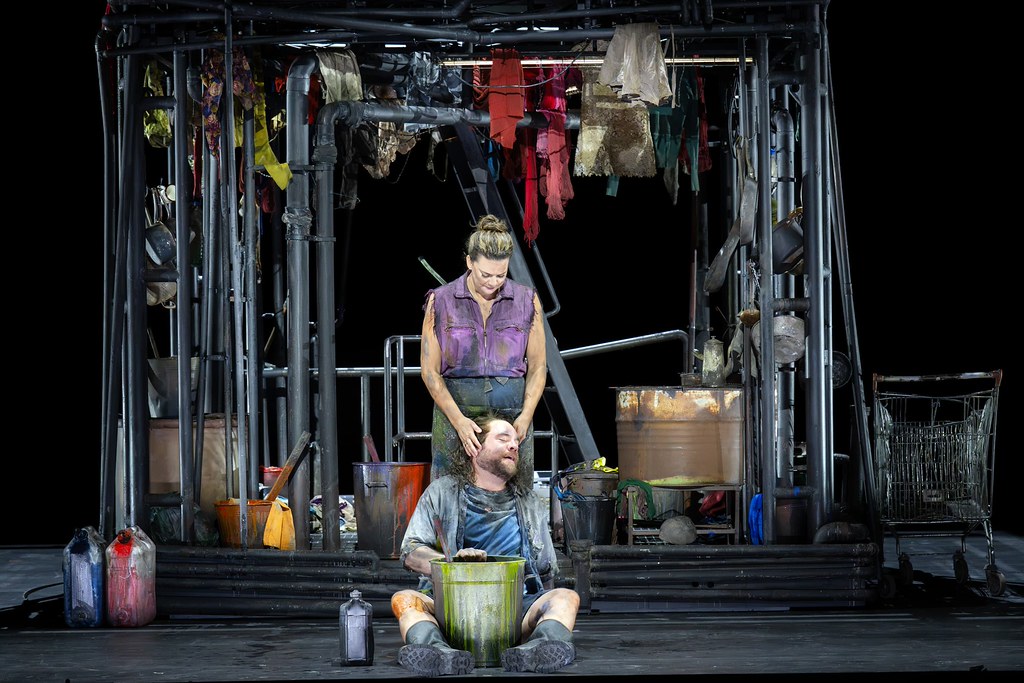
Photo: Monika Rittershaus
Aix assembled an enviable cast with one knockout performance. Ambur Braid’s Färberin had the amplitude, steel, and nerve for the role, but also the desolation. Her voice cut through the orchestra with thrilling security, and she seemed dramatically alive in every bar. The part did something similar for Christine Goerke in the Met’s 2013–14 revival; Braid’s tour de force gave the same sense of a performer seizing this towering role with utter conviction. Though no one else onstage matched Braid’s white-hot intensity, all the performances benefited enormously from Kosky’s dramatically refined and nuanced direction, which included words and phrases that were barked out, whispered, or screamed.
Stemme, a veteran Amme, knows how to turn the character’s endless arioso into rousing theater with Sprechstimme-like commands, threats issued between clenched teeth and sudden eruptions of vocal extravagance. Vida Miknevičiūtė’s Empress took longer to persuade me. At first, her voice sounded too steely, too firmly planted in the human world, for a figure who begins as an ethereal creature. The role ideally wants a gleam that can suggest both fragility and distance. Yet as the Empress gained moral weight over the course of the opera, Miknevičiūtė’s full-bodied, even lusty, intensity felt earned. By the final Act, her soaring, frankly hochdramatisch singing was deeply moving.
Michael Spyres, who recently wowed in the Met’s recent Tristan, sang the Emperor with elegance and nobility, though the part did not seem a perfect fit. Strauss’s finest tenor role asks for heroic altitude with lyric poise. Spyres’s sound was occasionally too weighty, with some patchiness in the exposed writing. Still, he lent the character dignity, no small feat in a role that is nearly a psychological blank. Brian Mulligan’s Barak was the weak link among the principals. He sang thoughtfully and with clear musical intelligence, but the voice lacked the dark, burnished center and weight the role needs. Barak should anchor the mortal world. Mulligan offered sympathy in spades, but not enough gravity.
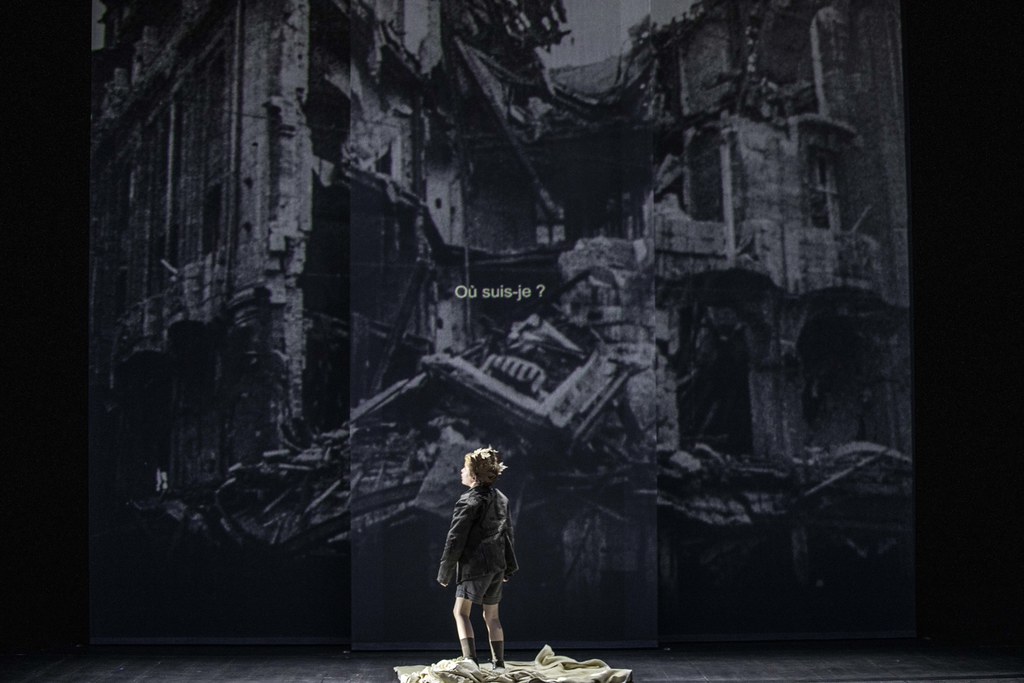
Photo: Jean-Louis Fernandez
If Frau was the festival’s triumph, Clément Cogitore’s Die Zauberflöte, staged at the outdoor Théâtre de l’Archevêché, was its most exasperating failure. There was a clear logic to placing the two works on the same program: Strauss and Hofmannsthal modeled their Märchenoper on Mozart’s earlier one.
Cogitore, a French video and multimedia artist, approached Zauberflöte as a reckoning with the moral and historical legacy of the West since the end of World War II. Tamino and Pamina were doubled by child and adolescent actors, figures of innocence trapped in the nightmare of history. For better or worse (and mostly for worse), projected video carried much of the production’s burden: An endless montage of archival footage showed cities of rubble slowly being rebuilt and the triumph of the American way of life alongside anti-Black racism and late 20th-century and early 21st-century wars and calamities.
Zauberflöte is, on one level at least, about enlightenment and initiation. Yet the ethics of the piece is far from straightforward. The Queen of the Night — a clear progenitor of Strauss’s Amme — lurks in moral ambiguity. The opera asks us to accept on faith that Sarastro is an enlightened leader rather than simply a misogynist tyrant. There was, then, a certain logic to using the piece to meditate on the dark side of rationality and the dialectic of Enlightenment. Sadly, the severity overwhelmed an opera that is often just plain silly. Any director who approaches Zauberflöte needs to allow solemnity to rub up against nonsense.
For a while, the child doubles, who delivered the spoken text in adorably high-pitched voices, helped. Tamino, one of the stiffest characters in opera, gained vulnerability; Pamina’s suffering seemed connected to the terror of learning what kind of world adults had prepared for her. The Three Boys made sense as witnesses from the ruins rather than decorative cherubs. But Cogitore kept barraging the audience with archival footage that supplied commentary rather than moving the production forward.
The musical side was another matter. Leonardo García-Alarcón and Cappella Mediterranea played with elegance, lift, and an ear for chamber-scale detail. The prominent glockenspiel and harpsichord gave their reading a zing that the onstage action sorely lacked. One of the production’s few jokes was musical: Sarastro’s ceremonial motif recurred as a ringtone during a series of phone calls during which Tamino and Pamina’s fate was discussed with unseen interlocutors. The idea was not especially deep, but in this ponderously Sebaldian Zauberflöte any comic relief was welcome.
The cast rescued much of the evening. Ying Fang’s Pamina was exquisite: pearly, poised and delicate. Her melting, aching “Ach, ich fühl’s” had time-stopping intensity. Mauro Peter was a handsome and capable Tamino, singing with sturdy, flexible tones. Sabine Devieilhe’s Queen of the Night was wild, eccentric, and adored by the audience. Brindley Sherratt brought old-school authority to Sarastro, here imagined as blind. Sean Michael Plumb’s Papageno had charm, ease, and a boisterousness that seemed out of tune with almost everything else in Cogitore’s production.
Several nights later, the ruins projected during Zauberflöte gave way to full-scale annihilation in Mozart’s Requiem, also staged at the Théâtre de l’Archevêché. Castellucci’s well-travelled production is an intricately conceived, masterfully executed meditation on the ceremonies and rituals through which humans respond to the pain and mystery of death.
The production begins with a woman near the end of life and expands outward until her departure becomes a planetary inventory of vanishings. The names of extinct animals, languages, places, peoples, and civilizations are patiently projected onstage. The staging piles loss upon loss until Mozart’s funeral mass seems to be sung for the cosmos.
That description makes the evening sound grueling and bleak. It was not. Castellucci can be severe, and some of his work trades in a sleek, fashionable pessimism. This Requiem, by contrast, was full of bodies in motion and color in bloom. Dancers, choristers, folk costumes, children, flowers, ritual objects, processions: The stage kept generating forms of life even as the production recorded their disappearance. Death was everywhere, but so were human invention and joy. Flowers, bodies, voices, gestures, and even the theater itself appeared as temporary concentrations of energy, beautiful because they were transitory. Castellucci treats dissolution and entropy as processes that awaken and ignite our creativity. We make music, costumes, rites, and dances because everything will, someday, vanish.
Raphaël Pichon and Pygmalion, an ensemble comprising orchestra and chorus, made Mozart’s unfinished score, supplemented in this 95-minute arrangement by various other Mozart works, plainchant, and German chorales, feel like an organic whole. The playing was refined and forceful, with impressive transparency and discipline. Mélissa Petit, Beth Taylor, Duke Kim, and Alex Rosen formed a strong vocal quartet, but the choral singing carried the evening’s physical and spiritual weight. In the program, Castellucci writes of performers exhausted like supernovae at the end of the piece, and the image felt apt.
Silvia Costa, Castellucci’s assistant on the original production, deserves credit for the revival’s precision and vitality. Recreating Castellucci can easily become a matter of preserving cryptic images under glass. Here the staging had rigor as well as warmth, and the choreography of bodies and objects felt freshly inhabited.
The updated atlas of vanished or endangered places included sites destroyed in Gaza and southern Lebanon, which may have prompted the lone but very vociferous boo at the curtain call. The final projected title, a memorial to Audi, was also deeply moving. What had been one of the major successes of his tenure now returned as a tribute and farewell.
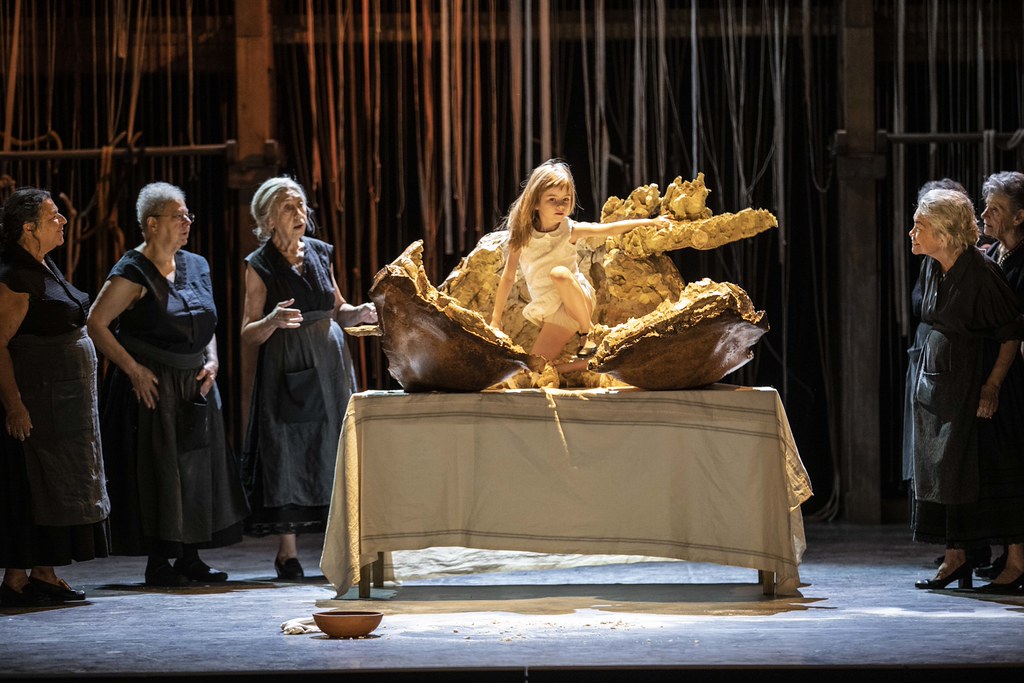
Photo: Jean-Louis Fernandez
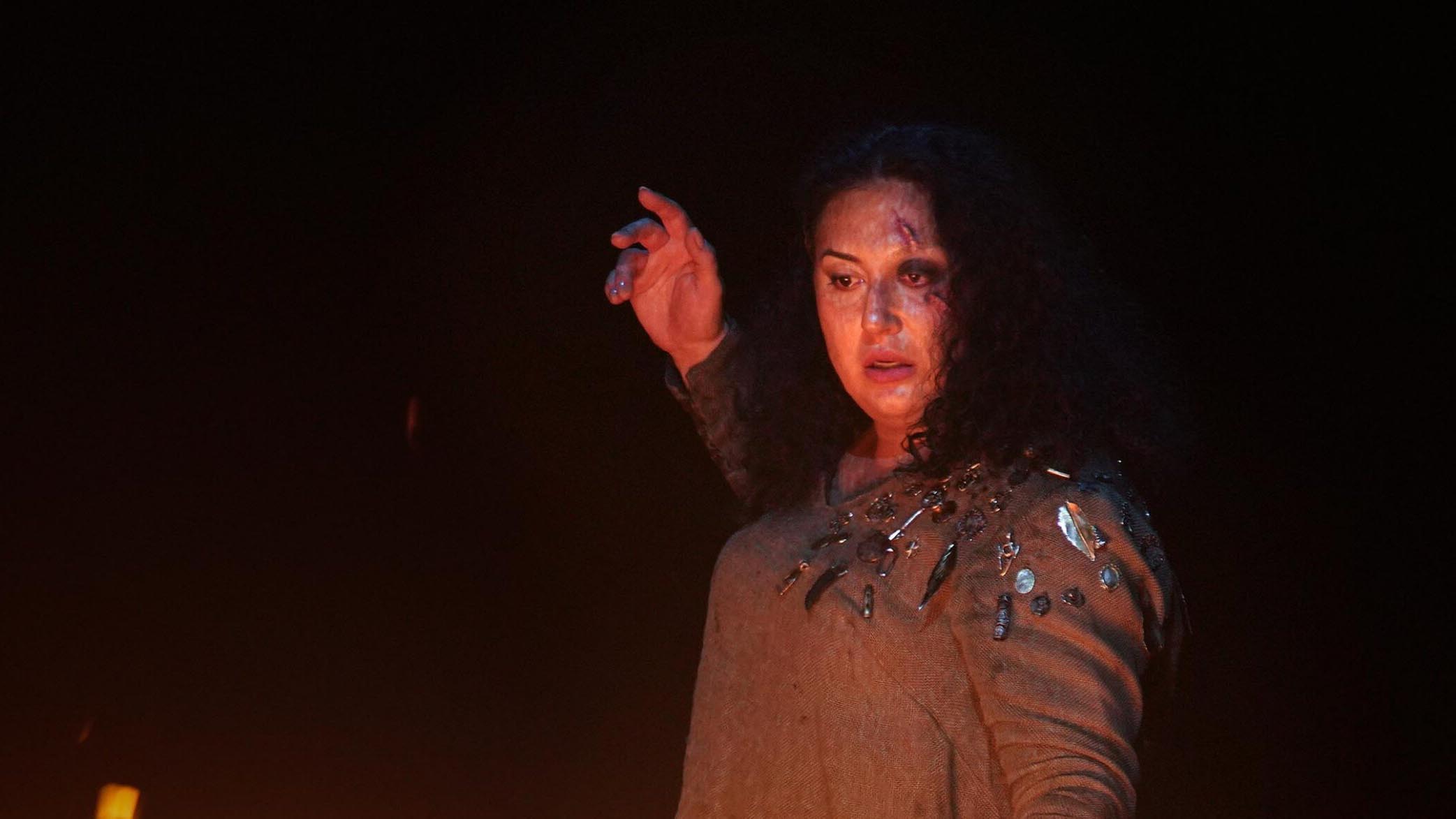
If Castellucci’s Requiem draws individual mortality outward toward the extinction of cultures and species, Francesco Filidei’s Accabadora brings death back to the bedside. Adapted from Michela Murgia’s novel, the opera follows Tzia Bonaria Urrai, a Sardinian seamstress called on to end the suffering of the dying, and Maria, the adopted daughter who discovers Bonaria’s vocation and recoils from it.
Filidei’s previous opera was a large-scale adaptation of Umberto Eco’s The Name of the Rose that had its world premiere at La Scala in 2025. Accabadora is an 80-minute work scored for 17 players; Lucie Leguay led members of the Orchestre de l’Opéra de Lyon in a precise but somewhat chilly performance. Filidei creates a finely graded chamber texture from harmonics, tremolos, and flickering dynamics. Harp, accordion, celesta, and bells give the ensemble some of its most distinctive colors; the Sardinian identity enters most forcefully through the evocative choral writing. Much of the solo vocal music remains close to inflected speech, keeping the Italian text unusually intelligible while also constraining lyrical expansion. An offstage male ensemble evokes cantu a tenore, while a more nakedly expressive female chorus comes to the fore in an extended lament at the opera’s midpoint.
Filidei writes in the program that he conceived of the chorus as a second orchestra, but its uneven distribution throughout the piece means that it rarely determines the work’s musical syntax. This folkloristic music, sung in Sardinian, opens a rougher, more resonant space. I wished it were more fully absorbed into the score. So many of the surrounding scenes developed through curiously colorless recitative and ostinatos.
I enjoyed Accabadora much more in the radio broadcast, where I could focus on Filidei’s attentiveness to sonority and proportion, and on the friction between individual and collective voices. Without Valentina Carrasco’s attractive but static staging before me, Filidei’s control of timbre and instrumentation became easier to admire. In the theater, the bread baking, looms, and grapevines descending for the vendemmia produced prettified images of village labor that remained stubbornly undramatic — and troubling in their romanticization of rural poverty. The direction of the singers was often broad and awkward, leaving Noa Frenkel and Rachel Masclet, the accabadora and her adopted daughter, to supply emotional definition lacking from the production. Frenkel nevertheless lent Bonaria weight and concentration, while Masclet channeled Maria’s youth and openness.
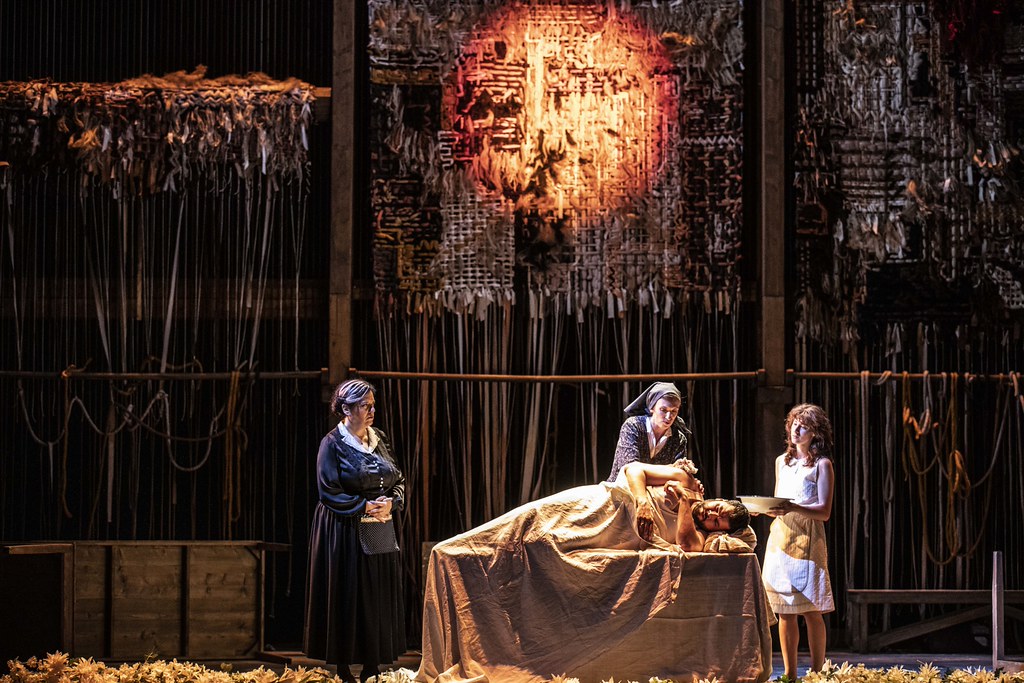
Photo: Jean-Louis Fernandez
Accabadora was staged at the 493-seat Théâtre du Jeu de Paume, an 18th-century Italian-style theater that has hosted the festival’s past chamber operas. Given the festival’s financial constraints, smaller-scale works like these will likely become more necessary in the future. Aix is hardly alone in finding that though artistic plans are made years ahead, production costs refuse to stand still while subsidies and sponsorship are far from guaranteed. But the festival’s own position is particularly delicate.
A regional audit covering 2014–20 had already described the festival’s economic model as fragile. Under Audi, who ran the festival from 2018 to 2025, Aix pursued a larger and more expensive program while relying on sponsorship that proved less dependable than projected. A combined €4.4 million shortfall for 2023 and 2024 led to €1.6 million in repayable emergency public aid, and the €23.1 million budget for 2026 is 16 percent below the 2023 level. Future projects are likely to be scaled back as Aix repairs its finances. All that makes chamber opera more than an economical sideline. Works such as Accabadora allow Aix to keep new opera a vital part of the festival without assuming the cost – or the risk – of a large-scale world premiere. Whatever changes Huffman makes to Aix, I hope that new chamber opera remains part of the festival’s identity.
On its opening weekend, Aix looked less like a festival in mourning than one pondering both its inheritance and its future. Frau and Zauberflöte asked how people become fully human through education, initiation, trial, and temptation. Requiem and Accabadora asked how we meet our inevitable end: through memory and ritual, through naming and being named. In Audi’s final fully planned Aix, opera became what it has always been at its strangest and most powerful: a medium where the living sing in the presence of the dead.

A.J. Goldmann
A.J. Goldmann is an American writer and critic based in Munich and Berlin. He is a longtime contributor to The Wall Street Journal, The New York Times and The Forward. He has also written for The Atlantic, The New Republic, The Guardian, The Spectator and Gramophone Magazine. Between 2007 and 2023, when it folded, he was the Berlin, Vienna and
Salzburg correspondent for Opera News Magazine.
-
Topics: aix-en-provence, Review
-
People: Alex Rosen, Ambur Braid, and Alex Rosen, Barrie Kosky, Barry Kosky, Beth Taylor, Brian Mulligan, Brindley Sherratt, Christian Thielemann, Christine Goerke, Clément Cogitore, Duke Kim, Francesco Filidei, Herbert Wernicke, Hugo von Hoffmannsthal, Klaus Mäkelä, Leonardo García-Alarcón, Lucie Leguay, Mauro Peter, Mélissa Petit, Michael Levine, Michael Spyres, Nina Stemme, Noa Frenkel, Pierre Audi, Rachel Masclet, Raphaël Pichon, Romeo Castellucci, Sabine Devieilhe, Sean Michael Plumb, Silvia Costa, Ted Huffman, Valentina Carrasco, Vida Miknevi?i?t?, Ying Fang, Zubin Mehta
-
Works: Accabadora, Die Frau ohne Schatten, Die Zauberflöte, Lulu, Requiem (Mozart), Tristan und Isolde
-
Places & Organizations: Cappella Mediterranea, Chicago Symphony Orchestra, Festival d'Aix-en-Provence, Metropolitan Opera, Orchestre de Paris, Pygmalion, Royal Concertgebouw Orchestra, Teatro alla Scala, Théâtre de l'Archevêché, Théâtre du Jeu de Paume