Aegean in place
Greek National Opera’s Medea in the ancient theater at Epidaurus is an intermittently rewarding exercise in nostalgia.
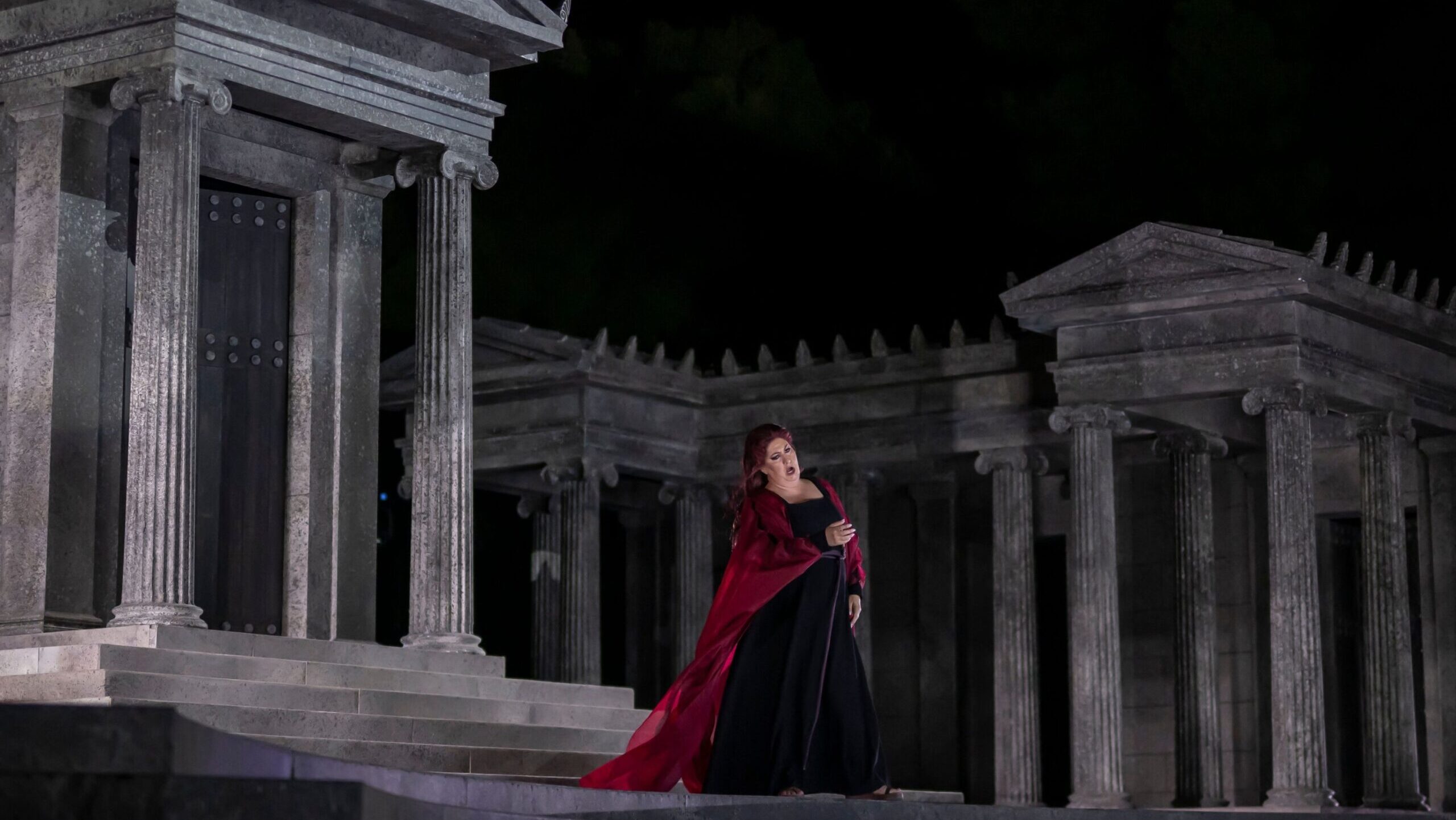
Anna Pirozzi in Medea at the ancient theater at Epidaurus / Photo:AFP Photo
The trip from Athens to Epidaurus is long enough to turn a performance into a pilgrimage. By the time our bus reached the Argolid hills, glowing golden in the setting sun, in the eastern Peloponnese, I was giddy with the anticipation of seeing and hearing an opera based on a foundational Greek tragedy in situ. Indeed, the intersecting strands of culture, nature and civilization had convinced me to take this lengthy trip (with my wife, who was intrigued but considerably less enthusiastic than I was) for a what was bound to be a unique musical, theatrical, and historical reenactment.
The Greek National Opera’s one-night-only reconstruction of the 1961 Medea in which Maria Callas sang the title role at the Ancient Theatre of Epidaurus – the soprano’s final performances in Greece – was easily the operatic event of the summer here (seen June 20). In the week leading up to the performance, Athenians I met expressed their surprise – and envy – that I had secured such a coveted ticket. Clearly this was not going to be your run-of-the-mill open-air opera. Instead, it was closer to a national gathering around Greece’s most famous opera singer: a peak event for the cult of Callas.
The original, well-travelled 1961 production has long since become part of Greek operatic mythology. Callas had already helped bring Cherubini’s long-neglected opera back to life when she sang Medea in Florence in 1953. The production that reached Epidaurus began in Dallas in 1958. Alexis Minotis directed; Yannis Tsarouchis designed the sets and costumes; and Nicola Rescigno conducted. The production went on to Covent Garden in 1959, to Epidaurus in 1961, and, finally, to La Scala in 1962, where Callas sang the role for the last time.
The Epidaurus performances have acquired legendary status. The Greek prime minister was in attendance; Onassis’s yacht had sailed into the nearby harbor; journalists wrote breathlessly of the jampacked theater and the overflow crowd. Marios Ploritis, writing in Eleftheria, observed that it was “as much a wonder to see Maria Callas as it is to hear her,” and even singled out her “moments of silence.”
Good luck trying to reconstruct all of that, without La Callas!
Remarkably, however, the 10,000 available tickets sold out months ago, making this almost certainly the biggest crowd that Cherubini has drawn in 65 years. The rare opportunity to see opera at the Ancient Theater of Epidaurus (this was GNO’s first time performing there since 1961) coupled with the sheer scale of the undertaking – reconstructing a production like this for a one-night-only performance borders on folly – was evidently enough to lure legions of opera fans to the middle of the Peloponnese on one of the longest and hottest days of the year.
The production, directed by Panaghis Pagoulatos under the guidance Giorgos Koumendakis, GNO’s Artistic Director, was reconstructed using Tsarouchis’s original designs, surviving photographs, and archival material, including Minotis’s directing notebooks. Clearly an enormous amount of work went into recreating the porticoed temple architecture, the draped costumes, the formal groupings of chorus and the dancers. All of this was carefully and lovingly rebuilt and presented before an audience that clearly wanted contact with the past.
“Theater ages insanely fast,” the late director René Pollesch once told me. There’s a good chance that Minotis’s production, which self-consciously uses archaic elements to time travel between Athens in the Fifth century B.C., Cherubini’s age and our own, already felt old in 1958. Encountering its full-scale replica seven decades later made me question the wisdom of the undertaking. Reviving Cherubini’s Medea in a self-consciously old-fashioned staging is precisely the sort of enterprise that reinforces the idea of opera as a sort of necrophilic club.
There are rare cases where reviving an old production does more than serve nostalgia or flatter memory. Heiner Müller’s 1993 Bayreuth Tristan und Isolde survived a 2017 reconstruction in Lyon precisely because Müller’s production with neither decorative nor decorous. Rather, the late German playwright and director’s vision of Wagner reduced to light, geometry and stasis was so influential and epoch-defining that it still resonated 25 later. Ditto Robert Wilson’s 1976 production of Einstein on the Beach, which still felt bracingly fresh during its most recent tour, in 2014. In 2017, the Salzburg Easter Festival marked its half century with an “altneu” Walküre that reconjured the cosmic sets of the legendary Karajan/Schneider-Siemssen production from 1967 while allowing a new director, Vera Nemirova, to update it as she saw fit.
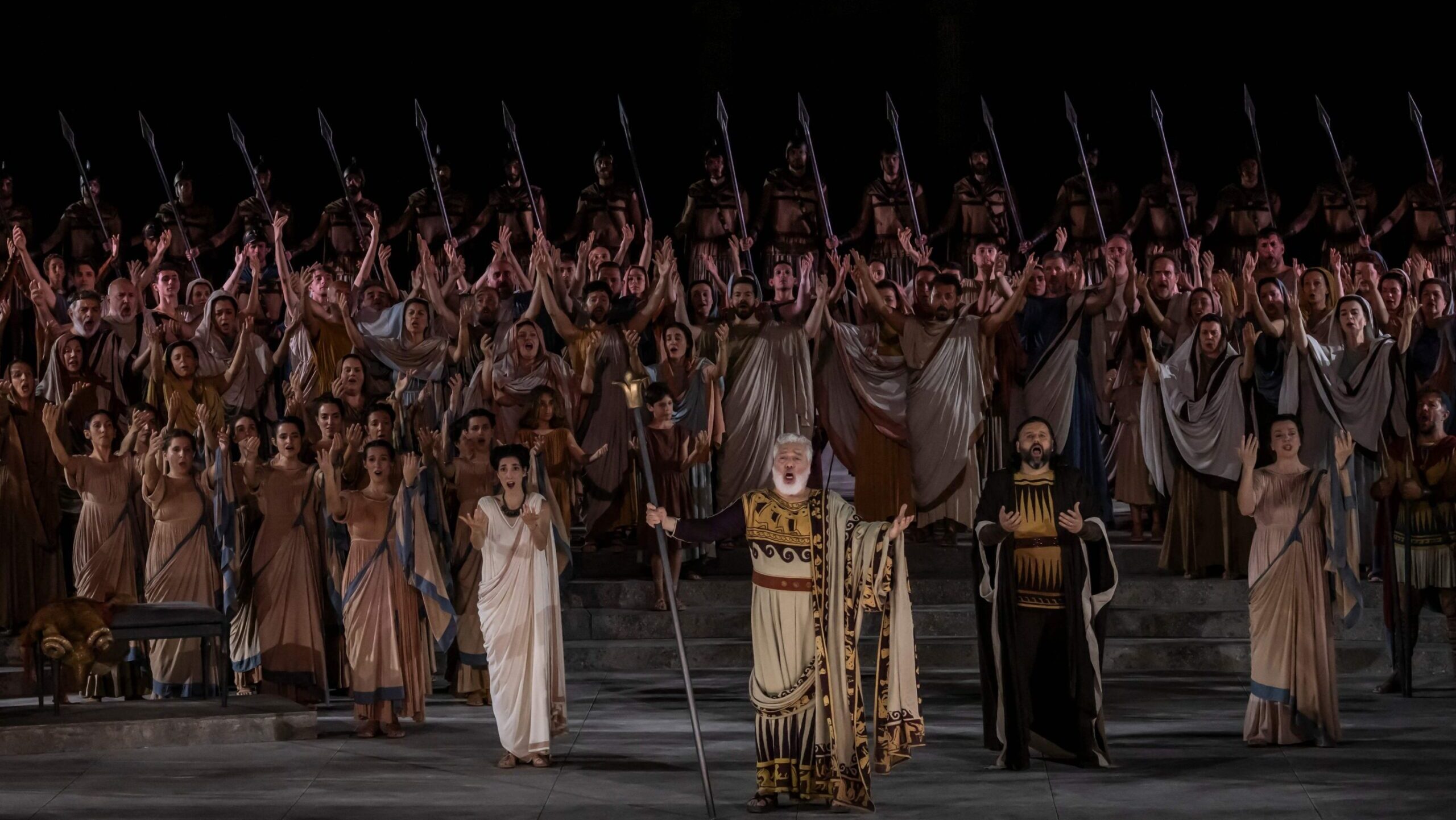
Anna Pirozzi in Medea at the ancient theater at Epidaurus / Photo: AFP Photo
The GNO’s Medea at Epidaurus took a more reverential, even worshipful, path. It was handsomely done and frequently beautiful to behold, yet seldom theatrically alive.
The set and setting were harmonious and elegant. The clean, columned architecture harmonized organically with the ancient theatre and the natural surroundings. Tsarouchis’s visual world, even in reconstruction, suggested an intelligent compromise between opera and Greek tragedy: not archaeological realism, nor museum classicism, but a dignified stage language based on grandeur, symmetry, and a dash ritual. The best stage pictures were clear and uncluttered. The emptiness around the singers gave them scale.
But that scale also exposed the production’s weaknesses. Too often the performers seemed arranged rather than directed. They entered, took their places, faced outward, and sang. Creonte repeatedly lifted his staff and pointed across the nearly bare stage. Giasone moved awkwardly, or not at all. The blocking often treated the singers as figures in a recovered image rather than as characters linked by fate.
The choreography helped. In their draped costumes, the dancers occasionally broke up the rigidity of the stage pictures and enhanced the evening’s sense of volume and pomp. The chorus, too, could look imposing when massed against the pale set and with the starry sky overhead. But neither could solve the central problem; the production knew how to place bodies in space yet was unable to use them to generate dramatic heat or tension.
That is a serious limitation in Medea, because Cherubini’s 1797 opera is neither static nor ceremonial. The score has grandeur, but also speed and menace. Its world may come from myth, but its emotional situation is earthbound and devastating: a foreign woman abandoned by the man for whom she betrayed her family.
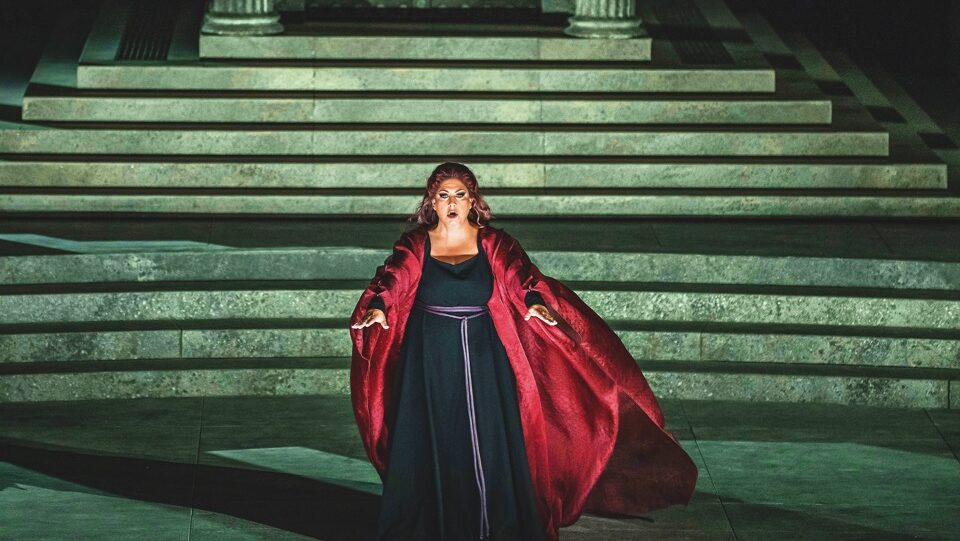
Anna Pirozzi in Medea / Photo: Andreas Simopoulos/Greek National Opera
Anna Pirozzi accepted that burden with both nerve and verve. Her Medea was vocally fearless, and dramatically compelling. This is not a role that rewards caution; it requires a singer willing to let the sound harden and darken before it flares. Pirozzi, who was recently profiled about this undertaking on Parterre Box, paid homage to Callas not by impersonating the great soprano, but in her sharper attacks, her plunges into chest voice and her willingness to make phrases that sounded bruised rather than merely beautiful or decorative. Having said that, her performance could have used more nuance and shading. Pirozzi could arrive at full force early, and some scenes would have been stronger had she allowed Medea’s rage to build more slowly. But she never let the character become static or rote. In a production that often looked backward, she insisted on the immediacy of Medea’s pain and fury.
With her large, warm voice, Alisa Kolosova made a strong Neris. Her affecting aria “Solo un pianto” was perhaps the evening’s most concentrated musical episode. The bassoon obbligato was one of the few orchestral details that traveled cleanly in the open air. Kolosova answered it with a line that sounded grounded, sorrowful, and protective. For several transporting minutes, the performance stopped seeming like a reconstruction and became felt closer to an act of artistic genesis.
Danae Kontora’s Glauce was attractive and brightly sung, though the character remained pale beside Medea and Neris. Some of that is built into Cherubini’s writing. Glauce’s music is lighter, more graceful, and less psychologically exposed. Kontora gave it elegance and ease, but the staging did little to make Glauce more than the young bride whose existence detonates Medea’s revenge.
The men were, on the whole, less persuasive. Jean-François Borras sang Giasone with security but did not make him dramatically legible. The character cannot simply stand there as the tenor who has behaved badly. He needs vanity, cowardice, charm, self-pity and evasiveness (qualities that American tenor Charles Castronovo brought to his Giasone at the Berlin Staatsoper several years back). Tassis Christoyannis brought vocal authority to Creonte, but his performance, too, was trapped by the production’s rigid, staff-pointing, ceremonial vocabulary.
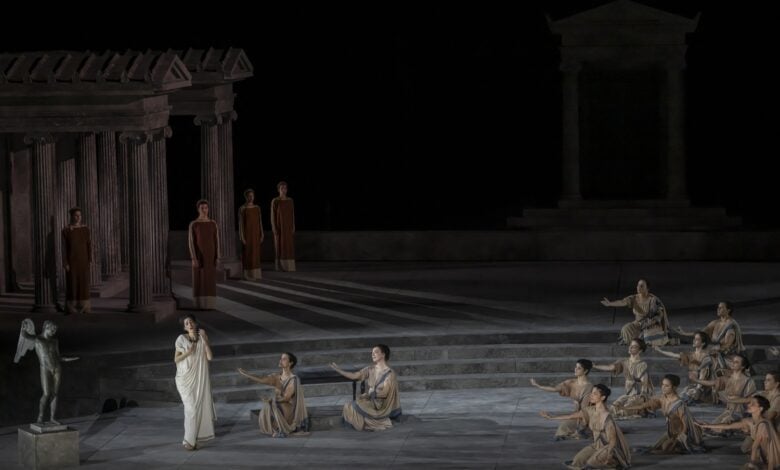
Medea at the ancient theater at Epidaurus / Photo by Aris MESSINIS / AFP
Jacques Lacombe presided over the performance with pace and alertness, but the sound took time to settle. Especially in the overture, the orchestra sounded thin and reedy. It put me in mind of the 1953 live La Scala historic recording with Bernstein and Callas, whose thin, wiry quality is not always flattering. At Epidaurus, some of the problem may have been the ear adjusting to the outdoor acoustic. The theater was a well-deserved reputation for carrying voices, but spoken tragedy and late-eighteenth-century opera clearly make different demands. Much orchestral detail struggled to cross that distance and competed with off-stage sounds, include a pesky overhead drone (filming the performance, I imagine) and the regular hooting of a Eurasian Scops owl.
It would be unfair to treat this evening as evidence that the GNO has a backward-looking artistic profile. The artistically adventurous company was one of the co-producers (with the Met, Canadian Opera Company, and Lyric Opera of Chicago) of David McVicar’s recent Medea, which opened the Met’s 2022–23 season and was later presented in Athens (with Pirozzi in the title role). That staging placed the myth in a darker, more psychologically extroverted visual world. The Epidaurus Medea was a clearly special project, aimed at a special audience, in a special place.
As a popular event, it succeeded. 10,000 people made the schlep to Epidaurus and back. And they came ready to applaud not only the singers but the restoration of a cherished chapter in Greek cultural history. Despite the limitations of the performance, the event’s symbolism and its grandeur were undeniable. To encounter Cherubini’s Medea in Epidaurus was to feel the origin story of opera turn back on itself, as one of opera’s great heroines (or anti-heroines) returned to the ancient landscape of myth.

A.J. Goldmann
A.J. Goldmann is an American writer and critic based in Munich and Berlin. He is a longtime contributor to The Wall Street Journal, The New York Times and The Forward. He has also written for The Atlantic, The New Republic, The Guardian, The Spectator and Gramophone Magazine. Between 2007 and 2023, when it folded, he was the Berlin, Vienna and
Salzburg correspondent for Opera News Magazine.
-
Topics: anna pirozzi, greek national opera, maria callas, Review
-
People: Alisa Kolosova, Alisa Koslova, Anna Pirozzi, Charles Castronovo, Danae Kontora, David McVicar, Günther Schneider-Siemssen, Heiner Müller, Herbert von Karajan, Jacques Lacombe, Jean-François Borras, Leonard Bernstein, Maria Callas, Nicola Rescigno, Panaghis Pagoulatos, Robert Wilson, Tassis Christoyanis, Tassis Christoyannis, Vera Nemirova
-
Works: Die Walküre, Einstein on the Beach, Medea, Medée (Cherubini), Tristan und Isolde
-
Places & Organizations: Bayreuth Festival, Greek National Opera, Lyric Opera of Chicago, Metropolitan Opera, Royal Ballet and Opera, Salzburg Easter Festival, Staatsoper Berlin, Teatro alla Scala