Great Scot!
A new Macbeth summons the forces of hell — and the star power of Quinn Kelsey and Lise Davidsen — for a fiery start to the Met’s new season.
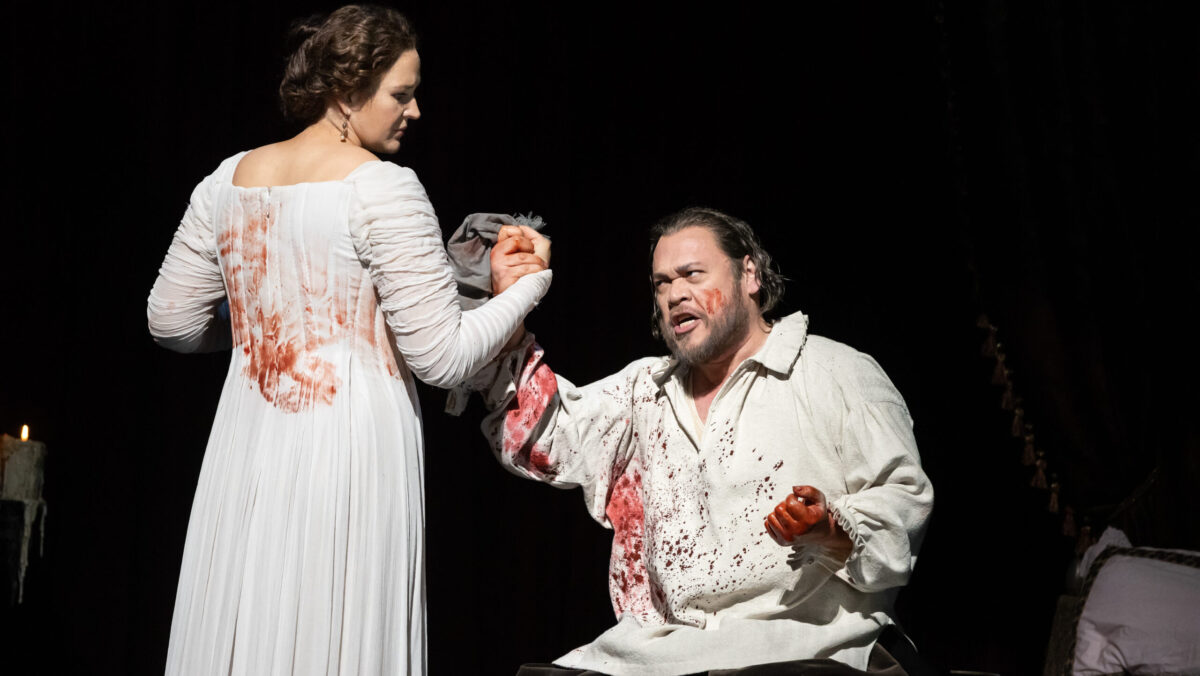
Lise Davidsen as Lady Macbeth and Quinn Kelsey in the title role of Verdi’s Macbeth. Photo: Marty Sohl / Met Opera
A long-held theater superstition commands that no one must mention Shakespeare’s Macbeth by name. It is therefore routinely instead called “The Scottish Play” in an attempt to avoid the work’s purported curse. If one ponders the history at the Metropolitan Opera of Verdi’s opera based on said play, one might reasonably believe that a similar curse has frequently operated there. However, opening night of the company’s 2026-27 season found no unfortunate forces in action: despite a somewhat uneven cast, a consistently involving and powerful production by debuting Louisa Proske served Verdi, Piave/Maffei, and Shakespeare and proved a rousing success crowned by a towering performance of the title role by baritone Quinn Kelsey!
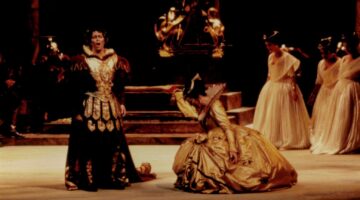
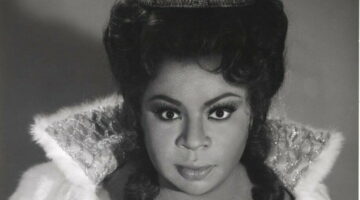
When in 1959, nearly ninety years after its premiere, Rudolf Bing at last introduced Macbeth to the Met, he brought Carl Ebert and Caspar Neher to the company to recreate their 1938 Glyndebourne Festival success and hired Maria Callas to sing her first Lady Macbeth since 1952. But we all know about the huge scandal of Callas’s firing and that Leonie Rysanek took her place to great acclaim. But unfortunately her co-conspirator Leonard Warren died on the Met stage less than two weeks after his final scheduled Macbeth.
In 1982, the Ebert production was finally replaced with one by the debuting Sir Peter Hall, noted director from the Royal Shakespeare Company, the first of his pair of notorious Met flops: the second, Carmen, starring his then-wife Maria Ewing, followed four years later. Renata Scotto’s controversial Lady was the centerpiece of the Hall production which was received with derisive laughter and boos and which a friend recalls included stuffed black cats, witches on broomsticks, and the diva masturbating with a sword during her first aria. The Met sought to revitalize it during the 1987-88 season by engaging Giuseppe Sinopoli to conduct the starry pairing of Eva Marton and Renato Bruson; as “luck” would have it, all three pulled out months before it premiered, and a revolving-door, ill-starred revival turned out to be most notorious for its Saturday matinee when an attendee plunged to his death from the balcony during intermission.
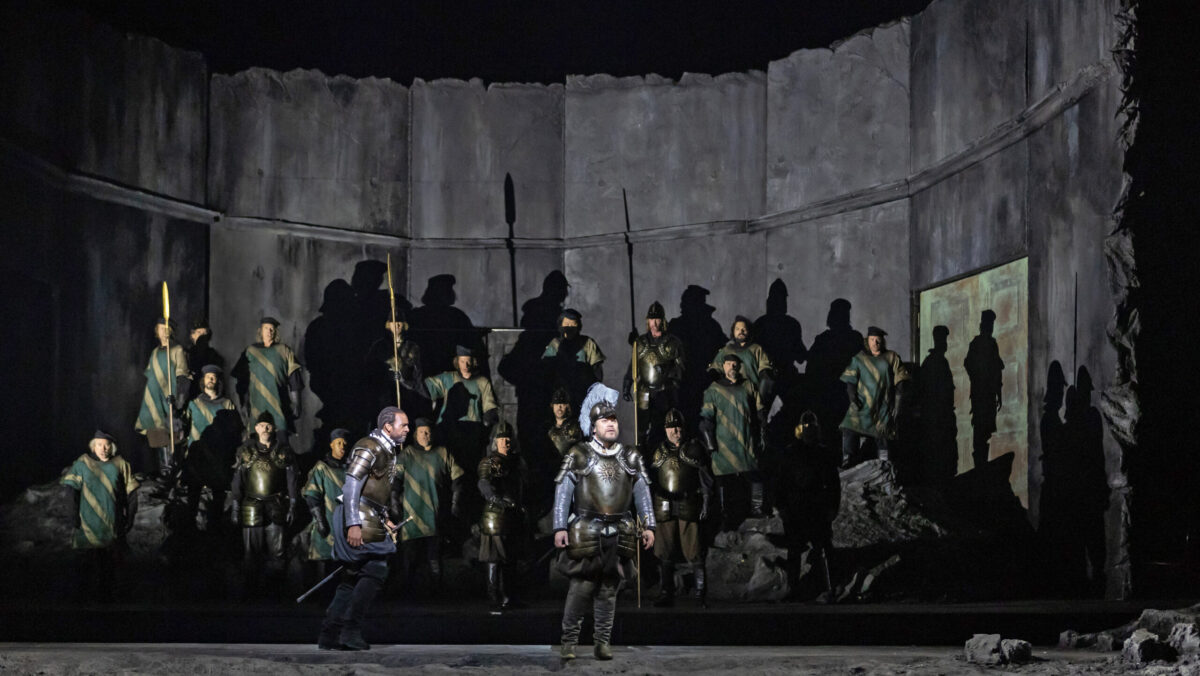
Ryan Speedo Green as Banquo and Quinn Kelsey as Macbeth in a scene from Verdi’s Macbeth. Photo: Marty Sohl / Met Opera
After that “cursed” run concluded the opera wasn’t performed again for nearly twenty years when Adrian Noble, a second English director from the RSC, had considerably better luck with Macbeth at the Met. The most successful run of his production, however, occurred by accident when Anna Netrebko once again decided to swear off a role she’d agreed to sing—this time, Marguerite in Faust—and the Met quickly retooled its Gounod forces for Verdi’s opera which the diva had recently taken into her repertoire with her Met Faust and Méphistophélès– Joseph Calleja and René Pape–becoming Macduff and Banquo. A revival five years later lost its leading man before the season premiere when Plácido Domingo after having sung the dress rehearsal was summarily dismissed from the Met for sexual harassment charges. But, wait, then there was the revival when Nadja Michael and Thomas Hampson assumed the Scottish crowns; well, maybe, the less said about that, the better.
This season’s new production was likely initially conceived as a vehicle for Lise Davidsen when the Met’s reigning prima donna decided she wanted to add another Verdi role to her repertoire before diving with full force into the three Brünnhildes for the company’s upcoming new Ring cycle. As it turned out, the Norwegian soprano was in many ways all kinds of wrong for her role: the voice is too top-heavy and bottom-light, the Italian is not incisive enough, and she is physically reticent when one expected flamboyance.
And yet, Davidsen has clearly worked hard on the role, advancing considerably over her bland, recently-released Verdi CD and indeed her initial concert performances during the spring in Copenhagen. With the guidance of Proske, her Lady was quieter, subtler than most, one who steadily manipulated her ambitious yet wildly erratic spouse. If her opening scena lacked vaulting drive, her ferocious “La luce langue” packed a thrilling punch and the Brindisi displayed surprising élan. Her genuinely haunting Sleepwalking Scene rose to a finely shaded soft high D-flat. Her first-ever stage Lady Macbeth made its best effect with thrilling power and inventive nuance.
A recent interview with Louisa Proske revealed that she was asked less than a year ago to take over Macbeth when Bartlett Sher’s schedule became too crowded. Having suffered through Sher’s previous awkward Verdi productions—Otello and, especially, Rigoletto, I absolutely believe that Met audiences lucked out. I first became acquainted with Proske as one of the founders of Heartbeat Opera. She directed its genuinely disturbing Lucia di Lammermoor and a Don Giovanni whose first Act was wonderfully good but after intermission became one of the worst misfires I’ve ever attended. Recently her European home has been the Halle Opera where I saw a revival of her Handel Serse, a slickly entertaining romp that unfortunately short-changed the score’s more moving pages.
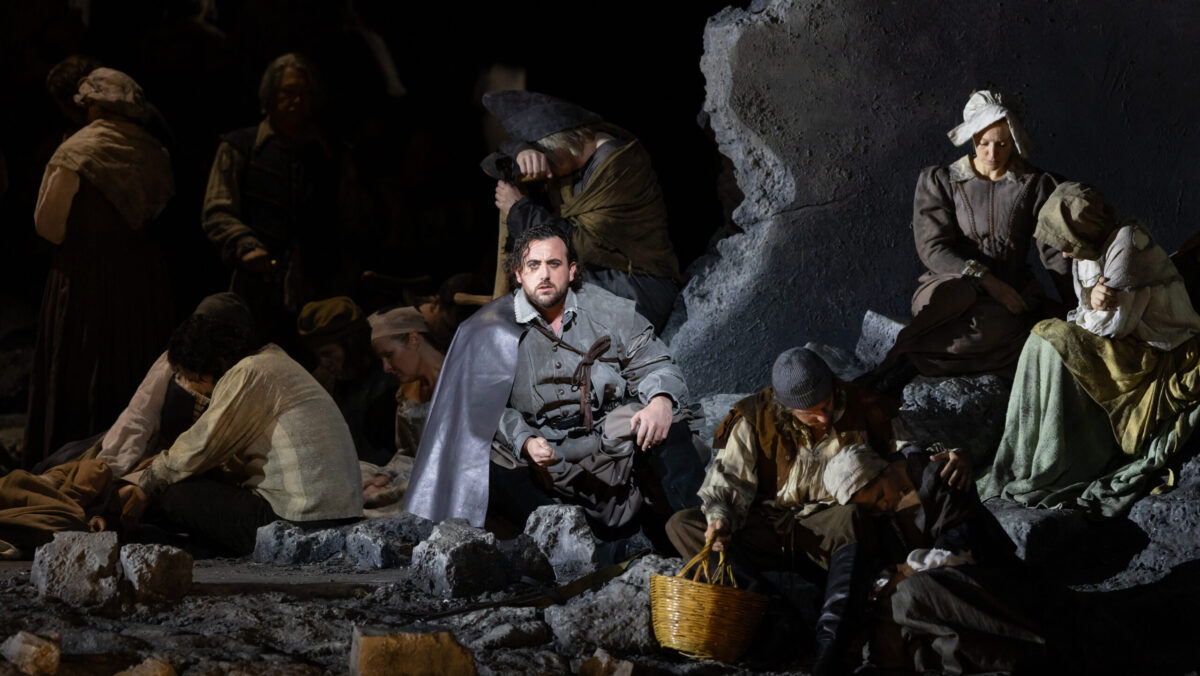
Freddie De Tommaso as Macduff in Verdi’s Macbeth. Photo: Marty Sohl / Met Opera
But at the Met she scarcely put a foot wrong creating a darkly focused Macbeth of unstoppable doom, malevolently overseen by an enormous band of wise witches. With gleeful cackles, they delighted in the havoc they initiated when they foretold a future that prompts the Macbeths to become conscienceless murderers. The stalwart men of Tilman Michael’s Met Chorus often earn most of the attention, but Macbeth’s witches truly gave his women choristers opportunities to shine, which they greedily grabbed.
Jon Bausor’s rocky proscenium focused the action, and he made the most effective use in years of the Met’s revolving stage, ably enhanced by Adam Silverman’s smoky lighting. Montana Levi Blanco’s regal costumes grew increasingly oppressive on the backs of the royal couple as their corruption exploded. Jorrell Lawyer-Jefferson’s savagely sexy choreography and Ran Arthur Braun’s heady action direction made for both eye-catching battle and banquet scenes.
While Ryan Speedo Green’s King Marke in last season’s Tristan und Isolde proved a mixed success, he was hopelessly miscast as Banquo. His distressingly light bass-baritone lacked the needed gravitas, especially in his moving aria. Freddie De Tommaso had made an equivocal impression at his debut as Cavaradossi opposite Davidsen’s Tosca two years ago, but as Macduff, his earnestly Italianate tenor rang out with touching pathos as he lamented his slain wife and children.
Sometimes an uneven Verdi conductor, Yannick Nézet-Séguin strove for monumentality in his first Macbeth which often created great excitement but sometimes went awry as in the usually surefire refugee’s chorus in the final Act. He took it so slowly that it lost all shape and defeated his chorus’s sterling efforts. Sometimes in deference to Davidsen, he also slowed down her music, robbing it of its coruscating power. But throughout the evening this orchestra responded with virtuoso energy and vibrant power.
Having starring in the Met’s recent erratic new productions of La traviata, Rigoletto, and Aïda, Kelsey once again laid claim to being the Met’s ideal Verdi baritone. His fierce yet at times achingly vulnerable anti-hero resounded with house-filling power while negotiating Verdi’s demanding lines with seemingly inexhaustible breath. Though sometimes he and Davidsen brought to the couple great intimacy, more often they seemed a mismatch — but isn’t that just the point? Brought together by a dream of supreme power, they splinter and self-destruct in strikingly different ways.
While the Lady gets several show-stopping bravura arias, Macbeth communicates his tortured inner thoughts through two starkly powerful monologues until the final Act when Kelsey brought down the house pouring out his nakedly personal “Pietà, rispetto, amore” with thrilling fervor, as well as Macbeth’s “Mal per me,” interpolated back into the Paris version from the opera’s original 1847 score. Nézet-Séguin, in addition, also rescued several usually omitted movements from its French ballet.
Over nine more performances remain through October 20, and I expect this powerful Macbeth to only get better, Davidsen especially. Audiences outside NYC will get the opportunity to judge for themselves at the 17 October HD, beamed to theaters worldwide.

Christopher Corwin
Christopher Corwin began writing for parterre box in 2011 under the pen name “DeCaffarrelli.” His work has also appeared in , The New York Times, Musical America, The Observer, San Francisco Classical Voice and BAMNotes. Like many, he came to opera via the Saturday Met Opera broadcasts which he began listening to at age 11. His particular enthusiasm is 17th and 18th century opera. Since 2015 he has curated the weekly podcast Trove Thursday on parterre box presenting live recordings.
-
Topics: Metropolitan Opera, Review
-
People: Adam Silverman, Freddie De Tommaso, Jon Bausor, Jorrell Lawyer-Jefferson, Lise Davidsen, Louisa Proske, Montana Levi Blanco, Quinn Kelsey, Ran Arthur Braun, Ryan Speedo Green, Tilman Michael, Yannick Nézet-Séguin
-
Works: Macbeth
-
Places & Organizations: Metropolitan Opera