Hysterical blondeness
Wednesday brought the Met’s “real” season opener, an indelible, indispensable night at the opera: a starry revival of Verdi’s Macbeth crowned by Anna Netrebko’s demented Lady.
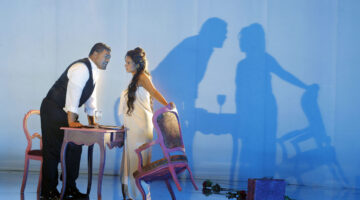
 With its worrisome labor troubles behind it, the Met really did have something to celebrate this fall at its ultra-swanky Opening Night gala. Unfortunately the Peter Gelb tradition of premiering a new production came a cropper with Le Nozze di Figaro in Sir Richard Eyre’s lackluster ersatz-Spanish 1930s staging. The next night’s Bohème was reportedly a bit of a mess and its erratic soprano has already been replaced. However, Wednesday brought the “real” season opener, an indelible, indispensable night at the opera: a starry revival of Verdi’s Macbeth crowned by Anna Netrebko’s demented Lady.
I have seen every role (other than an early Zerlina and Musetta) she has sung in her nearly 13 years at the Met, but I admit to having always been a somewhat ambivalent Netrebko-watcher (and -listener). Some performances I’ve enjoyed more than others, yet other than a concert with the Mariinsky Opera a few years ago at the Kennedy Center where she was exquisite in the great Iolanta duet, I’ve never really “gotten” the mystique that has made her opera’s biggest star—until the other night, that is.
Bolting upright in bed clad only in a clingy grey slip and rocking glamorous blonde tresses, Netrebko launched into her opening scena with all guns blazing and then never let up the sizzling intensity all evening.
httpvh://www.youtube.com/watch?v=_ogsDRwTxoQ
During the single intermission I recalled the doubters who had forecast disaster when she announced her intention to take on Verdi’s malevolent anti-heroine. Shouldn’t she should be sticking to the Trovatore Leonora (with which she recently triumphed at the Salzburg Festival) or taking on Desdemona or Luisa Miller?
Based on an in-house recording of her first attempt this summer in Munich, the naysayers might have had a point: it was a bold but somewhat tentative Lady. At the Met, though, she was transformed. Wednesday she bit into Piave and Maffei’s text with a specificity and relish that was startling, particularly as previously I had often found her use of words disappointingly lax. While the top of the voice gleamed as always, there was a new, pungent strength to her dark middle and lower voice coupled with unusual care over dynamics, particularly in the arresting, hushed act I conspiratorial duet with her balking husband.
 This is not to suggest that Netrebko was faultless: as always, her intonation can be erratic and rhythmic acuity suffered as her increasingly thick, lush soprano would fall just slightly behind the beat. Those who have criticized her sometimes ill-considered excursions into the bel canto repertoire could again point out the imprecision of her coloratura technique, and it was true that there was a lot of slip-sliding through the sixteenth notes in her first-act scena, but she showed admirable care in negotiating the challenging trills in the banquet scene brindisi, the second verse of which she memorably sang through determinedly gritted teeth.
After dominating the opera’s first half (acts I & II), Lady Macbeth has rather less to do until the sleepwalking scene, which here seemed still a work-in-progress. At this point Adrian Noble’s staging does its soprano no favors: there’s lots of distracting business with chairs and that recurrent swinging lamp but Netrebko gamely negotiated it all, but there was less of the guilt and regret than one wanted. I expect as the run progresses Netrebko will find more depth and nuance in this haunting “mad scene,” and one hopes that she will be able to fine down her final high D-flat to the fil di voce Verdi requested.
 Yet, despite these reservations, this was the fearless, take-no-prisoners prima donna star-turn that many hunger for but seem to rarely experience these days. And, happily, this revival, dedicated to the memory of Carlo Bergonzi—who memorably sang Macduff in the 1959 company premiere of this opera—was not only about its ferocious leading lady. As her ambitious but wavering husband, Zeljko Lucic returned to the role he created when this production was first seen in 2007. Although some have bemoaned that the Serbian singer lacks the power and amplitude of an ideal Verdi baritone, I have always found him an immensely engaging and moving artist (his recent diffident Rigoletto notwithstanding).
Perhaps ignited by the potent strength of his stage wife, Lu?i? drew a powerful portrait of the conflicts inside Macbeth from his frightening breakdown at the banquet to the resignation of “Pietà, rispetto, amore.” Although the tone can be a little grey, the aria was sung with an impressively flowing legato earning an ovation equal to those awarded earlier to his more famous consort.
 Absent last season, René Pape returned to the Met for the first time since the Girard Parsifal. As Banquo, his resonant bass was in fine form and rang out confidently as he was perhaps relishing the role’s comparative brevity. Macduff, too, is a short part, but it profited from the splendid tenor of Joseph Calleja who reveled in the pathos of “Ah la paterna mano.” I hadn’t heard him in several years and wondered if perhaps his signature quick vibrato (so worrying to some but always appealing to me) hadn’t slowed a bit. However, as before, I wished that this fine Maltese singer could appear more engaged and animated in the stage action. Noah Baetge displayed a promisingly clarion tenor in the small role of Malcolm.
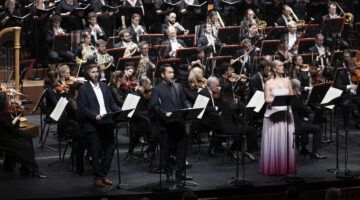
Always a fine Verdi conductor, Fabio Luisi proposed a swift, biting view of this Shakespearian adaptatio,n eliciting precise, alert playing from his orchestra and providing admirable support for his hard-working cast. Not inclined to linger, he did surround his Lady with the subtle, eerie accompaniment suited to her restless night. Although the ladies of the chorus sounded in uncharacteristically raw form, the men thundered resoundingly and together with Luisi helped build the thrilling act I concertante to an overwhelming conclusion. Another of the evening’s high points came in the chorus’s affecting rendition of “Patria oppressa” where the Scottish refugees mourn their tragic displacement.
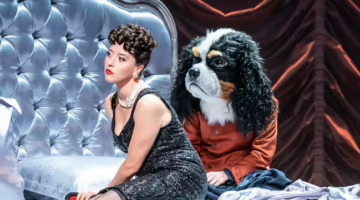
 Noble returned to supervise this revival of his sole Met production which takes a decidedly modern but not aggressively regie look at Verdi’s masterpiece. Mark Thompson’s set and costumes and Jean Kalman’s lighting effectively create an oppressively gray world doomed to grief until the pernicious Macbeths are purged. The fast-moving staging holds up well, including its fanciful reimagining of the witches as a coven of nattering housewives wielding their prim handbags.
So, on its third try, the Met has its first hit of its nascent season. Although it may not reveal the riches of his later Shakespeare operas Otello and Falstaff, Verdi’s early masterpiece is always compulsively entertaining and this thrilling revival instantly became this fall’s essential viewing, either at its six remaining performances or at its HD transmission to theaters worldwide on October 11.
Christopher Corwin is the reviewer formerly known as DeCaffarrelli.
Photos: Marty Sohl/Metropolitan Opera.

Christopher Corwin
Christopher Corwin began writing for parterre box in 2011 under the pen name “DeCaffarrelli.” His work has also appeared in , The New York Times, Musical America, The Observer, San Francisco Classical Voice and BAMNotes. Like many, he came to opera via the Saturday Met Opera broadcasts which he began listening to at age 11. His particular enthusiasm is 17th and 18th century opera. Since 2015 he has curated the weekly podcast Trove Thursday on parterre box presenting live recordings.
-
Topics: anna anna anna, dementia, fabio luisi, joseph calleja, Metropolitan Opera, rene pape
-
People: Adrian Noble, Anna Netrebko, Carlo Bergonzi, Fabio Luisi, Jean Kalman, Joseph Calleja, Noah Baetge, Peter Gelb, René Pape
-
Works: Falstaff, Il trovatore, Iolanta, La bohème, Le nozze di Figaro, Macbeth, Otello, Parsifal, Rigoletto
-
Places & Organizations: Kennedy Center, Mariinsky Opera, Metropolitan Opera, Salzburg Festival