Beyond the valley of the gods
The Bayerische Staatsoper’s Ring cycle scores another triumph with Tobias Kratzer’s take on Die Walküre.
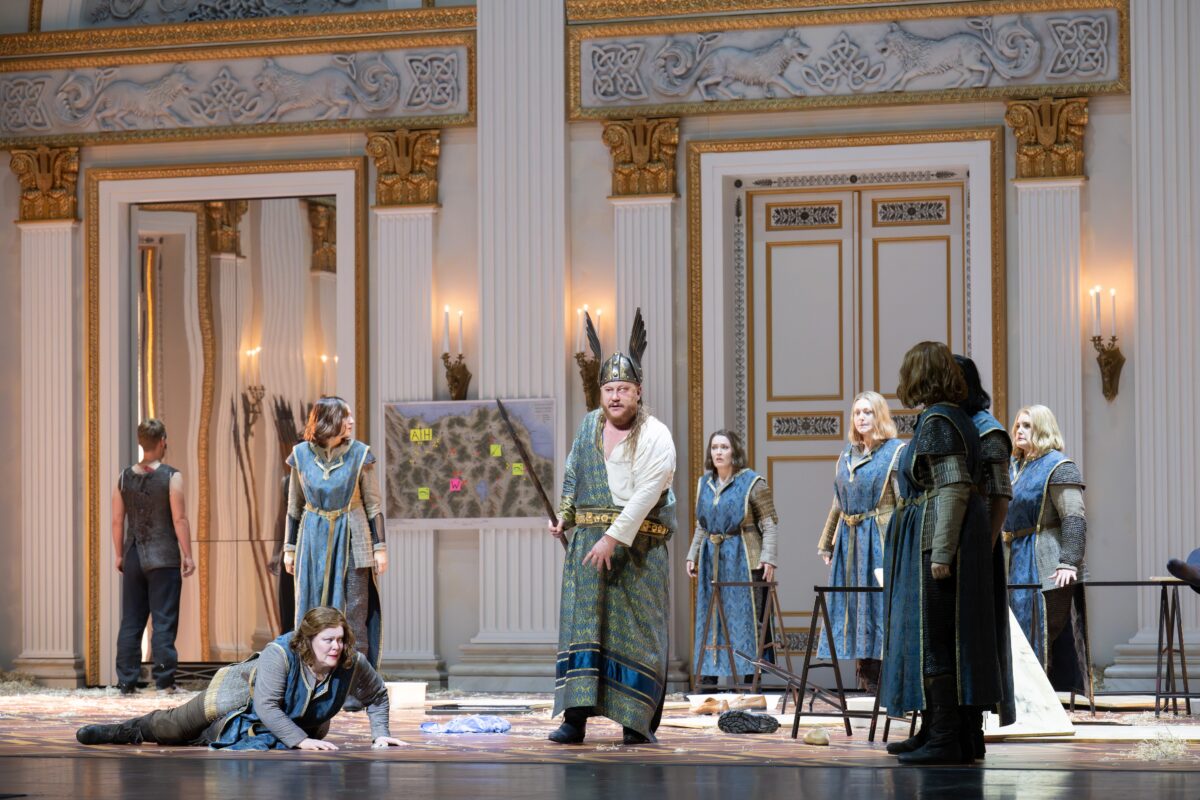
Photo: Monika Rittershaus
Ahead of its “Opera for All” July 4 public viewing and livestream, Die Walküre‘s refreshing cast, stoic musical interpretation, and important dramaturgical insights all deserve praise.
On the surface, Kratzer’s Ring is very simple. It tells the Nibelung saga in a straightforward way and often takes the libretto at its word with appropriate iconography—winged helmets, horses, and swords. Yet underneath lies a deeper ironic lens that exposes Wagner’s own unstable ruminations on power and religion. As I wrote last year of Kratzer’s first Ring installment, “this is a Rheingold for the post-secular age. The Norse gods are the new faith, a Golden Calf that seduces many. Magic is real here, too.” Set several years after the events of Rheingold, Die Walküre shows the new religion unraveling, entrenched in culture but hurtling towards “das Ende.” As Günther Heeg’s program essay notes, this spiritual evolution is analogous to the historical rise of ethnonationalism which Richard Wagner immersed himself in. Instead of a faith that sought to transcend conflict, the 19th century nationalist cult of the dead glorified war and sacrifice for one’s country, an attitude that persisted even after the World Wars and totalitarian slaughter. This strand of Western modern culture has maintained its religious valence and distorted moralism, though it eschewed not only rationalist secularism but also older notions of divine mercy and justice.
Kratzer’s saga began with Nietzsche’s dictum “God is Dead” interpreted in two ways: The pagan gods remake contemporary religion, while the Nibelungs reject organized religion in favor of techno-anarchism. Kratzer heightens this gods-and-mortals dialectic in Die Walküre, beginning and ending with excerpts from Friedrich Hölderlin’s Mnemosyne:
Not everything
Is in the power of the gods. Mortals would sooner Reach toward the abyss. With them
The echo turns.
(translation Richard Sieburth)
Perhaps drawing on Martin Heidegger’s interpretation of Hölderlin’s Earth as the “Echo of Heaven,” here both the gods and humanity are moving to the precipice of disaster.
In the second installment, we see the effects of Wotan’s violent religious ideology in the very place where Wagner’s work premiered in 1870. With sets and costumes once again designed by Rainer Sellmaier, Hunding’s hut is a mid-century rural Bavarian house inculcated by the new death cult. The massive golden altar built in Valhalla’s cathedral at the end of Das Rheingold is now displayed in miniature as a living room shrine. A Marian-style devotional image of Fricka stands illuminated outside of the hut, with lighting by Michael Bauer creating an unsettling nocturnal environment. As Wotan recounts the construction of Valhalla, a converted pagan church appears with visible parodies of Christian iconography (though Alberich’s henchmen continue to lurk around it).
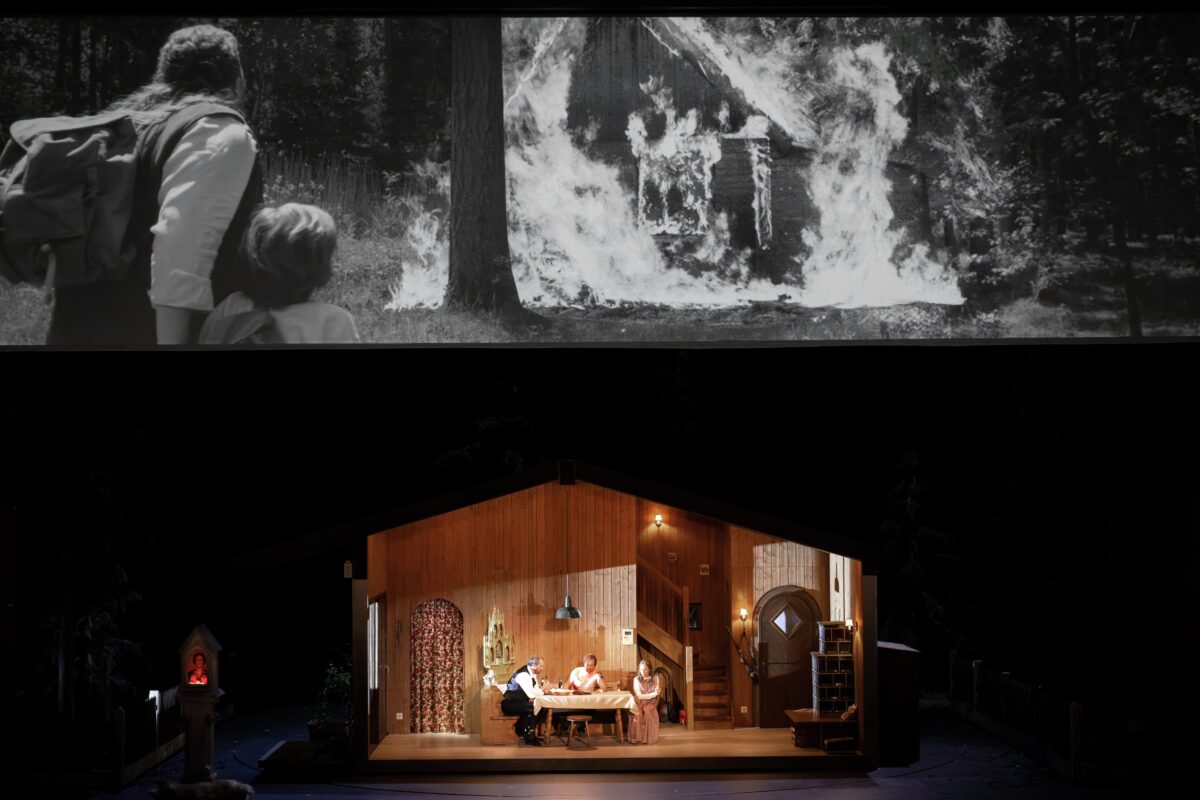
Photo: Monika Rittershaus
Act III moves the action from the Bavarian countryside to Munich, as the Valkyries bring bodies from around the city to a fenced-off National Theater. Opera itself is Verboten in this society, the arts are “occupied by Wotan’s militant religion,” as Kratzer has explained in an interview. Instead, the theater’s neoclassical Royal Hall serves as Valhalla’s morgue, decorated with Wotan’s symbols like ravens and the ash tree instead of Greek ornaments. The Valkyries prepare zombie soldiers for battle — are they the modern products of Wagner’s own Gesamtkunstwerk? No need for kitschy modern uniforms or overt political references like Stefan Herheim’s Bayreuth Parsifal — Kratzer is aware of the balance between irony and irreverence in staging Wagner today.
The evening was also one of musical triumphs. It should be noted that the entire cast and orchestra managed heroically in this second performance (as well as the premiere’s broadcast) despite the record-breaking heatwave that has gripped Germany over the last two weeks.
Nicholas Brownlee continued to demonstrate why he is one of the best Wotans around. His immense vocal range was commendable: from a tender “mit Liebes-Zauber zwang ich die Wala,” to contemptuous sprechstimme “für Frickas Knechte kämpfe du nun!”, to shouting furiously “Und das ich in Stücken ihm schlug” when Brünnhilde reminds him of Nothung. Brownlee’s vocal projection has developed even more since last year’s Das Rheingold. While his youthful timbre does not necessarily convey an aging god, his excellent acting and powerful voice paired to portray a volatile and dangerous Wotan, with only a glimmer of remorse at the end.
Despite their violent rule, the gods themselves cannot shed blood, only that of their human subjects. Brownlee acted this to great effect with a prop knife, attempting to cut himself as he wished for “Das Ende” and then again as he departed from Brünnhilde. His exhausted demeanor and voice almost breaking on “Leb Wohl” was apt for his portrayal of a shattered father, even if it was at least in part very real and heat-induced (an onstage announcement before Act III explained Brownlee’s decision to ditch the heavy robes midway in favor of just a lighter undershirt).
A mezzo-soprano increasingly tackling Wagnerian Zwischenfach parts, Irene Roberts’s full role debut as Sieglinde (she performed Act I in concert with Jurowski in Berlin this past April) was a success. Roberts’ middle register in particular packed a punch, navigating the emotional rollercoaster from fear to ecstasy and bac; in a Personenregie highlight, Sieglinde breaks free from Hunding’s abuse by destroying his shrine to the gods. Later, Roberts also brought out a surprising tenderness and pathos in Act III expressing gratitude for her safe passage.
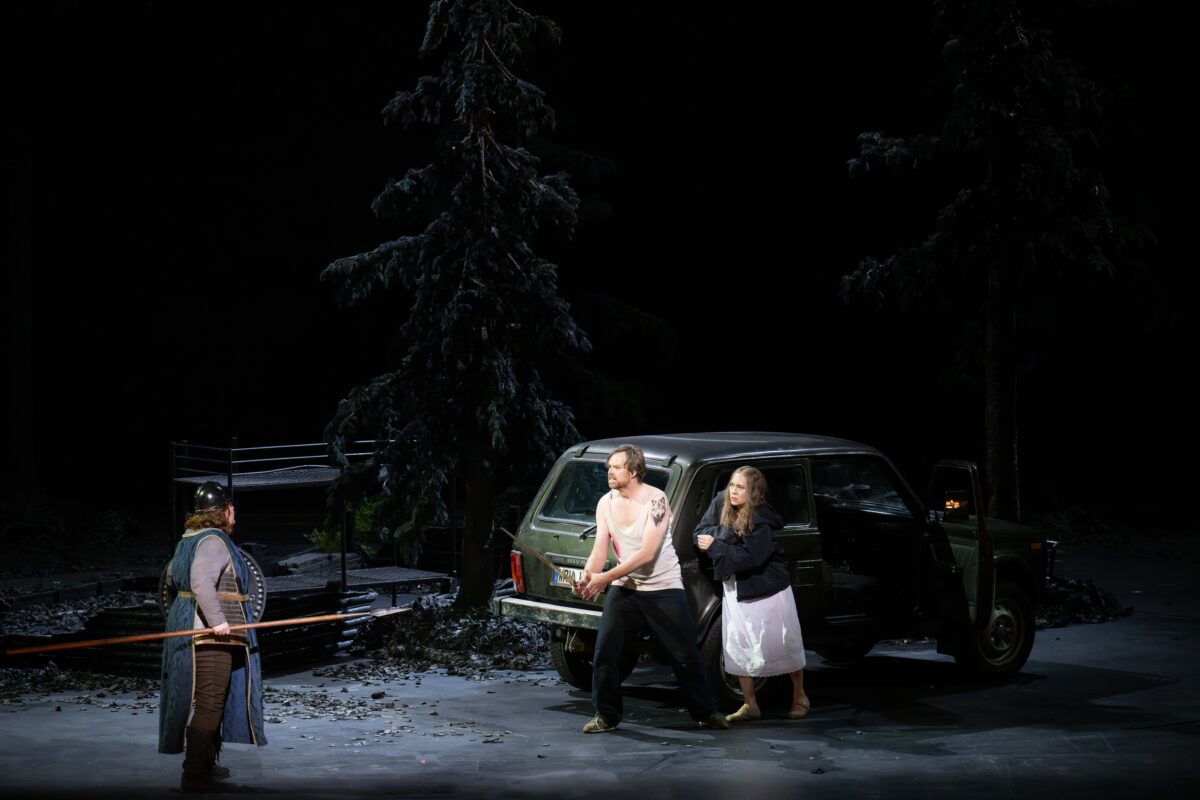
Photo: Monika Rittershaus
Miina-Liisa Värelä also made her stage role debut as Brünnhilde. Though Värelä did not quite match the vocal power or stage presence of Brownlee or Roberts, she sustained her longer notes with necessary intensity and impressive stamina. Värelä’s Brünnhilde stepped up in Act III as she is condemned to mortality, pacing herself before the climactic A on “Felsen.” Her sister Valkyries were occasionally covered by the orchestra after their rousing entrance, though Julie Adams and Natalie Lewis stood out for their clarity and diction.
Joachim Bäckström portrayed a Siegmund who stumbles into Hunding’s ideologically and spiritually suffocating environment, a fugitive following the destruction of his childhood home. Like the rest of the cast, Bäckström had remarkably sharp diction but never resorted to the “Bayreuth bark.” Siegmund’s Personregie presented some challenges, his cries of “Wälse! Wälse!” flattening as he sung seated with his hands tied behind his back. One moment of slight miscoordination came during Bäckström’s brisk rendition of “Winterstürme wichen dem Wonnemond,” rushing ahead from the orchestra. While his voice strained on the act I’s closing high “Wälsungen-Blut!” Bäckström was stronger in Act II as he conveyed defiance with pointed declamation in praise of his sword Nothung, fighting Hunding in the burnt remains of his Wälsung childhood house.
Wagnerian veterans Ekaterina Gubanova as Fricka and Ain Anger as Hunding complemented the ensemble with apt cynicism. Gubanova shaped the text in her rich lower register to convey a goddess dissatisfied by her husband’s escapades. Yet Fricka is equally ruthless in her cult of personality, her call for blood symbolized by her ritual sacrifice of a ram. Anger’s Hunding came across as a sinister religious fanatic. His snarling bass, while lacking some nuance, was particularly vengeful after discovering that Sieglinde destroyed his altarpiece.
Vladimir Jurowski and the Bayerische Staatsorchester’s playing showed great restraint both in terms of tempo and necessary balance with the singers. The whirlwind opening was appropriately sinister, the low strings rising and falling like gusts of rain with thunderous timpani rolls. Perhaps inspired by HIP approaches to Wagner, the orchestra’s overall string sound was lean with little vibrato on their melodic lines, avoiding any Stokowski-style heavy and long-bowed lyricism. Wotan’s farewell and the magic fire music were as unsentimental as possible: the first woodwind chorale sounding almost hesitant, the muted strings more bitter than elegiac, followed by fiery trombones that cut through the theater.
*Spoilers ahead* In a video montage at the opening of Act III (directed by Manuel Braun, Jonas Dahl, and Janic Bebi), the Valkyries ride on horseback through Munich navigated by helicopter—a clear nod to the violent raid in Coppola’s Apocalypse Now. While the audience reacted immediately with laughter and applause, a tongue-in-cheek Kratzer explored how contemporary society can itself consume this new faith (though we also see presumably baby Hagen and Grimhilda looking on as outsiders) through entertainment. In another twist, when Wotan calls Loge to create a circle of fire around Brünhilde’s “rock,” the link to the twin’s childhood trauma becomes clear. The criminal Loge (having suggested to Wotan to steal from Alberich in Das Rheingold) comes back with Fricka. A video reveals that the two had set fire to the Wälsung house. Loge ironically places one small devotional candle in front of Brünhilde.
Regardless of whether you react to Kratzer’s references and sight gags (Siegmund finding a lightsaber when looking for Nothung or Hunding’s car with a RW1870 license plate) with scorn or enjoyment, the evening’s comprehensive theater experience and first-rate musical performances were undeniably thrilling. Wagner’s nearly four hours of music has rarely sounded so exhilarating as it did in its original theater.
Montagu James
Montagu James is a PhD student at Brown University studying modern European political and cultural history. He also enjoys composing and conducting.
-
Topics: bayerische staatsoper, Review
-
People: Ain Anger, Barrie Kosky, Ekaterina Gubanova, Friedrich Hölderlin, Irene Roberts, Janic Bebi, Joachim Bäckström, Jonas Dahl, Julie Adams, Manuel Braun, Michael Bauer, Miina-Liisa Värelä, Monika Rittershaus, Natalie Lewis, Nicholas Brownlee, Rainer Sellmaier, Richard Wagner, Stefan Herheim, Tobias Kratzer, Vladimir Jurowski
-
Works: Apocalypse Now, Das Rheingold, Der Ring des Nibelungen, Die Walküre, Die Walküre, Parsifal
-
Places & Organizations: Bayerische Staatsoper, Bayerische Staatsorchester