Gonna build a heaven from a little hell
Tobias Kratzer‘s Das Rheingold in Munich kicks off a Ring for the post-secular age

Geoffroy Schied
The Bayerische Staatsoper’s summer festival ended on an incredible high note with the first installment of its eagerly anticipated new Ring cycle. With lofty expectations in the city were Richard Wagner’s Das Rheingold had its 1869 premiere, Tobias Kratzer’s new production from October 2024 certainly delivered.
While a no-nonsense Ring can be exhilarating, too — demonstrated by the ongoing Dresden Musikfestpiele historically-informed The Wagner Cycles; Die Walküre and Siegfried were reviewed here)—Tobias Kratzer’s approach unashamedly embraces oft-derided “Euro Trash” aesthetics at its very best. Rainer Sellmaier’s costumes feature the traditional winged helmets and pseudo-medieval garb of the gods, but they are treated ironically alongside the rest of the cast’s modern dress.
This is a Rheingold for the post-secular age. The Norse gods are the new faith, a Golden Calf that seduces many. Magic is real here, too. The Stranger Things-like Rhinemaidens can cast spells, Loge can start fires, the Tarnhelm can shape-shift its owner into a dragon, and Erda can prophesy.
The production is so rife with subtle references, smart Personenregie, and old-school stage effects that a comprehensive summary would be far too long. A live goat, fireworks, videos depicting Wotan and Loge’s comical travels to Niebelheim as they try to get a toad through airport security, and a gruesome serpent reminiscent of John Carpenter’s The Thing that eats Mime’s labrador (perhaps a future source of sibling rivalry) are just some of the many striking details.
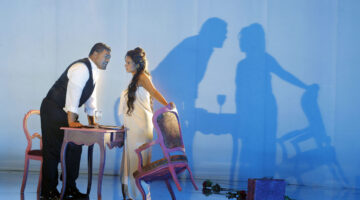
In the prelude, Alberich contemplates suicide and graffities a dilapidated church with Friedrich Nietzsche’s (a son of a Lutheran pastor) famous “God is dead.” Encouraged by the black-clad nihilistic demigod Loge to steals the gold, he uses his gun to shoot one of the Rhinemaidens. Yet despite Alberich’s efforts, the new gods reign supreme by the end of the opera, the first of Wagner’s four-part Ring series. By the end of this prologue, Valhalla the refurbished cathedral, now has a magnificent stained-glass depicting the tree of life and its golden altarpiece (implied to contain repurposed Rhine gold) both paganizes and transforms Christian symbols into new, mass-appealing objects—spiritually and aesthetically. However, glimpses of an apocalyptic future are already apparent. The new church burns in the background when Erda, dressed as a veiled pious churchgoer, predicts the ring’s curse.
The production is also rich with subtle ideological analysis. The dwarves, gods, and giants are aligned in their quest for power and wealth. Each ring-seeking faction represent variants of dangerous ideology, and each see religion as a powerful force. Alberich is an incel-turned-hacker, instructing via video call his hoard of dwarves to burn churches, thus offering new meaning to his line, “Everywhere over you he waits and watches.”

Geoffroy Schied
The gods seem initially weak and aimless, but their use of good promotional material and advertising, combined with Alberich’s ransomed treasure of cash and guns, provide them a platform to spread their populist new religion. The gods in Kratzer’s production are generally unsympathetic, except for Freia, who is suspended from the church scaffolding and only saved once bags of money are laid under her feet.
In the new church, aging statues of Jesus are replaced with those of Wotan. Fasolt and Fafner supply the new material — “Your Valhalla, your Wotan,” a tacky poster reads. The giants, played impressively by Matthew Rose and Timo Riihonen, are opportunistic and predatory priests, perhaps defectors from the old, worn-out Christianity.
Having previously played in Munich the nefarious Fr. Barré in Penderecki’s The Devils of Loudun, Martin Winkler as Alberich continued to prove his ability to play true villains. Winkler was quite unlyrical; his retorts to the mocking Rhinemaidens or Wotan and Loge were delivered in quasi-Sprechgesang. His acting was superb too, particularly in the scene where he is excruciatingly humiliated by Loge and Wotan, tied stark naked to a church pew in a perverse pseudo-Ecce Homo. Wotan proceeds to bloodily cut off his finger to take the ring. In turn, the untied Alberich urinates on a church pillar as he curses them and leaves; this graphic imagery flashes as he says, “Thus greets you then this, my freedom’s foremost word!”
Nicholas Brownlee was a revelation as Wotan. As the relatively young chief of the gods, Brownlee has a rich, full lower register and impressive projection. Having debuted the role only in 2023 at the Dallas Opera, Brownlee will surely be a Wotan in demand in the coming years.

Geoffroy Schied
Sean Panikkar continues his meteoric rise as Loge. His light voice and acting were not overly sarcastic and cartoonish. Instead, Panikkar provided a serious take on the trickster demigod. For example, he almost yelled the suggestion to steal the gold from Alberich: “durch Raub!”, followed by a dramatic pause, reinforcing his character’s cynical, even criminal behavior.
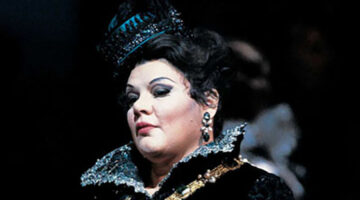
The supporting cast was well-balanced too. Wiebke Lehmkuhl gave Erda real depth and warmth as seemingly the only sensible in the whole story. Ekaterina Gubanova’s Fricka sometimes lacked vocal control in her upper register, but aptly showed how Wotan’s wife seems skeptical of Valhalla’s re-branding. Freia was sympathetically portrayed by Mirjam Mesak, who had the challenging task of singing while suspended in the air. The Rhinemaidens Sarah Brady, Verity Wingate, and Yajie Zhang could have projected more but blended nicely. Milan Siljanov and Ian Koziara rounded out the gods as Donner and Froh respectively.
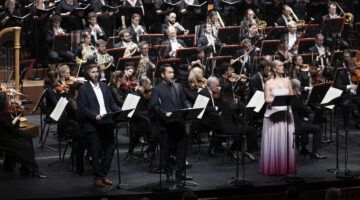
Vladimir Jurowski (who just announced a contract extension as Music Director) led the orchestra with a no-nonsense, sleek rendition of Wagner’s music. The enormous score requires so many instruments that the 6 harpists played from the boxes on the sides above the pit, while the 11 anvil percussionists played on an underground stage such that speakers amplified the sound to envelop the audience with the sounds of the Niebelung’s hammers. The prelude’s primordial E-flat pedal tone from the double basses began in a completely dark theater — not even the pit was illuminated — for a suspenseful start. Jurowski took the prelude and interludes at brisk tempo; the Rhine flowed nervously, rather than gloriously. Conversely, the narrative moments were held back, perhaps even somewhat bogged down, but nevertheless the action pulsed forward.
One wonders what Kratzer’s next installments will look like in upcoming seasons. Will Siegfried be a charismatic cult leader? Will Hagen and Alberich hack and vandalize the new churches? As Bayreuth concurrently presented a revival of Valentin Schwarz’s convoluted production and gears up for a new version next summer, supposedly with some sort of AI content, Kratzer’s vision in Munich is one of the smartest directorial efforts in recent years at the Bayerische Staatsoper.

Montagu James
Montagu James is a PhD student at Brown University studying modern European political and cultural history. He also enjoys composing and conducting.
-
Topics: bayerische staatsoper, Review
-
People: Ekaterina Gubanova, Ian Koziara, Martin Winkler, Matthew Rose, Milan Siljanov, Mirjam Mesak, Nicholas Brownlee, Rainer Sellmaier, Sarah Brady, Sean Panikkar, Timo Riihonen, Tobias Kratzer, Valentin Schwarz, Verity Wingate, Vladimir Jurowski, Wiebke Lehmkuhl, Yajie Zhang
-
Works: Das Rheingold, Die Walküre, Siegfried
-
Places & Organizations: Bayerische Staatsoper, Bayreuth Festival, Dallas Opera