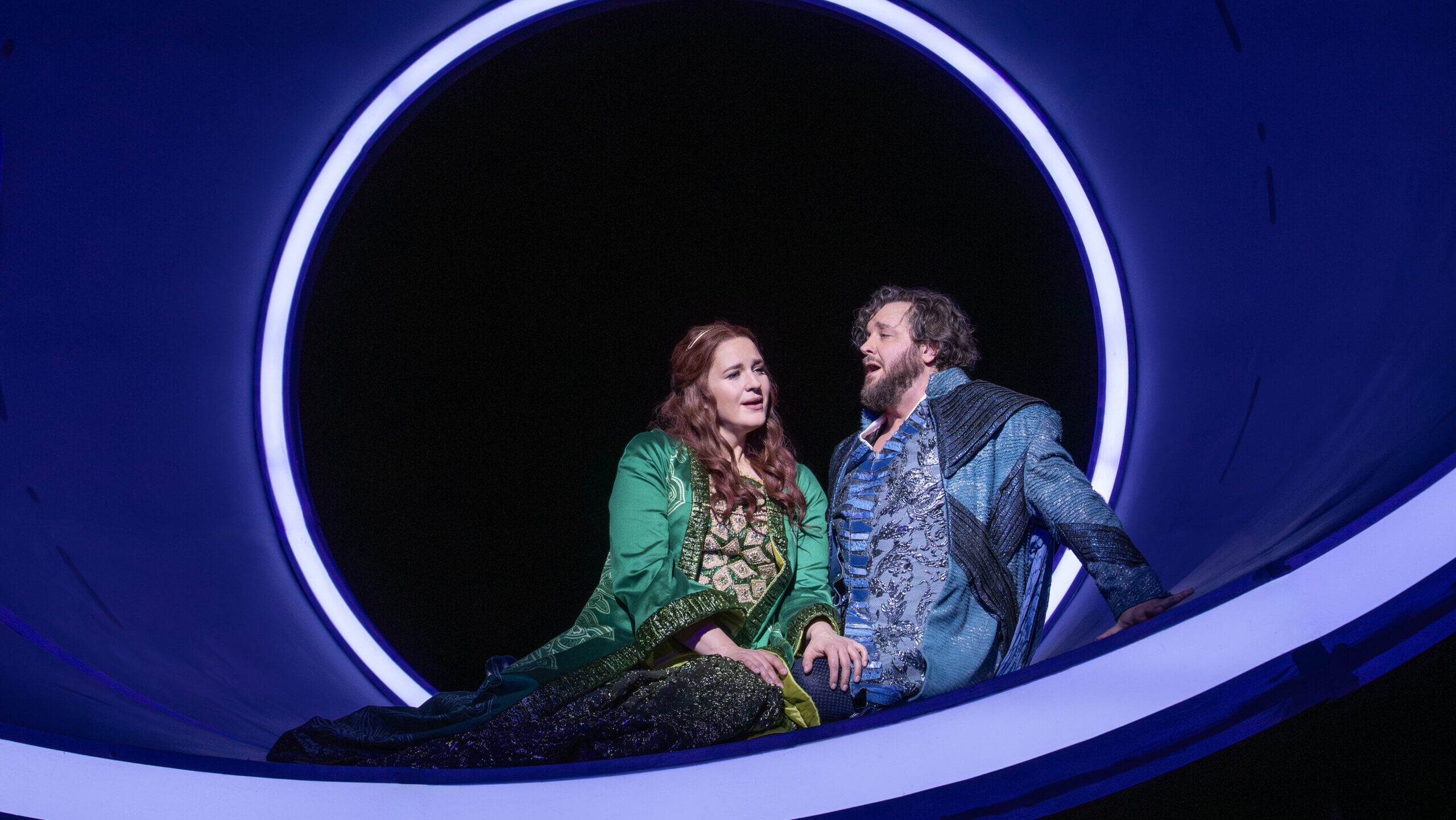
Lisa Davidsen as Isolde and Michael Spyres as Tristan in Wagner’s Tristan und Isolde. Photo: Karen Almond / Met Opera
Recently, the algorithm gods decreed that the most important topic of interest to me was Timothée Chalamet’s comment about the performing arts. His withering views on opera (and ballet) unleashed an avalanche of offended rebuttals and discount ticket offers, most of which I skipped. But one favorite I clicked came from Doja Cat, the 30-year-old actor’s near-exact contemporary and “Queen of Pop-Rap,” who in under two, expletive-laden minutes (complete with a hilarious meme-worthy mispronunciation of his name) cooly assured the world that many people do indeed care about the art forms he dissed.
And because I too care about opera (and ballet), I and nearly four thousand enthusiasts were clearly pleased that Tristan und Isolde has returned to the Metropolitan Opera’s repertoire after nearly a decade. However, as I also care about Wagner in particular, I’m distressed, after Monday’s premiere, that director Yuval Sharon will also be in charge of the company’s new Ring commencing in the spring of 2028. Though heralded for productions in Los Angeles and Detroit as well as Berlin and Bayreuth, the debuting 47-year-old American has given the Met a bafflingly awkward Tristan that not only failed to impress, but also let down the company’s superb musical forces, especially Lise Davidsen and Michael Spyres as its astonishing title pair.
Sharon’s Tristan played out simultaneously on two parallel planes amidst Es Devlin’s elaborate, no-doubt-quite-expensive mobile set. A long dining table rested near the edge of the stage throughout while above most of the action occurred in an ever-changing oval, then circular tunnel which, while sometimes quite shallow and other times vastly deep, reminded some of a vagina. (“The onstage tunnel signifies both the final and first moments of life; Sharon likened it to a birth canal,” said a recent preview in The Times.) That association might help explain Sharon’s vulva-framed death for Tristan, as well as the director’s most shocking addition to the narrative: the hectic onstage birth of Isolde’s child just prior to Davidsen’s sublime, achingly slow Liebestod. Instead of suggesting the transcendence Wagner’s music evokes, his earthbound final tableau focused on Marke’s tenderly cradling the infant suggesting, I suppose, that life goes on?
Because overtures and interludes must always be staged nowadays, the performance opened with the sound of rain and Davidsen and Spyres sat at opposite ends of the table as Yannick Nézet-Séguin began Wagner’s haunting prelude. Davidsen eventually poured liquid into a glass (foreshadowing the love draught that seals the fate of the pair), a gesture captured by the striking live video feed (designed by Ruth Hogben) that often punctuated the evening. As the singers exited, the video of the goblet expanded to the entire height of the stage and then exploded in slow-motion imagery recalling the fabled Bill Viola-Peter Sellars Tristan staging.
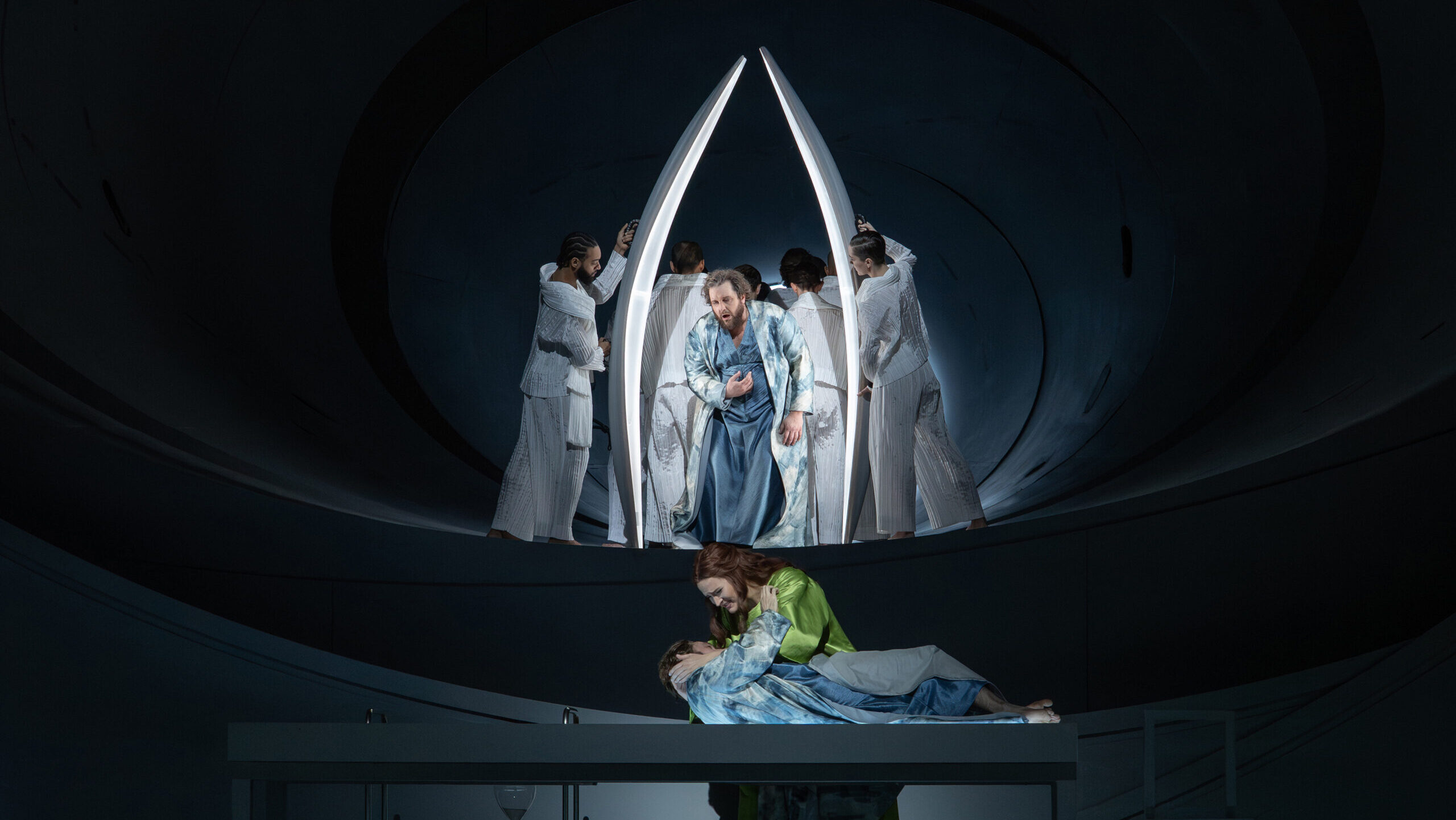
Michael Spyres (above) as Tristan and Lise Davidsen as Isolde in Wagner’s Tristan und Isolde. Photo: Karen Almond / Met Opera
After Ben Reisinger’s ringing Sailor (performed from the balcony level of the Met), Davidsen and Ekaterina Gubanova as Brangäne (the sole veteran of the company’s previous staging which premiered in 2016 and lasted just eight performances) launched into their first scene in an uncomfortably narrow oval while the first of two Tristan and Isolde doubles arrived to distract us at the table below. Their scene, eventually culminating in Isolde’s terrifying curse–which Davidsen delivered with stinging vehemence–gave notice that Sharon’s personenregie would prove surprisingly bland: it was as if his hands were so full simply directing traffic up, down and around Devlin’s set that he left the principals pretty much to their own devices. This non-strategy seemed unwise as the much-anticipated event showcased Spyres first-ever Tristan and Davidsen’s second run of Isoldes following her January role debut in Barcelona.
When the production was first announced a year ago, I noted with some alarm that the name of a choreographer—Annie-B. Parson—was included. Parson, whose work added to the unnecessary clutter of the Met production of The Hours, provided unintended comic relief in the first Act when the silhouettes of five dancing sailors popped up anytime the male chorus interjected. More prominent and puzzling were Tristan’s band of male back-up dancers who accompanied his searing delirium. Isolde then got her equal choreographic time when swift female attendants dashed in and out grabbing her many green veils so she would be clad in only off-the-shoulder all-white for the Liebestod.
So many more head-scratching moments occurred that my scalp was raw by the opera’s serene final moments. The photos the Met released before the premiere whetted my appetite, but the production’s sometimes striking images did not add up to a satisfying spectacle. The first Act’s electrifying scenic transition into a bright sword introduced a narrow, unhelpful stairway which Davidsen had to effortfully negotiate. During the most unerotic Liebesnacht imaginable, the couple began seated in a close embrace then retreated into their own circle-of-light bubbles which crossed back and forth until they were again reunited because something had to happen during that long sequence. When the lovers were discovered, a blinding stage-wide white florescent light descended like a curtain so that Davidsen and Spyres could scurry from their high perch to stage level where they resumed their places at either end of the table, so Ryan Speedo Green in a sumptuous robe and crown could deliver to them his anguished cry of betrayal.
The “urgent” need to periodically move singers and their doubles from the highest expanses of the set to the stage-level below reached its silly nadir during the third Act when Spyres, who began outstretched on what had been reconfigured as an operating table arrayed with surgical tools, had to swap positions with his double several times while performing his insanely demanding death throes. One felt for the tenor having to repeatedly hop up and down while singing – with notable beauty and stamina – pages of the score that can defeat even the most experienced Tristan.
Throughout the long evening, I repeatedly asked myself why this or that was happening. My frustration after the first Act grew as I struggled to discover coherence in a vision of the work that often felt random. I wasn’t surprised that Sharon’s lengthy program note is titled “Drowning in the Waves of the Universal Breath:” the result is actually a mostly traditional Tristan suffused with simple symbolism via complex contemporary technology. For example, as seen via the live video feed spanning the entire stage, the lover’s illicit connection was represented by a stark white dinner plate that, after it had been garlanded by violets, shattered at their discovery and which Marke helplessly tried to reassemble.
Sharon’s Tristan, like Charles Edwards’s hopeless I puritani which too included an inexplicable on-stage birth, turned out to be another instance of the Met failing its absolutely first-rate, world-class musical presentation. Last year Nézet-Séguin “tried out” Tristan with the Philadelphia Orchestra, another of his musical homes, and demonstrated that the work brings out the best in him.
If I were to choose, I’d say the Philadelphia performance orchestrally was finer than Monday’s which sometimes felt like a work in progress. The first-Act prelude failed to cohere and the remainder of that Act felt attenuated and the surefire excitement of its final moments chaotically sped toward intermission as Davidsen and Spyres (finally returned to stage level) did their best. On the whole, the Maestro’s Met tempi were slowish, sometimes to ravishing effect: the rapt “O sink hernieder” spun out with a bewitching glow by Davidsen and Spyres has rarely cast its spell so completely. By the third Act, however, Nézet-Séguin and his possessed orchestra were digging deeply into the mournful prelude, and they accompanied Spyres with stellar command leading to the work’s blissful final moments which—hurrah—were not interrupted by premature applause.
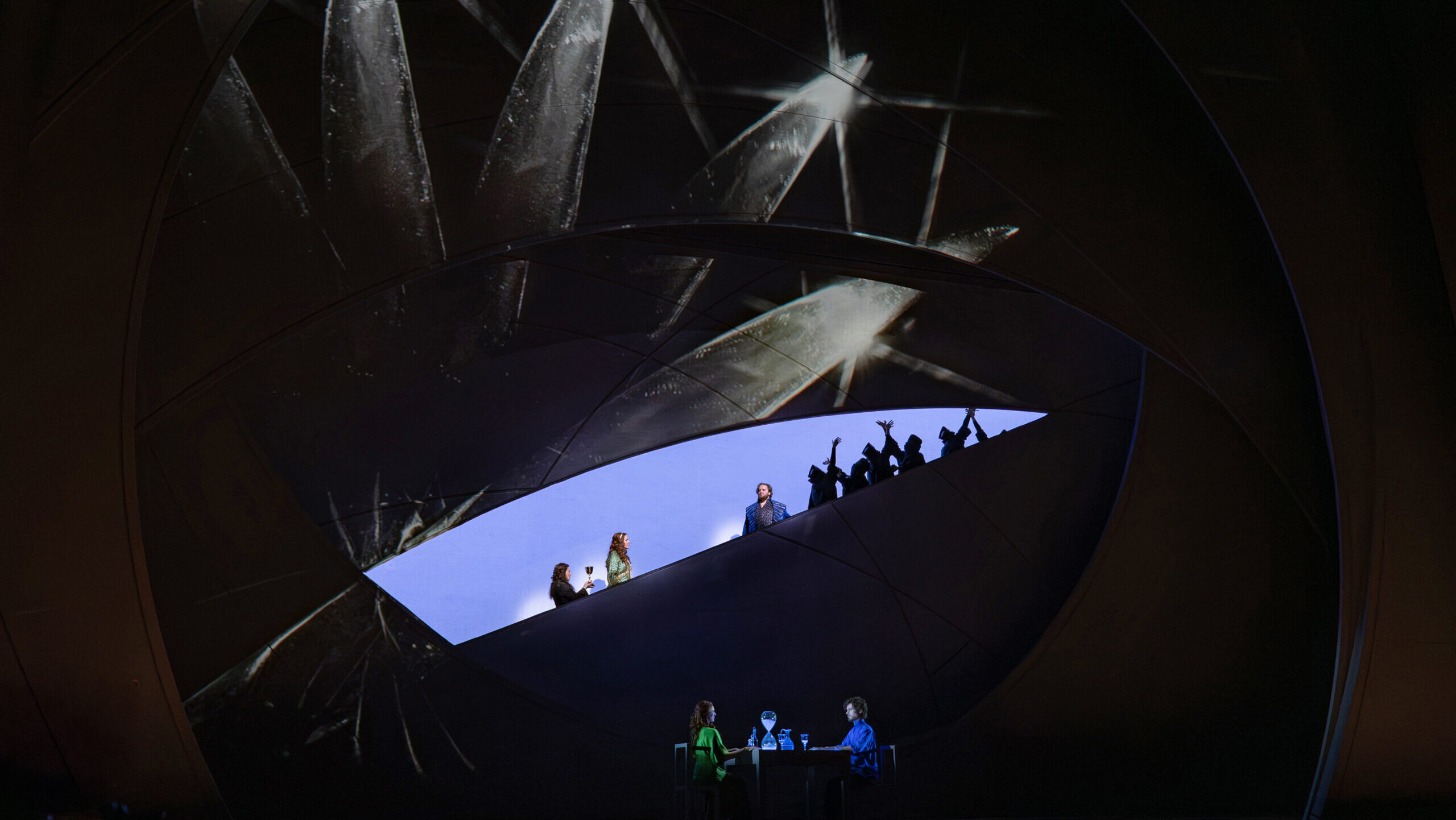
A scene from Act I of Wagner’s Tristan und Isolde. Photo: Karen Almond / Met Opera
I’ve often been puzzled by complaints that Nézet-Séguin routinely covers his singers. For the past decade I have only heard his performances from seats in the orchestra, and I don’t recall a single instance when I couldn’t hear the singers, including Monday’s performance. However, a friend who was in the balcony for Tristan complained mightily that the sound barrage from the pit during the first Act covered everyone but Davidsen. The conductor ultimately tempered his dynamics going forward, but clearly where one sits at the Met drastically affects the balance between the stage and the pit. And, yes, as in Philadelphia, he took the traditional cut in the love duet which I regretted, but the third Act was done complete.
Gubanova who had been an uneven Venus in Tannhäuser at the Met in 2023 was again a persuasive Brangäne, but this time she sounded increasingly strained by the role’s high tessitura. And the long lines of her Watch revealed an alarming unsteadiness. As Sharon seemed little interested in Brangäne’s complex relationship with Isolde, Davidsen’s strong portrayal kept Gubanova pretty much in the background. Tomasz Konieczny had more luck as Kurwenal especially in the third Act when he provided the sole consistent element as Spyres and his double played musical tables. The bass-baritone who had been so appealing as Mandryka in last fall’s Arabella regained some of the unattractive snarl that had marred his Fidelio Don Pizarro, but he used his booming voice to smart effect in comforting the stricken Tristan and standing up to the lethal Melot of Thomas Glass.
Green’s first Marke was no doubt the most controversial portrayal of the premiere. His at-times gritty bass-baritone is much different from the rolling Germanic basses one usually hears as the King. However, his restrained yet intensely felt portrayal ably captured the monarch’s complex mixture of anger and sadness, and his security on high meant the climaxes of the monologue resounded easily. All in all, Marke suggested that Green’s ascension to Wotan in the new Ring (with a detour to Klingsor next season) may be more successful than his recent outings as Don Giovanni.
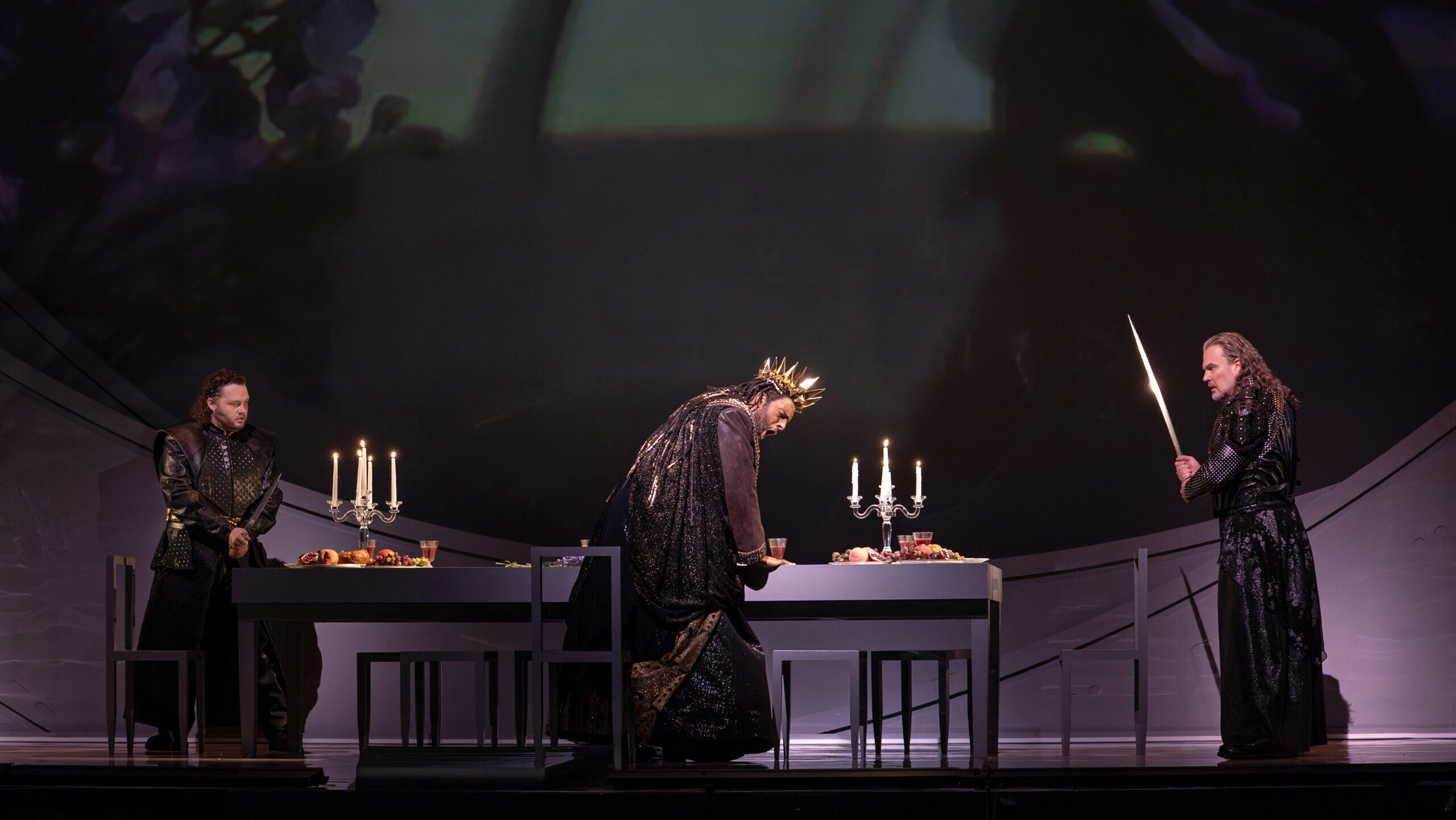
Thomas Glass as Melot, Ryan Speedo Green as King Marke, and Tomasz Konieczny as Kurwenal in Wagner’s Tristan und Isolde. Photo: Karen Almond / Met Opera
The astonishing versatility of Spyres continues to amaze: how many tenors have sung both their first Nemorino and first Tristan during the same season? That this Wagner debut succeeded should not, however, come as a surprise as the self-styled “baritenor” has in recent years taken on Lohengrin, Siegmund, and Walther, the last two bravely premiered at the composer’s own Bayreuth Festival. Any concerns that his pairing with the volcanic Davidsen might result in dire imbalance were almost immediately banished as they partnered so well together displaying enviable sensitivity and grace. There was no trace of “Bayreuth bark” in his healthy lyrical approach to Tristan and even the most challenging pages sounded remarkably bel canto.
Davidsen, capable of titanic high notes that are surely peeling even more gold paint from the Met’s proscenium, also brought exemplary sensitive dynamic subtlety to Isolde’s wide-ranging music. Her curse sizzled, her Liebestod surged. However, she looked uncomfortable in the low, narrow sloping capsule set for her first scene, and one imagines that she’ll bring more linguistic and dramatic variety to her portrayal as she continues exploring a part she herself admits she was born to play. Given that her Met commitments for the near future will be taken up with Lady Macbeth and the three Brünnhildes, one wonders when New York will next get another chance to experience her thrilling Isolde, already the best since….?
It’s no wonder that demand has been such that the Met added a performance on 4 April, but everyone worldwide can catch the sure-to-be-memorable for Davidsen and Spyres HD transmission on 21 March.