
Prodigal divos
Long absent from the Metropolitan Opera, tenors Jonas Kaufmann and Benjamin Bernheim show New York audiences what they’re missing at Carnegie Hall.
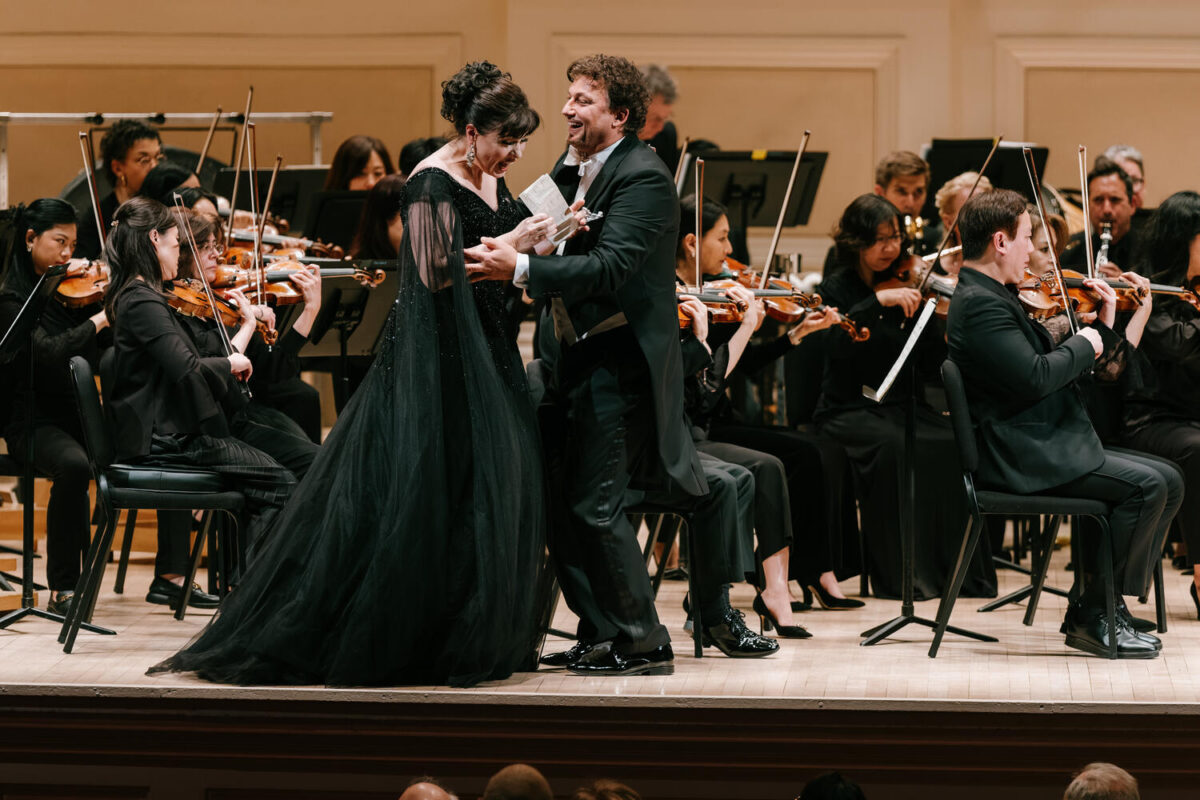
Photo: Fadi Kheir
The current Metropolitan Opera management has a penchant for creating opera stars, pushing them hard, and then dropping them precipitously. Kristine Opolais comes to mind, as do Anita Rachvelishvili and many others. Sometimes, it’s the management who feel the star hasn’t lived up to expectations or engages in behavior that offends. Sometimes, it’s the star who decides to work elsewhere.
Currently, there are several internationally prominent tenors who became house favorites at the Met but have not been hired in years. Javier Camarena has been gone since January 2023. Vittorio Grigolo was fired in 2019 for an incident that happened in another theater in another country. Juan Diego Flórez last bowed in the production premiere of Michael Mayer’s La Traviata in 2018; he is no longer a young wunderkind, but his recent concerts have shown he still has his vocal chops and charm in spades.
Jonas Kaufmann has not appeared at the Metropolitan Opera since a 2018 revival of La Fanciulla del West. His absence has been pretty much self-imposed, having decided to stay in Europe, closer to his family, and concentrate on a few theaters and staged productions per year. His participation in the Opening Night Gala of the Carnegie Hall with the Berliner Philharmoniker under Kirill Petrenko on October 8, reportedly found the German divo singing four arias in rather tired voice and perfunctory attitude to moderate audience response.
So, it was a delight to find Kaufmann returning to New York in restored vocal form so soon in a very highly anticipated event: the New York Philharmonic’s concert rendition of Puccini’s warhorse Tosca on November 13, which initiated an annual series of concert operas led by the New York Philharmonic’s white-hot new music director Gustavo Dudamel. It turned out to be a lucky night on Friday the 13th, with everyone from the stars to the second oboe player bringing their best game.
Dudamel really juiced things up with his energy, attack and command with his forces responding beautifully to his leadership. All three lead singers, soprano Marina Rebeka, Kaufmann and baritone Ludovic Tézier have been absent from our local stages for years. All three pitched in like crazy, singing beautifully, performing with conviction, and acting away despite the concert setting.
The performance marked Rebeka’s role debut, but she was a convincing youthful diva in distress, looking beautiful in three different bespoke evening gowns with matching diaphanous capes. Different colors for each act—white with silver sequins in Act I, red for the bloody Act II and dramatic black for the fatal Act III. I liked Rebeka back in the day, but I found her tone glassy with a hard, overly bright tone that could tire the ear. That was gone. Her brilliant soprano was rounded, fruity, brightly pointed and easily responsive throughout the range, especially on top where she nailed the high C in “Io quella lama” in Act III. Her tone was pretty throughout, if at times weak on the bottom as is typical of the “pushed lyric” type of Tosca. “Vissi d’arte” began haltingly with hushed tone but soared by the final phrases. She was girlish and insecure in her jealous tantrums in the Act I love scene, playing up the romantic comedy. Act II could use a little more tragedienne gravitas and tigress energy but she was touchingly vulnerable and distressed rather than demented diva. Act III was well-balanced and showed more of her potential in the role. The audience took strongly to her very quickly. The Met needs to bring Rebeka back—and soon.
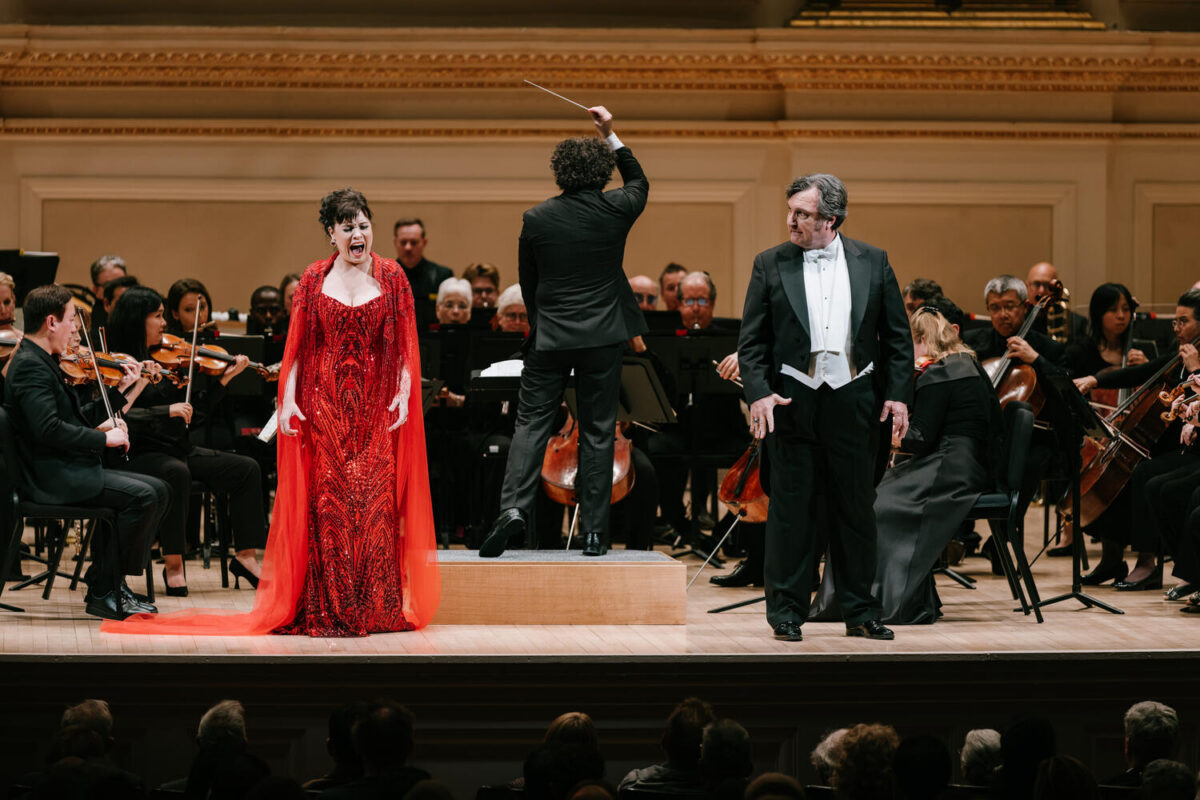
Photo: Fadi Kheir
Tézier, matured since his long-ago Met appearances as Marcello, Enrico, Count Almaviva and Escamillo, has established himself as Europe’s premiere Verdi dramatic baritone. He is a frequent recording and theatrical partner of Kaufmann in Europe’s premiere houses. His tone is smoothly cultivated, making his Scarpia a rather elegant villain. Unlike Quinn Kelsey, the Met’s current Scarpia, his velvety tone has little bite or snarl, and his personality comes off affable but retiring. I wanted more cunning and more sinister text projection. He did not ooze evil though he sang strongly throughout with more vocal than dramatic authority. It’s a deluxe voice, but he is not a verismo singer, not in my book anyway.
Reports and recordings of Kaufmann since the pandemic have indicated a vocal decline— a hoarse, leathery tone with more effort in the vocal production and less ring at the top. His first phrases as Cavaradossi strolls into the church of Sant’Andrea della Valle surprised with ringing, fresh and full sounds. His signature timbre with the baritonal center, surrounded by a halo of open upper partial tones, was present. The “Recondita armonia” was sung with ardor, and Kaufmann acted as passionately as he sang. The top was very there with Kaufmann taking a vacation on the high notes of “La vita mi costasse” and “Vittoria! Vittoria!” with the maestro’s full assent and assistance on the podium. The tone was also pliable, if in a rather calculated way, and he softened the dynamics for “Quale occhio al mondo può star di paro” and “O dolci mani” in his Act I and III duets with the prima donna. The “E lucevan le stelle” had long floated phrasing with endlessly sustained breaths that reminded me of Franco Corelli’s memorable recordings. I noticed a slight lessening of the vocal energy towards the end of Act I but that was the only concession to a long career I detected.
The supporting singers were generally young and strong voiced. The tall, rather hunky bass-baritone Ben Brady was odd casting as the bumbling buffo Sacristan though he clowned gamely; he seems more an Angelotti, which Andrew Moore performed well. Ben Reisinger and Benjamin Taylor earned notice as Spoletta and Sciarrone, and young Emrys Pengelly brought lovely phrasing to the young shepherd boy. The girls of the Brooklyn Youth Chorus sang quite well as the uproarious choirboys in Act I.
This was my first experience of the New York Philharmonic under Dudamel, and the chemistry is there. The Philharmonic has long gained a reputation for being temperamental and not always cooperative with their leaders. (Bernstein and Zubin Mehta had difficult tenures that soured towards the end.) Here, they produced a gleaming new Cadillac sound full of bright surfaces with smooth transmission. I had wondered what I would gain from a concert Tosca performance, but we received a deeper appreciation of Puccini’s kaleidoscopic orchestration, full of detail and color rendered more brightly visible by being brought out of the pit. Dudamel was good at bringing out subtle detail but is also a storyteller with dramatic attack and sweep. The audience, clearly enamored of their new local hero, awarded everyone with a standing ovation.
Suggestion: if the Philharmonic is going to make these concert operas an annual series, how about Verdi’s Otello with these three soloists?
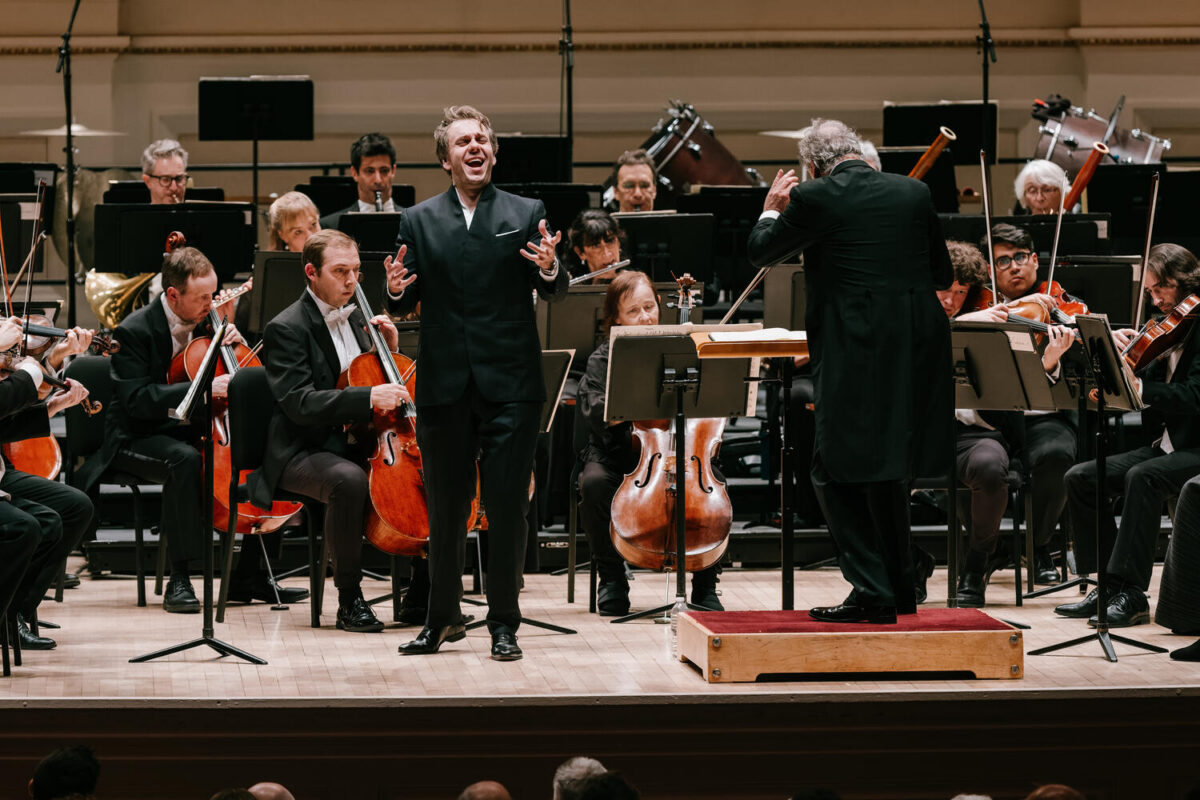
Photo: Fadi Kheir
Another tenor favorite at the Metropolitan Opera is French lyric tenor Benjamin Bernheim, whom we last heard two seasons ago in Les Contes d’Hoffmann. Two years is too long an absence for such a treasurable artist though he gave us a very worthwhile recital last year at Alice Tully Hall.
On November 5, Bernheim returned to Carnegie Hall to sing Les nuits d’été in an all-Berlioz program given by the Orchestra of St. Luke’s, conducted by Louis Langrée. The program started off with Berlioz’s Overture to Les francs-juges, which is the surviving fragment of an unfinished opera that Berlioz abandoned and all but destroyed, though its overture become a concert favorite in his day. Some of the opera’s lost music may have been repurposed by Berlioz in other compositions. It begins in a brooding, searching fashion in a dark minor key and then a surging major key theme sweeps all the darkness behind it in a very headlong stirring fashion. One wonders who these “judges of the secret court” might have been and what they were up to in this lost masterpiece? Langrée conducted with the forward motion and clear orchestral textures that suit Berlioz perfectly.
Then came our French étoile in Les nuits d’été, which benefited from his pure clean tone and crystalline diction. Once past some garbled text in “Villanelle,” Bernheim was light on his feet breezing through the melody on vocal wings. “Le spectre de la rose” (“The Ghost of the Rose”), was sung with hushed sensuality. The mood turns somber in “Sur les lagunes” (“Over the Lagoon”), which was filled with a distant longing suggesting a love remembered. “Absence” was ardent and more present tense. Next, “Au cimetière” (“In the Cemetery”) Théophile Gautier’s poem is set in a moonlit graveyard where Bernheim exploited his voix-mixte soft head voice capabilities hauntingly. The last song, another barcarolle, “L’île inconnue” seemed like a dream-like reverie blending fantasy and reality. Bernheim’s authentic diction, keen insight, firm musicianship, and prismatic colorations brought the songs to life. The clarity of his tenor got right to the heart of the matter with no fuss or artfulness.
There was an encore of Massenet’s “Pourquoi me réveiller?” from Werther, which Bernheim has been touring around various theaters in Europe recently. This aria was also programmed in his piano recital last year, but with orchestral support and his recent theatrical experience, it was sung here with greater intensity and fervor, reaching a heartbreaking climax. I was disappointed that Bernheim wasn’t our Chevalier des Grieux in the Met’s Manon revival this season and would love to see his Werther live. I hope he and the Met come to some agreement to bring him back regularly. He is too special to become another one of their lost stars.
The second half of the program consisted of the familiar Symphonie Fantastique which had cinematic sweep and dramatic contrast abetted by Langrée’s firm leadership and the OSL’s adroit playing.
-
Topics: concert performances, paging peter gelb, Review, tenors
-
People: Andrew Moore, Ben Brady, Ben Reisinger, Benjamin Bernheim, Benjamin Taylor, Emrys Pengelly, Gustavo Dudamel, Jonas Kaufmann, Louis Langrée, Ludovic Tézier, Marina Rebeka
-
Works: Les nuits d’été, Tosca
-
Places & Organizations: Carnegie Hall
Comments