JK, just OK
The world’s leading tenor garners a tepid response at Carnegie Hall‘s season opener featuring the Berliner Philharmoniker.
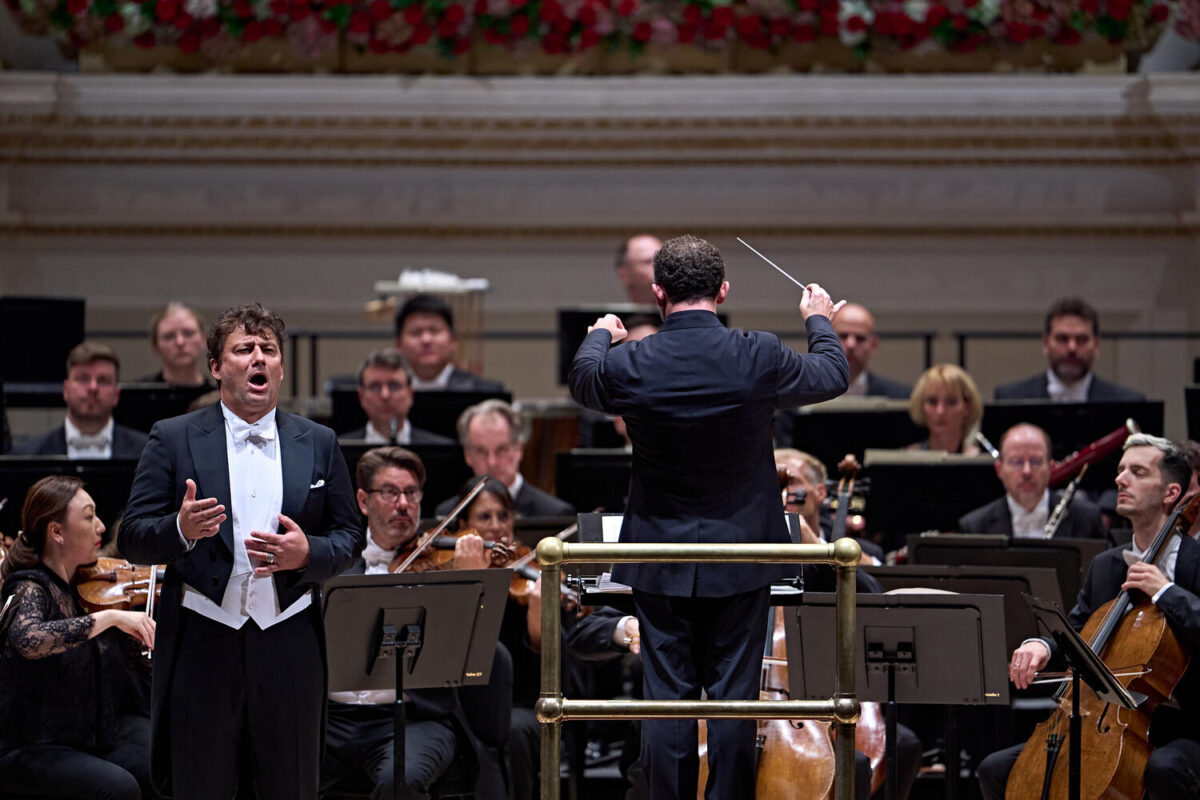
Photo: Rob Davidson
Opening Night at Carnegie Hall regularly features a tip-top visiting orchestra led by its renown music director and featuring a star soloist. The 2026-27 season-opener began a four-concert residency by the Berliner Philharmoniker conducted by Kirill Petrenko, who offered a relatively brief program (75 minutes, presented without intermission) of Italian music.
Of special interest was the reappearance of Jonas Kaufmann, absent from Carnegie Hall for five years and three from New York City, where last he appeared at the Park Avenue Armory in Doppelgänger. Anyone hankering to hear the tenor again at the Metropolitan Opera (where he last appeared in October 2018 as Dick Johnson in Puccini’s La Fanciulla del West) was disappointed to learn in late 2025 that he would not be returning to his U.S. opera home. Kaufmann declared that his reason was the company’s objectionable strategy of invoking force majeure during the pandemic closure to avoid paying its soloists, chorus, and orchestra. At the same time, the world’s leading tenor also renounced the Royal Opera because he has found temporary housing in London prohibitively expensive.
Judging from the polite applause he received throughout the concert, Carnegie’s very dressy opening night audience was only staidly pleased to welcome Kaufmann back. Freshly shaved and once again all-brunette, the 57-year-old tenor began his reshuffled program with the “Prologue” (“Si puó? Si puó?”) from Leoncavallo’s Pagliacci, a baritone aria. Its inclusion brought back memories of the arguments that swirled around the singer when he made his Met debut twenty years ago. Many listeners complained that his exceptionally dark, ardent tenor was misidentified: He was really a baritone!
I never understood this claim, and at Carnegie Hall, Kaufmann sounded very much like a tenor on an ill-judged detour. Not having sung locally with an orchestra in eight years, his voice sounded somewhat reduced in size, and his lowest notes were noticeably weak. His younger colleague, “baritenor” Michael Spyres, was altogether more successful when he recorded Tonio’s aria a few years ago. After the orchestra played Pagliacci’s Intermezzo, Kaufmann returned to more comfortable territory with Canio’s despairing “Vesti la giubba,” which featured the usual bitter laugh (albeit a modest one) but no sobs.
Following the first of the orchestra’s pair of Respighi Roman showpieces, Kaufmann returned for a distractingly mannered “Lamento di Federico” from Cilea’s L’Arlesiana. He and Petrenko took this marvelously melancholic aria quite slowly, and Kaufmann more than once indulged in his familiar habit of exaggerating pianissimo phrases while building to a melodramatically fortissimo ending marred by a brief hiccup as he attacked the final high note. The Pagliacci arias were originally scheduled to end his participation in the concert, but the order was changed after the program was printed. He concluded instead with Loris’s very briefly soaring “Amor ti vieta” from Fedora. After the hearty applause that greeted the Cilea, the Giordano’s ovation was much more muted. After he gathered up two bouquets, Kaufmann, with Petrenko, left the stage; The applause died out before they even reached the exit. If an encore was even planned, the crowded definitely didn’t demand it. I imagine that even the most enthusiastic Kaufmann fan was disappointed by just four short verismo arias ably, if not exceptionally, performed.
In the years since Kaufmann last appeared at the Met, it might have seemed that he was cutting back on opera. He continues to tour widely: some lieder recitals, but more often concerts with soprano and orchestra, sometimes tied to a recently released recording. This season’s tour will be “Tutto Verdi,” first with Marina Rebeka and then Juliana Grigoryan. But otherwise his schedule this season shows a surprising increased emphasis on opera. Next month, Kaufmann returns to Otello at the Wiener Staatsoper, after which he’s back at Carnegie Hall to join Gustavo Dudamel and the New York Philharmonic for a pair of Tosca’s with Rebeka and Ludovic Tézier. Next year finds the tenor tackling Dick Johnson in Zurich, Parsifal at his Tiroler Festival in Erl, and Tannhäuser in Munich, the last of which he’s only previously performed at the 2023 Salzburg Easter Festival.
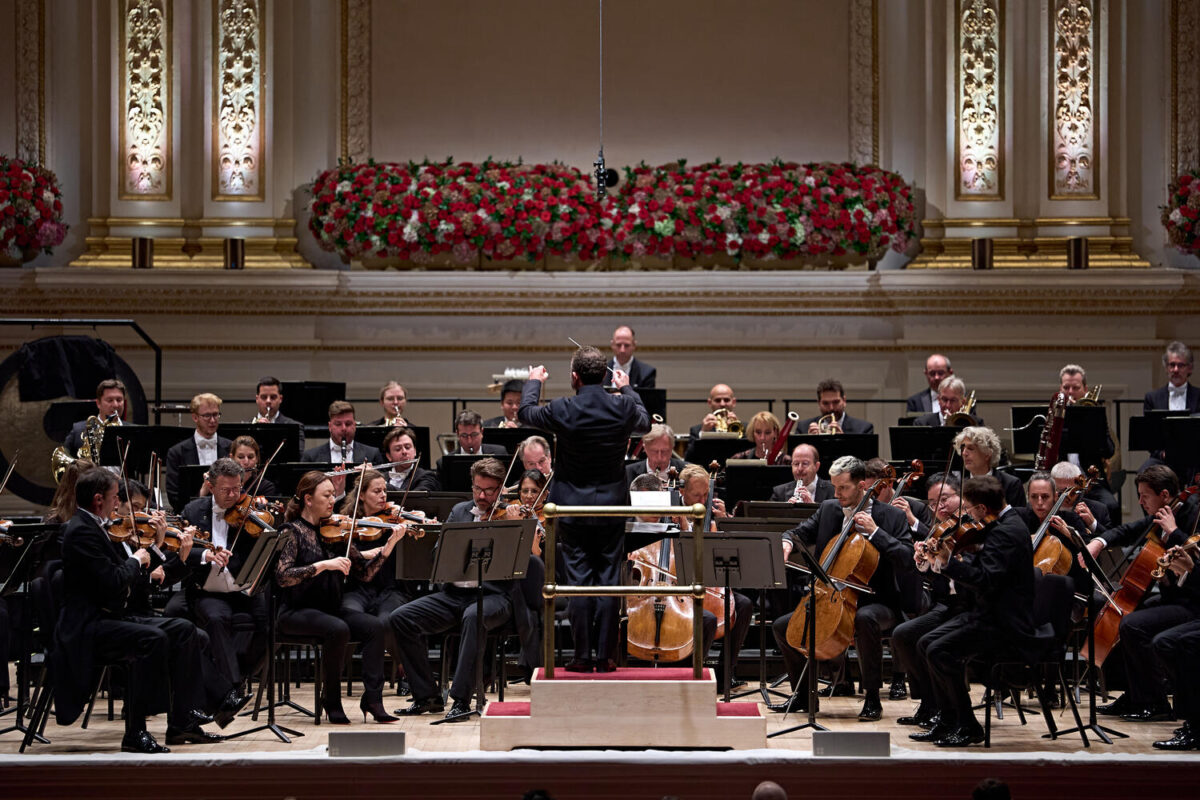
Photo: Rob Davidson
The gala audience at Carnegie Hall was much more appreciative of Petrenko and his deluxe Berliners. After a sumptuous but oddly fragmented overture to Verdi’s La Forza del Destino, they concentrated on two of Respighi’s three dazzling Roman tone poems. Although I preferred the Fontane di Roma, it was impossible to resist the majestic bravura that the conductor and his orchestra brought to Pini di Roma, especially its thrilling conclusion for which Petrenko placed a pair of brass sections in Carnegie’s balconies. After the glorious rising sun on the Appian Way, the audience immediately rose to its feet for a long and loud ovation that far eclipsed anything that the evening’s star tenor received. Then the orchestra did offer an encore: a bracing “Folk Festival” from Shostakovich’s The Gadfly Suite, Op. 97a, No. 3.
In December, Petrenko will take the tour to Frankfurt and Baden-Baden again with this all-Italian program, adding Feste Romane to reunite the Respighi trilogy. His tenor will instead be American Jonathan Tetelman who is scheduled for three of the four arias Kaufmann performed. Dropping the Pagliacci Prologue, he’ll fold in Turiddu’s “Mamma, quel vino è generoso.”
Unfortunately, their program won’t be performed at the Berlin Philharmonie from which many of the orchestra’s concerts are streamed on its exceptional online home, Digital Concert Hall. This past season I enjoyed its live streams of Petrenko conducting lavish versions of Mahler’s Symphony of a Thousand and Wagner’s Das Rheingold. Of its future streams, parterre box readers will sure be most interested in April 3, 2027, when Die Walküre will be performed in concert after stage performances in Salzburg that feature Lise Davidsen’s first Brünnhildes.

Christopher Corwin
Christopher Corwin began writing for parterre box in 2011 under the pen name “DeCaffarrelli.” His work has also appeared in , The New York Times, Musical America, The Observer, San Francisco Classical Voice and BAMNotes. Like many, he came to opera via the Saturday Met Opera broadcasts which he began listening to at age 11. His particular enthusiasm is 17th and 18th century opera. Since 2015 he has curated the weekly podcast Trove Thursday on parterre box presenting live recordings.
-
Topics: concert performances, Review
-
People: Gustavo Dudamel, Jonas Kaufmann, Jonathan Tetelman, Juliana Grigoryan, Kirill Petrenko, Lise Davidsen, Ludovic Tézier, Marina Rebeka, Michael Spyres
-
Places & Organizations: Carnegie Hall