Hit me with your best shot
Dmitri Tcherniakov‘s production of Der Freischütz in Munich may fire a few blanks, but the musicians are all on target.
 By
Lisa Hirsch
By
Lisa Hirsch
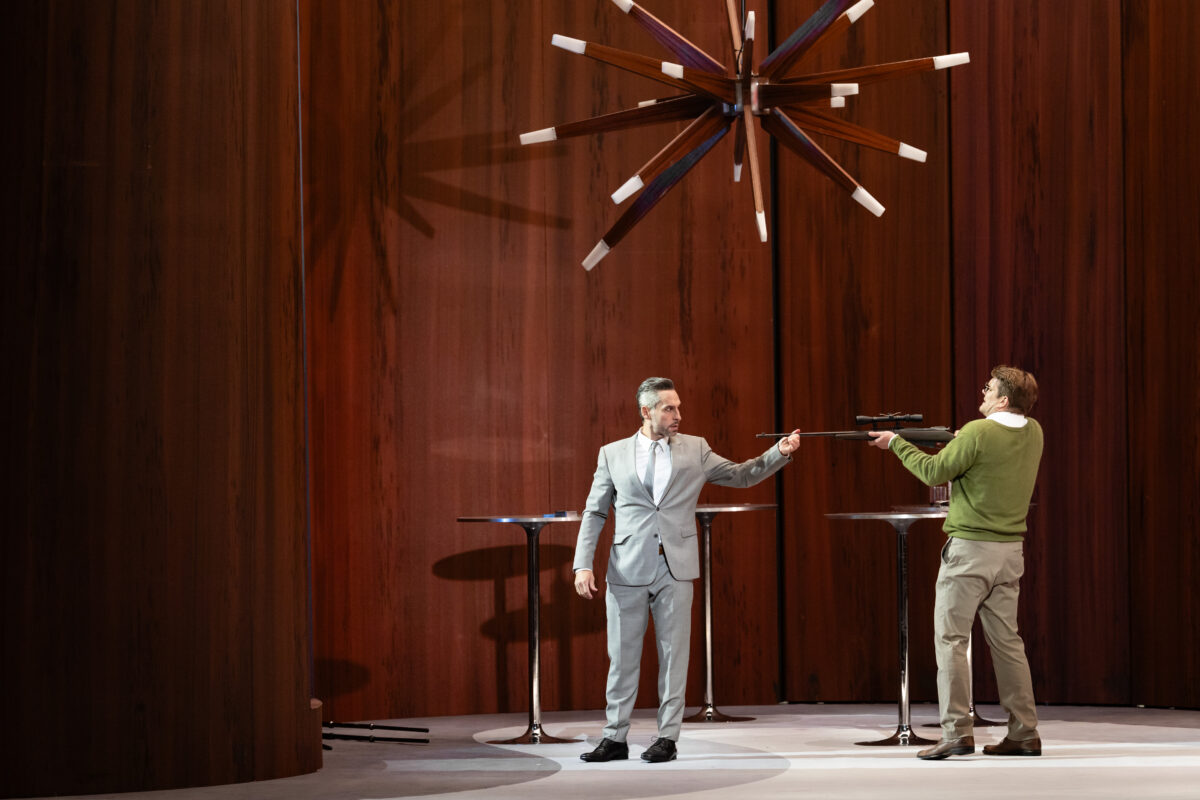
Photo: Geoffroy Schied
It’s not every week that you get to see a production by Dmitri Tcherniakov: the Russian director hasn’t often worked in the United States. But the performance of Carl Maria von Weber´s Der Freischűtz at the Bayerische Staatsoper mirrored themes of his Les Troyens production, which I saw at the Paris Opera in 2019 — that’s the one that so upset the audience that conductor Philippe Jordan had to wave a white flag from the pit to stop the booing.
So after a couple of Tcherniakov productions, I can say that some patterns emerge: The production will be in modern dress and placed in a modern context. If possible, he’ll find some source of personal trauma. Les Troyens postulated sexual abuse of Cassandre by Priam, which I found unlikely and unnecessary. He placed the Carthage acts in a sanitarium for people traumatized by war, which worked surprisingly well.
In the United States, Der Freischűtz is a great rarity. The Met has performed it just 30 times, the last in 1972. San Francisco Opera presented a single Spring Opera performance, in English, in 1964, then three performances in concert in 1985. Pamela Rosenberg intended to stage it at SFO earlier in this century, but her tenure ended before she got to it.
On the face of it, the scenario for the opera is not bad: Max (tenor Stanislas de Barbeyrac), a forester, must land a perfect shot in order to win the hand of Agathe (soprano Golda Schultz), the daughter of Kuno (bass Bálint Szabó), who is the most senior forester. At the opening of the opera, he loses to a peasant, but he’ll get another chance. Kaspar (bass-baritone Kyle Ketelsen, in another devilish role in Munich), another forester, is also in love with Agathe, who has rejected him in favor of Max.
Kaspar wants revenge and plots accordingly, luring Max into a scheme to create a magic bullet that Max thinks will win him the contest. Kaspar has sold his own soul to Samiel, the Black Huntsman, and has arranged things so that the magic bullet he and Max cast will kill Agathe and thus Samiel will be able to seize the souls of Max and Kuno instead of Kaspar’s.
In the end, Agathe is saved by protective roses given to her by a holy hermit (the suitably benevolent bass Tariq Nazmi), and when Max fires the magic bullet, it kills Kaspar instead. Max should be banished for the killing, but the hermit’s testimony results in Max being granted a year’s probation by Prince Ottokar cq (baritone Vitor Bispo), which will be followed by the wedding.
There’s plenty of room for musical drama there, and Der Freischűtz has some terrific music as well as a crackling overture: Agatheś big aria, ¨Leise, Leise,” a drinking song, some charming short ensembles. But the libretto fails to really take advantage of the possibilities in the scenario. Agathe’s rejection of Kaspar has already taken place before the curtain goes up, missing a good dramatic opportunity. The casting of the magic bullets could be a great scene, but it’s surprisingly brief. The opera is, unusually, too short for the story it’s trying to tell, at a compact two hours that the Staatsoper presented in a single act.
Tcherniakov sets all of the action on a unit set of his own design, a large, wood-paneled meeting room in an anonymous skyscraper. You can see other buildings through moveable slats and what would be windows. My first thought: Is this the same set as the family gathering space in Les Troyens? No, but it feels like it.
And then we get another trademark: Each character is introduced to us, with photos and text describing their positions in relation to Kuno, the head of a company. Both Max and Kaspar work for him. Agathe is estranged from him, but wants him to attend and pay for her wedding, which he agrees to. The director orients you in time by periodically displaying the time of day.
We see people milling around the meeting room, then there´s a challenge to use a new gun, on a tripod and pointed out a window, to shoot a person on the street. Max, fearful, refuses; Kilian (baritone Thomas Lehman) takes up the challenge. We see what he sees through the gun sight; he fires; a man falls, one of the most shocking things I´ve seen on stage. (We’ll learn shortly that the shot was faked.)
Max is drinking too much and frustrated, knowing he used to be a better shot than he is now. Kaspar bullies him into shooting a bird, then tells Max it was a magic bullet. Kaspar calls on the powers of darkness to help him with revenge.
Meanwhile, Agathe is consulting about Max and the wedding with her BFF, Ännchen (soprano Mirjam Mesak), who also works for Kuno. In her powder-blue power suit and white-blonde hair, is she lesbian-coded? Maybe, though there’s nothing between the two women, and except for the four bridesmaids (the delightful Nontobeko Bhengu, Lucy Altus, Meg Brilleslyper, and Serafina Starke) and female choristers, theyŕe the only women on stage.
We know things will not go well when Kaspar drags a body bag on stage for the casting of the magic bullets — yes, that´s Max in the bag. Here, Tcherniakov delivers a fine and spooky moment: Ketelsen, always an intense stage presence, sings Kaspar and takes the speaking role of Samiel in a completely different voice. This Kaspar might have some serious mental problems beyond raging jealousy.
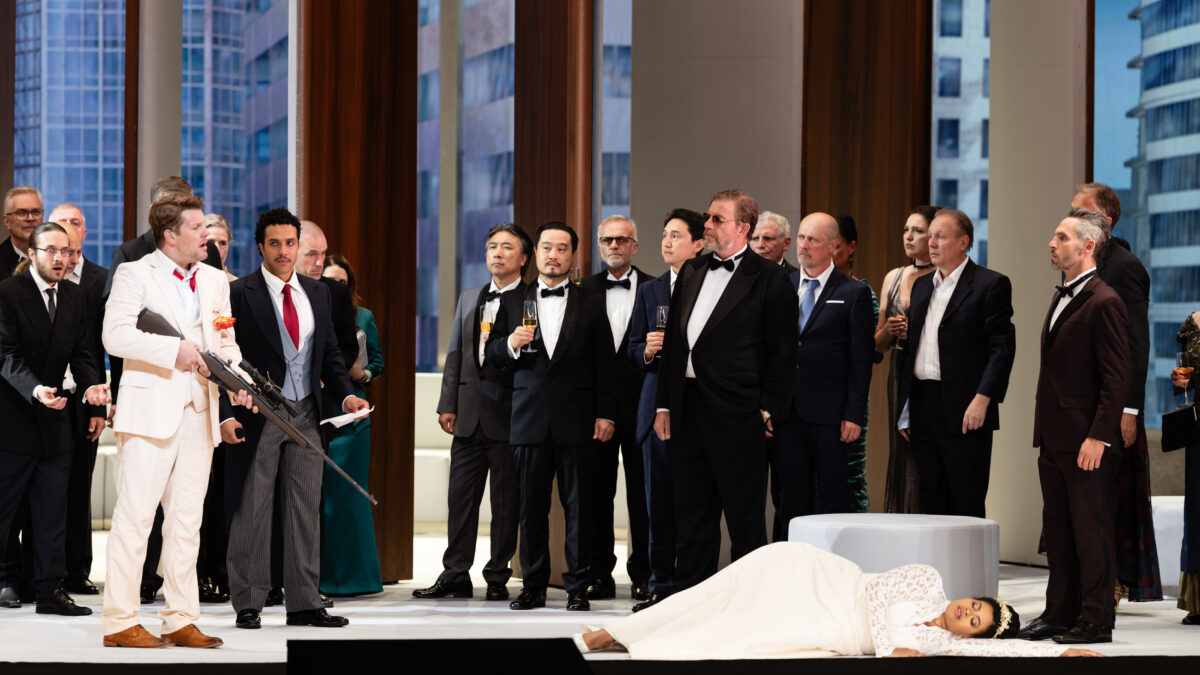
Photo: Geoffroy Schied
What to make of the close of the opera? Kaspar wants the magic bullet to kill Agathe, and when Max fires it, she falls to the floor. Eventually, we learn that she fell over from the shock of the bullet, but she was protected by those roses. Kaspar falls dead! And yet…after the reconciliation with the Prince and forgiveness for Max, there´s a brief blackout. When the lights come up, Agathe is again laying on the stage, apparently dead.
I can’t explain this, and if there is an explanation in the program, well, it’s in German, which I do not really read. But I certainly can state that this was an eminently persuasive performance from every musical standpoint. Daniele Rustioni conducted with commitment, propulsion, and great awareness of the colors in the orchestra, giving the best possible support to the singers. The orchestra of the Bayerische Staatsoper is as good as any I have heard.
Schultz was a dignified Agathe with an iron spine, her shimmering, velvet voice a good match for the role. Mesak’s slightly insouciant, professionally-climbing Ännchen made the perfect foil. De Barbeyrac, now a leading jugendlich Heldentenor, played the hapless Max to the hilt (I suspect in a more conventional staging Max would be less hapless!). Szabó’s oily, repellent Kuno, who is surely committing many white-collar crimes, was perfect for the staging.
Lisa Hirsch
Lisa Hirsch studied music at Brandeis University and Stony Brook. She studied flute seriously for a number of years and has sung a wide variety of music in many choruses. She has written about opera and classical music for San Francisco Classical Voice, Opera News (RIP), Opera, and the San Francisco Chronicle. She blogs about these subjects at Iron Tongue of Midnight, which also includes many of her photos.
Though she has attended San Francisco Opera and other companies since the early 1980s, her opera obsession really started in the early 90s, when she started listening to historic singers.
-
People: Bálint Szabó, Carl Maria von Weber, Daniele Rustioni, Dmitri Tcherniakov, Golda Schultz, Kyle Ketelsen, Lucy Altus, Meg Brilleslyper, Mirjam Mesak, Nontobeko Bhengu, Pamela Rosenberg, Philippe Jordan, Serafina Starke, Stanislas de Barbeyrac, Tareq Nazmi, Tareq Nazmi., Thomas Lehman, Vitor Bispo
-
Works: Der Freischütz, Les Troyens
-
Places & Organizations: Bayerische Staatsoper, Metropolitan Opera, Paris Opera, San Francisco Opera