Sealing the deal
The Bayerische Staatsoper’s summer festival wound down with Lotte de Beer’s darkly effective production of Gounod ’sFaust.
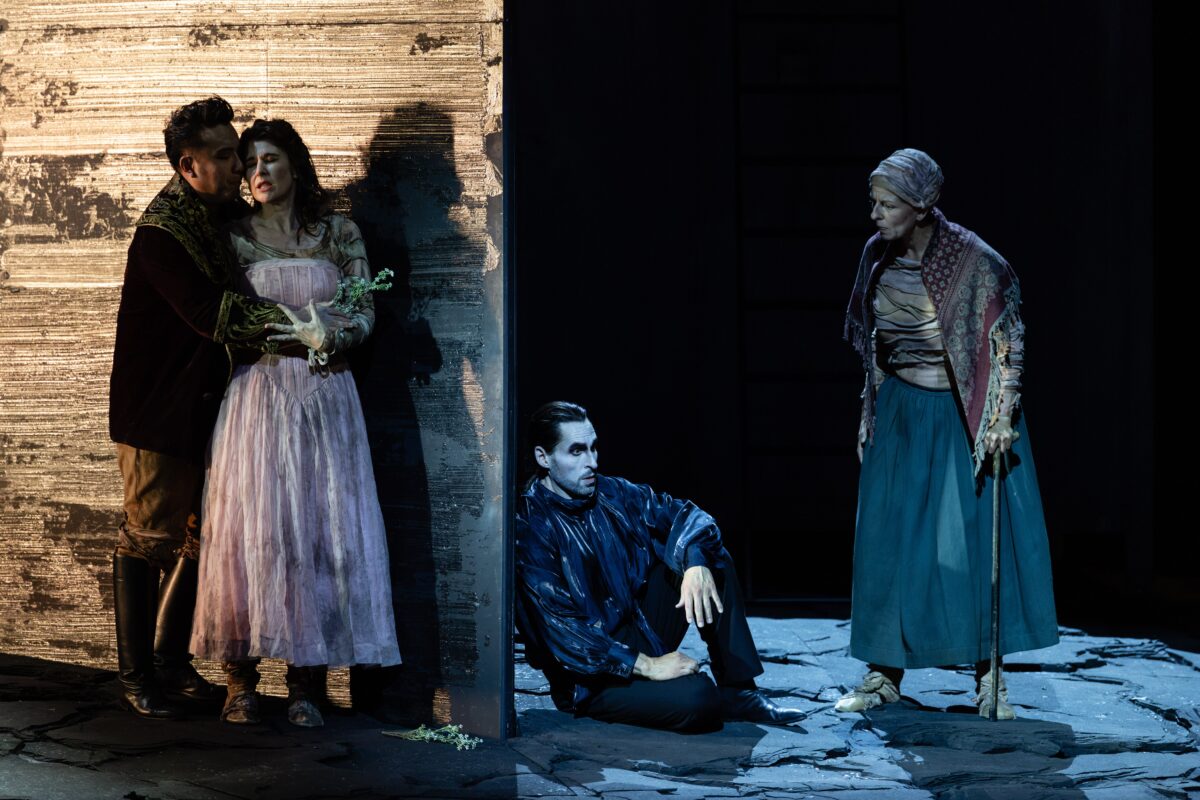
Photo: Geoffroy Schied
De Beer’s staging, which premiered in February as a co-production with Teatr Wielki Polish National Opera, was fairly minimalist. It had a mostly bare, rotating stage designed by Christof Hetzer, accented by occasional fantastical projections with lighting by Benedikt Zehm. Costumes by Jorine van Beek featured monochromatic beige rags that contrasted with Faust’s glittering jacket, Méphistophélès’s black cloak, and the soldiers’ blood-red uniforms.
De Beer takes a human-centered approach to the classic tale, less focused on the supernatural and more on the psychology of each character. Here, Méphistophélès’s main task is to bring out the worst in our own humanity, whether its Faust’s selfishness or the chorus’s desire for money and pleasure. He acts as a sort of demonic emcee, “conducting” the bacchanalian dances and frequently rotating the stage to reveal alternate realities—flash-forwards predicting the soldiers’ grisly deaths in battle and, while holding Marguerite’s mirror during the jewel song, visions of the deadly child labor that mined her diamond-crusted dress.
A go-to casting choice for villainous roles, Kyle Ketelsen was an appropriately menacing Méphistophélès. While his dark lower register did not always project in softer passages, Ketelsen compensated with a charismatic stage presence and dynamic variety: from a nasal timbre for his mocking serenade to a gloating demeanor as Méphistophélès blocks Marguerite from entering church.
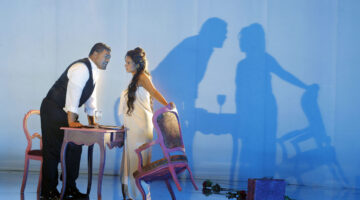
In de Beer’s staging, Marguerite is primarily a caretaker, first of her elderly neighbor Marthe (played by Dshamilja Kaiser) and then of her infant. Her exclamation at the end of Act III is not out of joy in seeing Faust return but rather from discovering Marthe’s corpse after Méphistophélès’s seduction. This theme returns in the next act, as Marguerite drowns her child while bathing in a tragic accident, distracted by Méphistophélès’s infernal invocations. Nicole Car (stepping in for Ailyn Pérez) gave a confident rendition of this challenging part. Car showed impressive timbral range: almost guttural as she rebuked Méphistophélès and breathy as she recounted the King of Thule ballad.
Her brother Valentin also oscillates in his conscience: Even while he curses Marguerite, the siblings embrace. Boris Pinkhasovich portrayed Valentin as a stoic soldier. This characterization, however, resulted in a somewhat dramatically inert voice, as if stuck between resilience and reservedness when alongside Ketelsen’s more imposing presence.
The young admirer Siebel, like Marguerite, suffers public humiliation at the hands of the chorus, his naïve goodness taunted by the mob. While slightly underpowered in ensembles, Emily Sierra’s bright timbre gave a poised and sympathetic reading of Siebel.
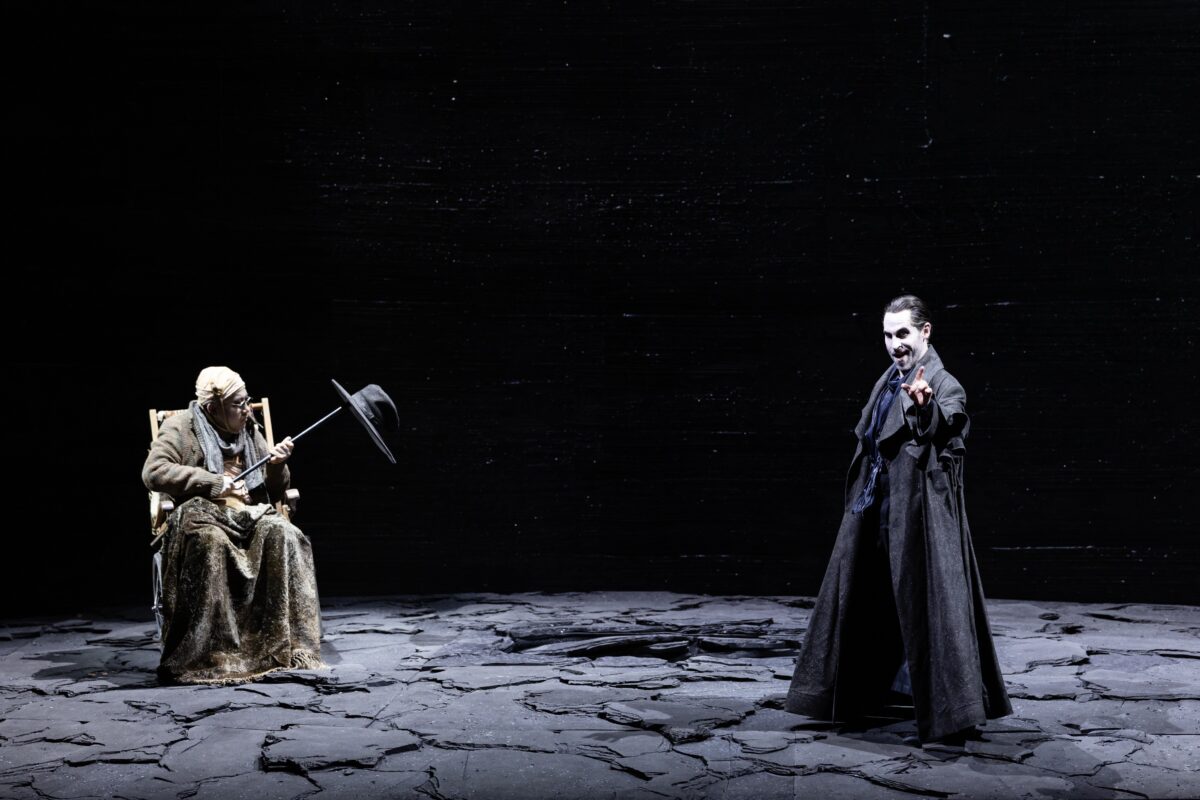
Photo: Geoffroy Schied
Faust has arguably the least to do in de Beer’s production. He is neither particularly smart nor charming. There is no sign of his academic acumen in Act I and, once Méphistophélès arrives, he constantly looks to his demon guide for reassurance. After a moment of empathy in the Act V when Faust searches for the dead infant among Méphistophélès’s pile of corpses, he quickly gives up and gazes helplessly as Marguerite confronts the devil in the final scene.
This was a one-off performance for Piotr Beczała, having recovered from illness that forced him to withdraw from the first performance as well as Bayreuth’s Beethoven 9. Considering this (and yet another heatwave gripping Germany at the moment), his performance as Faust was admirable. At ease in the title role, Beczała only once lost a bit of steam with a wobbly high C during “Salut! Demeure chaste et pure.” Though his amber tone now sounds heavier than his 2010 Vienna recording, Beczała continues to inhabit the role with poise.
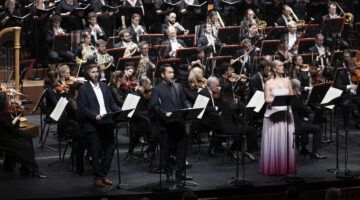
Daniele Rustioni led the Bayerische Staatsorchester with confidence and energy. Never leaning into a sappy reading of Gounod’s score, Rustioni instead grounded the orchestra’s sound; it was neither too lush in the love scene nor too sinister as Méphistophélès reveals to Faust his Walpurgis abode.
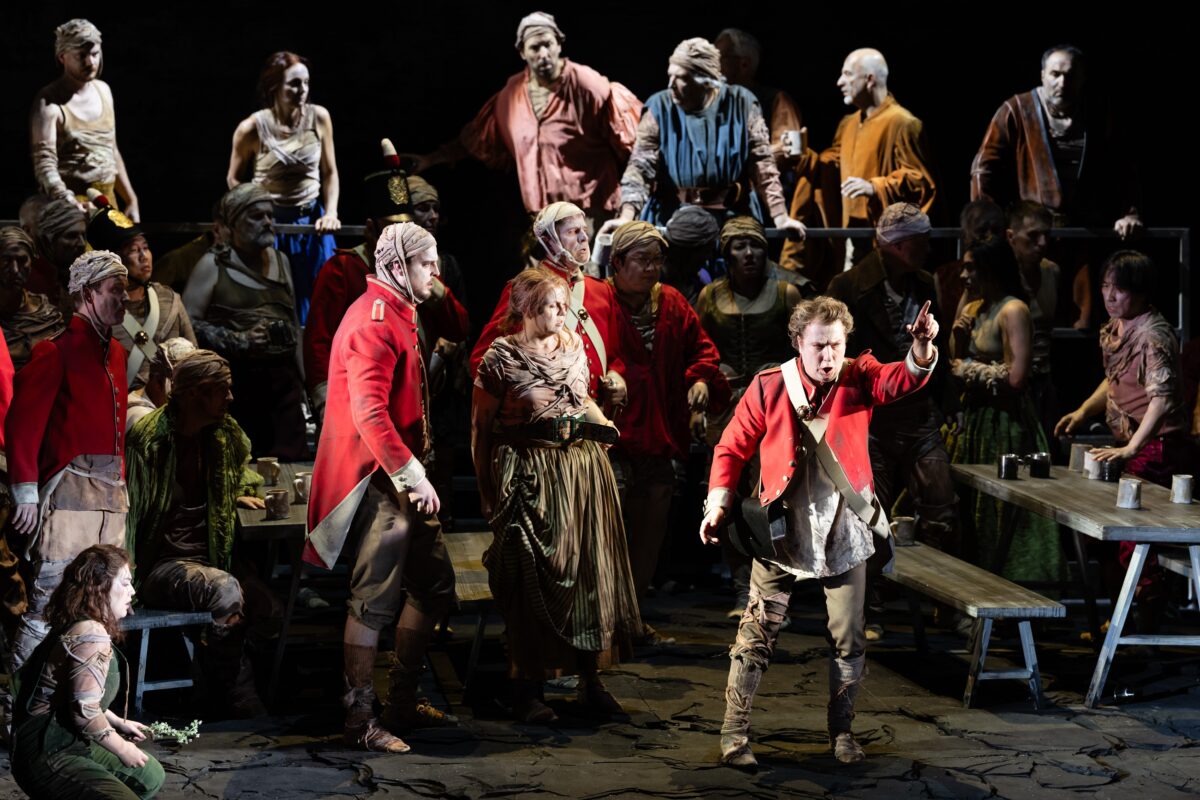
Photo: Geoffroy Schied
A quasi-liturgical work, Gounod’s score relies on choral set pieces and the organ in its final two acts. A small downside was in the sound design for the amplified digital organ and offstage heavenly and infernal choruses, which resulted in somewhat unblended sonics with the pit. However, the chorus of the Bayerische Staatsoper were in top form. Waving a white flag to surrender rather than triumph, the soldier’s chorus was a somber funeral procession for the wartime casualties, while in the final scene they collectively disassembled Marguerite’s prison bars announcing her salvation.
Although Faust opened the Met Opera’s inaugural 1883-84 season, it has somewhat receded in popularity in recent decades. Both Berlioz and Boito’s versions, while problem-cases in their respective forms, contain more exciting musical material. Yet the Faustian legend remains timeless. The strong cast, Rustioni’s no-nonsense reading, and De Beer’s stark unsentimental staging all made a case for Gounod’s continued place in the opera pantheon.

Montagu James
Montagu James is a PhD student at Brown University studying modern European political and cultural history. He also enjoys composing and conducting.
-
People: Ailyn Pérez, Arrigo Boito, Boris Pinkhasovich, Charles Gounod, Christof Hetzer, Daniele Rustioni, Dshamilja Kaiser, Emily Sierra, Hector Berlioz, Kyle Ketelsen, Lotte De Beer, Nicole Car, Piotr Beczala
-
Works: Faust
-
Places & Organizations: Bayerische Staatsoper, Bayerische Staatsorchester, Metropolitan Opera