Queening out
Brett Dean‘s Of One Blood casts a well-trodden Tudor tale in a poignant, new light.
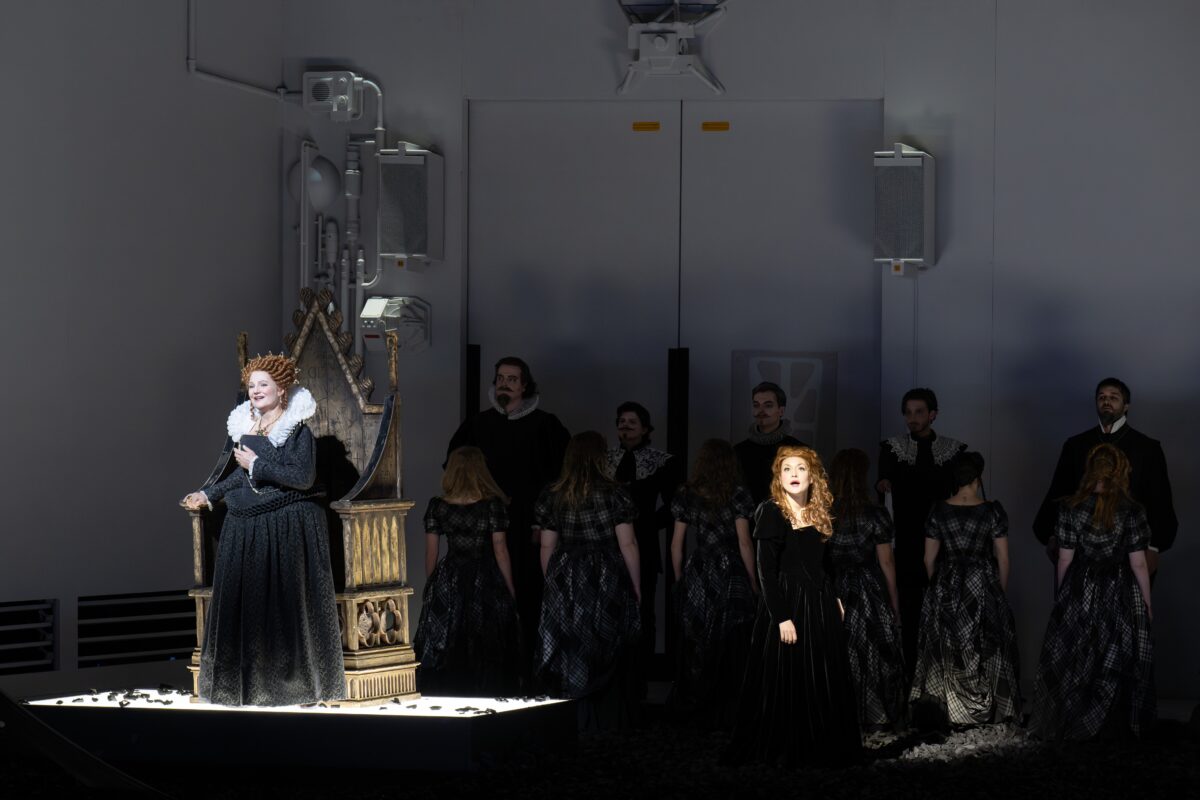
Photo: Monica Rittershaus
Brett Dean’s new opera Of One Blood, premiered at the Bayerische Staatsoper, takes the familiar biographies of Queen Elizabeth I of England and her cousin Mary Stuart, Queen of Scots, in new directions. Though often portrayed as rivals, the two are buried next to each other in the Lady Chapel in Westminster Abbey, as the Catholic Mary’s tomb was moved there by her Protestant son James I in 1612 (who had succeeded Elizabeth to the throne of England a decade earlier). Dean’s work spans from their first correspondence 1566 to the Scottish Queen’s execution in 1585.
Although the cousins never met in person, they wrote poems and exchanged copious letters. Librettist Heather Betts (Dean’s wife) employs these poetic and epistolary sources to great effect. The opera’s title comes from a letter Mary wrote to Elizabeth: “I am the nearest kinswoman you have, we be both of one country, in one island and of one blood,” a line that serves as the epigraph on screen and is paraphrased by Elizabeth in the opera. Later, the two sing in unison for the first time when they both proclaim, “in this our realm.” Poignantly, the work opens with a prayer written by Mary on the eve of her execution. The hymn then returns in the epilogue; this time the monarchs sing together “from beyond the grave” in Westminster Abbey to plead “that I may have my share, my share of everlasting joy.” Though Mary and Elizabeth are separated on stage throughout the work, they become united in spirit and in voice after death in their neighboring tombs.
Act I contains a dizzying set of vignettes concerning Mary’s unhappy marriage to Lord Darnley and the birth of her son James. Mary flees to England following accusations of complicity in Darnley’s murder yet is shunned by her English cousin. Act II takes place 19 years later with the Scottish Queen in house arrest. Elizabeth agrees to sign Mary’s death warrant for treason once her advisors find evidence that her cousin supported a Catholic plot against her. Both monarchs are now isolated. Elizabeth—away from the devious English and Scottish Lords—laments:
that we were but as two milkmaids
with pails upon our arms;
or that there were no more dependency upon us
but mine own life were only in danger
and not, Gentlemen,
and not the whole estate of your religion and well-doings.
Here in many ways the core of Dean and Betts’s take on the story: a critique of exclusionary culture and praise for two strong women who are constantly assailed by suffocating chauvinism.
The stars of the show were the royal pair: Johanni van Oostrum’s Elizabeth and Vera-Lotte Boecker’s Mary Stuart. Both have incredibly demanding vocal parts. Van Oostrum’s heavier voice conveyed gravitas and remorse, her experience with Wagnerian roles demonstrated by her warm middle range and well-measured vibrato. Her compelling stage presence, combined with Betts’s text, made for a sympathetic portrayal of the English queen, a solitary monarch holding firm in the midst of male-dominated court intrigue.
A lyric soprano, Boecker portrayed Mary as resilient, soaring in her upper register when incredulously asking “my dear subjects, why now betray me?” Her bright voice gave Mary a youthful presence as a foil to her older English cousin. Both royals also employed sprechstimme throughout, Boecker’s clear diction cutting through thick orchestral textures to convey Mary’s distain for her degenerate husband Lord Darnley, while van Oostrum expressed scorn towards her scheming advisors.
Each character is also accompanied by a male and female quintet, whose members also double as other characters like Lord Darnley (played with apt cockiness by tenor Michael Butler) and Jane Kennedy (a mellow part for contralto Freya Apffelstaedt). The coordination between each queen and the whirlwind voices and actors surrounding them sometimes felt disjointed, and the group’s diction and balance with the orchestra was occasionally hard to discern. Nevertheless, the quintets brought contrast to van Oostrum and Boecker’s isolated vocal lines.
A former violist in the Berlin Philharmonic and DJ immersed in the city’s nightlife, Dean has a nuanced and eclectic approach to music history and operatic conventions. From his earliest compositions such as Carlo (1997, for sampler and string ensemble) inspired by Gesualdo, to Hamlet and Approach (both from 2017, the latter performed attacca with Bach’s Brandenburg Concerto No.6), Dean mixes Renaissance and Baroque stylistic homages with extended techniques and innovative timbre. Often in Dean’s work musical clarity gradually emerges out of harsh textures.
Most strikingly, Dean experiments with electronic and acoustic timbre from the very opening, using prerecorded samples to mimic the sound of quill-on-paper handwriting. Throughout the piece, electronic sounds (designed and recorded by Dean and Bob Scott, produced alongside Sven Eckhoff and Michaela Wiesbeck) envelop the auditorium to heighten a sense of nervousness and intrigue. The prologue features a ghostly chorale reminiscent of Ligeti’s Clocks and Clouds. As the drama picks up pace, the consort of English Lords swirling around Elizabeth take part in a sinister masque, represented by scurrying bassoons, while an inconsolable Mary is paired with a wailing oboe. Onstage, Mahan Esfahani’s impressive cembalo drives the narrative forward. Esfahani’s Elizabethan gestures on the keyboard clash with the dissonant orchestra, a compositional technique that to my ear represented a musical history deconstructed and clouded by the fog of time.
Dean has an established relationship with both conductor Vladimir Jurowski (who led the world premiere of Hamlet at Glyndebourne in 2017) and the Bayerische Staatsorchester, which gave the German premiere of Hamlet and recorded Testament for orchestra. Jurowski and the orchestra brought a steely assurance to Dean’s challenging score.
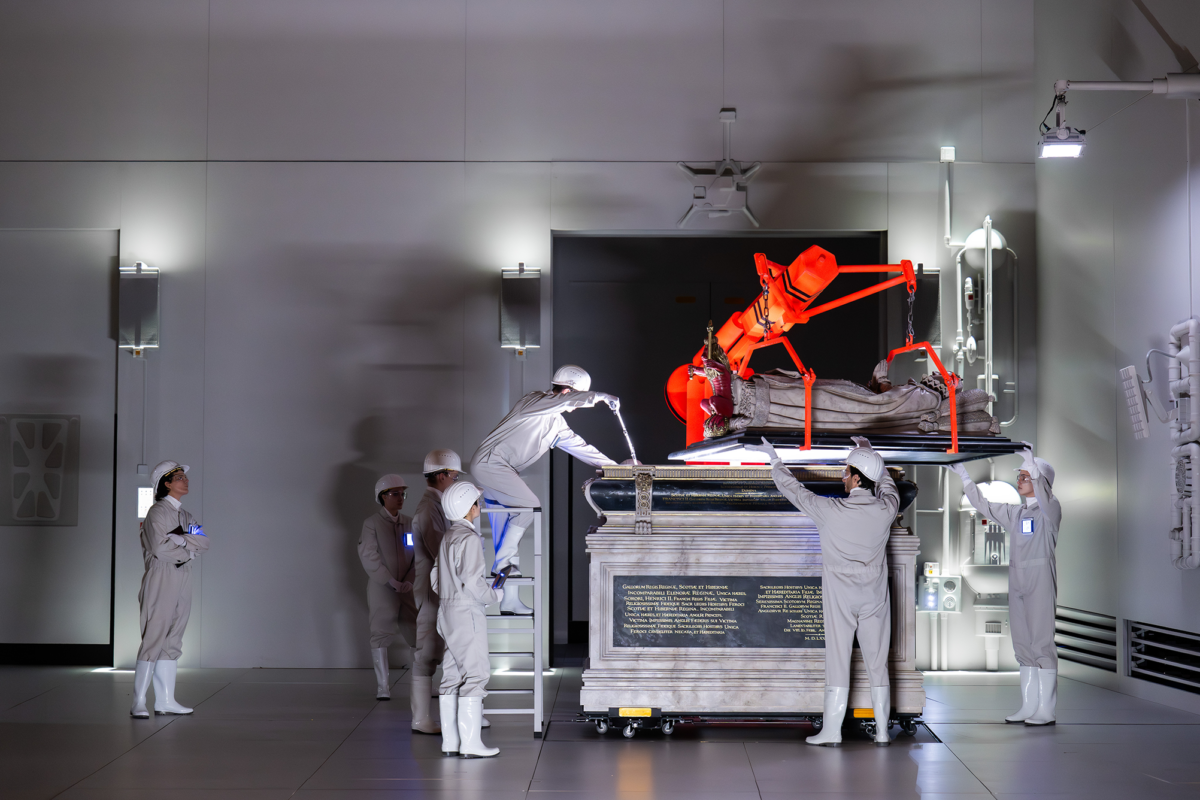
Photo: Monica Rittershaus
Of One Blood joins a long list of works framed around the notion of history as a synthesis of contemporary archeology and mythology. The opera metaphorically reopens historical sources that have inspired a legendary canon, including Schiller, Donizetti, Zweig, John Ford, and many others. This is matched by Claus Guth’s production, which has scientists literally excavating letters and quills from Westminster Abbey (reminding me of Phelim McDermott’s production of Glass’s Akhnaten). The action takes place in a high-tech laboratory designed by Etienne Pluss. Within this artificial reconstruction of history, each character is guided and given artifacts by technicians. Costumes designed by Ursula Kudrna reflect this dual timeline, with the present-day lab workers in generic white uniforms, the Scottish historical characters in maroon tartan, and the English court in austere black outfits. Michael Bauer’s lighting design is used to great effect, such as the contrasting cold and warm light for Elizabeth’s scorn and Mary’s tenderness to her infant son James respectively. The production’s slight weakness was however in Sommer Ulrickson’s choreography for the male and female consort imitating Renaissance pantomimes, which often came across as busy or cheesy, particularly in the first act.
A great strength of Dean and Betts’s work is that while not a radical, avant-garde departure from operatic conventions, it nevertheless favors focused storytelling instead of easy saccharine melodies and on-the-nose commentary. Of One Blood will have its US premiere next summer in Santa Fe (with Guth’s production), before heading to Garsington Opera in 2028 (directed by Louisa Muller) and State Opera South Australia in Adelaide later. Audiences may not find instant gratification in this work, but it makes for a somber and poignant contemporary retelling of a well-known tragedy.
Montagu James
Montagu James is a PhD student at Brown University studying modern European political and cultural history. He also enjoys composing and conducting.
-
Topics: contemporary opera, premiere, Review
-
People: Bob Scott, Brett Dean, Claus Guth, Etienne Pluss, Freya Apffelstaedt, Heather Betts, Johanni van Oostrum, Louisa Muller, Mahan Esfahani, Michael Bauer, Michael Butler, Michaela Wiesbeck, Phelim McDermott, Sommer Ulrickson, Sven Eckhoff, Ursula Kudrna, Vera-Lotte Boecker, Vladimir Jurowski
-
Works: Akhnaten, Hamlet, Of One Blood
-
Places & Organizations: Bayerische Staatsoper, Bayerische Staatsorchester, Berlin Philharmonic, Garsington Opera, Glyndebourne, Santa Fe Opera