Sister, sister, oh so fair
Conductor Eun Sun Kim and soprano Elza van der Heever play to their strengths in a piercing revival of Elektra at San Francisco Opera.

Elena Pankratova as Elektra and Elza van den Heever as Chrysothemis in Strauss’ “Elektra.” Photo: Cory Weaver/San Francisco Opera
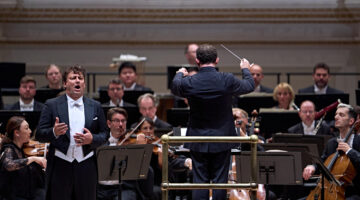
Hell hath no fury like a woman scorned, especially when she’s a certain girly girl in pink! No, no, I’m not talking about that ambiguously “good” witch—I’m referring to soprano Elza van der Heever’s Chrysothemis, who, alongside conductor Eun Sun Kim, energized and electrified the San Francisco Opera’s revival of Richard Strauss’s one-act tragedy Elektra, which began last Sunday, elevating it into a must-see event.
Almost a decade has passed since Keith Warner’s psychologically taut “reinterpretation” first graced the War Memorial Opera House stage in 2017. In an age when violence seems glorified, the cautionary tale of a young woman stranded in a contemporary museum and grappling with PTSD stemming from her family’s tragedies felt even more relevant than at its premiere. The cost of violence to those we love permeated every scene, as Anja Kühnhold once again directed Warner’s vision with keen insight. Is revenge really the best solution?
Warner’s staging featured the work of Boris Kudlička (sets), Kaspar Glamer (costumes), John Bishop (lighting), and Martek Macias (projections). The most striking feature of the production was how each part of the museum transformed into a scene from the opera, almost as if they were fragments of the young woman’s imagination. The left display case became Chrysothemis’ room, where Aegisth molested her (and met his end there); the kitchen was on the right; and the giant projection TV served as the gateway to the family drama. So much thought went into the details that the production definitely warranted multiple viewings to catch all the symbolism!
As meticulous as the production was, the musical aspect of last Sunday’s show was on another level. Based on the strength of the three Wagner operas she has conducted so far and on this performance, I truly believe Kim’s forte is the Austro-German repertoire, and I, for one, look forward to her leading The Ring cycle in the coming years.
Elektra (together with Salome) is often considered Strauss’s most modernistic opera, and many thought he retreated in his later works. Over the years, many interpreters have approached the score either traditionally (emphasizing the lyrical aspects) or modernistically (highlighting the score’s cacophonic nature, especially in the percussion). Kim approached the score by embracing both sides; the opening maidservants scene sounded thorny and jagged (pity there were some balance issues on Sunday between the orchestra and the amplified singers when they sang off-stage), while Elektra’s dance near the end in triple meter wonderfully recalled the delicious waltzes of Der Rosenkavalier. Bear in mind that with 95 personnel, Elektra has, to this day, the largest pit orchestra SFO has ever employed (for comparison, the 2002 Saint François d’Assise had more orchestra members, but some were on stage). Kim confidently took charge of the large force, keenly detailing various aspects of the score while vigorously propelling the action forward. The scenes starting with Orest’s arrival, particularly, moved with such breakneck speed, like a train wreck waiting to happen, pulling the audience breathlessly into the gory and tragic events. It was everything Elektra was supposed to be: brutal, loud, breathtaking, and overwhelming!

Elza van den Heever as Chrysothemis, Elena Pankratova as Elektra, and Kyle Ketelsen as Orest in Strauss’ “Elektra.” Photo: Cory Weaver/San Francisco Opera
In an interview, The Met’s Music Director Yannick Nézet-Séguin said that “Elza is the ideal artist to bring [Strauss’ works] to life.” With last year’s Salome and this run, van der Heever further cemented that notion. Not only did she have a large instrument that easily soared above the orchestra, but she also fully inhabited the character through her voice and mannerisms, stealing the scene every time she appeared (she was also in pink!). Her proclamation “Es ist Orestd, er es getan hat!” simply had to be experienced for its sheer joy and brilliance. Her Chrysothemis was a fascinating character study, a grown woman (who might or might not be a victim of sexual abuse) who eschewed a life of violence for domestic bliss only to be pulled back in. Van der Heever made it easy for the audience to sympathize with her.
Van der Heever more than met her match in Kyle Ketelsen’s Orest. Tall, dark, and dangerous, with a booming voice to boot, Ketelsen made his presence felt despite his limited stage time. He also navigated the dense orchestration with ease, projecting a dark yet sonorous sound that matched his acting. After a rather underwhelming Escarmillo seven years ago, I felt this was the repertoire he should sing more often. If you’re in town this month, be sure to catch his recital with Carrie-Ann Matheson as part of the Schwabacher series.

Elena Pankratova as Elektra and Michaela Schuster as Klytemnestra in Strauss’ “Elektra.” Photo: Cory Weaver/San Francisco Opera
Michaela Schuster took her role as the mother from hell, Klytemnestra, seriously. The silvery quality of her voice and her bleak, wide-eyed expressions made her portrayal effective. Nevertheless, her Klytemnestra was fully on the evil, demented side, with no redeeming qualities whatsoever. Little wonder the audience rejoiced at her demise. William Burden, who made his role debut as Aegisth, took the same approach, presenting a fully villainous character. After years of seeing Burden as the good guys, it was refreshing to see him change it up a bit, and he seemed to revel in the role.
As usual, the comprimario roles were filled by current and past Adler Fellows, who provided a thrilling experience with their considerable contributions. The five maidservants (Gabrielle Beteag, Sadie Cheslak, Laura Krumm, Mary Hoskins, and Caroline Corrales) imbued their chatter with fright and dread, and Alexandra Loutsion, with her big voice, brought up the gory early as The Overseer. Sofia Gotch and Alexa Frankian worked in tandem as Klytemnestra’s confidante and trainbearer, giving the whole proceeding an aura of ambiguity and ghostly evil (they were, after all, the ones who betrayed Klytemnestra!). As Orest’s tutor, Jongwon Han had the hardest job, singing behind a thick gold Agamemnon mask, so much so that he had to be amplified!

A scene from Strauss’ “Elektra” with Sadie Cheslak, Laura Krumm, Mary Hoskins, Caroline Corrales, and Gabrielle Beteag as the Maidservants and Alexandra Loutsion (far right) as the Overseer. Photo: Cory Weaver/San Francisco Opera
That left us with Elena Pankratova, who made her house debut in the punishing title role. I was excited to see her performance, especially knowing this was her 17th production in the role. Unfortunately, on Sunday, she was rather underwhelming, especially from where I sat. She sang earnestly, and the high notes came blazing. The scene with Orest was tender and heartbreaking. Nevertheless, her mid- and low-range notes sounded weak, and she was often drowned out by the orchestra. I hope it was just a case of her being under the weather or first-show jitters! It was interesting to note that she got a standing ovation from the people surrounding the stage, but barely anyone around me stood up!
Despite its shortcomings, Elektra was an overwhelming experience at the Opera, a well-thought-out production with a great cast. On the way, I imagined all the scenarios in which I wanted to see van der Heever and Kim together again in a Strauss opera. Dare I suggest Salome next, with Ketelsen as Jochanaan? Nevertheless, be sure not to miss Kim’s next fall Strauss concert, which will include the tone poem Till Eulenspiegel‘s Merry Pranks, a suite from Der Rosenkavalier, and Brentano Lieder with Adela Zaharia!
Michael Anthonio
Michael Anthonio's love affairs with classical music and opera started in primary school, when his parents bought him an organ and he began taking lessons. During high school and college, he gave private organ lessons to some of his parents' friends' kids (for pocket money) and he was church organist and later, choir conductor. In 1999 he moved to Singapore where he got involved with the classical music online website "flying inkpot." His interest in opera became an obsession when he was transferred for work to US in 2008. In addition to enjoying world-class opera in SF, he indulges in opera tours in Europe. His favorite opera composer is Handel; at this point, Michael seen 24 of his operas , with hopefully three more coming next year.
-
Topics: Review, richard strauss
-
People: Adela Zaharia, Alexa Frankian, Alexandra Loutsion, Boris Kudlicka, Caroline Corrales, Carrie-Ann Matheson, Elena Pankratova, Elza van den Heever, Eun Sun Kim, Gabrielle Beteag, Jongwon Han, Keith Warner, Kyle Ketelsen, Laura Krumm, Mary Hoskins, Michaela Schuster, Richard Strauss, Sadie Cheslak, Sofia Gotch, William Burden, Yannick Nézet-Séguin
-
Works: Der Rosenkavalier, Elektra, Saint Francois d'Assise, Salome
-
Places & Organizations: San Francisco Opera, War Memorial Opera House