La voix surhumaine
Barbara Hannigan mesmerizes as both a brilliant vocalist and a proficient opera conductor in a double bill of Strauss and La voix humaine with the New York Philharmonic.
 By
Dan Johnson
By
Dan Johnson
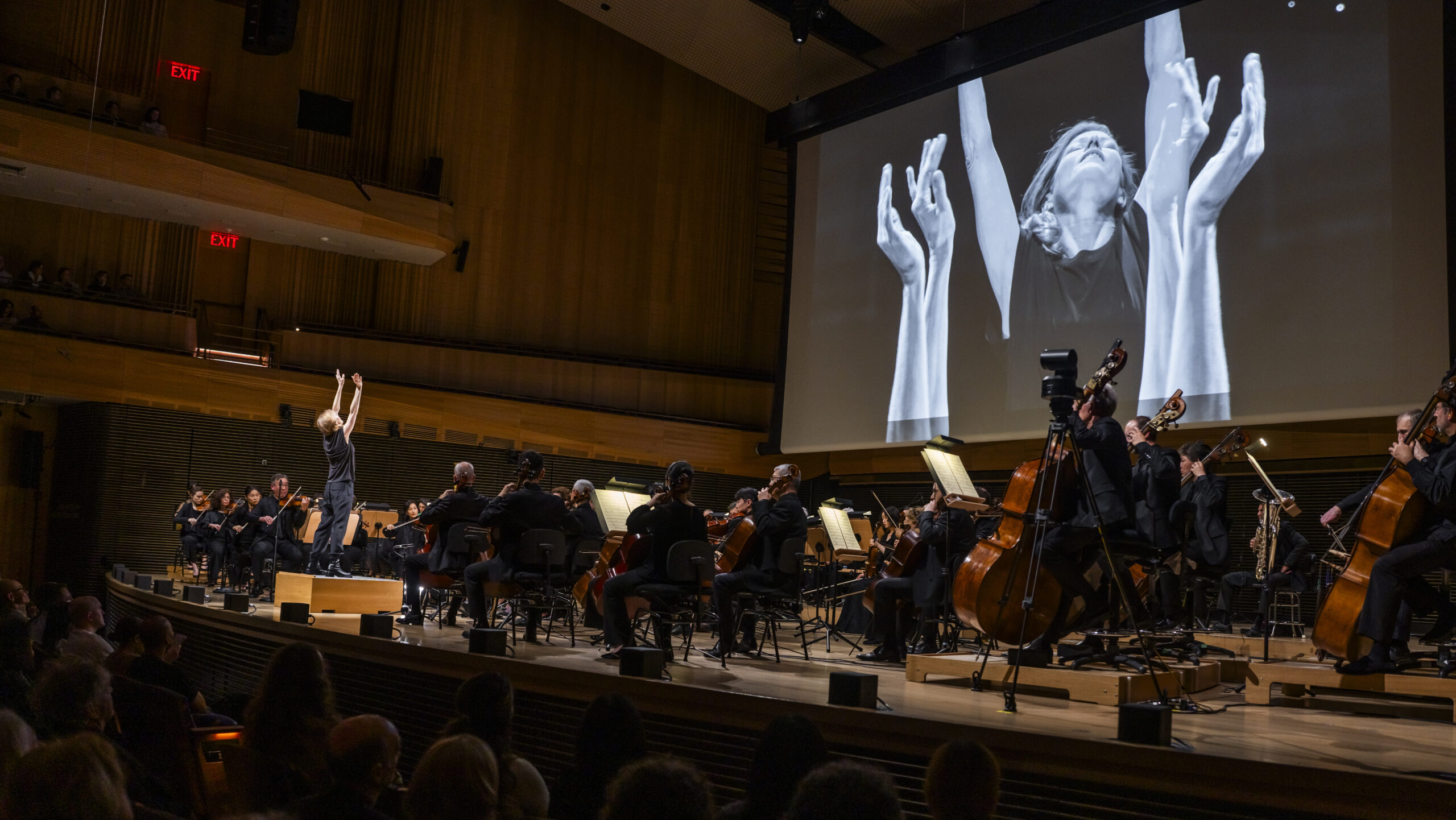
Barbara Hannigan conducts the New York Philharmonic performing R. Strauss Metamorphosen and Poulenc La Voix humaine at David Geffen Hall / Photo by Chris Lee
I’d loved the videos floating around online for a decade. Barbara Hannigan makes an entrance in full costume to sing one of her signature pieces, György Ligeti’s Mysteries of the Macabre—his concert extracts, for coloratura soprano and chamber ensemble, from his opera, Le Grand Macabre—while conducting the ensemble herself, in character. An incredible stunt! Imagine singing one of the most outrageously difficult pieces in the vocal repertoire and simultaneously leading the players through the complex and difficult score!
But on Friday night, I got to see her top that feat by leading the New York Philharmonic through an even more ambitious program: Richard Strauss’s Metamorphosen for 23 string soloists, followed by a complete performance of Poulenc’s telephone monodrama, La Voix humaine.
Does Hannigan have anything to prove? Surely we already know, from her traversal as vocalist of scores by Alban Berg, George Benjamin, Hans Abrahamsen, and, yes, Ligeti, that she stands unmatched among the opera world’s interpreters in her combination of a deep intellectual and musical sophistication, her total dramatic commitment, and the sheer range, loveliness and agility of her vocal instrument. Her conducting repertoire spans the gamut from the 18th century to the day before yesterday. And she can conduct and sing at the same time? What’s next? Is she going to walk out onstage with a harmonica around her neck, a kick drum on her back, and cymbals between her knees, yodeling and playing a squeezebox?
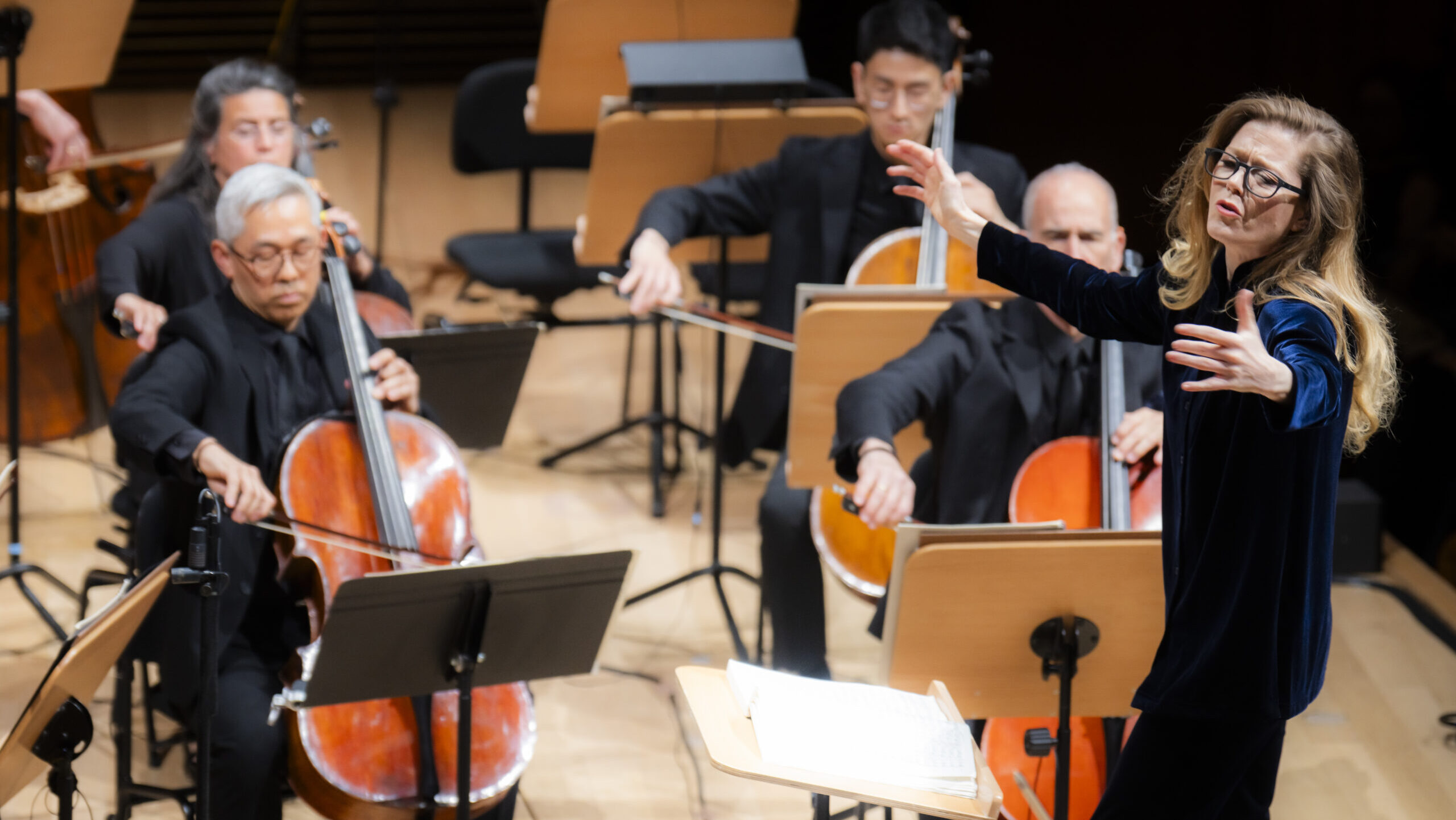
Barbara Hannigan conducts the New York Philharmonic performing R. Strauss Metamorphosen and Poulenc La voix humaine at David Geffen Hall, 4/23/2026. Photo by Chris Lee
But her choice of the Metamorphosen as a concert opener seemed designed to prove her range as a musical interpreter. Strauss, of course, composed some of the operatic stage’s greatest roles for Hannigan’s fach, but I don’t know whether she’s even sung Zerbinetta or Sophie in her professional career. And instead of bringing a prima donna’s indulgence to Strauss’s decadent score, she brought an opera conductor’s efficiency, carefully pacing and balancing the work so that each detail came to the fore, each dramatic twist in the harmony conveyed clearly but not oversold.
Her interpretation was startling from the first bar. The low string chorale the opens the work was performed non vibrato, like the cool, hushed sound of a viol consort, not at all like the sound of an ensemble of midcentury Solostreicher. Here and there, the players added a dash of vibrato to warm up an accented note, but it wasn’t until the violins entered that the ensemble allowed the straight tones to give way to a consistent vibrato sound.
Now, we know that this couldn’t possibly have been the sound that Strauss had in mind. We have recordings from the composer’s own lifetime, and shortly thereafter, by conductors who knew him intimately, and guess what? They don’t sound anything like this. Hannigan’s version of the piece was entirely her own, drawing on interpretive ideals formed in the decades after Strauss’s death.
To which I say: Good. We don’t hear this music with the same ears with which it was heard at its premiere 80 years ago. Those interpretive—let’s call them “technologies”—have hardly rendered the old ones obsolete, but they are worthwhile tools for understanding, translating, and communicating even pieces such as this one. More to the point, perhaps, Hannigan’s refined artistry made a powerful case for her revisionist reading, weaving the performance together with a nuanced pattern and crystal-clear cues throughout Strauss’s dense “study.”
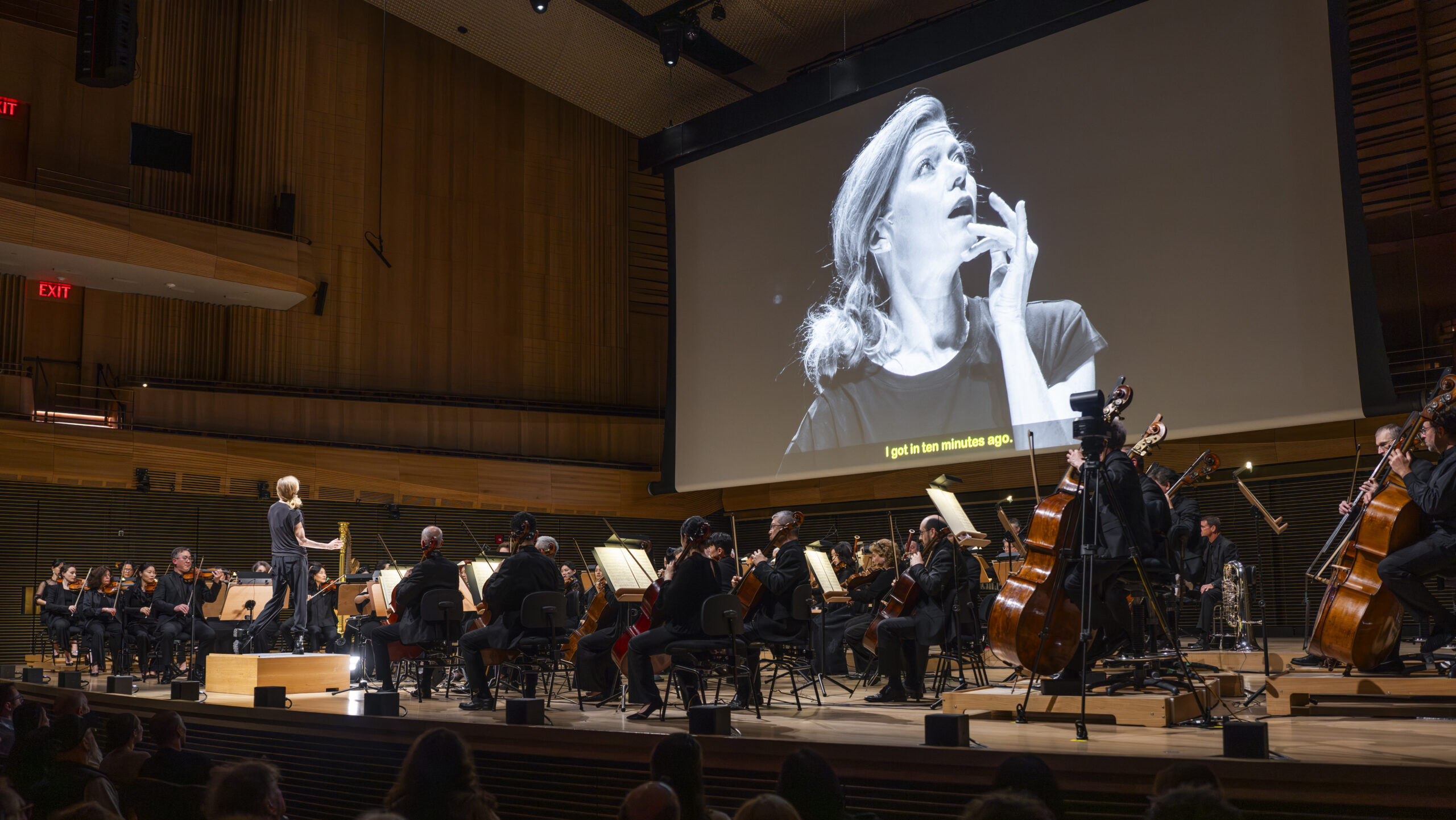
Barbara Hannigan conducts the New York Philharmonic performing R. Strauss Metamorphosen and Poulenc La voix humaine at David Geffen Hall, 4/23/2026. Photo by Chris Lee
The second, much longer “half” of the program showed us a different Hannigan entirely. (We even got a costume change!) A movie screen above the stage, which had—to general applause—dedicated the concert to the memory of Michael Tilson Thomas, now gave us, in the opening bars of La Voix humaine, the blurry monochrome image of our conductor, shot head on by a remote-controlled camera hidden in the orchestra, her suddenly bare arms white against the black of the dark concert hall behind her. The camera zoomed in, the singer-conductor came into focus, and the drama began.
La Voix humaine is based on a monodrama by Jean Cocteau—perhaps most familiar these days through Pedro Almodóvar’s film adaptation, starring Tilda Swinton—and Almodóvar’s obsession with the work, which also plays a role in his earlier La Ley del deseo, speaks to many of the play’s compelling qualities. It is conceptually gratifying, being a drama told entirely via one side of a telephone conversation. It tells the story of a deeply sympathetic woman suffering in extremis because of the unseen, unheard man at the other end of the line. It is a dramatic tour de force, meaning that it makes an ideal star vehicle for a mature and glamorous actor. And in its deeply earnest, just slightly over-the-top melodrama, it is the highest of high camp.
The aesthetically minimal, yet visually delicious live video projections designed by Clemens Malinowski placed Hannigan between, I think, four cameras, so that we could see her from multiple angles in a sort of digital multiple-exposure. Two conductors, at either side of the screen, seemed to be reaching their arms towards each other in symmetry, while in the center, an extreme closeup of the soprano glowed like Dreyer’s Joan of Arc in the pale brilliance of a footlight behind her podium. When she cued the cellos, she also pointed at her audience through what I’ll call Camera One; when she cued the violins, she gesticulated at us through Camera Two. It was brilliantly choreographed business, a little ballet with cameras.
And what gesticulations! Her conducting pattern, so tidy and straightforward in the Strauss, had become a dance of arms and fluttering fingers: she was beating in character. She was conveying the character’s emotional state not only with her voice, not only with her face—huge on the silver screen above her—and not only with her physical attitude, but in her conducting of Poulenc’s lush and mercurial accompaniment.
The necessity of singing with her back to the audience led this production to intersect with the text in a few unexpected ways. The opera is called, after all, La voix humaine, and we hear only one human voice, that of the main character (called simply Elle). But the title has a second meaning: her struggle to hear the voice of the ex-lover on the other end of the line, through bad connections and crossed wires. In a conventional production, she would be unamplified, present with us, her voice vibrating the same air that we are breathing; she, tethered to the physically and emotionally remote other by a telephone line, finds herself cut off from him by the same technology that has connected them together.
But when Hannigan sings the role amplified by a discreet mic, the performance is conceptually altered: she, the singer, is now using audio technology to communicate with us, the audience. In one shocking moment, there was a rustle of noise, and I realized to my horror that with a dramatic toss of her head, her mic had come unglued from her temple, slipped out from behind her ear, and had fallen down to her neck. In a moment of queasy dramatic irony, we had all seen it on the big screen, but Hannigan didn’t notice until it slipped down far enough that it stopped picking up her (human) voice.
Don’t worry, she got the mic back behind her ear without missing a beat or breaking character. And this unsettling moment was of a piece with Malinowski’s video, which in two moments paused unexpectedly—but, apparently, on purpose—with static quivering on the screen, as if we were watching a frozen, buffering Facetime call.
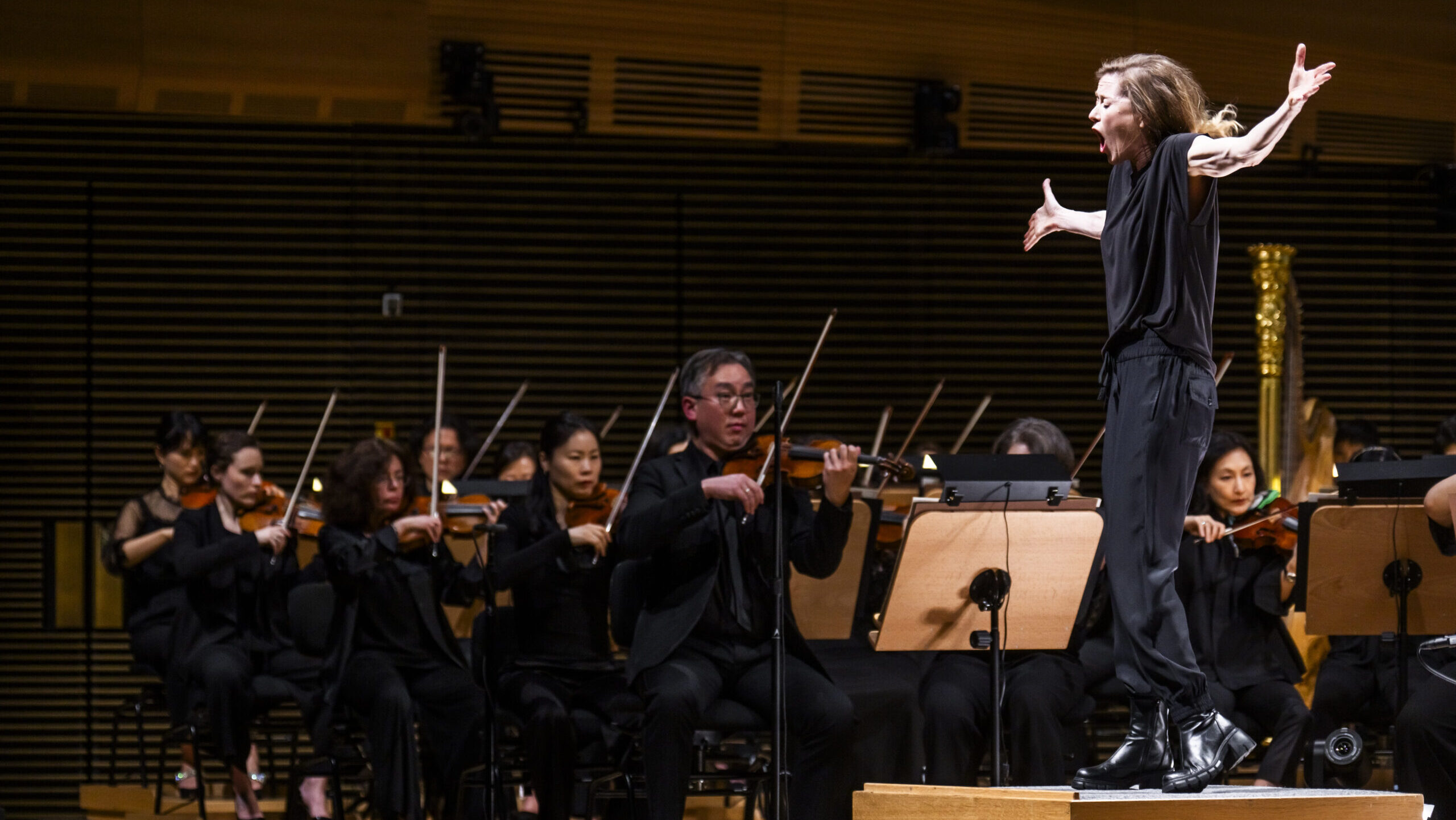
Barbara Hannigan conducts the New York Philharmonic performing R. Strauss Metamorphosen and Poulenc La voix humaine at David Geffen Hall, 4/23/2026. Photo by Chris Lee
And the amplification, by sound designer Etienne Démoulin, was discreet enough that Hannigan’s own extraordinary vocalism came through loud and clear across her range. She gave high, brilliant hysterics up in the ledger lines, guttural despair down low, and a sweet, pure tone in her lyric register when she tried to put on a brave front. And her conducting never got in the way of her vocal production, never distracted from her singing.
If anything, the opposite was the case: I was too mesmerized by her performance to pay much attention to what the orchestra was doing, which is the sign of both a brilliant vocalist and of a proficient opera conductor. What I noticed most of all were the moments when her voice rang out, unaccompanied, over Poulenc’s sudden silences in the orchestral score, and she could allow her arms to drop to her side, her face to turn away from the players, and sing directly to us. I had never noticed just how many of these grand pauses there were in the score.
In other words, this wasn’t just a stunt. Barbara Hannigan’s approach to La voix humaine, as well as to Metamorphosen, may have been shockingly new and ambitious, but they represented—and offered to the audience—a deeper understanding of these pieces. Her performance, as the Philharmonic’s, was more than dazzling: it was insightful, it was emotionally wrenching, and it was deeply, richly pleasurable to the ear and eye.
Dan Johnson
Dan Johnson was born in the desert and learned to play the fiddle. Now he lives in Brooklyn, working as a freelance writer and music communications specialist and helping to throw some of the city's most notorious underground parties.
-
Topics: barbara hannigan, new york philharmoic, Review
-
People: Alban Berg, Barbara Hannigan, Clemens Malinowski, Etienne Démoulin, Francis Poulenc, George Benjamin, György Ligeti, Jean Cocteau, Michael Tilson Thomas, Pedro Almodóvar, Richard Strauss
-
Works: La voix humaine, Le Grand Macabre
-
Places & Organizations: David Geffen Hall, New York Philharmonic, The New York Philharmonic