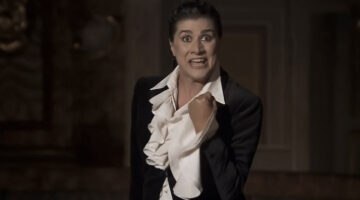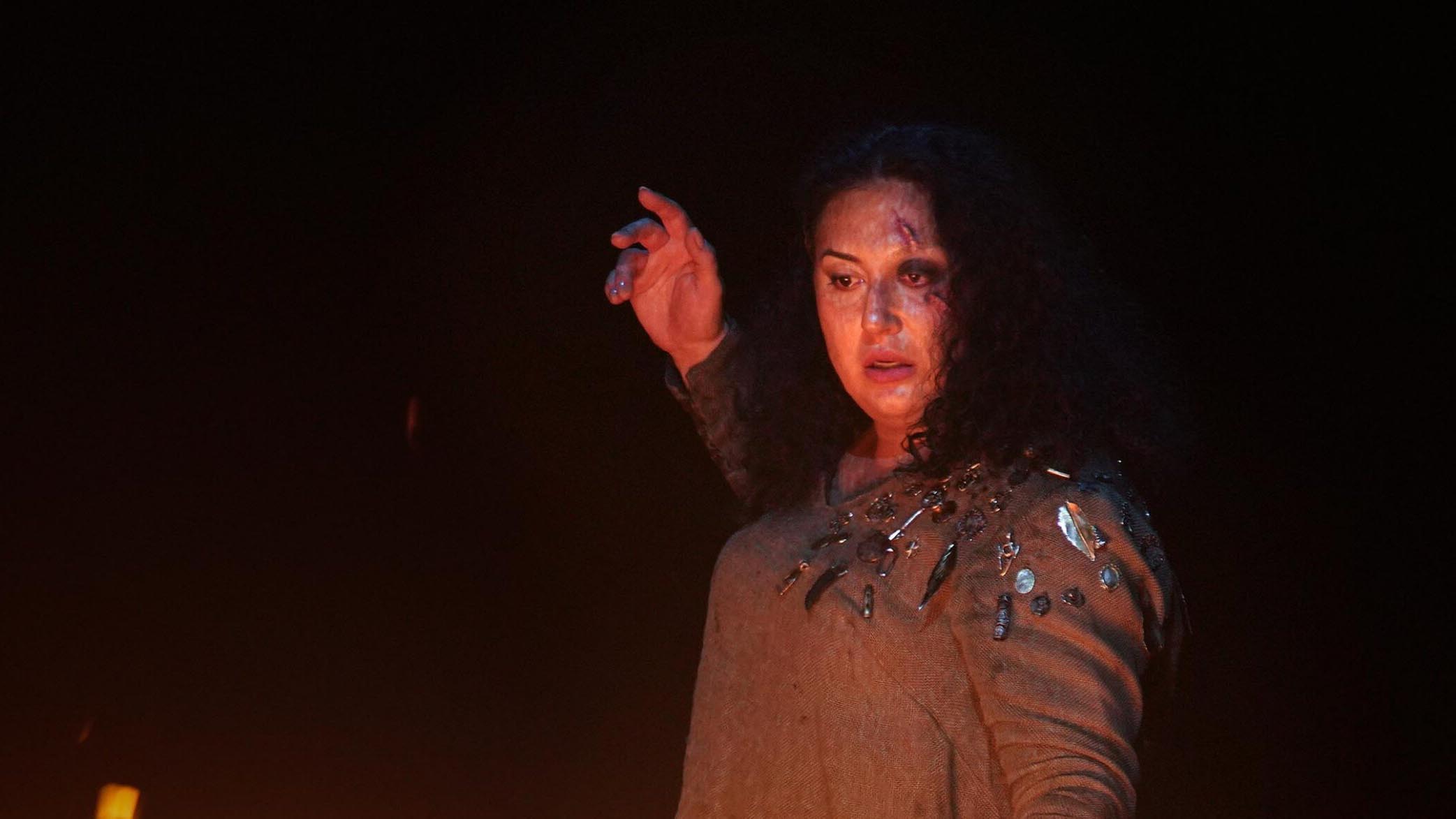
Breaking up is hard to do
Before her one-woman La voix humaine with the New York Philharmonic, Barbara Hannigan talks to Kevin Ng about her career, her artistry, and whether or not there’s a voice on the other line.
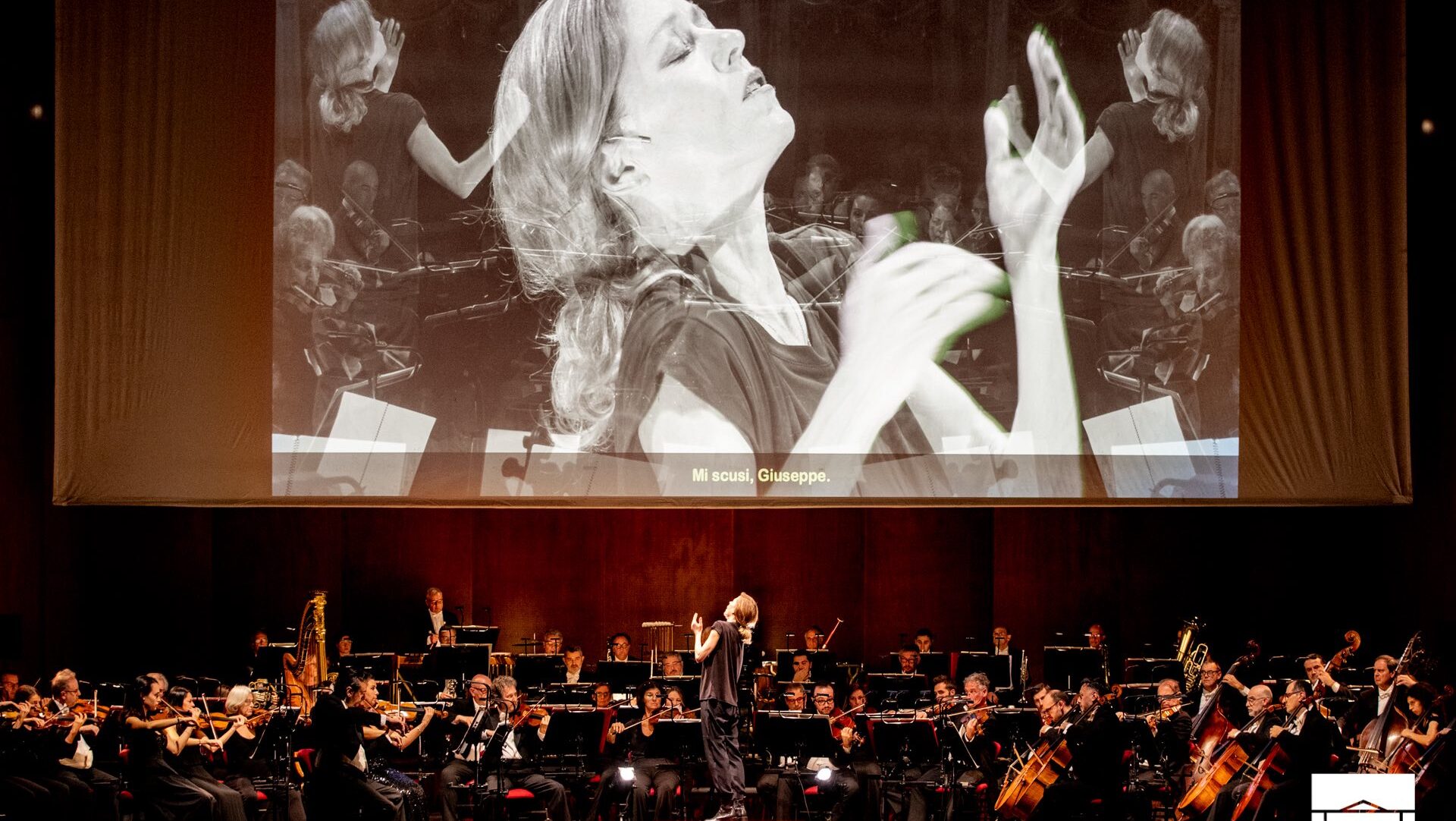
Barbara Hannigan in La voix humaine at Teatro alla Scala / Photo: © Andrea Veroni
“Hello? Can you hear me?” Barbara Hannigan’s voice emerges from my laptop. It’s 11:30 pm in Berlin where I am, and she’s in New York after her first day of rehearsals with the New York Philharmonic where she’s simultaneously singing and conducting Francis Poulenc’s La voix humaine. There’s something oddly fitting about discussing that opera over Zoom. “Sometimes my computer camera does this,” she sighs. “Too bad. I even put on makeup for you.”
Barbara Hannigan is everything to everyone: soprano, conductor, director, muse, mentor, and often at the same time. She’s a gay icon without really understanding why — or so she claims. As she tackles an opera about a woman who controls how the world perceives her, how does Barbara Hannigan herself want to be perceived? “I think a lot about Lulu,” she says, somewhat obliquely. It’s an opera she’s justly famous for, whether in Krzysztof Warlikowski’s high-gloss Black Swan-inspired production or Marthaler’s more austere, abstract take. “The great thing about Lulu is that she doesn’t care what anybody thinks of her. She’s not trying to control anybody’s perception, and she realizes that she has to be true to herself or die — and that’s what’s so infuriating for the other characters.”
This production of La voix humaine features Hannigan as not only soloist, but also conductor and dramaturg. She’s surrounded by a series of cameras that project her image, often in extreme close-up, onto a giant screen. “I first sang the role in Krzysztof [Warlikowski’s production] in Paris, and during that process I kept thinking that this could also work with the orchestra and the screens and the cameras and me conducting. And that’s how it all began, with just this crazy idea of doing it like that.”
But the cameras are active characters rather than passive observers — Hannigan’s Elle is not only aware of but deliberately plays for the cameras and observes herself. “I think it’s a very powerful statement on many levels: on leadership, on the act of performing and rehearsing. But then also dramaturgically, it’s about power, really, and power dynamics in a relationship. And we have all of these levels: relationship to the ex-lover, relationship to the orchestra, relationship to the audience.”
Hannigan first did this production with the Orchestre Philharmonique de Radio France in 2021 and has since toured it around the world. I saw her do it with the London Symphony Orchestra in 2022, where the audience was a surreal mix of women in evening gowns, excited music students, and gay men in leather. She’s just come from a series of performances in Istanbul and La Scala. How does her relationship with the piece change based on her onstage colleagues?
“Whatever presence or excitement you saw in London is simply a very, very intense concentration and empathy. We just had our first rehearsal today, and after the first three minutes everyone realizes that they basically have to sit on the edge of their seat, hold on tight, and just fly. Every orchestra has their own sound and presence, and I don’t try to turn them into a French orchestra.”
“Of course as a conductor,” she adds, “I’m shaping it, but I want to work with what each orchestra has to offer. Every single performance and rehearsal is different. I think that being constrained on the podium with the three cameras is interesting because I have a limited playground, but within that playground I feel like I have a lot of space.”
For Hannigan, conducting and singing at the same time isn’t a party trick: it’s essential to the dramaturgy. “This opera is very much about someone who wants, but doesn’t really have, control. It’s kind of like conducting, you know? The character seems to be going through a breakup, but there’s so much subtext where she talks about how important it is to live a fantasy life, how much more important imagination is than reality, and how important it is to be able to lie. Anybody would certainly question how much of her narrative is true. She might imagine that she’s standing on the podium conducting the New York Philharmonic. She might imagine that she’s Barbara Hannigan!”
Hannigan returned to Warlikowski’s production of the opera two years ago in Naples and premiered a new production by Claus Guth last summer in Erl. How is it to go back to a “conventional” staged production? “In Krzysztof’s production, for example, I play her as an absolutely destroyed woman. My version is a lot more fun — well, it has more humor, let’s say. When I did Krzysztof’s production again, he wanted me to stop being funny! In my production I wanted to keep that humor — it’s the same thing with my Lulu. When people are going through intense situations, they find themselves laughing and they don’t really know why.”
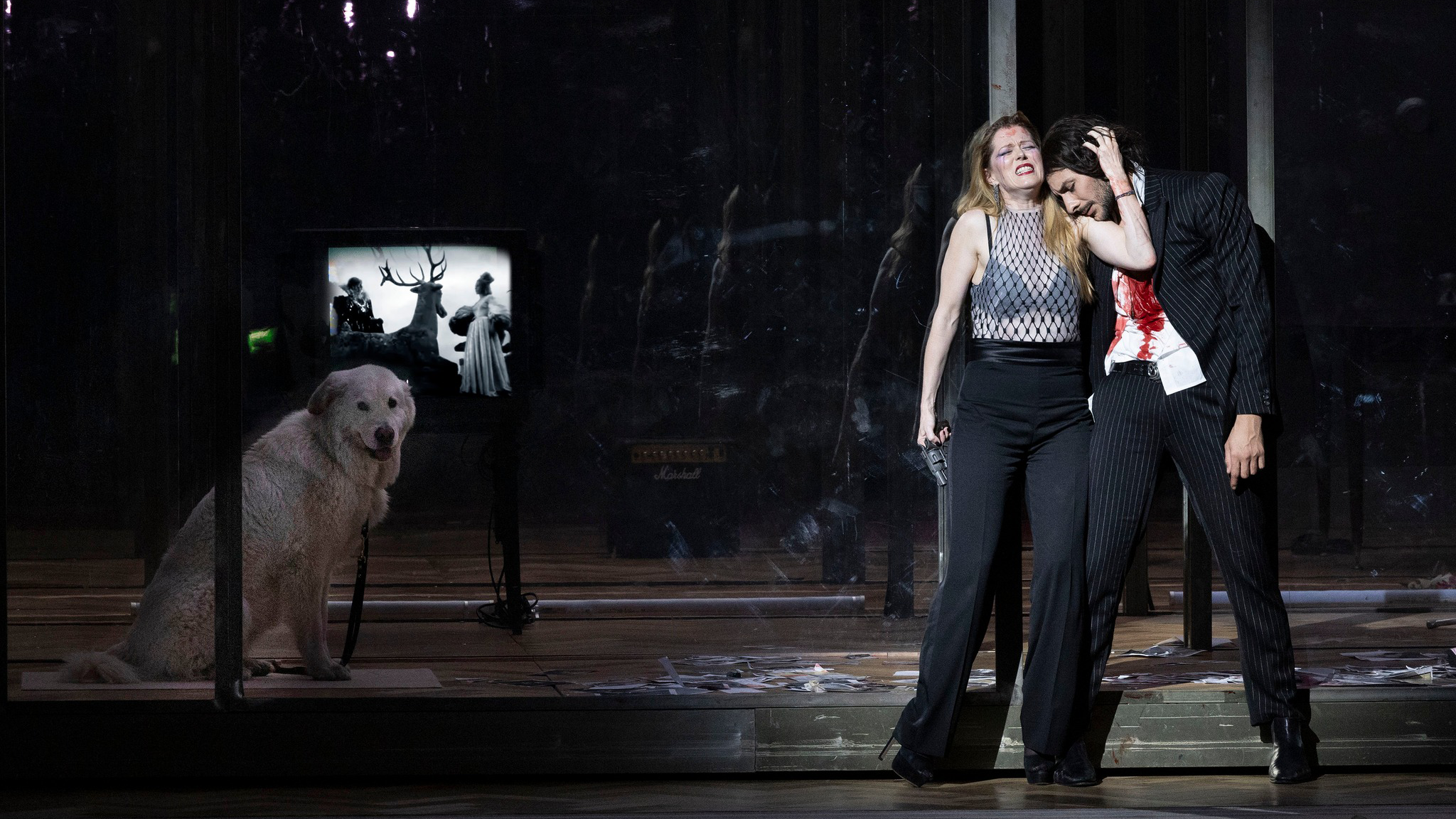
Barbara Hannigan in La voix humaine at the Teatro San Carlo in 2024 / Photo: Luciano Romano
I ask her whether she thinks La voix humaine is misogynistic. “I don’t think it’s misogynistic at all. She’s a person who’s running the full gamut of emotion, and she’s giving as good as she gets. She’s manipulating a lot, but certainly in my dramaturgy we don’t even know if this situation is real. She’s playing. So she’s really, I would say 60-65% of the time, in the power position. I don’t know what you mean by misogynistic.”
I argue that La voix humaine is part of an operatic lineage of male voyeurism and fetishization of women in distress. “Well, okay. I’m not denying what you’re saying. But in my view, it’s perfectly okay to be mad. It would be crazy if she didn’t go mad! Deception, lies, love, loss, isolation, nostalgia, melancholy — I think it’s simply human, and these deep emotions are normal reactions to intense occurrences.”
Poulenc’s score draws upon a range of stylistic influences, from the harmonic and timbral richness of Debussy to the rhythmic precision of Stravinsky to the avant-garde stylization of Satie. Hannigan herself has found success in all of these composers both as singer and conductor — how does she integrate all of these musical lineages? “I think Poulenc is so clear in the score. He basically gives indications for how he wants every phrase to be played, and this is part of his genius. He’s interpreted the text in such an intense way that there’s really not much I need to do apart from what he says. I just have to be very, very deeply inside it.”
Would she ever do the Cocteau play? “Oh yeah, for sure.” How would she play the character differently, freed from the confines of the score? “The thing with the Poulenc is that you have the commentary of the orchestra. And you can ask: is the orchestra the man? Is it her mind? I think it’s her psyche — her disturbed thoughts, her anger, everything she doesn’t dare to say. Sometimes it’s very sweet, and then it’s very violent. I would certainly miss the orchestra, but Poulenc is so emotionally specific that it is its own form of dramaturgical constraint. And I have to keep reiterating: I am not committing to the idea that she’s actually going through a breakup. This could be a person who’s had several relationships and this is an amalgamation of, ‘Oh, I should have said that!’ and, ‘I should have done this!’ Or maybe she’s never had any relationship before. Maybe she’s sitting in her parents’ basement ordering Uber Eats, you know?”
Singer, conductor, dramaturg — Hannigan has done it all, and all at the same time. Are there still any challenges she feels she has yet to take on? “Oh, yeah. I have big wish lists of repertoire and composers I’d like to work with. I just premiered Laura Bowler’s The White Book, based on a text by Han Kang, and it’s an absolute masterpiece. Now we’re talking about an opera that Laura’s going to write with me in the lead. There are lots of irons in the fire, and it’s very exciting.”
Hannigan simultaneously exists within and outside the institutions of opera, contemporary music, and symphony. How does she position herself, both artistically and career-wise? “You know, I’ve always done my own thing. I didn’t have management until I was forty, and I basically just built trust and relationship with colleagues and continue to do so. I simply commit to things I’m instinctively drawn towards, and if I don’t have that instinct I’m not going to do it. It’s like Lulu, what she says about being true to myself, but with a very intense artistic and technical discipline. And in doing so I liberate myself from the industry.”
Freed from the confines of industry pressure, from where does she draw her artistic inspiration? “Everywhere. I get it from society, from nature, from personal relationships, from films. I’m like a sponge. I get it from the news — both good and bad. You know, today an Iranian friend of mine said something about how many times she’s tried to reach her family back home and how many times the telephone call gets disconnected. And that’s going to somehow manifest when I rehearse La voix humaine tomorrow. I’m not going to say anything, because that feels like it would be trivializing my friend’s experience, but I know that I’ll have that at the back of my mind.”
How does she convey that artistic approach and vision to the young musicians she mentors? “We’ve got twenty Juilliard students coming to the dress rehearsal, and I think it’s important for these students to meet me, work with me, and see that you do not have to follow some kind of cookie-cutter path of following this Fach and going to this kind of manager and doing these types of auditions. It’s all about building trust and relationships and having agency within themselves. It’s not for their manager to get them work. And what work, at the end of the day? If they don’t know themselves as artists and aren’t digging and learning all the time, they shouldn’t be going to the practice room! They should be coming to this show, because it will make people open their minds and then go home and practice.”
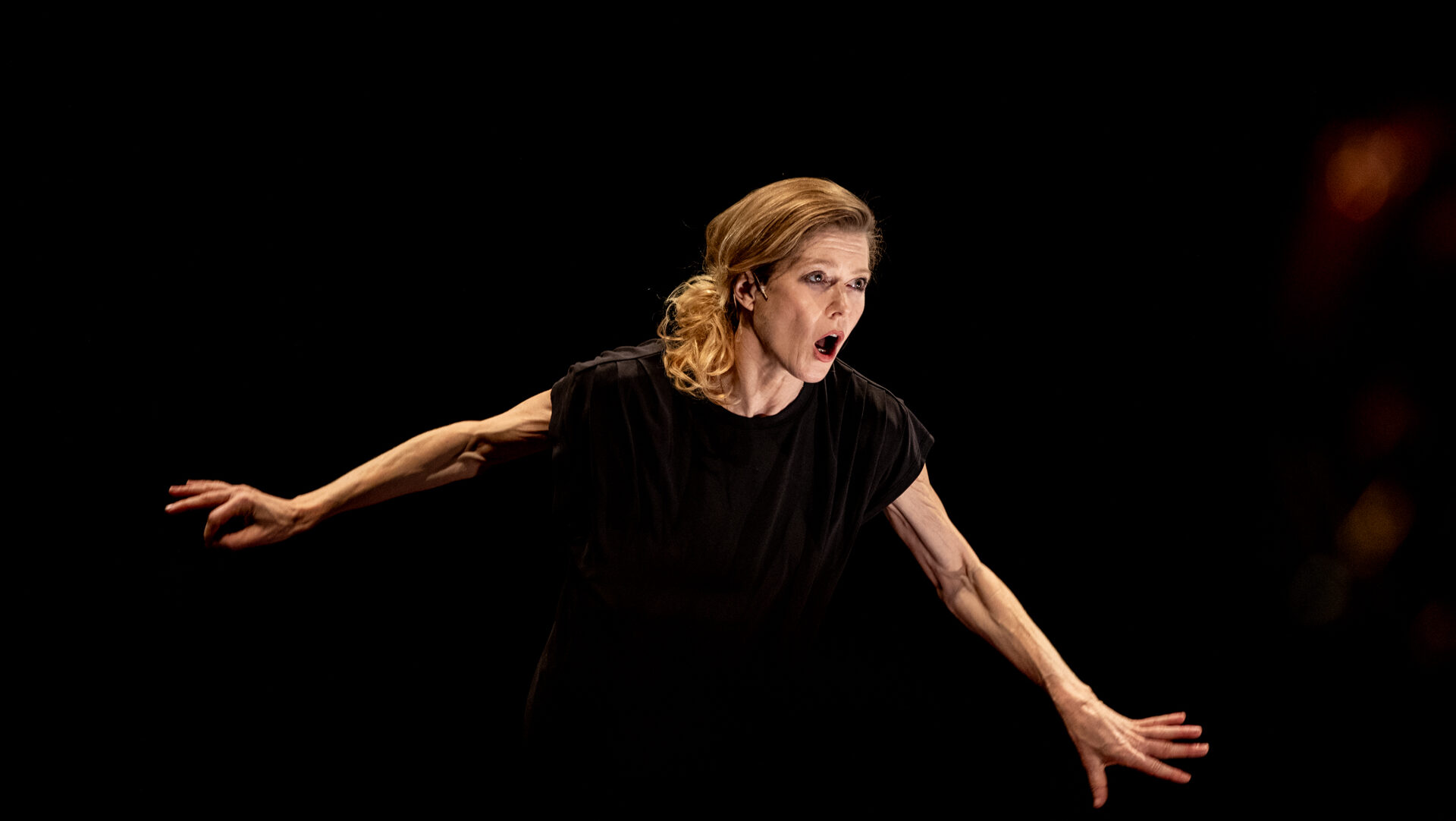
Barbara Hannigan in La voix humaine at Teatro alla Scala / Photo: © Andrea Veroni
And despite her singular aesthetic sensibility and avant-garde credentials, Hannigan manages to be a bankable star. How does she strike that balance without compromising on her artistic ideals? “Well, again, trust and relationships. I’m coming to the New York Philharmonic because Deborah Borda asked what would make me come. I know Deborah because we sat on the jury of the Mahler Competition several times, and it’s those personal relationships that establish trust with orchestras and audiences. I didn’t go to conducting school, but orchestras respond to the authenticity of my gestures and now I’ve been doing it for fifteen years or so. And I have this very particular view on conducting and conductors which I’m also making fun of in this show a little bit. It’s, like, 3%, but it is in there, you know? The power play, thinking they need you, and what do they need you for, really?”
Finally, as a fellow Canadian, I ask Hannigan about her advocacy for arts funding. Her home province of Nova Scotia has recently elected a conservative premier, and a social media campaign to stop the cuts has allied a rather unexpected group of Nova Scotian artists that includes country singer Anne Murray, Oscar-winning production designer Tamara Deverell, and Heated Rivalry author Rachel Reid. What is it about Nova Scotia, with a total population of just under one million inhabitants, that has allowed it to produce so many top-tier artists? “Well, we don’t have a lot of distractions. Each community tends to have something they’re good at, whether it’s the school music program or the soccer team. What we were doing wasn’t very sophisticated, but we had discipline. So when I went to Toronto and then to Europe, I took that discipline and applied it to what I then became interested in artistically.”
What does discipline mean? “For me it’s concentration. And it’s hard to concentrate nowadays, you know what I mean?” Are there parallels with La voix humaine’s relationship between art and technology? “Well, I think anyone watching this production is going to have their own perception and interpretation. For me, she’s playing with the screen, her image, and just trying stuff out. Of course, social media is a great example of that. But I grew up pre-internet and we were with other people and just doing stuff with people, and that’s its own kind of laboratory.”
-
Topics: barbara hannigan, feature
-
People: Barbara Hannigan, Christoph Marthaler, Claude Debussy, Claus Guth, Igor Stravinsky, Jean Cocteau, Krzysztof Warlikowski
-
Works: La voix humaine, Lulu
-
Places & Organizations: Juilliard School, London Symphony Orchestra, New York Philharmonic, Teatro alla Scala, Teatro San Carlo