
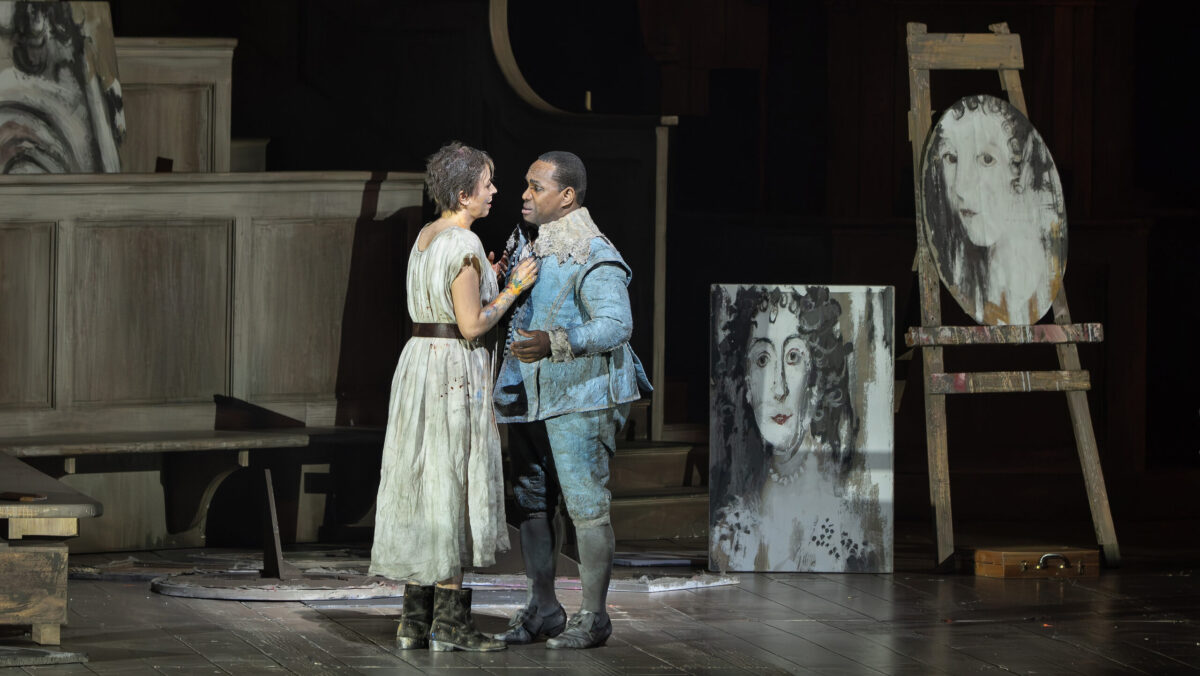
Lisette Oropesa as Elvira and Lawrence Brownlee as Arturo in Bellini’s “I Puritani.” Photo: Ken Howard / Met Opera
Last fall, I undertook the pilgrimage of all pilgrimages for a resident of eastern New England: a visit to Plimoth Patuxet Museums, New England’s premier living history attraction, which re-evokes the original settlement at Plymouth as well as the Wampanoag village it disrupted.
Living history museums, strange as they can seem, are places where documentation and fantasy combine to create present history. At Plimoth Patuxet, I watched a canoe be dug out of a tree, played with a hoop and stick, and overheard a Puritan reenactor recount a recent illness that had her “spittin’ blood and shittin’ blood.” I walked away with a deeper appreciation for the material world of that time, a helpful compliment to the lessons I learned from Schoolhouse Rock videos, and a fervent gratitude for modern-day climate control.
I recalled this experience watching bonneted Puritan maids scurry across the stage during the second performance of Bellini‘s I puritani at the Met last weekend. The story of the Puritans is “intrinsic to the American sense of history in a way that we’ve erased in the UK,” said director and designer Charles Edwards in an interview with Parterre Box ahead of the premiere. “So, it’s actually almost more your story than ours.” A Puritani that is more New England than England, more severe than Romantic? I’m interested.
Yet the modern crusade would emphasize that opera houses, which repeatedly conserve uncritical versions of the same small handful of works, are not, or at least ought not be, museums — not even living history museums. The goal of opera houses is to be more pathetic than didactic. That detail seems to have fully derailed Edwards, whose production is neither completely traditional, nor completely conceptual, nor remotely coherent.
Historical detail hangs around this staging in such a mindless, overly complicated way —through intermittent character doubles, projected historical recaps, and blocky leaflets that miraculously fall from the rafters at the end announcing Cromwell’s pardoning of the Royalists — that one nearly forgets that regardless of the complicated vicissitudes of the English Civil War, none of the action that occurs onstage in I puritani is particularly hard to follow. (Boy and girl are in love, girl thinks she’s being abandoned and loses her mind, girl realizes she wasn’t abandoned, and she comes to her senses again.) With Carlo Pepoli’s lovely poetry being pure, singable echolalia, the work is, as Edwards himself suggested in his Parterre Box interview, a less-is-more opera. But in trying to make the staging historical and conceptual and aesthetically unified, Edwards succeeds at confusing the audience and, so it seems, himself. He goads art and history to duel, but as he is inadept at managing either, the real loser is I puritani.
This idea of “art” is the production’s biggest problem; Edwards heaps his Roundheads with graven images and a designer’s fascination with paint. From the pantomimed overture (featuring young Elvira and Arturo doubles, for your Gelb-era staging bingo card), Elvira is something of an amateur artist whose madness induces her to increasingly experimental and even abstract expressionist renditions of her friends and loved ones. By the time she is fully unhinged, a supernumerary dutifully unveils a series of portraits that run the gamut from Van Dyck to Picasso to Richard Serra to Cecilia Giménez. (These paintings will also be heaped Savonarola-style and doused with what looks like gasoline for Arturo’s funeral pyre.) And at the end of “Suoni la tromba,” Riccardo and Giorgio smear themselves with the St. George’s cross, perhaps suggesting modern-day football fans, but actually looking more like your favorite NSFW Michigan frat boys who know how to party.
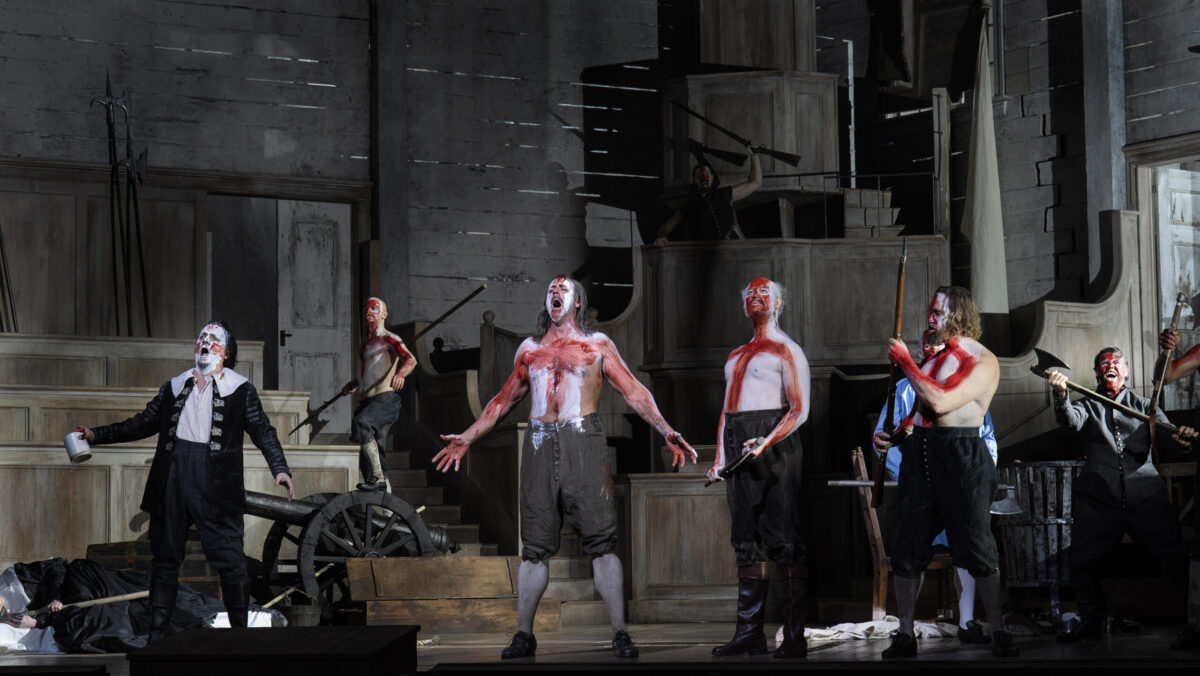
Artur Ruciński as Riccardo and Christian Van Horn as Giorgio in Bellini’s “I Puritani.” Photo: Ken Howard / Met Opera
I think Edwards is onto something by suggesting, through a quirky, artsy Elvira (who emerges at the end with a horrendous pixie cut), that the patina of artistic artifice that distinguishes bel canto opera exists apart from the historical circumstances of its characters and might actually bring their repression into a certain degree of relief. It’s easy (and predictable) to condescend to Bellini and Pepoli in assuming they were so fully oblivious of the apparent mismatch of their virtuosic composition style to their dour subject matter; that Edwards avoids this pitfall is, in its bare-minimum way, laudable.
Edwards designed the sets, too, and the Puritan meeting house unit set looks like if M.C. Escher re-did the House of the Seven Gables. It’s imposing and attractive, yes, but the trapdoors, ‘exterior’ exits that open up to hallways, and, most laughably, a second-story window through which Enrichetta and Arturo make their escape shows just how little a grasp Edwards has over this world of his creation. The picture-perfect, almost entirely greyscale costume designs (by Gabrielle Dalton) might have a second life in a production of Robert Ward’s The Crucible, and Tim Mitchell’s lighting is intermittently evocative and heavy-handed, though shaky follow-spots often dulled the effect of solo moments.
The weaknesses of the production may have been overlooked had Saturday’s performance not been so musically inconsistent, with the two leads obviously under the weather, even though no announcements had been made. Lisette Oropesa, as Elvira, seemed the most compromised. Slower, more legato moments often emerged with a note-perfect evenness, though as the evening progressed, floated notes sputtered and went flat, ascents inconsistently took flight, and the highest notes (E-flats and Fs) turned damp and shrill.
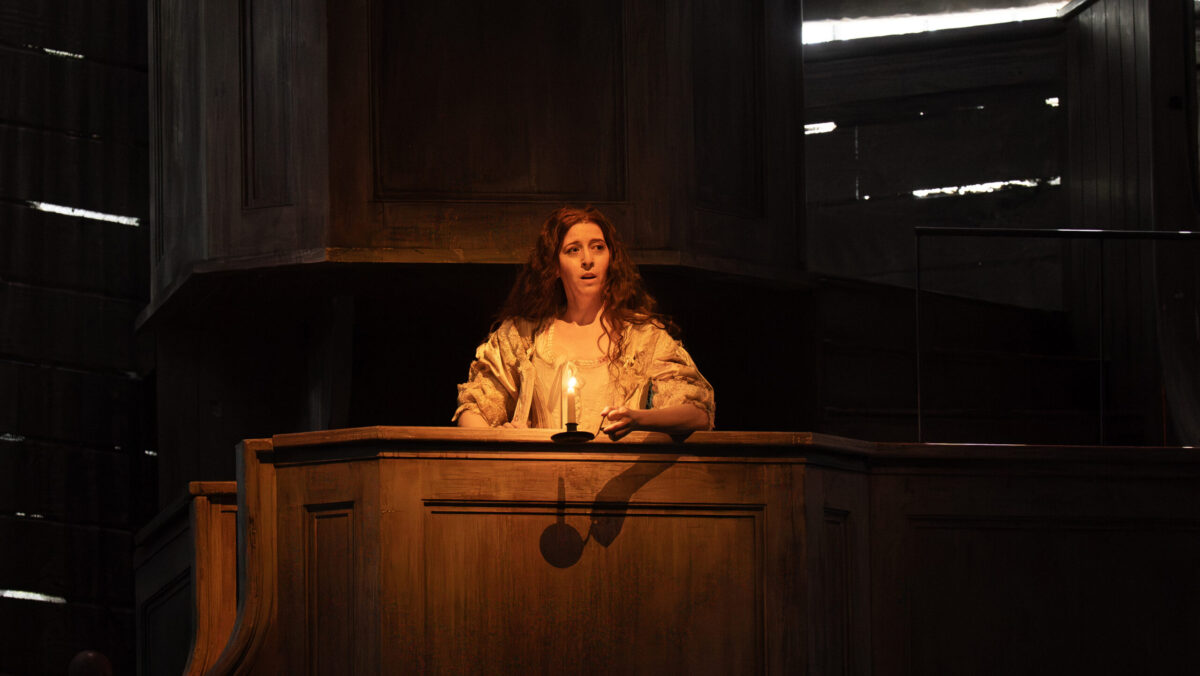
Lisette Oropesa as Elvira in Bellini’s “I Puritani.” Photo: Ken Howard / Met Opera
Yet, whether because of an illness or an evolution in her artistry, there was something notably grittier about this performance. Oropesa has come a long way from the immaculate, tightly controlled lyric coloratura showcases of her earlier career. “Vieni al tempio,” for example, though not quite pristine, showed a refreshing pathos as she pulled more colors from a voice that paradoxically has both milkiness and bite. The same could be said for “Rendetemi la speme;” even if the effects did not all land and the end of the cabaletta had run her ragged, a sense of definition and overall shape to the role nevertheless emerged.
Lawrence Brownlee, a veteran Arturo, sounded steadier; his diction is still the best in the business, the onsets are sooooo clean, and the novelty of hearing a more substantial chiaroscuro sound in such high-flying repertoire never grows old. His high notes, especially at the beginning, like during “A te, o cara,” had a gorgeous pulse, and despite the awkward contortions into which he was obliged at the end of “Corre a valle” (during which a canvas fell over and knocked him in the head), had an unusually satisfying emotional weight. But by the end of “Credeasi, misera,” he, too, sounded fatigued, and the anticipated high F proved to be the only one of his high notes all evening sung with a conspicuous falsetto mix.
The most consistent singing of the evening came from Artur Ruciński as Riccardo, a Puritan leader infatuated with Elvira, who from the very beginning made an impression with “Ah, per sempre io ti perdei.” Phrasing daringly on long breaths and holding the aria’s final G as long as I have ever heard a note held live, he brings a lilting, evenly proportioned baritone voice and an easy sense of style.
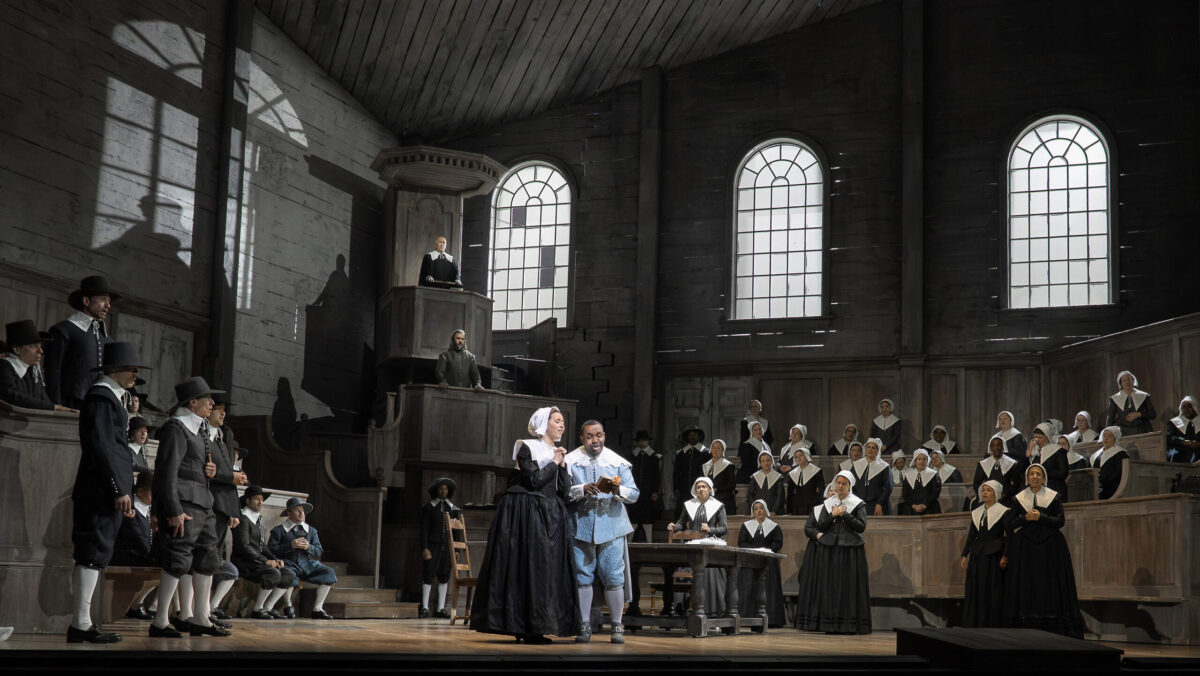
Lisette Oropesa as Elvira and Lawrence Brownlee as Arturo in a scene from Bellini’s “I Puritani.” Photo: Ken Howard / Met Opera
Meanwhile, Christian Van Horn, as Elvira’s uncle Giorgio, made a non-impression, singing with neither legato nor a firm core to his sound. “Cinta di fiori” was completely devoid of style or gravitas, and the lowest notes were barely audible over Marco Armiliato’s largely temperate, balanced orchestra. And tasked with lugging around a briefcase the entire evening (With Elvira’s art supplies? The nuclear codes?) when he wasn’t shirtless and smeared with paint, he seemed exceptionally ill-served by Edwards’s lack of vision. When David Pittsinger opened his mouth to sing the few lines of Gualtiero, Elvira’s father and Giorgio’s brother, one was briefly reminded what a bass actually sounds like.
Fortunately, Eve Gigliotti was a vibrant presence and a secure voice as the fugitive queen Enrichetta whose escape sets the opera’s conflict in motion — such a big and bold stage personality would make for an ideal Azucena. And under Tilman Michael, the Metropolitan Opera Chorus sounds notably more textured, if also notably less cohesive, than it did under Donald Palumbo.
Some, if not all, of Saturday’s inconsistencies may be airbrushed away in next Saturday’s Live in HD presentation. But the fact remains that this much-awaited new production offers not an exciting encounter with the past but a dispiriting view of the Metropolitan Opera’s dismal present.