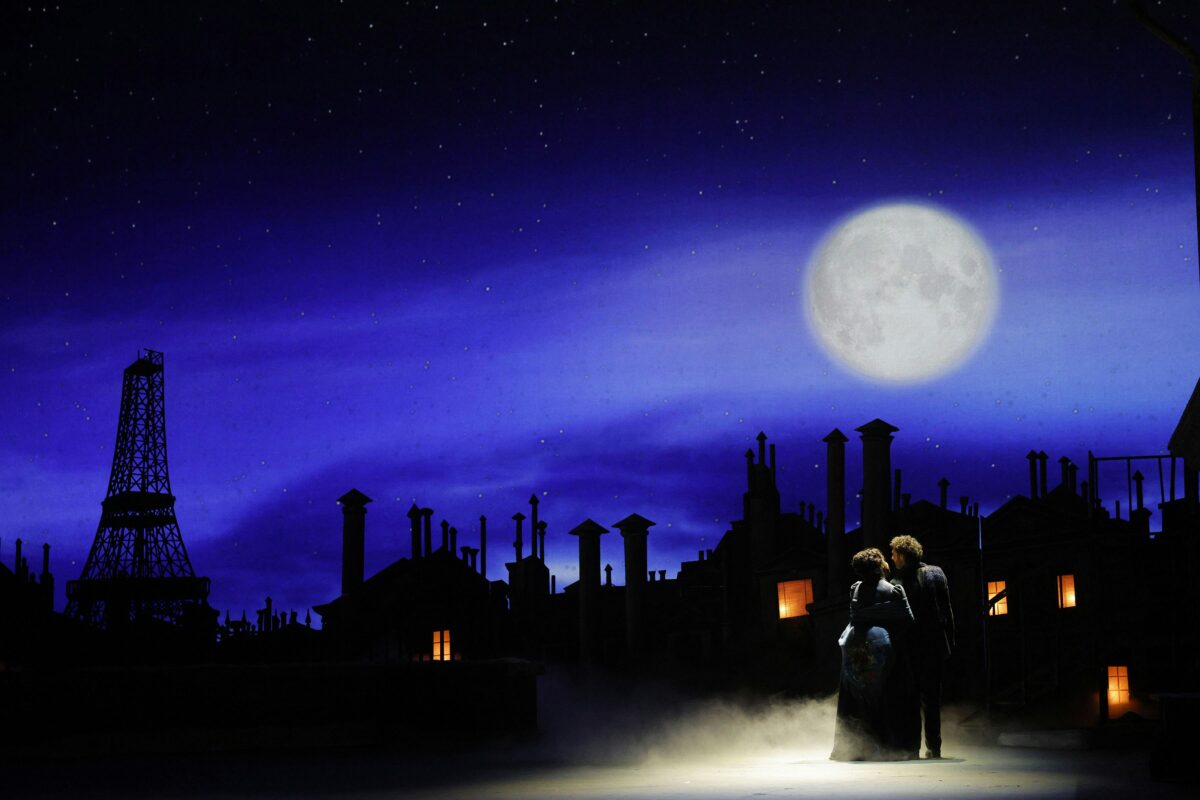
Janai Brugger as Mimi and Oreste Cosimo as Rodolfo in LA Opera’s 2025 production of La Bohème. Photo: Cory Weaver.
Nostalgia filled the air at Dorothy Chandler Pavilion as the Los Angeles Opera (LAO) mounted its eighth revival of the Herbert Ross production of Giacomo Puccini‘s perennial La bohème for the eighth time as part of its 40th Anniversary Season. This classic production, created as the 1993 season opener, was highly beloved by LA audiences—quite an achievement considering LAO had only performed La bohème ten times in its 40-year history, with the other two instances being the Christopher Alden-directed premiere in LAO’s second season, and the short-lived, death-obsessed Barry Kosky staging in 2019.
Seeing this renowned production fresh, there was a lot to appreciate in this completely traditional take, now directed by Brenna Corner, especially in its meticulous execution of every word of Luigi Illica and Giuseppe Giacosa’s libretto. However, I couldn’t help but notice that the production was also beginning to show its age.
Gerard Howland’s detailed two-story garret (complete with a side staircase), Café Momus, and the toll gate at the Barrière d’Enfer immediately transported the audience to turn-of-the-20th-century Paris. My personal favorite was when the garret swung out to reveal a moonlit Paris backdrop, into which the lovers disappear at the end of Act 1— kitschy perhaps, but highly effective. Coupled with Pablo Santiago’s sepia-toned lighting, the entire stage reminded me of the set pieces from another nostalgia-filled film, Woody Allen’s Midnight in Paris!
On the other hand, the screen showing the Paris street scene, decorated with multiple posters at the start of Act 2, looked quite worn, which reduced its impact. More problematic was the large screen used during the somewhat long pauses between acts. While I think the idea of displaying a watercolor image of a Paris street with overlay text describing the actions in between could work, the execution was unfortunately rather poor.
Corner adopted a lighthearted approach in her direction, emphasizing every comedic moment in the script, even bordering on slapstick, especially in the interaction among the four bohemians that opened Act 4. She was fortunate to have a young cast capable of bringing this to life beautifully. The four friends had a real sense of brotherhood (after all, misery loves company!), infusing the entire show with a rom-com vibe. Their rapport lightened the mood, balancing the tragic elements of their lives.
The appeal of any revival, especially one that has been revived many times, is to see the cast. This round featured many LAO debuts—and one US debut! I was most impressed with Korean baritone Gihoon Kim and Chinese bass William Guanbo Su as Marcello and Colline, respectively. Named the 2021 BBC Cardiff Singer of the World, Kim brought intelligence and sensitivity to his nuanced Marcello, a role he has performed from London to Korea. His voice was large and round, and he effectively used a variety of colors to match the scenes, especially in Act 3 with both Mimi and Musetta. He also portrayed a genuine friend and was unafraid to show off his comic timing. Likewise, Su mesmerized as Colline, demonstrating delicious low notes and beautiful phrasing, especially in his little ode to the old coat, “Vecchia zimarra.” His performance in the title role of Handel’s Hercules with the English Concert next year is sure to be a treat.
Italian tenor Oreste Cosimo, making his US debut as Rodolfo, sang earnestly as the poet in love and maintained a strong rapport with everyone on stage. It took him some time to warm up, and he often got drowned out by the orchestra and in ensemble pieces. His “Che gelida manina” was also somewhat choppy in delivery and didn’t quite catch fire. He later improved in the second half, and his scenes with Mimi at the end were heartbreaking. Emmett O’Hanlon completed the quartet with his affecting performance as Schaunard.
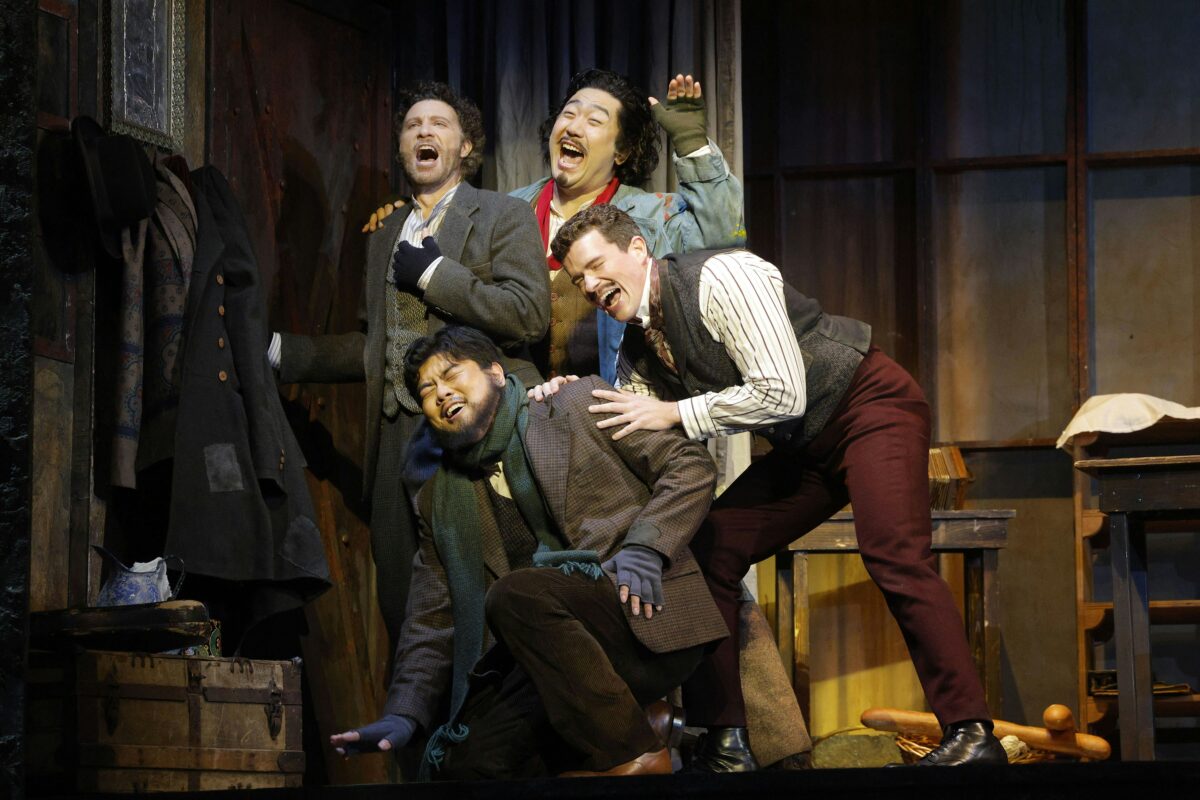
Clockwise from bottom: William Guanbo Su (Colline), Oreste Cosimo (Rodolfo), Gihoon Kim (Marcello) and Emmett O’Hanlon (Schaunard) in LA Opera’s 2025 production of La Bohème. Photo: Cory Weaver.
The two sopranos, both LAO veterans, served as a study in contrasts: one darkish and velvety, the other bright and shimmering. Janai Brugger made her role debut as Mimi, having previously sung Musetta in the same production in 2012 and 2016. I felt her voice had darkened considerably since I last heard her, with a warm, velvety middle register that was very alluring. She had no trouble projecting above the orchestra, even during the loudest moments. However, she wasn’t a timid Mimi; hers was full of confidence from the moment she knocked on Rodolfo’s door. Erica Petrocelli’s Musetta also projected confidence, infusing the role with equal parts sassiness and kindness, whether in Musetta’s Waltz or the little prayer in the last act. Her bright tone also complemented Kim’s well, making their quarrel at the end of Act 3 nearly overshadow the principal pair!
Veteran Rod Gilfry showcased his comedic skills in his 36th role with the company (more than anyone else!) as Benoît/Alcindoro. Current Domingo-Colburn-Stein Young Artist Program member Nathan Bowles stole the scene with his booming voice as Parpignol, the toy seller.
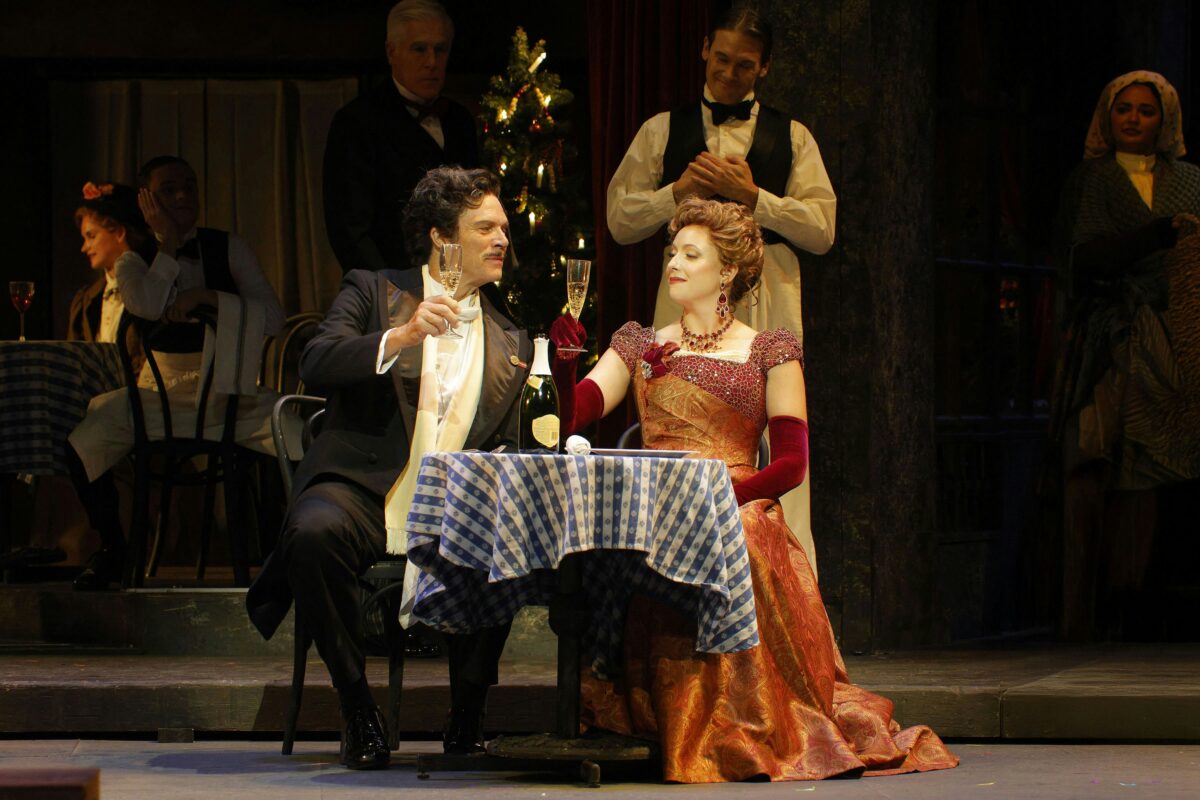
Rod Gilfry as Alcindoro and Erica Petrocelli as Musetta in LA Opera’s 2025 production of La Bohème. Photo: Cory Weaver.
Resident Conductor Lina González-Granados led the LAO orchestra in a lively and energetic performance. She chose brisk tempos that matched the stage action and helped move the story forward. She generally supported the singers and choir well, although at times I wished she had attenuated her dynamics. Jeremy Frank prepared the chorus well enough for them to play a significant role in the overall performance.
Judging by the loud cheers and enthusiastic applause from the audience at the end, I believe that tradition and nostalgia are still alive and celebrated at the Dorothy Chandler Pavilion. After all, isn’t that what watching La bohème is all about?