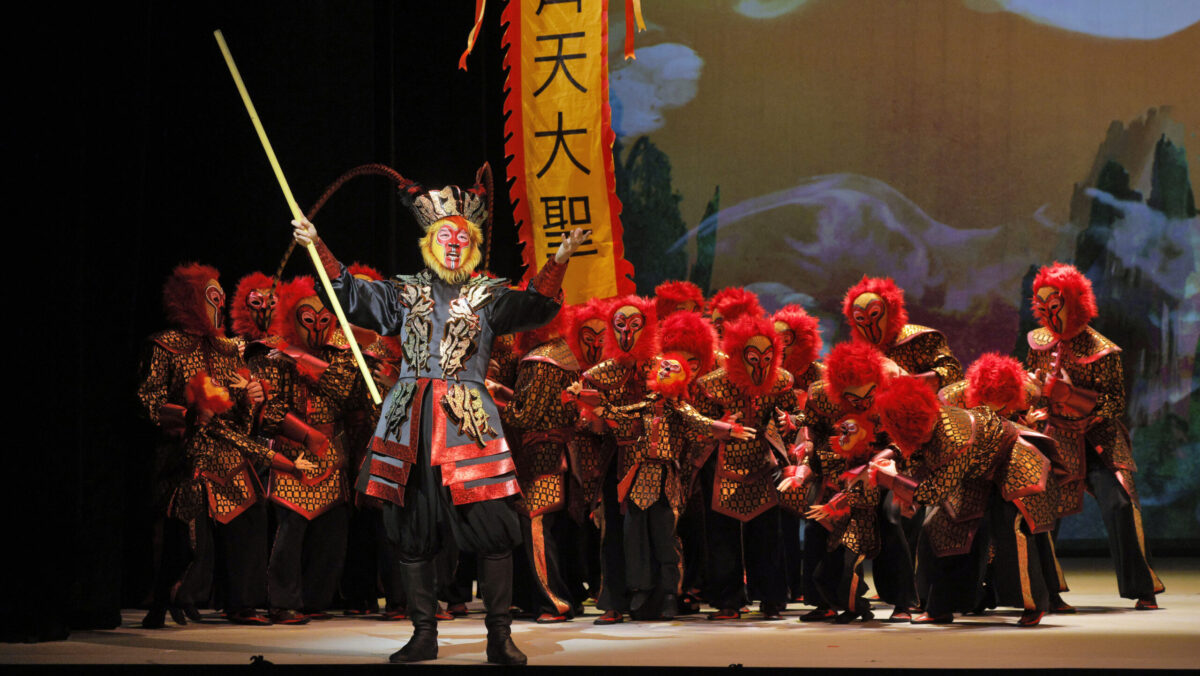
Kang Wang as the Monkey King with members of the San Francisco Opera Chorus in Huang Ruo and David Henry Hwang’s “The Monkey King.” / Photo: Cory Weaver/San Francisco Opera
The San Francisco Opera (SFO) concluded its extraordinary Fall 2025 Season – which included a radiant Rigoletto, a moving 25th Anniversary revival of Dead Man Walking, and a transcendental Parsifal– on a high note with outstanding performances of composer Huang Ruo and librettist David Henry Hwang’s newly commissioned The Monkey King. The new opera premiered on 14 November (and was seen during the fifth show on Saturday, 22 November), and it quickly became one of SFO’s most successful commissions, selling out the entire run!
The Monkey King exemplifies SFO’s strong commitment to engaging with Asian and Asian-American communities and building connections with Chinese opera houses in order to “take advantage of that country’s explosive interest in the artform” as the company continues to face financial challenges. A key aspect of their strategy is to present Chinese works on stage, a process that began with SFO-commissioned Bright Sheng and Hwang’s Dream of the Red Chamber in partnership with The Chinese Heritage Foundation of Minnesota (which also co-sponsored The Monkey King). Dream of the Red Chamber received its world premiere at the War Memorial in 2016 and was revived in 2022 following an extended tour in Hong Kong and mainland China.
In San Francisco itself, there’s no escaping The Monkey King. Ever since it was announced in February last year, SFO’s marketing team has gone into overdrive, producing numerous articles about the piece, placing ads on Muni buses and trains, and flying banners promoting the opera all over the city. SFO even created a dedicated The Monkey King Giving Circle, whose donors included tech luminaries such as Jerry Yang and Joe Tsai. Little wonder that all performances have been completely sold out, and they have raised over three million dollars in philanthropic support. And the company even engaged Lion Dance ME, “the best lion dance team in the West,” to perform a demonstration before every showing of The Monkey King. May this level of community outreach become the standard moving forward!
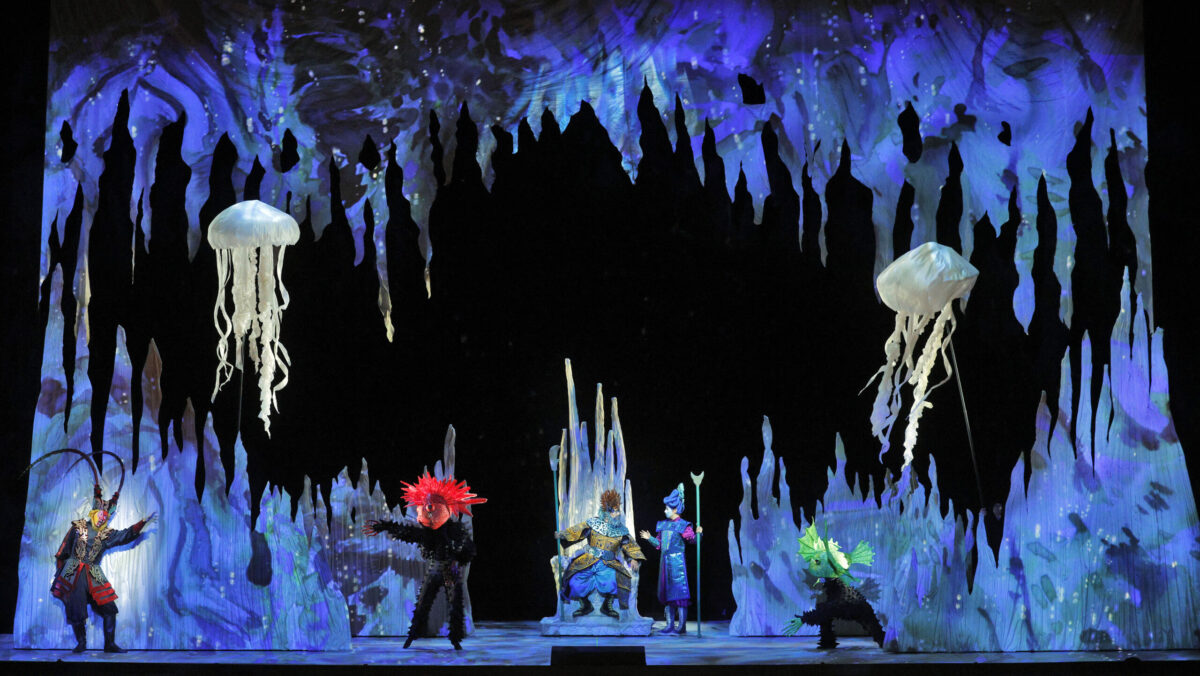
The Dragon Palace of the Eastern Sea in Huang Ruo and David Henry Hwang’s “The Monkey King.” / Photo: Cory Weaver/San Francisco Opera
The Monkey King is the eighth new work to premiere under General Director Matthew Shilvock’s guidance and it exemplifies his commitment to work of artistic excellence and social significance. Indeed, excellence is also the name of the game for SFO’s production of The Monkey King. The story is based on the first seven chapters of Journey to the West, a highly regarded 16th-century Ming dynasty novel attributed to Wu Cheng’en. Journey to the West is considered one of the Four Great Classic Novels, a collection of the most beloved stories in pre-modern Chinese literature (some of the world’s longest and oldest novels), along with Romance of the Three Kingdoms, The Water Margin, and, yes, Dream of the Red Chamber. Since Journey to the West has 100 chapters, creating a complete operatic adaptation of the novel will undoubtedly be a challenge, so much so that Ruo playfully considered The Monkey King “the beginning of his Ringcycle!”
Much has been written about The Monkey King since its world premiere on 14 November, as it received widespread acclaim from critics like Joshua Kosman and Lisa Hirsch and rave reviews for both the score and the production. For Parterre Box, I choose a different approach and would like to share what the piece and the production personally meant to me, as someone who grew up with this story and is also a Chinese-descended immigrant chasing the American dream.
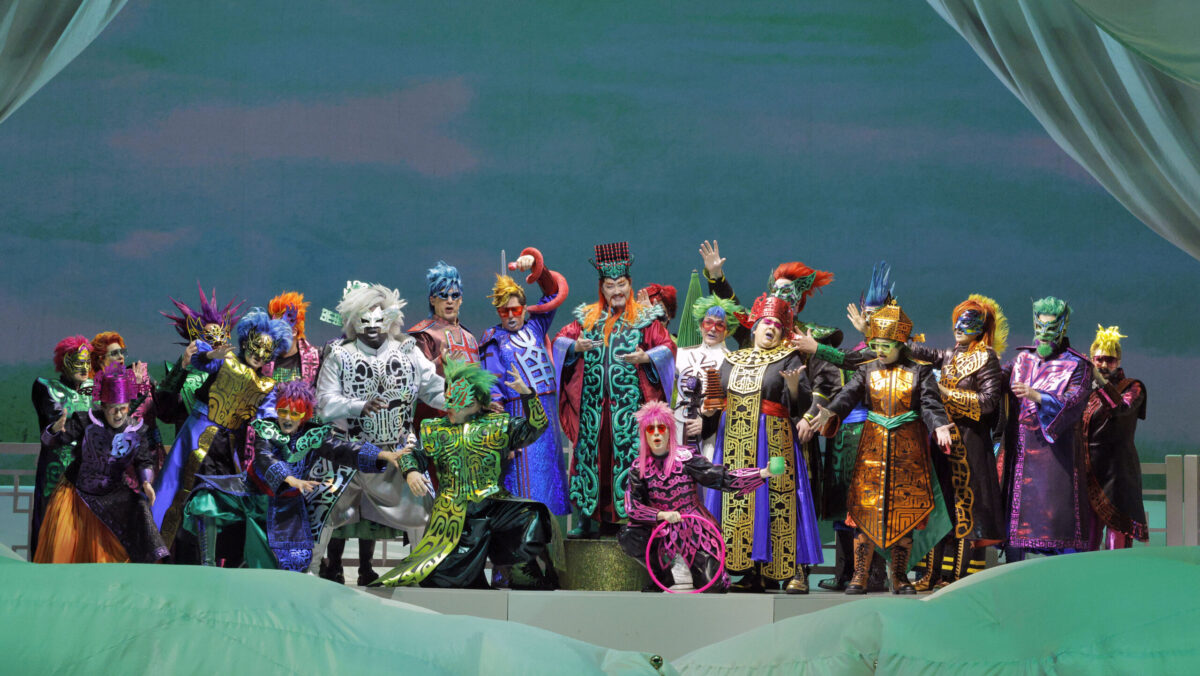
Konu Kim as Jade Emperor (center) with members of the San Francisco Opera Chorus in Huang Ruo and David Henry Hwang’s “The Monkey King.” / Photo: Cory Weaver/San Francisco Opera
Long before the age of superheroes, in China and throughout Southeast Asia, Sun Wukong, also known as the Monkey King, evolved from a literary character into a cultural icon, inspiring numerous reinterpretations and countless stage productions, movies, TV series, and even video games. By focusing solely on his story—framed by his imprisonment beneath the Five-Element Mountain for 500 years and his eventual release after attaining enlightenment (the entire story is told as a flashback from the day he was born from a stone)—the opera draws parallels to Parsifal with the “innocent fool” embarking on a similar journey of transformation toward enlightenment.
Nevertheless, Hwang’s libretto adds much more complexity to the character; more than just being an arrogant trickster, Wukong’s defiance comes from a survival instinct for both himself and his “children” (his tribe of Monkeys), whose existence was threatened because they are “different.” This was especially clear in how the gods in Heaven (dressed in kaleidoscopic colors by Anita Yavich to resemble “Valhalla-from-the-East” gods) treated Wukong. It was only later that Wukong became so self-absorbed and arrogant, leading to his own downfall at the hand of Buddha and serving as a cautionary tale of how the oppressed can easily become oppressors.
In an interview, Ruo rejected the “East meets West” label and instead described his music as what he called “dimensionalism,” a third culture emerging from the blending of the two. In The Monkey King, Ruo’s tenth opera, this idea reached full display in a soundscape that was unmistakably Ruo’s—not a Western orchestra trying to sound “Oriental.” It was, truly, his “magical Kung Fu opera.” Every element, including the pipa and the Indonesian button gongs (which began the score after the opening sutra chanting), felt essential to the piece, not just some superficial ornamentation. Debuting conductor Carolyn Kuan, a frequent collaborator with Ruo, was a tremendous asset in this regard, guiding the score confidently and maintaining the music’s propulsive drive to match the actions of the title role.
Ruo’s music evoked deep nostalgia in me. The chanting of the Diamond Sutra that filled the score (SFO Chorus at their best!) brought back memories of a Buddhist temple I used to pass by; I could almost smell the burning incense in my mind! The lively orchestral sections, including the battle scenes, reminded me of music from various TV shows and comic series. My mom is a big fan of the goddess Guanyin; seeing her highly honored as a protector and treated with the utmost respect in the production truly warmed my heart. The always excellent Mei Gui Zhang delivered a tender and caring portrayal, impressively singing from her floating golden lotus while teaching Wukong (and the world, practically) the importance of letting go.
I wasn’t prepared for Wukong’s powerful Act II aria, “In the Land of Bliss,” as it completely overwhelmed me. The song is truly an immigrant’s anthem, expressing the pursuit of a better life where one is weary of the families and friends left behind and anxious about the future in the “promised land.” Styled as an 11 o’clock number as in musical theater with soaring melodies and stirring accompaniment, the aria was performed by debuting tenor Kang Wang with jaw-dropping intensity that seemingly froze the moment in time!
Wang was indisputably the star of the show; not only did he give Wukong gravitas with the dark timbre of his voice, but he also fully immersed himself in the role, from the carefree mannerisms to the pompous boasting, creating a complete personification. He was equally skilled at performing tricks (guided by Peking Opera specialist Jamie Guan) as he was at delivering profound moments like the one above. Director Diane Paulus successfully cast the role into three manifestations: a singer (Wang), a dancer (Huiwang Zhang), and a puppet, all beautifully brought together by Ann Yee’s choreography and Basil Twist’s puppetry to form a cohesive portrayal of the shapeshifting deity. The transitions among the three on stage were so smooth and effortless that they reflected Wukong’s fluid motions, just as I always remembered him!
Fluidity also served as the guiding principle for Twist’s set designs. To be honest, when this $10-million production by Paulus and Twist was announced, I was a bit skeptical, fearing it might be overly gimmicky. To my pleasant surprise, Paulus directed it with great restraint, relying heavily on Hana S. Kim’s projections and Ayumu “Poe” Saegusa’s stunning lighting to emphasize the whimsical and mystical aspects of the story. Likewise, Twist used lots of silk – as backdrop curtains for the projections, as mountains, as ocean waters, and in a miraculous feat of stage wizardry, as the Heavenly horses! I appreciated the fluid onstage environment, as it not only made scene transitions (five scenes and a prologue in Act I, and three in the following Act) smooth and efficient, but the combination of projections and music also created an animated, graphic novel-esque feel.
SFO assembled an exceptionally talented cast for The Monkey King, including some veterans from the 2022 Dream of the Red Chamber revival. In the dual roles of Master Subhuti and Buddha, Jusung Gabriel Park brought a sense of solemnity and dignity, varying his tone to convey earthy authority as the former and ethereal wisdom as the latter. Similarly, baritone Joo Woon Kang and mezzo Hongni Wu made a thoroughly satisfying distinction between their roles in the oceanic Dragon Palace (as the outsmarted Dragon King Ao Guang and his Crab General) and, especially, inside the Jade Emperor’s Palace (as the Jade Emperor’s nephew Lord Erlang and Venus Star). Wu’s devious delivery and Kang’s bratty, confrontational temperament would surely make the powerful monkey angry!
Konu Kim transitioned from a remorseful, spoiled brat Bao Yu in Dream of the Red Chamber to a spineless leader, the Jade Emperor, which he played with glee. His scene begging Guanyin’s help after Wukong trashed Heaven and promising to change was particularly memorable (and reminiscent of the actions of many politicians in recent years). Beside him was Peixin Chen’s Supreme Sage Laojun, whose Machiavellian plans went awry. Chen, who impressed in his SFO debut as Sparafucile in last September’s Rigoletto, imbued the role with nobility, the dark tone of his voice betraying the malevolence of his schemes.
If you have read this far, you should know exactly what this opera means to me by now. The Monkey King is truly a monumental achievement for SFO, and I hope its success will open more opportunities for such transformative, interdisciplinary commissions and co-commissions in the future.