Cory Weaver/San Francisco Opera
Richard Wagner once called Ludwig van Beethoven’s Seventh Symphony “the apotheosis of the dance.” Similarly, the San Francisco Opera’s new production of Wagner’s final opera, Parsifal, which premiered on Saturday, October 25th, after 25 years, can be seen as the pinnacle of theater — a performance so captivating in every aspect that it drew the audience into the ritual of “enlightenment through compassion.”
Wagner saw Parsifal not just as an opera but as a Bühnenweihfestspiel, or stage consecration festival play. He loosely adapted Wolfram von Eschenbach’s 13th-century Parzival and Chrétien de Troyes’s 12th-century Perceval ou le Conte du Graal into a spiritual—even religious—journey for redemption and salvation. Scholar Paul Schofield argues that even though Wagner used Christian, Buddhist, Hindu, pagan, and mystery religion symbols in Parsifal, it wasn’t meant to “convert” anyone but rather to reveal the “universal truths.” It’s no surprise Wagner wanted to keep Parsifal exclusive to the Bayreuth festival (out of fear it would become “mere amusement”) until the Metropolitan Opera staged it in 1903.
This Parsifal had been a personal endeavor for General Director Matthew Shilvock since he took the helm ten years ago and in Matthew Ozawa he has found an ideal director. With this production and his previous one for San Francisco Opera, the captivating 2022 Orpheus and Eurydice, young Californian director Matthew Ozawa quickly established himself as one of the most promising emerging American directors working today. Ozawa views his Parsifal as a sort of continuation of his approach to Orpheus, where the “meditation on grief and renewal” in Orpheus deepened in Parsifal and became an “emotional terrain of suffering, spiritual longing, and the redemptive power of compassion.” He achieved this by adopting a “multicultural theatrical language—drawing from both Western and Eastern traditions, as well as diverse religious rituals and movement practices.”
Cory Weaver/San Francisco Opera
Ozawa successfully blended all those diverse influences into his vision, delivering a solid, coherent, and well-crafted presentation to the audience. However, his greatest strength was his belief in his creative team, as reflected in his illuminating Director’s Note, where each team member— including choreographer Rena Butler, set designer Robert Innes Hopkins, costume designer Jessica Jahn, and lighting designer Yuki Nakase Link (all except Hopkins also worked on Orpheus)—passionately shared their own perspectives on the piece. Every one of those elements truly came to life on stage, like a well-oiled machine that undoubtedly required countless rehearsals, and it was marvelous to witness the passion and dedication of everyone involved.
Hopkins designed the world of Parsifal using the simplest elements: double turntables stacked and spinning in opposite directions. A series of wooden pieces was placed on each turntable, serving as both the tree trunks (with leaves made of rope) and the walls of the Temple of the Grail (with the framing of the Temple’s ceiling dropping from above) in Acts I and III. A platform was set in the center of the inner turntable, creating the main action area. A giant checkerboard backdrop with an upside-down triangle in the center marked Klingsor’s domain. The straightforward set pieces provided a much-needed contrast to all the movement happening on stage.
Nevertheless, those rotating wooden pieces had their moments to shine during the Verwandlungsmusik(Transformation music) in Acts I and III, where the spinning stacks and descending ceiling frames were synchronized with the music, led by Eun Sun Kim in a powerful rendition. This created a kind of unbelievable stage wizardry that was truly jaw-dropping. Hopkins mentioned above that he listened to that particular music 100 times during the design process! When I think of those moments, Anton Bruckner, who idolized Wagner and whose music is often called “the cathedral of sound,” comes to mind – I never really realized how Brucknerian that score was!
Cory Weaver/San Francisco Opera
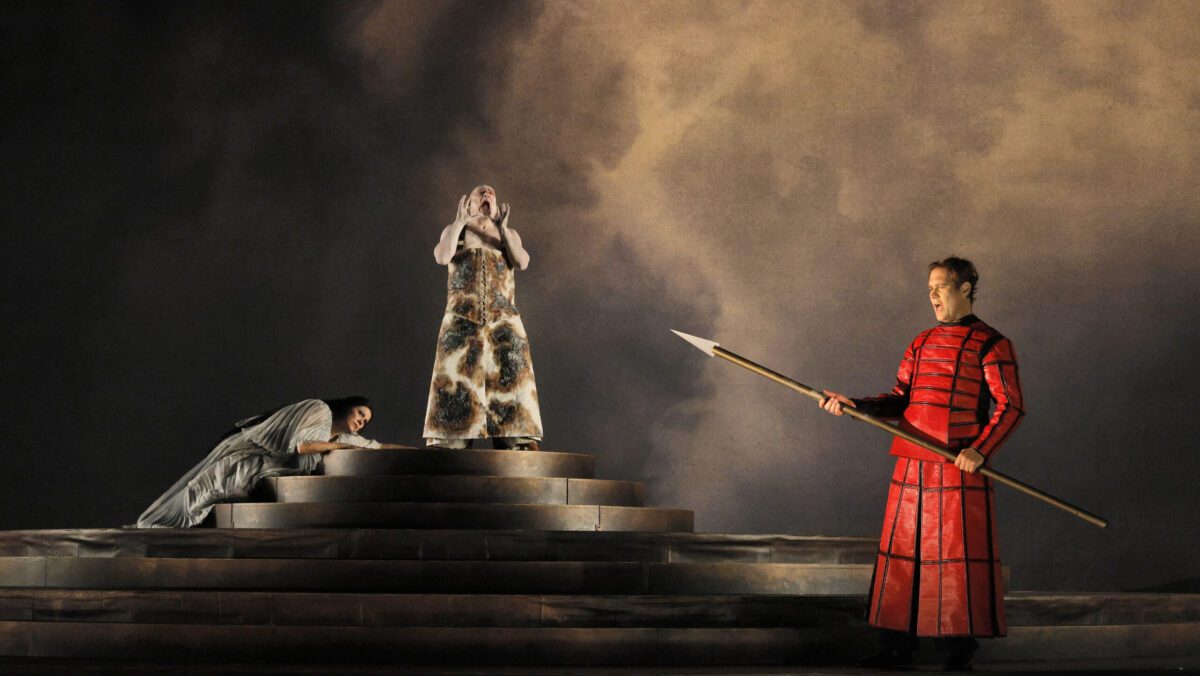
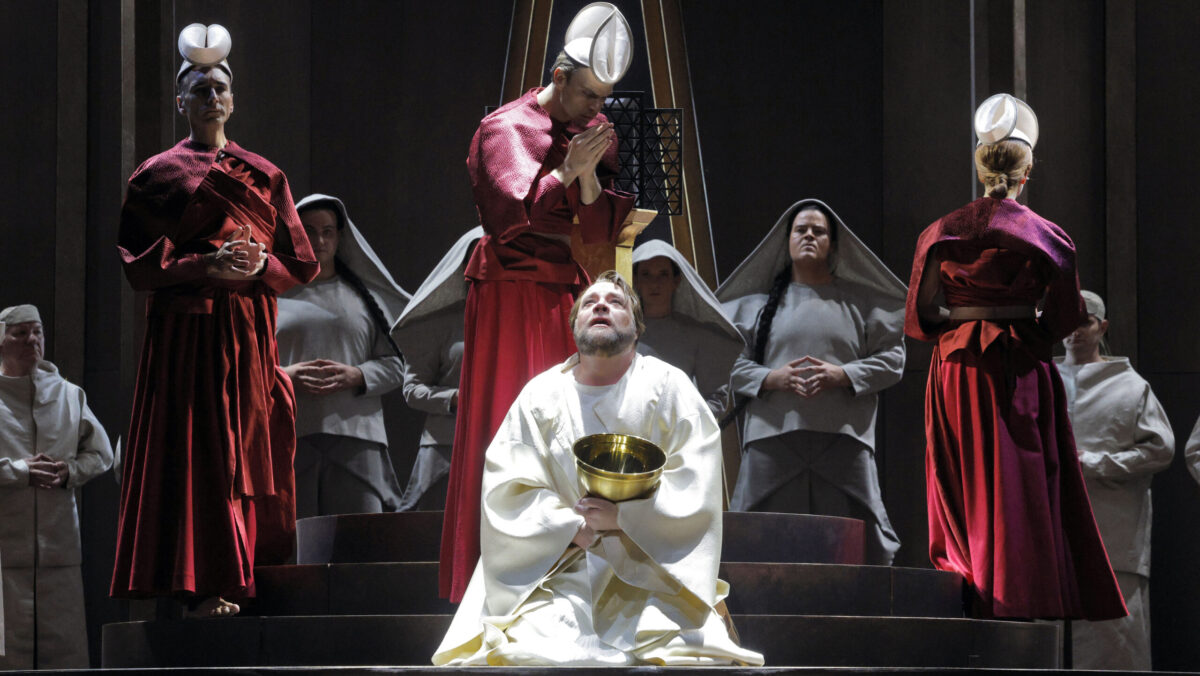
Dance is probably the last thing on anyone’s mind when they think of Parsifal. However, in this production, dance and movement in general became the heartbeat, serving as the “vessel for ritual, reflection, and transformation,” as Butler described. She drew on Japanese Butoh dance and Noh theater’s Jo-ha-kyū movements, especially for Amfortas and the Knights of the Temple of the Grail (whom Jahn also dressed in Noh theater’s pearl-white, adjacent costumes), giving the entire Temple of the Grail a distinctly “Oriental” feeling. Similarly, Gurnemanz was also clothed in a monk’s getup, complete with a Bodhi seed mala.
There were two moments when Ozawa and Butler introduced new characters to enrich the dramaturgy. First, they assigned three dancers (wearing bright red costumes with white hats resembling fortune cookies) to represent Amfortas’s wound, dancing around the altar as Amfortas revealed the Holy Grail and nearly disrupting the procession. The dancers helped energize a scene that was usually very static and church-like. Additionally, Butler and Ozawa skillfully used dancer Charmaine Butcher to develop a backstory for Parsifal’s Mother (Herzeleide), who lovingly and gracefully embraced Parsifal while Kundry narrated his family history. Notably, Jahn dressed both Kundry and Herzeleide in identical costumes, foreshadowing the ending. (More on this later.)
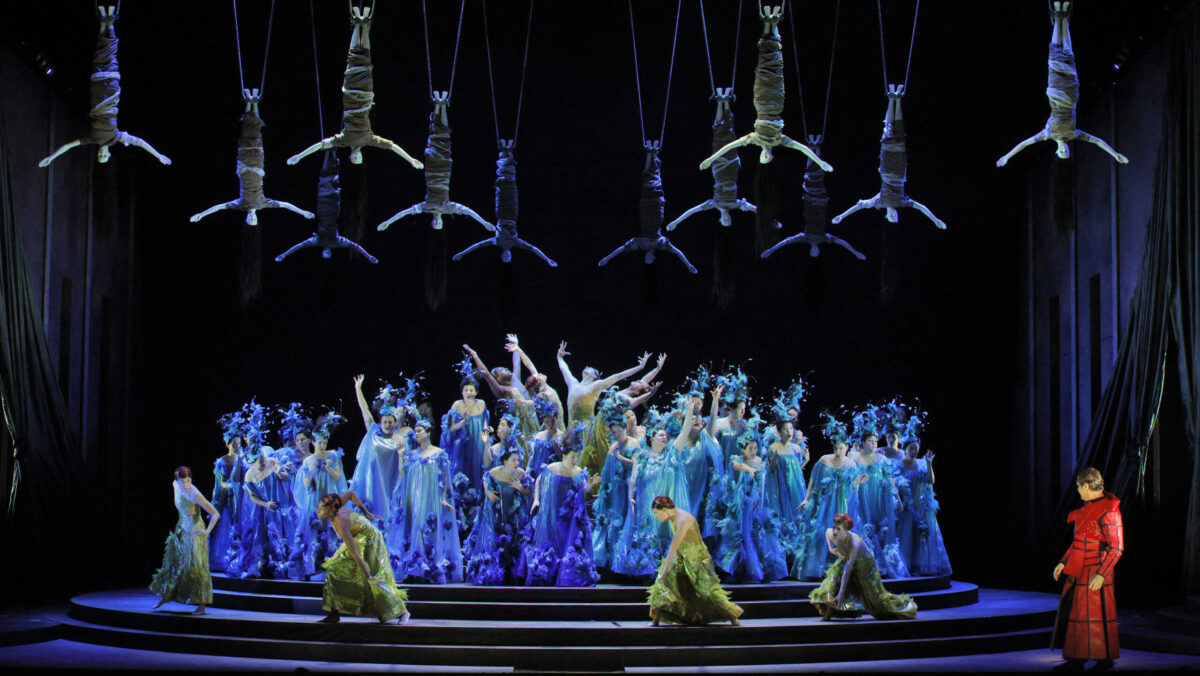
Jahn’s costumes came to life in the second Act when she arranged the flower maidens, chorus, and dancers in various shades of blue, green, and yellow, complete with matching flowery headgear. It created one of the most beautiful flower maiden scenes in recent memory. Mind you, a couple of upside-down Kundry mannequins were also hanging from the ceiling to remind the audience that, despite the beauty, it was also Kundry’s nightmare world!
Cory Weaver/San Francisco Opera
Wagner indicated for specific lighting in his libretto, especially during the unveiling of the Grail. Link paid close attention to this in her lighting design, with radiant sunlight illuminating the Grail’s pedestal and heightening the moment’s solemnity. However, I was most struck by the soft sepia tone that filled the stage at the start of Act III, which conveyed the story of past years even before any words were spoken.
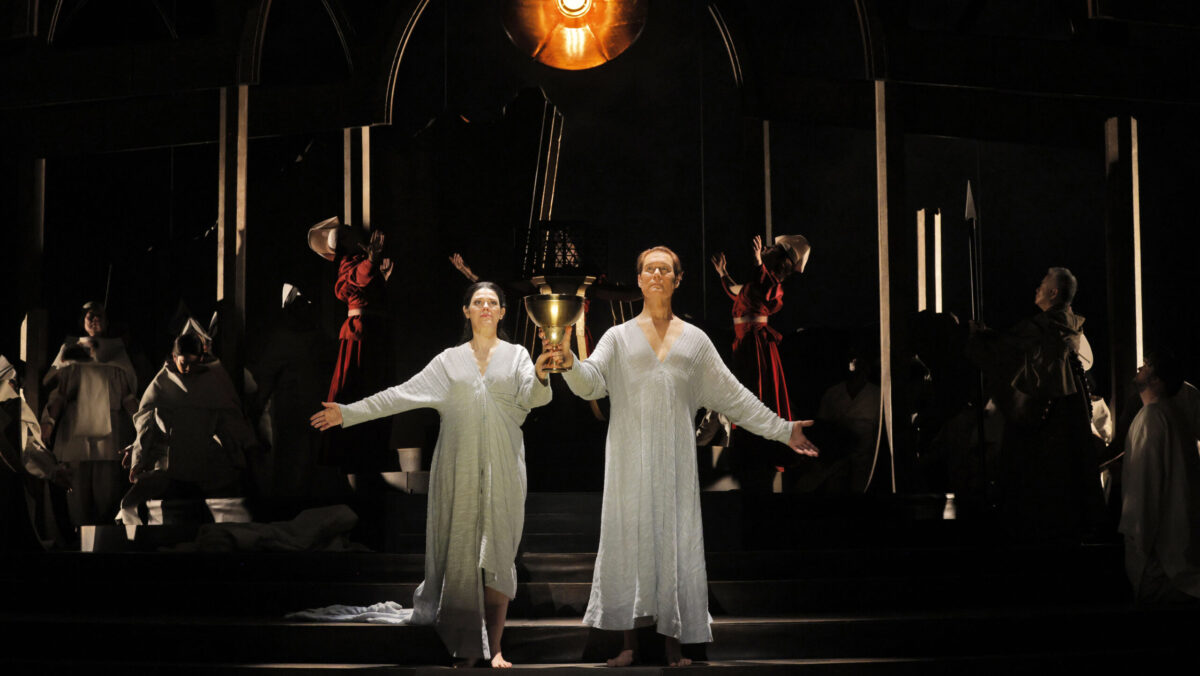
While Ozawa aimed to create “a Parsifal for the cancel culture age” in his interview for Parterre Box, his approach ultimately remained very traditional, closely following the libretto. However, his most revolutionary “revision” appeared at the end, where instead of the usual conclusion with Parsifal taking up the Grail and Kundry sinking lifeless, Parsifal and Kundry joined hands to uncover the Grail together. To me, this symbolizes that enlightenment (or Divine Essence, if you will) can be achieved through the balance and unity of masculine and feminine principles—the yin and the yang, the chalice and the lance. Seen through that lens, the ending shows Parsifal and Kundry almost as direct descendants of Tamino and Pamina from another symbolic opera, Die Zauberflöte, in which the pair also face trials before reaching enlightenment.
In the third installment of her multi-year Wagner opera explorations with new productions, Kim appeared to go from strength to strength, committed to making the San Francisco Opera the prime destination for Wagner excellence every fall. (The Ring is on the horizon, according to an interview with our very own Lisa Hirsch!) She drew a rich, luxurious sound from the orchestra, shifting between deeply meditative quiet moments and gloriously powerful, heroic climaxes, all while maintaining the score’s overall arc. She was also very supportive of her singers and attentive to their needs, ensuring no one was overshadowed even during the loudest passages. This time, there was also a greater sense of confidence and mastery in her rapport both with the Orchestra and the audience!
As the prophesied “innocent fool,” Brandon Jovanovich focused more on the “innocent” part than the “fool;” the brightness of his voice beautifully conveyed the naivete of youth thrust into an emotional and spiritual journey toward redemption. While Jovanovich may not be the most heroic Parsifal, his interpretation was definitely more human with compassion reflected in his phrasing and acting. His pain when channeling Amfortas — “Amfortas! Die Wunde!” — was remarkable in its intensity and portrayal. Although he ran out of steam a bit toward the end on opening night, he did more than an admirable job in his return to staged production at the War Memorial since Rusalka six years ago.
It was a rare occasion to have Swiss mezzo Tanja Ariane Baumgartner perform in the US, and her impressive company debut as Kundry proves that she should have appeared here more often. Her portrayal of Kundry navigated a wide range of emotions, with Baumgartner skillfully adapting her rich, dark voice to match each of Kundry’s states of mind. Demonstrating real stage presence, she delivered nuanced acting—from a wild, untamed character in the first Act (wearing a fur coat) to a redeemed, transformed woman in the finale. Her Act II seduction scene, “Ich sah das Kind an seiner Mutter Brust,” was truly a marvel as she combined the physicality of the role (including dancing to mirror Butcher) with the expressive coloring in the voice almost to the extreme.
Two veterans from the Lohengrin cast two years ago returned with even more impressive performances this time, namely Kwangchul Youn (Gurnemanz) and Brian Mulligan (Amfortas). Youn, who also played King Marke in last year’s Tristan und Isolde, amped up the intensity as Gurnemanz, radiating wisdom and weariness in his voice. His long Act III soliloquy, in particular, shimmered with a wide range of dynamics and beautiful phrasing. Meanwhile, Mulligan’s powerful portrayal of a remorseful man was almost unbearable; his suffering was deeply conveyed through his voice, not just through his (often bloody) costumes. Falk Struckmann delivered an absolutely terrifying Klingsor with his booming voice, completing the principal cast. San Francisco Opera filled the comprimario roles with incredible talents from top to bottom, making the show truly a joy to listen to.
Lastly, I had never cried during any performance of Parsifal before. But last Saturday, I just couldn’t stop bawling in the final Act. There was something about this performance—whether it was the “new” ending, the level of commitment from everyone involved, the sense of redemption after hardship, Wagner’s glorious score rendered perfectly, or even the times we live in—I don’t know. All I know is it stirred something deep inside me about how music soothes the soul. But don’t take my word for it—see it for yourself, or catch the livestream on Sunday, November 2nd!