
The mirror stage
Now in its penultimate installation, Tobias Kratzer’s Munich Ring is reaching full maturity—without compromising its humor.
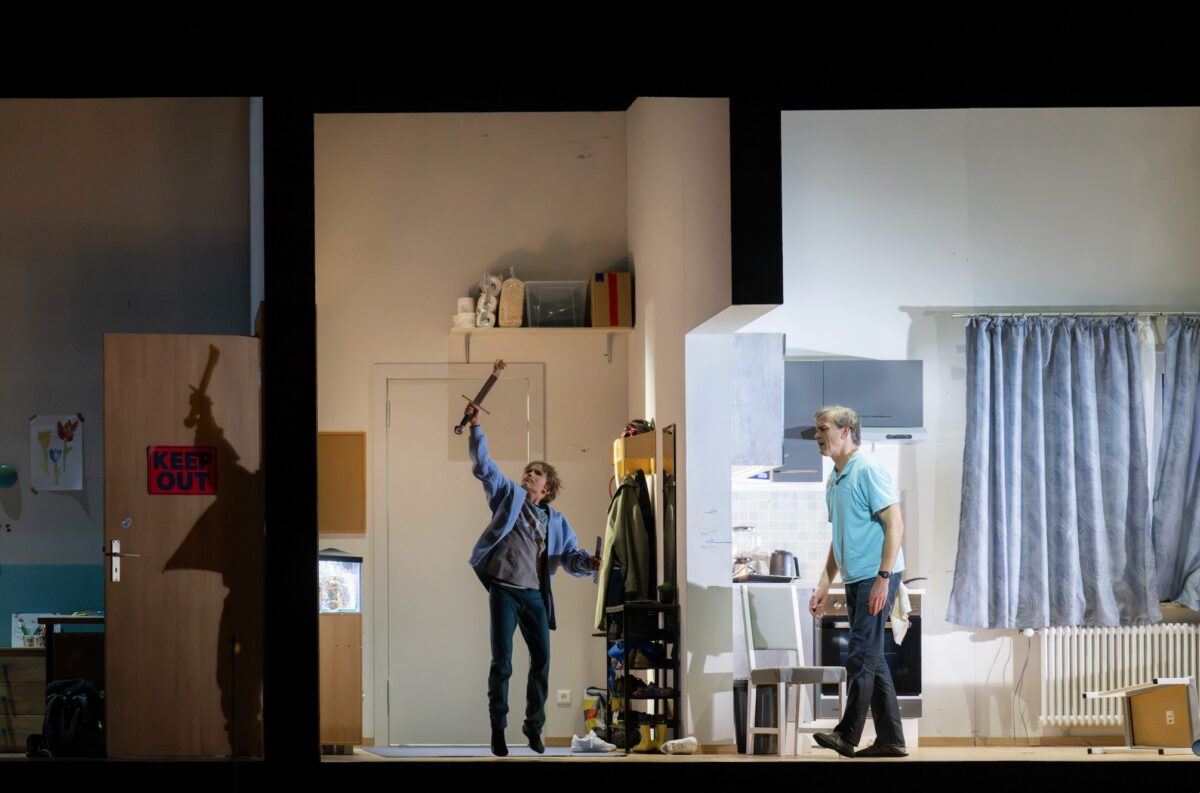
Photo: Monika Rittershaus
Richard Wagner developed his Der Ring des Nibelungen tetralogy in reverse, starting in 1848 with the libretto for “Siegfried’s Death” (renamed Götterdämmerung). The second day of the Bühnenfestpiel and third part overall, Siegfried was originally titled “Young Siegfried.” Tobias Kratzer’s latest installment at the Bayerische Staatsoper took the original title literally: The opera is a coming-of-age story from a child with fantastical imagination to a naïve but fearless warrior.
With Siegfried, Kratzer and dramaturges Bettina Bartz and Olaf Roth took their interventions in the characters’ interpersonal relationships and biographies much further. Combined with its innovative and fresh casting, these distinctive features continue to prove that this is one of the most exciting Ring cycles in recent years, if not decades.
Each part of the tetralogy has centered on an interconnected throughline in Wagner’s epic. Religion in Das Rheingold, unfulfilled romantic love in Die Walküre, and now the relationship between children and parents. This is a lot to tie together, but Kratzer and assistant director Matthias Piro pushed the drama forward at full throttle. The religious posters from Rheingold of Wotan’s glory are now faded and ignored. Only curbside prophets praise the gods, ignored like Boris Godunov’s Holy Fool. Siegfried also yearns for romantic love, but his relationship with his aunt Brünnhilde is more grounded in his maternal longing and her role as caretaker rather than a recurrence of his parents Siegmund and Sieglinde’s incest.
This Ring continues its deceptive adherence to Wagner’s extravagant vision on stage. Kratzer played up the fantastical elements: gods and mortals interact through pyrotechnics and modern technology, Brünnhilde’s Grane appears onstage as a majestic black horse, and Wotan shows off his ravens in his attempt to block Siegfried. Importantly, the funny gags and stage magic did not paper over the unsavory undertones of Wagner’s “comedic” humor. With Siegfried, Kratzer’s masterclass in interpersonal dramaturgy, stagecraft, and storytelling adhering to the original text all reached new heights, even as its increasing irreverence and witty attitude to Wagner’s Gesamtkunstwerk might not sit well with traditionalists.
Set designs and costumes by Rainer Sellmaier mixed realism with fantasy. The characters live in contemporary Germany, from Mime’s secluded apartment to Fafner’s sketchy neighborhood with a 24-hour kiosk to the dilapidated Nationaltheater in Munich (seen in Die Walküre) where Wotan surveils the captive Brünnhilde. Michael Bauer’s lighting help set the magic and human worlds apart, including ripple effects for Siegfried’s communion with the Waldvogel and exploding lightbulbs destroyed by the fire-breathing dragon.
The title character is a dual role. The young Felix Fröbel acted silently as pre-teen Siegfried in Act I, while Benjamin Bruns sang—score in hand—from the side stage. Bruns then entered the action and helped Fröbel during the forging song as a sort of imaginary friend, taking over when Siegfried sets off on his heroic journey. Bruns’s highly anticipated role debut definitively proves he is a more than capable Heldentenor, a welcome addition somewhere between Andreas Schager’s sheer power and Klaus Florian Vogt’s nimble lightness. Bruns was particularly moving in his interactions with the Waldvogel, a sweet tone that balanced tenderness and naivety.
Siegfried is still young and childlike at the end of the opera. When he sees a “beautiful” man wearing armor, he is referring to himself in the mirror of the Nationaltheater’s foyer. In a striking move, Fröbel then briefly reappeared when Siegfried encounters fear for the first time. He spots Brünnhilde lying on a mattress with a lone small candle and mimed Bruns’s “Erwache!”
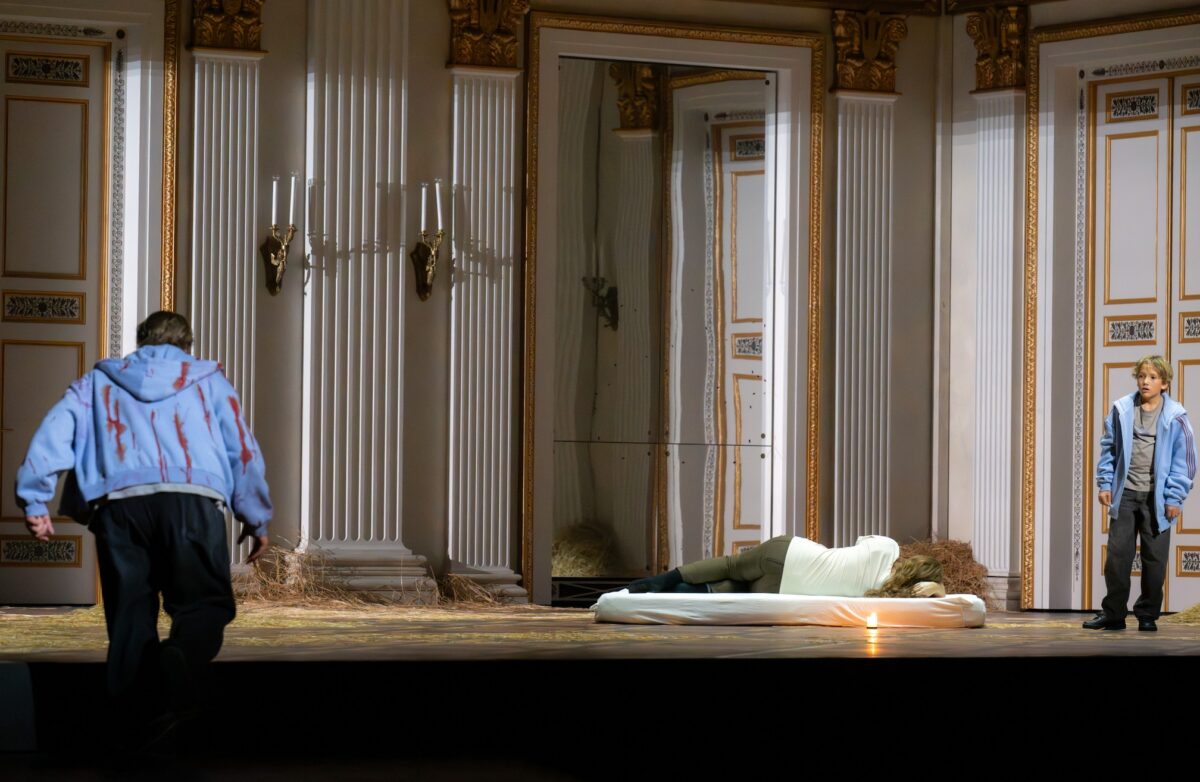
Photo: Monika Rittershaus
For Kratzer, “Siegfried’s childlike affirmation of life enables Brünnhilde to accept her mortality as a necessary condition of all human joy.” Here Brünnhilde’s “Heil dir, Sonne! Heil dir, Licht!” responds to Siegfried’s toy galaxy projector (first seen in the child’s room in Act I), and the two relieve their anxiety by finger painting on the hall’s mirrors (inspired by Andi Fischer’s child-like figures featured on the theater curtain). This revisionism fundamentally alters the nature of their relationship, yet it might also make Siegfried’s duplicity in the next installment much more believable: Despite his heroic deeds, he remains a naïve child.
Simone Schneider (taking over in this run for Miina-Liisa Värelä) was a revelation with her outstanding synergy alongside Bruns. In another clever twist, her “fürchtest du nicht das wild wütende Weib?” (“do you not fear this wild, passionate maid?”) referred not to herself, but to her Valkyrie sisters who arrive protective and skeptical of Siegfried. Schneider’s bright upper register easily reached her high Cs with a warm and balanced tone.
A video projection in the Act II prelude (impressive special effects designed by Manuel Braun, Jonas Dahl, Janic Bebi) shows Fafner’s backstory. In Rheingold, Fafner and Fasolt were priests who sold out to Wotan’s new religion. After the fratricide, Fafner realized he could turn back time with the ring. Biff Tannen-style, he uses it to accumulate a vast fortune through sports betting. Having abandoned his priestly duties, Fafner finds little pleasure in his new vices. He grows old and alone in a cramped apartment stacked with the world’s most famous paintings. Timo Riihonen’s disgruntled dragon was resigned and mellow, his basso profundo unable to cut through Siegfried’s conscience.
Krazter also provides surprising depth to the Niebelung brothers Alberich and Mime through Personenregie and casting. Neither are simply snarling villains. In Act II, Alberich and his anarchist henchmen lurk around Fafner’s apartment building. In another revision, Alberich, somewhat sympathetically, sits silently next to Siegfried during the “forest murmurs,” and they drink beer together. He has little patience, however, for the bird that defecates on them and shoots it down. Siegfried and his avian guide rush off just in time as the Nibelung gang return. The hero similarly escapes with Brünnhilde (and Grane) as Alberich’s mob break into the theater. Georg Nigl’s approach to the role had more lieder-like smoothness than gravelly menace. His light, lyric fach and distinctive articulation, especially on guttural Rs, brought Alberich a sense of overconfidence rather than overt sliminess.
Like his brother’s silent but menacing companionship, Matthias Klink’s Mime at first seems genial as a hapless foster parent. He puts up with childish tantrums about his flimsy carboard swords. But this friendliness is deceptive, and the exasperated Mime seems to care more about his pets than his adopted son—memorializing his dog killed by Alberich in Das Rheingold and mourning the guinea pig “bear” which Siegfried explodes in a microwave in a nasty prank. His sloppy cooking is here a “Wagner”-branded frozen pizza, burnt in the oven as Mime laments that “no fire of mine can ever fuse” the real sword. While Klink’s lower register lacked some intensity, physically at its limits by the end, he made up for it with superbly dynamic acting to show this two-facedness.
The Waldvögel that guides Siegfried is a mechanical bird, injured by Alberich’s gun. Per Wagner’s instructions, it is sung by a boy, here offstage by Leo Eisenreich of the Tölzer Knabenchor (the same boy choir used to great effect in the HIP Siegfried in Dresden). Eisenreich was unfortunately difficult to hear due to the distance, but given the dramaturgy, his broken phrasing made sense for the injured bird.
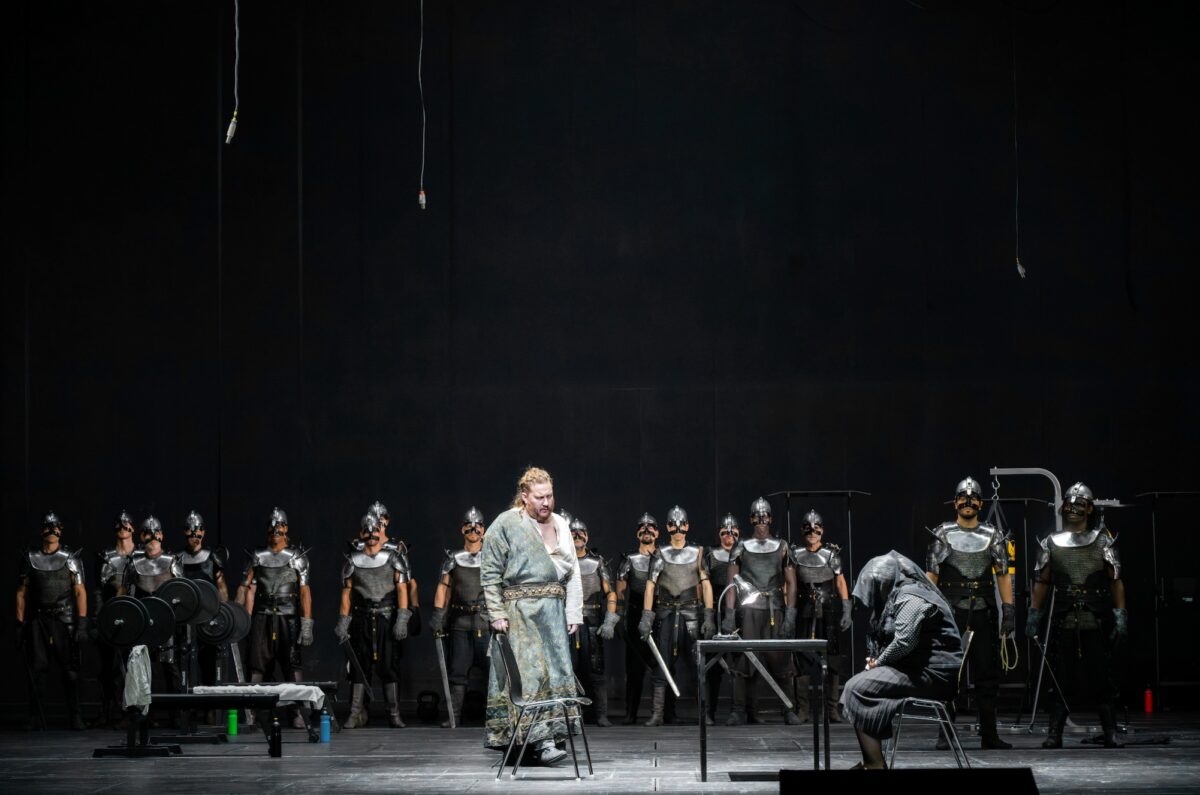
Photo: Monika Rittershaus
In Kratzer’s vision, the Wanderer is a Wotan still agile but increasingly weary of his power. He enters in thin disguise (as Mime prepares to take out the trash) and hands the sleeping Siegfried a golden apple (which he promptly dumps in the trash). Nicholas Brownlee inhabits the role with increasing nuance and even clearer diction since the last two installments. His voice is powerfully raw at moments, but still very refined in articulation and tone. Already a phenomenal storyteller in Die Walküre’s Act II monologue, here we saw Brownlee inhabit Wotan’s full psychological breakdown after interrogating Erda and unsuccessfully blocking Siegfried’s path.
The scene, set in the gym-like backstage of the Nationaltheater full of undead Valhalla warriors, underscores Wotan’s desperate clinging to power. Erda, by contrast, receives Wotan’s fury with poise. Wiebke Lehmkuhl delivered Erda’s advice at a measured pace with a bright tone.
Music Director Vladimir Jurowski and Bayerische Staatsorchester were at home with the score. Jurowski has noted how Wagner’s avant-garde colors and textures in Act I inspired Humperdinck’s witch in Hansel and Gretel and Stravinsky’s Kashchei in The Firebird. With Act III, composed twelve years later, Wagner innovated further. Jurowski emphasized these forward-thinking details with even more energy and volume than the first two Ring installments, especially relishing the galloping finish to Act I and the slender, spooky contrast to start Act II. The orchestra’s intensity occasionally came at the expense of the singers, covering Klink and Nigl in softer passages.
Signs point to an apocalyptic vision for the final installment. In Das Rheingold, Alberich graffitied churches with Nietzsche’s “God is dead” while converts were seduced by the new pagan golden altarpiece, staring agape Chereau-style. Now in Siegfried, a man on the street holds up a cardboard sign reading “the end of the world is nigh, only Wotan can save us.” Wotan has clearly failed with his army of Valhalla soldiers, and childlike Siegfried has already bonded with Alberich, setting up the perfect storm. Audiences next summer are in for a chaotic final showdown.
Montagu James
Montagu James is a PhD student at Brown University studying modern European political and cultural history. He also enjoys composing and conducting.
-
Topics: Review, the ring cycle, Wagner
-
People: Andi Fischer, Benjamin Bruns, Bettina Bartz, Felix Fröbel, Georg Nigl, Janic Bebi, Jonas Dahl, Leo Eisenreich, Manuel Braun, Matthias Klink, Matthias Piro, Michael Bauer, Nicholas Brownlee, Olaf Roth, Rainer Sellmaier, Simone Schneider, Timo Riihonen, Tobias Kratzer, Vladimir Jurowski, Wiebke Lehmkuhl
-
Works: Der Ring des Nibelungen, Siegfried
-
Places & Organizations: Bayerische Staatsoper