Showing yourself out
In eclectic productions of Carmen, Ariadne auf Naxos, and Così fan tutte in Salzburg, A.J. Goldmann finds vindication for Markus Hinterhaüser at the end of the intendant’s final Festival.
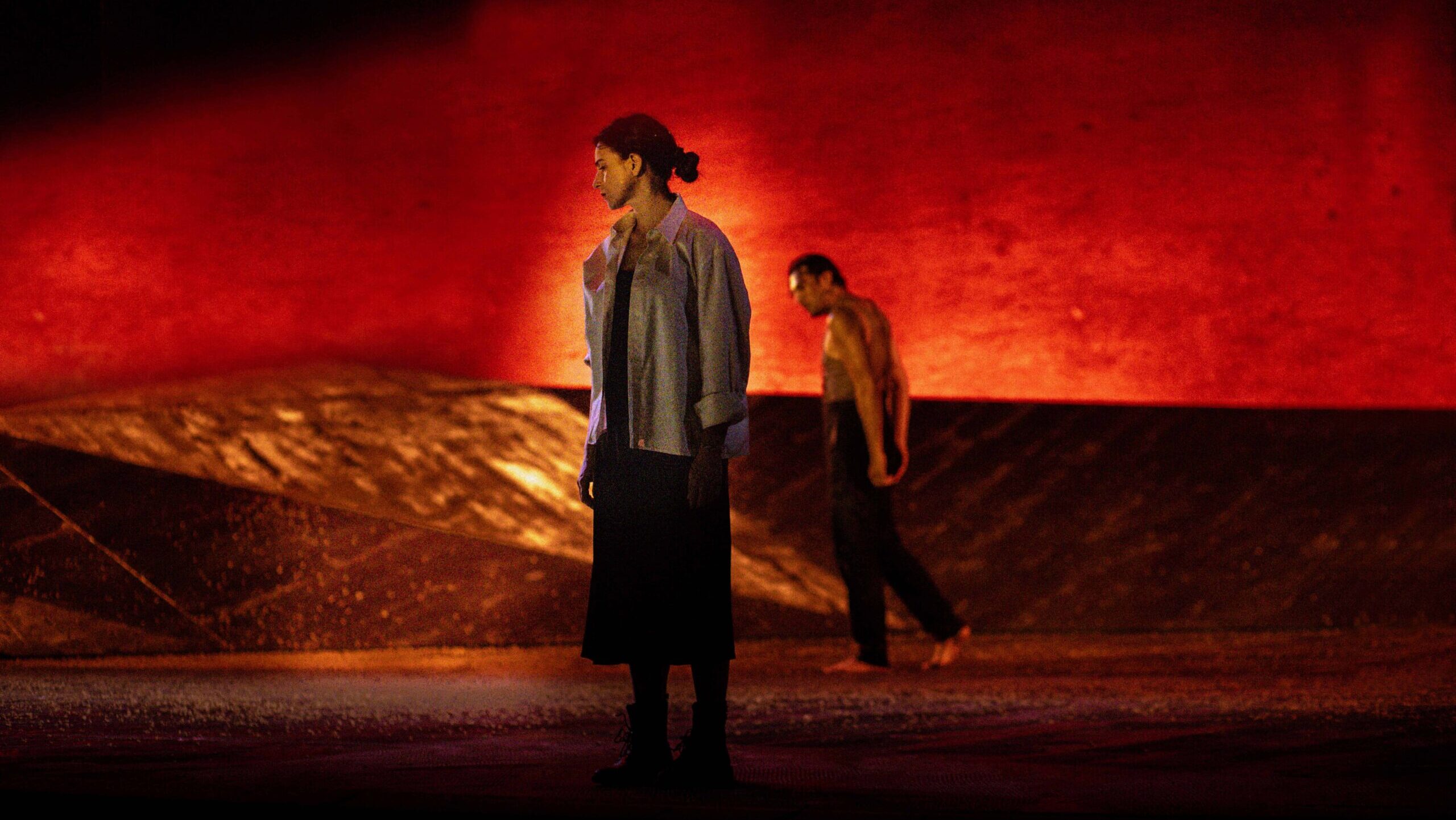
Carmen 2026 (Regie/Choreografie, Gabriela Carrizo (Peeping Tom)): Asmik Grigorian (Carmen), Jonathan Tetelman (Don José)
© SF/Virginia Rota
An Argentine choreographer with no experience directing opera makes her debut with Carmen, stripping away much of the picturesque Spanish atmosphere and inviting dancers from her own company onstage. She rejects the traditional interpretation of José as a man driven to violence by a dangerous and calculating femme fatale and Carmen’s murder as horrific crime that is the logical outcome of a culture seeped in misogyny and violent machismo.
I am referring, of course, to Constanza Macras’s production of Carmen, which opened at Theater Basel in 2024.
Two years later, the Salzburg Festival arrived at a remarkably similar proposition. Gabriela Carrizo, the Argentine co-founder of the Belgian dance-theater troupe Peeping Tom, had never staged opera when Markus Hinterhäuser, Salzburg’s erstwhile artistic head, invited her to tackle Bizet in the Grosses Festspielhaus. Like Macras, she brought her dancers with her, rejected the traditional couleur locale, and turned her production into a severe and unflinching commentary on the high rates of feminicide in her home country.
There is no reason to suspect that Carrizo set out to copy Macras – nor does anyone else seem to have picked up on this coincidence, which reveals just how natural this once-revisionist reading of Carmen has become. The operatic repertoire is strewn with the corpses of women; Carmen’s death is undoubtedly a femicide. The question then becomes whether seeing Carmen entirely as a victim of a jealous and possessive man risks flattening her into a type rather than the vivacious and charismatic protagonist that has fascinated operagoers for the better part of two centuries.
It was a question I pondered during the final Salzburg Festival programmed by Hinterhäuser, who was removed from active leadership in March, for reasons that are still shrouded in mystery but seem to owe more to political maneuverings than anything else.
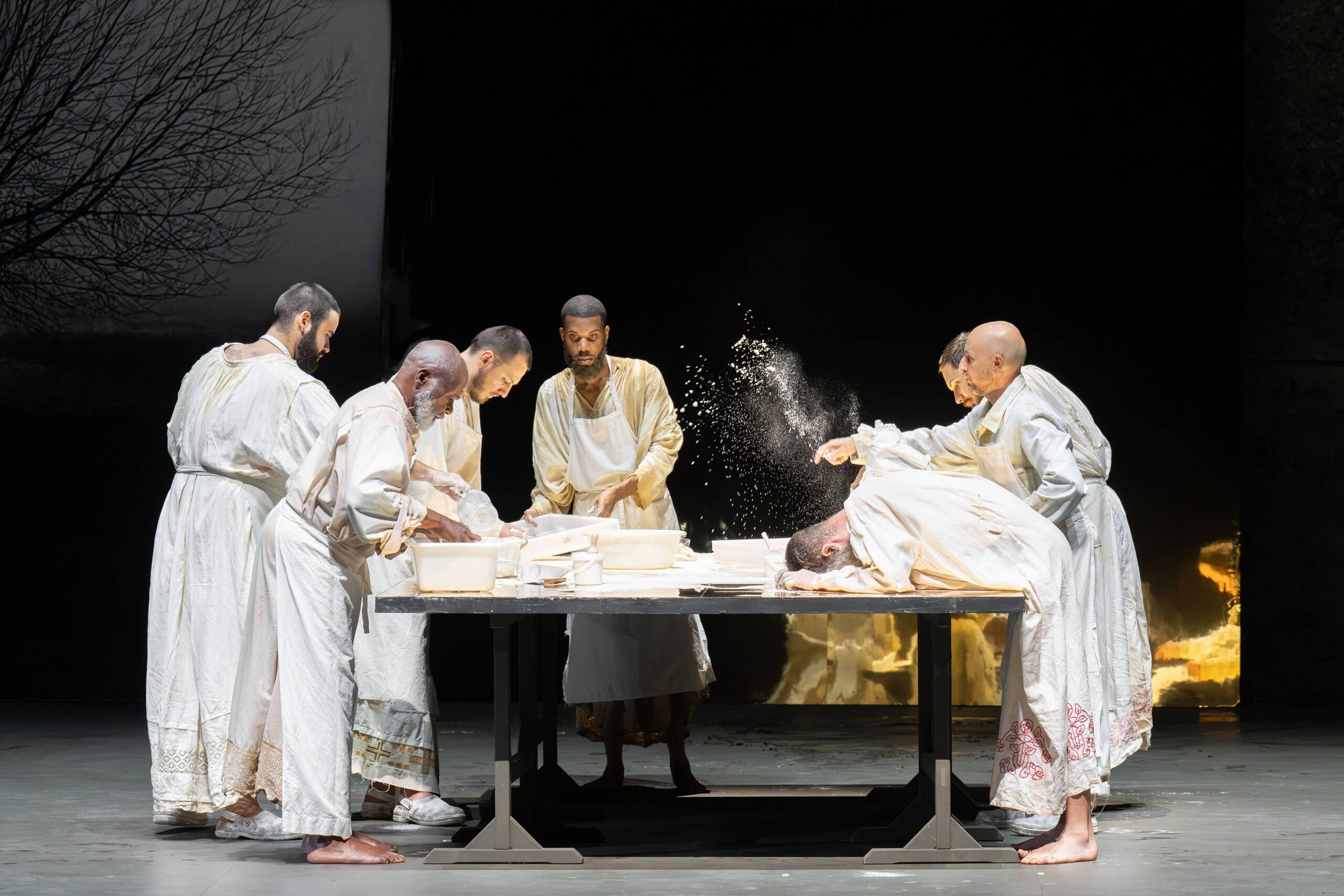
Saint François d’Assise at the Salzburg Festival / Photo: Monika Rittershaus
For the first time since 2021, staged operas by both Mozart and Richard Strauss appeared at the summer festival: Christof Loy’s Così fan tutte, first seen during the Covid pandemic in a judicious abridgement, returned uncut while Ersan Mondtag supplied a new Ariadne auf Naxos. At the same time, the program placed the most popular French opera beside one of the least performed: Messiaen’s Saint François d’Assise.
These juxtapositions were characteristic of Hinterhäuser, whose strongest seasons here paired canonical scores and famous singers with artists whose theatrical habits did not obviously belong to opera. Sometimes the result was more than the sum of its parts. Last summer, for instance, handing Donizetti’s Maria Stuarda to Ulrich Rasche, a director known for mechanized stages and relentless physical rhythms, produced an unexpectedly persuasive synthesis of bel canto and movement.
Hinterhäuser, who was sometimes accused of lofty intellectualism, gave this final program a theoretical frame as well: Roland Barthes’s A Lover’s Discourse: Fragments, which presumably allowed him to answer his detectors with feigned surprise: “Pretentious? Moi?” Yet the theme was not an empty one. Carmen, Così and Ariadne all concern people whose ideas about love, fidelity, or permanence collapse under the weight of messy lived experience.
The season’s most consequential statement on the subject of love was Saint François d’Assise, reviewed in detail elsewhere in these pages. Its place in Hinterhäuser’s last program was unmistakably personal. Peter Sellars’s 1992 Salzburg production of Messiaen’s only opera helped shape Hinterhäuser’s conception of what Musiktheater could be. Bringing the work back in a new staging by Romeo Castellucci, conducted by Maxime Pascal, gave the summer a formidable center of gravity. It also made practical sense to surround so demanding a work with Bizet, Mozart, Strauss, and the revival of Barrie Kosky’s exuberant Il viaggio a Reims, which carried over from this year’s Whitsun Festival.
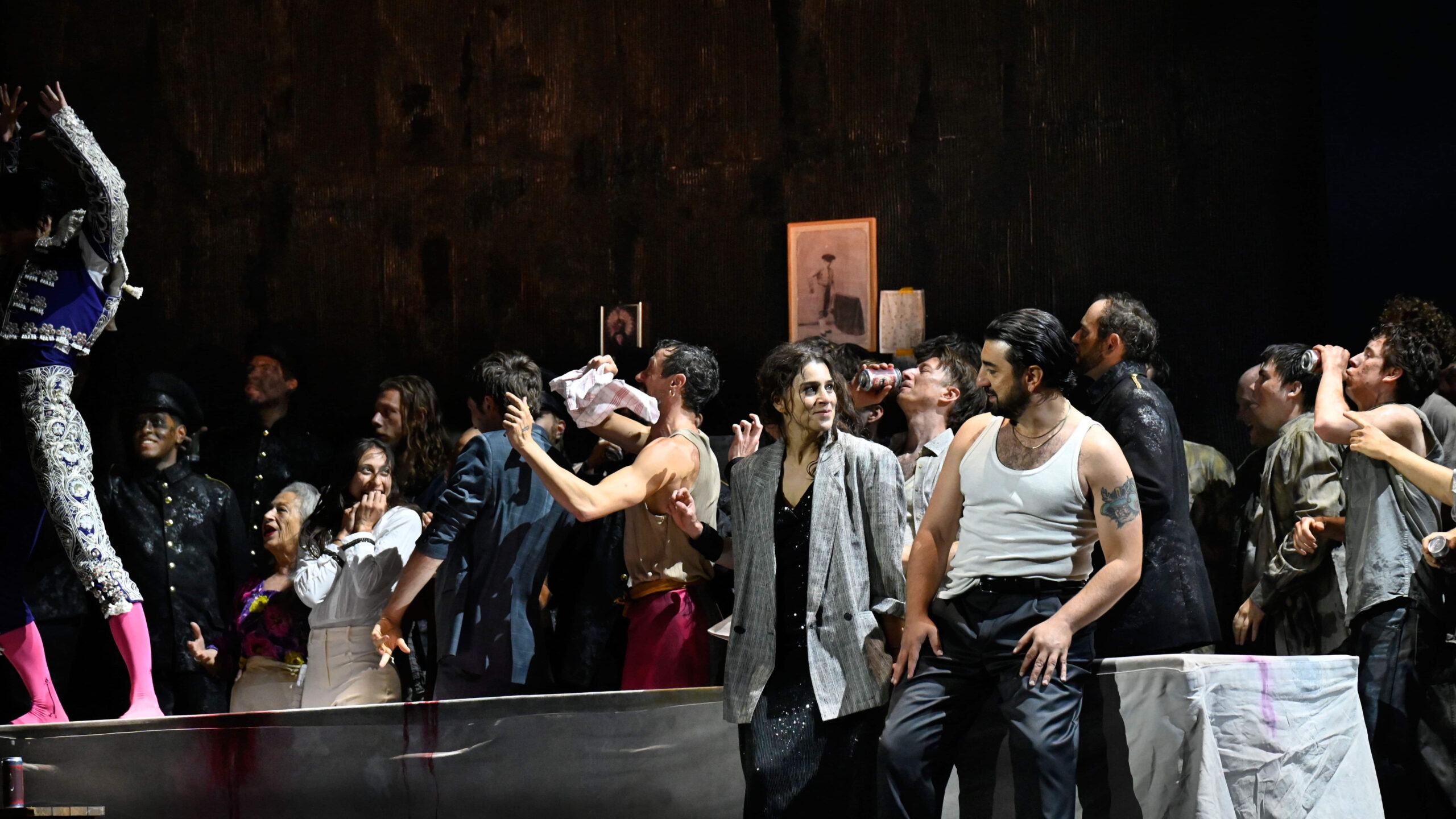
Carmen 2026 (Director/Choreography, Gabriela Carrizo (Peeping Tom)): Asmik Grigorian (Carmen), Davide Luciano (Escamillo), Ensemble / Photo: © SF/Thomas
Carrizo’s Carmen never quite justified the expectations created by its diverse and unexpected components, although musically it was extraordinary. Teodor Currentzis has been one of the defining conductors of the Hinterhäuser years and, since Russia’s full-scale invasion of Ukraine, one of Salzburg’s most controversial guests. His refusal to condemn the invasion and his Russian orchestra musicAeterna’s continued relationship with embargoed banks have made his appearances politically fraught. Utopia, the international orchestra he founded in 2022 and which performed this Carmen, operates separately with European private backing.
Currentzis rarely accepts a familiar score at face value. He stretched and compressed tempi, exposed secondary lines, and lingered over details that many conductors allow to pass unnoticed. The interventions could be mannered, but they were seldom inert. In an opera almost impossible to hear without accumulated memories of other performances, he repeatedly made Bizet sound newly considered. Utopia and its mighty choir gave Carmen unusual precision, color, and force.
The performing version was harder to understand or to endorse. Currentzis drew on Paul Prévost’s new Bärenreiter edition, which makes available material from different stages of Bizet’s revisions, but Salzburg did not perform Prévost’s coherent 1874 version. The Habanera and later entr’actes remained alongside selected earlier material. More consequentially, Carrizo eliminated all the spoken dialogue without replacing it with Ernest Guiraud’s later recitatives.
That decision deprived the opera of much of its connective tissue. The dialogue establishes relationships, motives and changes of emotional temperature; without it, the work becomes a sequence of musical numbers whose plot remains intelligible largely because almost everyone already knows it. Carrizo’s stated aim was to investigate the psychology of Carmen and José, yet her performing text removed much of the material through which that psychology develops.
The result acquired an unexpected formal resemblance to Saint François. Messiaen deliberately constructed his opera as a succession of large, self-contained tableaux. Salzburg’s Carmen, for entirely different reasons, also came to feel block-like. The best-known and one of the least-known major French operas thus occupied the same festival while approaching dramatic continuity from opposite directions.
Christof Hetzer transformed the Grosses Festspielhaus into a vast formation of black volcanic rock, steeply raked and difficult to traverse. Tom Visser’s lighting could make it look almost lunar, producing severe and sometimes beautiful images. The literal volcanic eruption was less effective, converting an atmospheric suggestion into a cumbersome piece of stage machinery.
Carrizo’s dancers spent much of the evening running, twisting, and tumbling across this terrain. Her intention was to externalize psychological states; José even acquired a dancing double. Too often, however, the choreography merely restated emotional intensity rather than clarifying it. Amparo Cortés, the flamenco singer who periodically interrupted Bizet’s score, was a striking performer, though her appearances varied between atmospheric and extraneous.
One stage image helped make Carrizo’s argument with disturbing economy. Soldiers handed guns to children, who began shooting other children. Violence was being taught as play. Instead of explaining José through an alter ego or another symbolic routine, the production briefly showed the social environment in which his brutality had been formed.
The final scene was similarly direct. Rather than assigning Carmen’s death to a single musical instant, Carrizo had José attack her repeatedly and Carmen spent much of the confrontation dying. The effect was ugly and difficult to watch, but it made the murder a prolonged act of domination rather than the conventional operatic knife thrust followed by a sudden thud.
Asmik Grigorian’s first Carmen was equally distant from tradition. She is unmistakably a soprano singing a mezzo role, and the lower and middle registers lack requisite plushness. She made no attempt to manufacture it, instead compensating by singing with the focus, intelligence, and the psychological intensity that has become central to her stage work.
Her Carmen was also as far removed from the traditional depiction of the sultry gypsy temptress as one could get. She often seemed tired or burdened, as though showing us how much effort it required to maintain her freedom. Whether Grigorian will retain Carmen in her repertory or whether this was a Salzburg experiment remains to be seen.
Jonathan Tetelman’s Don José required fewer reservations. His performance combined ringing power with lyric flexibility and an unusually convincing progression from tenderness to obsession. The Flower Song remained beautiful without becoming merely a tenor showcase; by the final scene the same beauty had acquired menace. He showed why José is one of his defining roles.
Kristina Mkhitaryan gave Micaëla purity, warmth and finesse. The absence of much of the spoken material also freed the character from some of the sentimental baggage that can make her seem merely the virtuous alternative to Carmen. Davide Luciano played Escamillo as an unrepentant ham, which suited both the character and the scale of the house.
The production therefore succeeded unevenly. Carrizo’s ideas about femicide and masculine violence were defensible but not especially new, while much of the dance-theater apparatus remained illustrative.
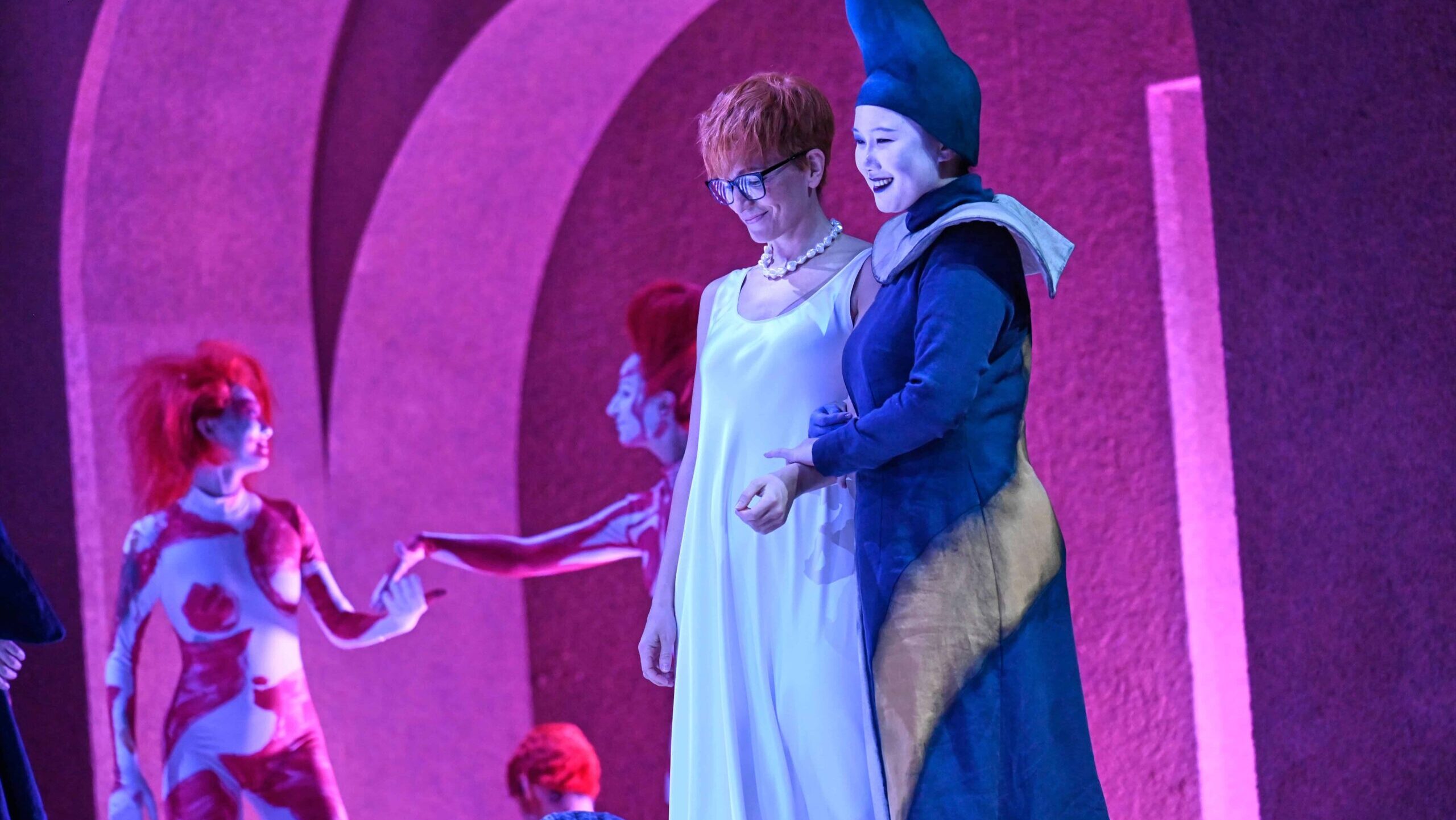
Ariadne auf Naxos 2026 (Regie/Bühne/Kostüm, Ersan Mondtag): Kate Lindsey (Der Komponist), Ziyi Dai (Zerbinetta), Tänzer·innen
© SF/Thomas Aurin
Strauss, one of the festival’s founders and, along with Mozart, one of its genii loci, has been strangely absent from Salzburg’s main opera slate lately: the last Strauss opera to be staged here was Elektra (in a magnificently savage production by Krzysztof Warlikowski) in 2020 and 2021. There was a compelling reason to stage Ariadne this year; exactly 100 years ago, it was the first Stauss opera that bowed at the festival.
Mondtag, making his Salzburg debut, moved Naxos to Mars. The richest man in Vienna became an interplanetary plutocrat (Elon Musk? Jeff Bezos? Peter Thiel?) who escapes a damaged Earth only to reconstruct the same hierarchy, greed and erotic disorder in some other corner of the solar system else. (The relocation had me wondering what other operas would benefit from an unexpected change of scenery: after Ariadne auf Mars, how about Nixon in Czechoslovakia, Die Meistersinger von New Jersey, Il barbiere di Shropshire, but I digress…)
The premise suited Ariadne better than it might sound. Hofmannsthal’s work is already about the whims of the wealthy, the humiliation of artists, and the forced collision of tragedy and entertainment. Mondtag’s retro-futurist architecture, eccentric costumes and spaceships initially seemed wonderfully compatible with its artificiality. The problem was that the setting ceased to develop once its reference points had been identified.
Alexander Pannier’s videos (which resembled an AI-generated computer game) sent spacecraft repeatedly across the red planet, viewed from a large window at the back of the set. Performers accumulated increasingly strange costumes and movements. Echo was repeatedly lifted into the air in a padded outfit that made her look like the Michelin Man. A spastic orgy was neither erotic nor funny; it merely added another layer of activity to a production already thin on dramatic purpose.
Mondtag also turned the attraction between Kate Lindsey’s Composer and Ziyi Dai’s Zerbinetta into an explicit lesbian romance that continued in pantomime during the opera proper, adding another layer of confusion to the production. Lindsey nonetheless dominated the evening. Her Composer combined arrogance, insecurity, panic and artistic conviction without smoothing away their contradictions. Dai was an agile and engaging Zerbinetta. Christina Nilsson, replacing Elīna Garanča as the Prima Donna and Ariadne, sang with strength and dignity, if without the sumptuous amplitude the part can reward. Eric Cutler brought clarion force to Bacchus, and Christoph Pohl was an excellent Music Master.
Manfred Honeck and the Vienna Philharmonic supplied the subtlety missing from the stage. Strauss reduces the orchestra to chamber dimensions while continually suggesting something larger, and Honeck balanced transparency with opulence. The Prologue moved with conversational alertness; the comedy had spring; the long lines of the opera proper expanded without becoming heavy. His reading understood the tension between intimacy and grandeur more clearly than Mondtag’s staging understood the tension between comedy and myth.
If Carmen represented a risky assignment that partially paid off and Ariadne one that did not, Così fan tutte showed a side of Salzburg’s programming that might become increasingly important as the festival navigates an artistically and politically uncertain future: the successful afterlife of an acclaimed production.
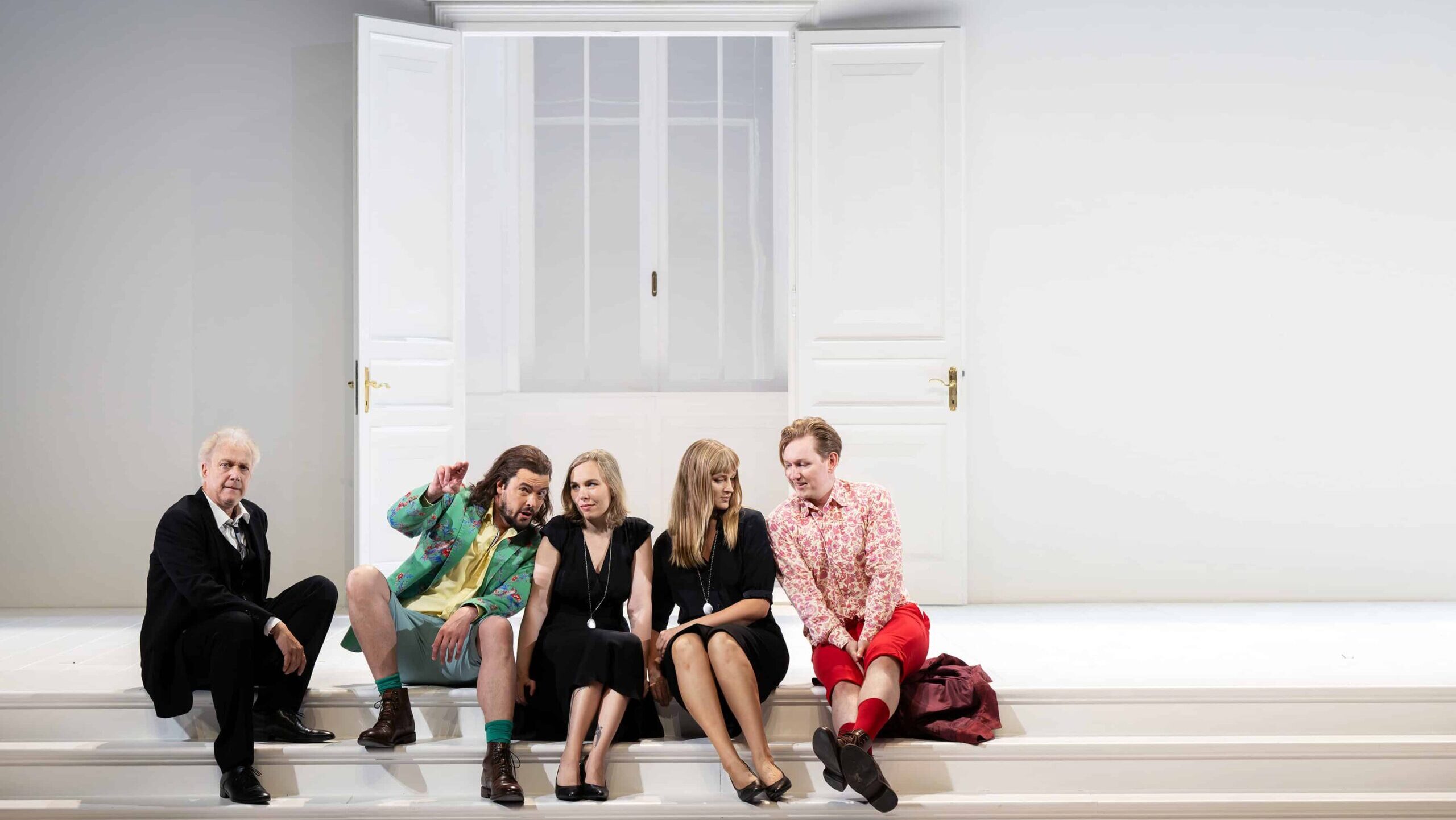
Così fan tutte 2026 (Regie, Christof Loy): Johannes Martin Kränzle (Don Alfonso), Andrè Schuen (Guglielmo), Elsa Dreisig (Fiordiligi), Victoria Karkacheva (Dorabella), Bogdan Volkov (Ferrando) / Photo: © SF/Monika Rittershaus
Christof Loy’s staging was created during the extraordinary pandemic summer of 2020, when Salzburg was one of the few major festivals able to proceed at all. The opera was then compressed into roughly two hours without intermission; at the time, Loy and Joana Mallwitz joked that Das Rheingold provided their upper limit. The production returned in 2021 and this summer came back for a third Salzburg season, with much of the missing music restored.
Almost the whole original principal cast returned: Elsa Dreisig as Fiordiligi, André Schuen as Guglielmo, Bogdan Volkov as Ferrando, Lea Desandre as Despina and Johannes Martin Kränzle as Don Alfonso. Among the principals, Victoria Karkacheva, a rich-voiced and responsive Dorabella, was the sole newcomer.
Johannes Leiacker’s enormous white room remains a remarkably effective setting. There are two doors and almost nothing else. Loy removes visual distractions so that every shift in allegiance, embarrassment or desire must be carried by the performers. His reading refuses to treat the opera as proof of female inconstancy. The men begin by assuming that they understand women and end by discovering that they understand neither their partners nor themselves.
That interpretation is still revealing, even if the production itself has inevitably lost some of the freshness and nervous immediacy it possessed in 2020. Mallwitz and the Vienna Philharmonic played with polish and responsiveness, but I missed some of the earlier danger. Six years of familiarity have given the cast assurance while also smoothing some of the edges.
The expanded score brought compensating gains. Desandre’s Despina acquired more shape and less of the quality of a mechanism for moving the plot. Volkov benefited from the restored Act II aria “Tradito, schernito,” which gives Ferrando’s pain a weight the abbreviated version could not supply. Dreisig remained an ardent Fiordiligi, Schuen an elegant Guglielmo, and Kränzle kept Don Alfonso’s wizened cynicism from settling into smugness.
Loy’s ending also fits Hinterhäuser’s chosen theme more persuasively than any amount of festival rhetoric. The original couples choose each other again, but they do so after learning that their feelings are less stable and their self-knowledge less secure than they imagined. Though innocence is lost, love survives.
Taken together, these productions offered a concise account of both Hinterhäuser’s strengths and the risks of his method. He used Salzburg’s lavish resources – the budget of this year’s 6-week-long festival was €77.3 million, or $89 million – to bring together artists, directors, singers and repertoire in unexpected and often challenging ways and to persuade Salzburg’s well-heeled audience that they should shell out upwards of $600 (the top opera ticket price this year was €485) not just for Grigorian’s Carmen or Netrebko’s Aida (2017), but also Enesco’s Œdipe (2019), Nono’s Intolleranza 1960 (2021), Martinů’s The Greek Passion (2023), Weinberg’s The Idiot (2024), Eötvös’s Three Sisters (2025), or this summer’s Saint François, a work so demanding and impractical that it defined the scale of Hinterhäuser’s ambition more clearly than anything else on this year’s program.
Salzburg does not need an artistic director to prove that Mozart can sound beautiful or Strauss sumptuous. The more consequential use of its wealth and prestige is to make possible ambitious and artistically bold projects whose results cannot be predicted in advance. Hinterhäuser’s final season showed both what can be gained from that wager, where it can fail and how the possibility of failure is the inevitably price for artistic risk-taking.
On August 28, Salzburg released its sales figures for 2026: in Hinterhäuser’s tenth and final summer in charge, the Festival sold a staggering 99% of all available tickets. If that’s not a vindication of Hinterhäuser’s leadership I don’t know what is.

A.J. Goldmann
A.J. Goldmann is an American writer and critic based in Munich and Berlin. He is a longtime contributor to The Wall Street Journal, The New York Times and The Forward. He has also written for The Atlantic, The New Republic, The Guardian, The Spectator and Gramophone Magazine. Between 2007 and 2023, when it folded, he was the Berlin, Vienna and
Salzburg correspondent for Opera News Magazine.
-
Topics: Review, salzburg festival
-
People: Alexander Pannier, André Schuen, Asmik Grigorian, Bogdan Volkov, Christina Nilsson, Christof Hetzer, Christof Loy, Christoph Pohl, Davide Luciano, Elsa Dreisig, Eric Cutler, Ersan Mondtag, Gabriela Carrizo, Joana Mallwitz, Johannes Leiacker, Johannes Martin Kränzle, Jonathan Tetelman, Kate Lindsey, Kristina Mkhitaryan, Lea Desandre, Manfred Honeck, Maxime Pascal, Romeo Castellucci, Teodor Currentzis, Tom Visser, Victoria Karkacheva, Ziyi Dai
-
Works: Ariadne auf Naxos, Carmen, Così fan tutte