The Grand Salzburg Hotel
A.J. Goldmann on the Salzburg Festival’s revolving doors, both in its administration and in its delectable production of Il viaggio a Reims.
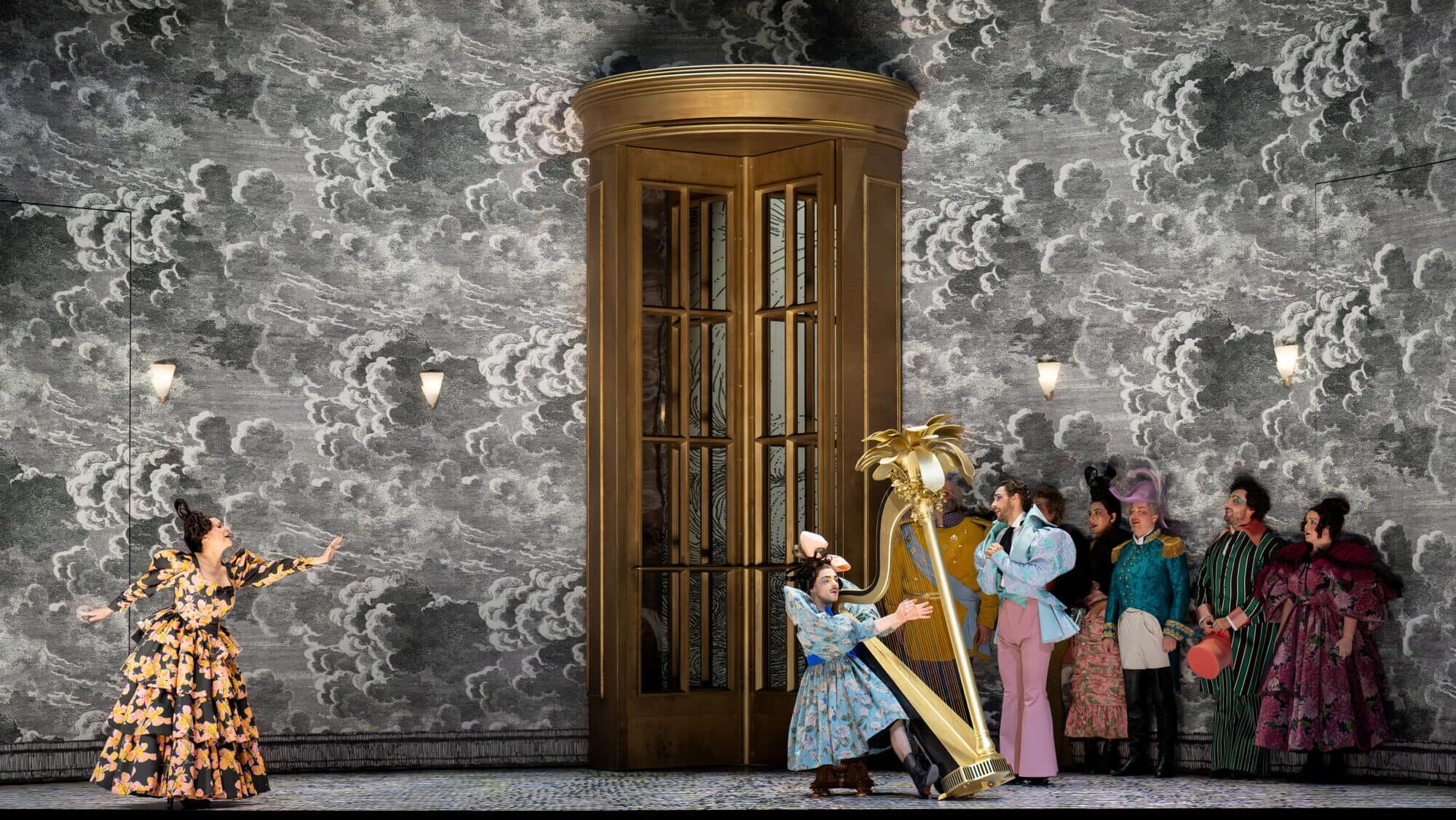
Photo: Monika Rittershaus/Salzburg Festival
For those who have been paying attention, the news from Salzburg of late has been dire. Markus Hinterhäuser, the Salzburg Festival’s artistic director since 2016, was removed from active leadership in March after a prolonged conflict with the festival’s supervisory board. In 2024, his contract had been extended through 2031. There had been reported tensions between Hinterhäuser and the board — including over the summary firing of the festival’s chief of drama, Marina Davydova, in 2024, just a year into her mandate — but the Austrian pianist and impresario appeared to enjoy the support of powerful allies who believed in him and his vision.
Earlier this year, however, the board argued that Hinterhäuser had violated a “Wohlverhaltensklausel,” or good-conduct clause, attached to his contract renewal. A festival that would like to confine the drama to the stage, preferably in Lorenzo da Ponte’s witty rhyming couplets or some gorgeously upholstered Hofmannsthalian idiom, suddenly found itself dealing with an institutional crisis as a comprehensive renovation, reorganization, and expansion of the festival district — whose public funding was originally put at roughly €262 million, with later reports citing a figure closer to €400 million — kicks into high gear. (The project will require the Großes Festspielhaus, Salzburg’s largest venue, to close for roughly two years.) More immediately, Hinterhäuser’s dismissal left the festival scrambling to find someone to steer a summer season conceived by the just-departed intendant.
Nor was the spring especially light onstage in this Alpine idyll. The Berlin Philharmonic made its long-awaited return to the Salzburg Easter Festival — a separate organization from the Salzburg Festival — for the start of a new Ring cycle under Kirill Petrenko. Director Kirill Serebrennikov’s Rheingold offered spectacle, ambition, and plenty of darkness. Petrenko and the Berliners gave a performance whose clarity and authority seemed, at nearly every turn, contradicted by a dreary staging that was less a production than a cluttered spectacle of projections, ethnographic masks, and rituals.
A change in temperature finally arrived, mercifully, last weekend with Barrie Kosky’s gleefully anarchic take on Rossini’s Il viaggio a Reims, which headlined the Salzburg Whitsun Festival and returns in August for five performances. The production was, of course, planned long before the Hinterhäuser crisis reached its fruition. Still, theater takes on color from the conditions in which it appears, and this Viaggio arrived as a release: exact, stylish, light-footed and far more disciplined than its surface gaiety at first suggested.
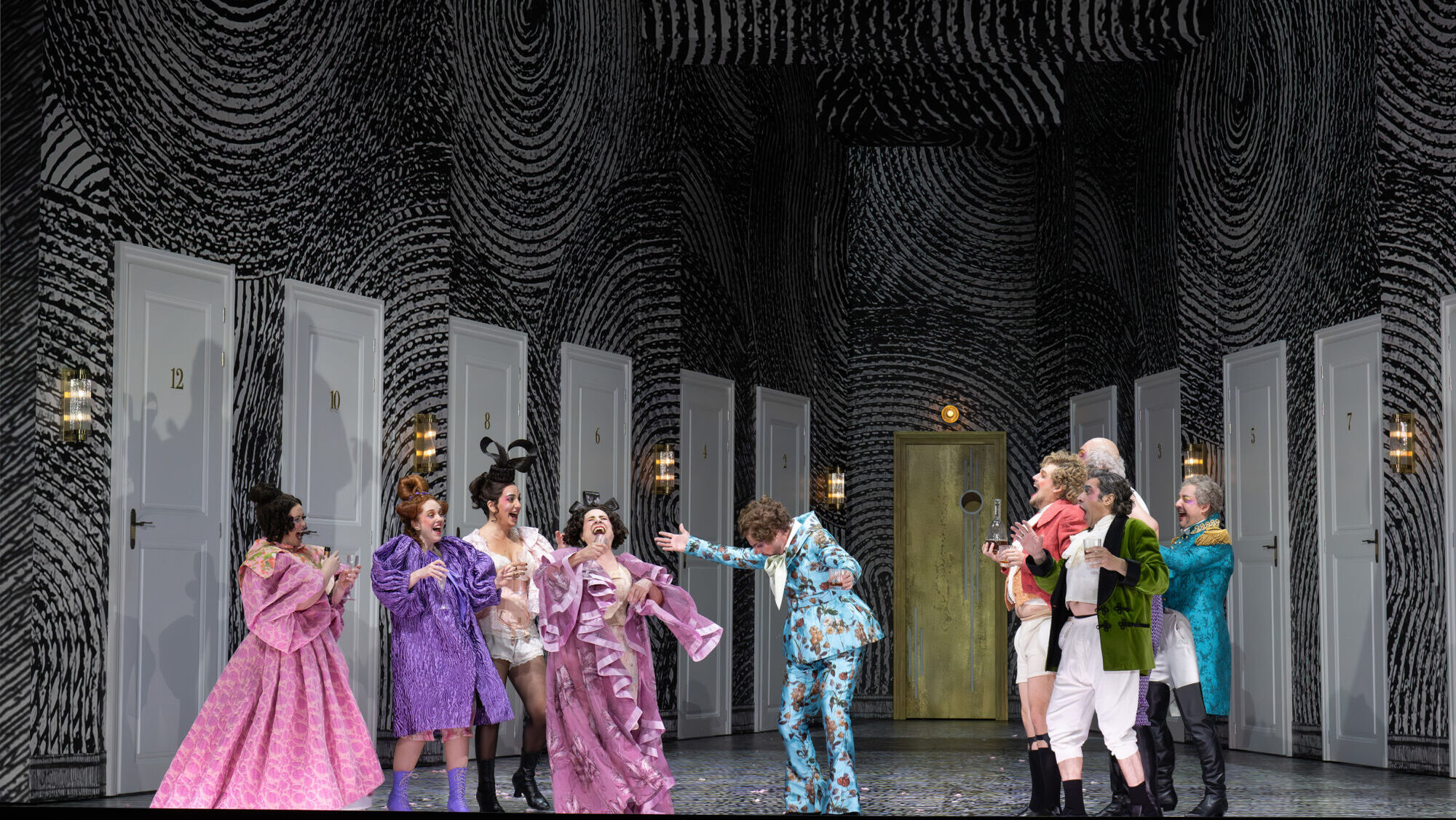
Photo: Monika Rittershaus/Salzburg Festival
Rossini’s 1825 opera is set at a spa hotel where a group of European travelers has been delayed on the way to the coronation of Charles X. Kosky swaps out the royal ceremony for the significant birthday of a very special someone referred to in the lightly adjusted libretto as “La Ceci.” Though programmed long before the Festival’s current difficulties, this work about elegant people stranded before an official ceremony could hardly avoid acquiring a certain resonance in a city where the cultural machinery has recently looked less smooth than its image suggests. Salzburg could hardly have asked for a more elegant mirror, or a less solemn one.
For much of the Hinterhäuser era, solemnity came naturally. His first season, in 2017, set the tone with Berg’s Wozzeck, Shostakovich’s Lady Macbeth of Mtsensk, and Reimann’s Lear. It was an ambitious program that showed little interest in the festival’s more comfortable self-image as a shrine to Mozart and Strauss. Hinterhäuser’s festival often returned to moral extremity, metaphysical inquiry, and psychological seriousness.
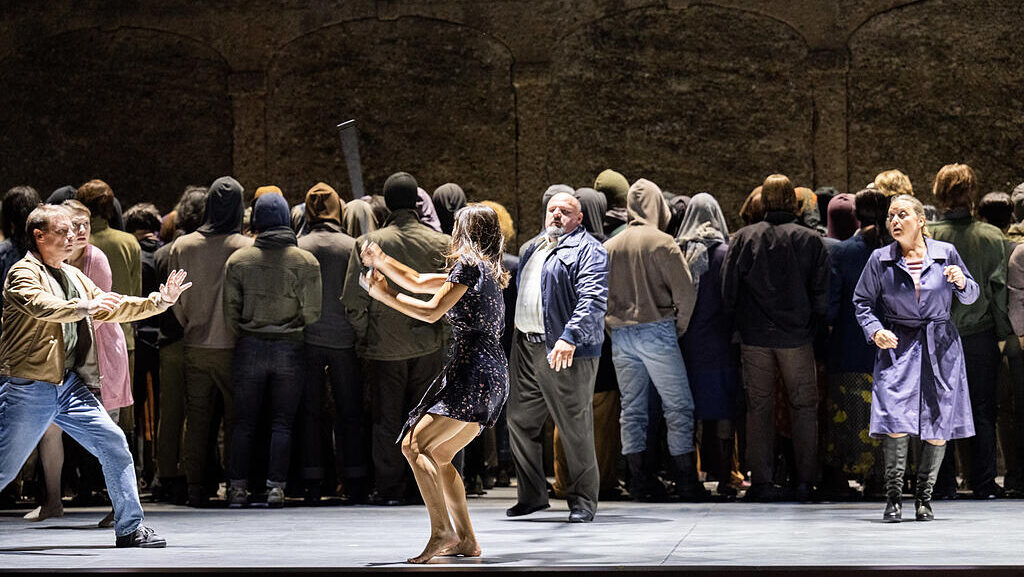
At its best, that approach produced artistic triumphs. Peter Sellars’s La clemenza di Tito, also in 2017, made late Mozart feel both ritualized and present. Warlikowski’s Elektra and Macbeth supplied large-scale, disturbing stage architecture. Simon Stone’s grand and shattering The Greek Passion gave the 2023 festival one of the period’s clearest successes. Kosky’s own Káťa Kabanová, in 2022, showed how severe and economical means could still produce emotional immediacy: on the immense stage of the Felsenreitschule, Janáček’s heroine stood isolated before a crowd of figures whose turned backs literalized her profound isolation and society’s indifference.
But Hinterhäuser’s method also had its limits. The Festival became very good at presenting ordeals on stages that looked alternately like tribunals, laboratories, bunkers, and clinics; one could admire the intelligence and still miss the pleasure. Comedy, especially, was unreliable. Kosky’s Orphée aux enfers in 2019 and Rolando Villazón’s Il barbiere di Siviglia in 2022 were joyous exceptions: colorfully comic evenings that took silliness seriously. Christoph Marthaler’s tedious Falstaff and Martin Kušej’s menacing Le nozze di Figaro, both from 2023, showed how easily the comic impulse could curdle into something formalistic, airless, or both.
Kat’a Kabanova at the Salzburg Festival in 2022 / Photo: Monika Rittershaus/Salzburg Festival
The coming summer still bears Hinterhäuser’s imprint. Olivier Messiaen’s Saint François d’Assise, in a new Romeo Castellucci production at the Felsenreitschule, looks back unmistakably to the Mortier years, when Sellars’s 1992 staging of the same work helped open Salzburg up to avant-garde music and drama. Castellucci is arguably the most significant director Hinterhäuser invited to work at Salzburg, starting with Salome (2018) and continuing with Don Giovanni (2021) and Bluebeard’s Castle / De temporum fine comoedia (2022).
The festival’s new Carmen unites the two arguably biggest musical stars of the Hinterhäuser years, the Lithuanian soprano Asmik Grigorian, making her debut in the title role, and the Greek-Russian conductor Teodor Currentzis. Approaching Gabriela Carrizo, the Argentinian artistic director of Peeping Tom, a Belgian dance theater troupe, to direct and choreograph this operatic warhorse sounds like a quintessentially Hinterhäuserian gamble. At its worst, the egos involved could wind up reinforcing each other’s worst instincts. At its best, the encounter could result in a genuinely new and illuminating way of viewing a perennial favorite.
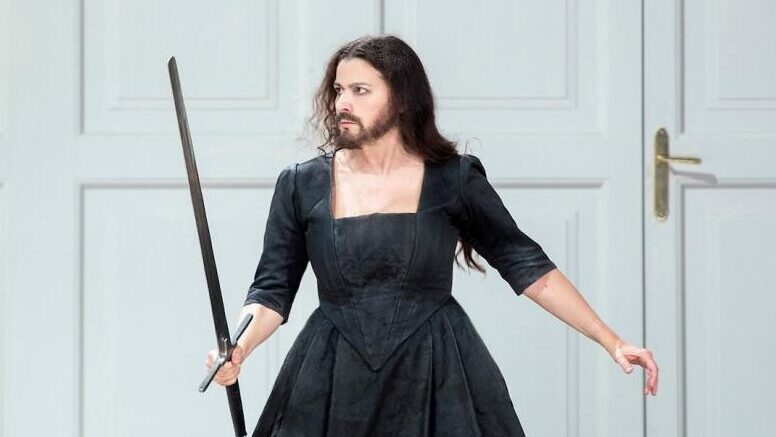
For the past decade and a half, the Whitsun Festival has represented another model inside of the same institution. Cecilia Bartoli has directed it since 2012, and her contract runs until 2031. In that time, she has worked alongside Alexander Pereira, Sven-Eric Bechtolf, Hinterhäuser, and now Karin Bergmann, the interim Artistic Director of the summer festival. Perhaps more than anyone else in Salzburg’s recent history, Bartoli has been a beacon of stability. Under her leadership, the main Whitsun opera – which Bartoli also performs in – has dependably returned during the summer Festival, making Whitsun feel less like a festive appendage than a workshop whose fully-staged productions feed into the main season.
Handel, Bellini, Rossini, Gluck, Bernstein, Mozart and Vivaldi have all found their way into Bartoli’s Whitsun repertory. The results have not always been equal, but the identity is clear: programmatic focus, scholarly curiosity, and enough popular appeal to give the weekend its own distinct, and distinctly festive, character.
Cecilia Bartoli in Ariodante at the 2017 Salzburg Festival / Photo: Monika Rittershaus/Salzburg Festival
Kosky belongs to both Salzburgs. At the summer festival, his Orphée aux enfers (2019) was a controlled explosion of Offenbachian subversiveness. His Káťa Kabanová was restrained, grave and devastating. Hotel Metamorphosis, his Vivaldi-Ovid pasticcio for Whitsun in 2025, treated a transitory space commonly associated with travel and leisure as a site of profound physical and spiritual transformation. A year later, Il viaggio a Reims felt very much like its comic counterpart, a satyr play, with the bellboy-stuffed setting – call it the Grand Salzburg Hotel – entrapping its eccentric inhabitants long enough for the director to showcase their most outlandish and flamboyant features.
In an official festival interview, Kosky calls Rossini’s opera “wonderful nonsense,” yet he treats that nonsense with the utmost respect. Rossini wrote Viaggio for the coronation festivities of Charles X; it was his first opera for Paris and his last in Italian. The score later disappeared from the repertory until its reconstruction in the late 20th century. Its dramatic premise is wafer thin, yet Rossini builds a sophisticated and varied score of abundance around it: virtuosic arias and firecracker ensembles that inhabit a variety of emotional and patriotic moods. Underplotted and overpopulated, the opera has not so much a plot as a situation. The guests do not reach Reims; instead, their delay becomes the action.
Kosky’s production understands that the opera’s apparent shapelessness — social rituals keep promising order, then lead nowhere – requires not explanation, but rhythm. The piece has a strange kinship with Buñuel’s unresolved bourgeois quests in The Discreet Charm of the Bourgeoisie and The Phantom of Liberty. Kosky adds to this a Lubitschian finesse, especially in the choreography of elevators and revolving doors that trap or discharge passengers and in the scampering of guests and domestics from one hotel room to another.
Kosky maintains that comedy is harder to direct than Wagner warhorses because the former depends on “timing, timing, timing.” Entrances, collapses, turns, reactions and pauses are planned and executed with musical accuracy. The acting is uniformly strong, not merely busy but exact. In a work this episodic, with so many characters and so many opportunities for excess, that clarity is a formidable achievement.
It is also plainly the work of a creative team that has internalized the director’s style intimately and knows how to deliver. Rufus Didwiszus’s set is not a decorative hotel but a structure for comic action. His work on Káťa Kabanová used rows of life-size figures to make social pressure visible; here, space is more mobile and porous. The hotel doesn’t so much house the comedy as generate it. Corridors, doors and public spaces keep producing the wrong encounters at the right moments.
Victoria Behr’s extravagant (Oscar, Tony, or Met Gala-worthy) costumes are among the evening’s chief pleasures. They give each guest a social identity and temperament to match the libretto and the music: aristocratic self-regard, professional vanity, national pride, erotic readiness, comic insecurity. Franck Evin’s lighting keeps the stage readable even when it is crowded. The hotel can be bright, conspiratorial, public, or intimate as the scene requires, and the lighting helps keep the comedy aligned with the music.
Otto Pichler’s choreography gives the production much of its snap. Pichler has been Kosky’s partner in crime on Ball im Savoy, La Belle Hélène, West Side Story, The Bassarids, and Fiddler on the Roof, among many others. He always finds the visual rhythms to complement the score and Kosky’s style of directing. Here, Pichler ensures that the hotel guests, dancers and servants all move as if Rossini’s coloratura runs have entered their bodies.
The performance from the pit was bright, agile and combustible: Rossini with bite, not simply whipped cream. Gianluca Capuano and the period ensemble Les Musiciens du Prince – Monaco, who have paced most of Bartoli’s Whitsun operatic outings since 2017, were particularly skilled at making the ensembles, including the famous Gran Pezzo Concertato, with its long a cappella ensemble, build with an exhilarating sense of inevitability. The historical instruments lent the music a sharp edge.
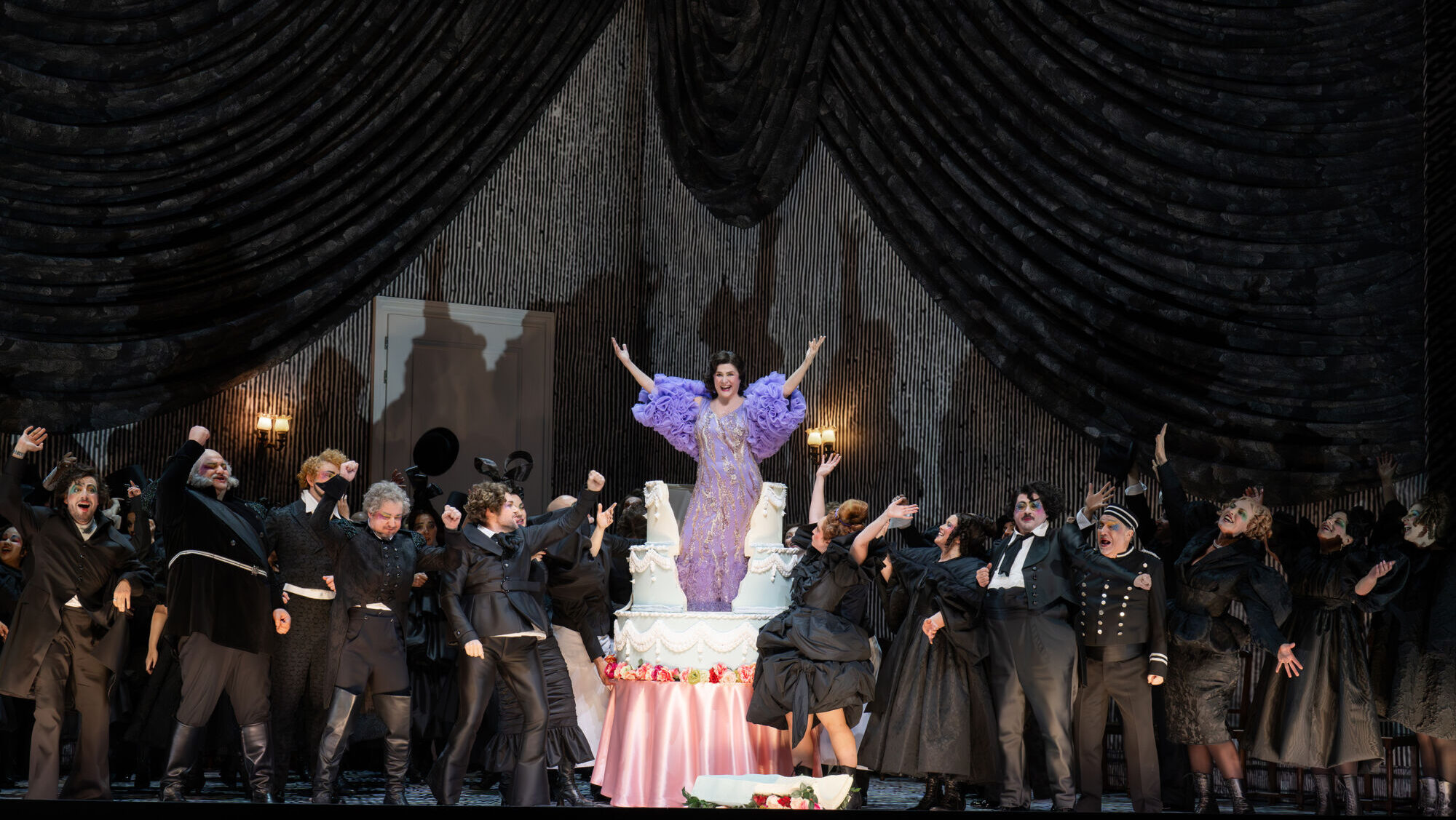
Photo: Monika Rittershaus/Salzburg Festival
Rossini wrote Viaggio for a company of virtuosi — it has ten major, demanding roles — and the Salzburg cast supplied both the vocal finish and comic nerve required. Bartoli, as the poetess Corinna, had comparatively little stage time, but she made it count. The music that Rossini gives her does not depend on torrents of coloratura, but rather poise, sensitivity to text and a shapely line. Bartoli supplied all three and graciously ceded the stage to her numerous, highly accomplished co-stars.
That ensemble had no weak links: Marina Viotti’s darkly colored Melibea and Dmitry Korchak’s ardent, jealous Libenskof gave the evening its strongest romantic charge, while Tara Erraught made Madama Cortese, the hotel’s proprietress, a bright and shrewd comic nerve center. Edgardo Rocha brought an elegant ease to the vain French officer Belfiore; Florian Sempey gave Don Profondo’s catalogue aria verbal bite and theatrical swagger; and Misha Kiria’s Trombonok, the gang’s preposterous German music lover, supplied the surrounding frenzy with a firm comic bass line. Mélissa Petit’s Contessa di Folleville made the presumed loss of her hat — and what a hat it was! — seem like a first-class tragedy. Ildebrando D’Arcangelo, as Lord Sidney, was especially deft at being daft, his comic manner dry and unexpectedly nimble, without the strain that often afflicts singers asked to be funny. At the end of the performance, Bartoli popped out of a birthday cake, not as Corinna, but rather as La Ceci, the birthday girl.
For Kosky, this Viaggio feels like a break from the serious and often dark repertoire he has busied himself with this season, Lady Macbeth of Mtsensk, Siegfried and the upcoming Die Frau ohne Schatten. However, comedy of this kind is not a vacation from seriousness, but rather a different display of prowess.
That is why the production feels so welcome in Salzburg now. After the leadership drama and before a summer program still shaped by the absent Hinterhäuser’s appetite for scale and difficulty, Il viaggio a Reims restored something Salzburg has not always handled easily in recent years: sophisticated pleasure.
A.J. Goldmann
A.J. Goldmann is an American writer and critic based in Munich and Berlin. He is a longtime contributor to The Wall Street Journal, The New York Times and The Forward. He has also written for The Atlantic, The New Republic, The Guardian, The Spectator and Gramophone Magazine. Between 2007 and 2023, when it folded, he was the Berlin, Vienna and
Salzburg correspondent for Opera News Magazine.
-
Topics: Review, salzburg festival
-
People: Alexander Pereira, Asmik Grigorian, Barrie Kosky, Cecilia Bartoli, Christoph Marthaler, Dmitry Korchak, Edgardo Rocha, Florian Sempey, Franck Evin, Gianluca Capuano, Ildebrando D'Arcangelo, Kirill Petrenko, Kirill Serebrennikov, Marina Viotti, Markus Hinterhäuser, Martin Kusej, Mélissa Petit, Misha Kiria, Otto Pichler, Peter Sellars, Rolando Villazón, Romeo Castellucci, Rufus Didwiszus, Simon Stone, Sven-Eric Bechtolf, Tara Erraught, Teodor Currentzis, Victoria Behr, Warlikowski
-
Works: Bluebeard's Castle, Carmen, Das Rheingold, Die Frau ohne Schatten, Don Giovanni, Elektra, Falstaff, Fiddler on the Roof, Il barbiere di Siviglia, Il viaggio a Reims, Kát'a Kabanová, La belle Hélène, La Clemenza di Tito, Lady Macbeth of Mtsensk, Le nozze di Figaro, Lear, Macbeth, Orphée aux enfers, Saint Francois d'Assise, Salome, Siegfried, The Bassarids, The Greek Passion, West Side Story, Wozzeck
-
Places & Organizations: Berlin Philharmonic, Salzburg Easter Festival, Salzburg Festival