High and dry
Ilana Walder-Biesanz reports from The Santa Fe Opera, where Tobias Picker‘s latest opera falls short, a new Rodelinda scintillates, and sumptuous singing abounds across the entire repertoire.
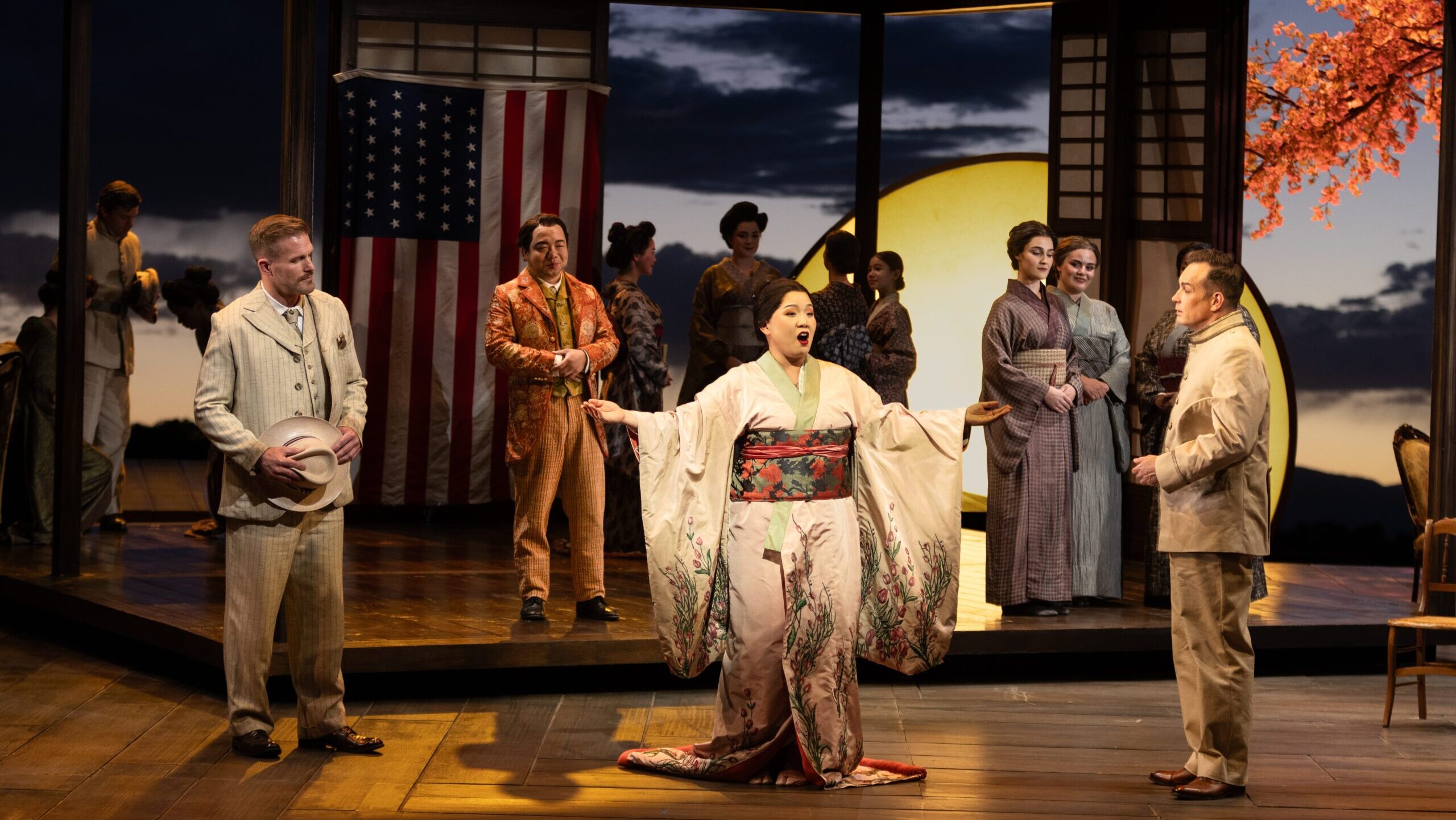
Background: The Santa Fe Opera Chorus, Ya-Chung Huang (Goro), Darya Narymanava (Mother), Sophia Baete (Aunt); Foreground: Jarrett Ott (Sharpless), Karen Chia-ling Ho (Cio-Cio-San), Stephen Costello (B.F. Pinkerton), by Bronwen Sharp for the Santa Fe Opera
The Santa Fe Opera has an enviable position. The stunning location provides built-in backdrops and serves as bait for talent, affording opportunities for luxury casting. (What singer wouldn’t like an excuse to spend the summer in Santa Fe?) Combine that with their tried-and-true programming mix – three recognizable titles, one relative obscurity, and one American or world premiere – and a festival schedule that lets devotees see five operas in as many nights. Voila! The perfect recipe to attract audiences from across the country.
My week began with Madama Butterfly, in Lee Blakeley‘s beloved and much-revived production (premiered here in 2010). I have a well-documented history of indifference to Puccini, so I can confess that Butterfly often leaves me cold. Not this one. The best Butterfly I have ever seen (live or on film), it left me questioning my opinion of the opera.
Credit goes first and foremost to the revival director, Melanie Bacaling, who delivered a master class in what opera direction should be. Every gesture, movement, and beat of the entire performance carried motivation and specificity. Every pair of characters that interacted showed a nuanced relationship. There was not a single moment of vague handwaving, aimless wandering, or vacant singing. Blakeley’s production (sets by Jean-Marc Puissant and costumes by Brigette Reiffenstuel), with its simple period realism and freedom from extraneous exoticized detail, provided the perfect setting.
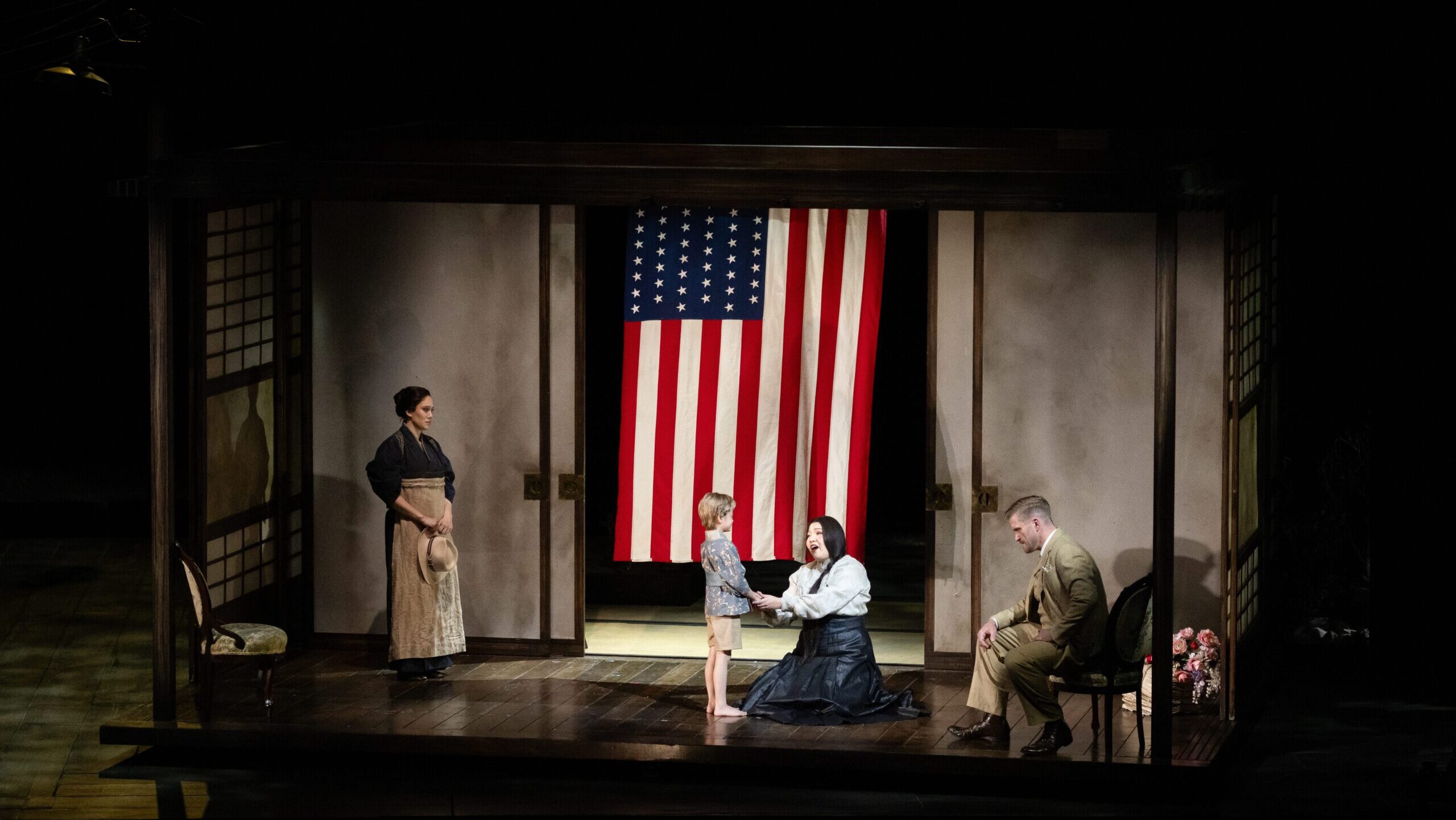
Sun-Ly Pierce (Suzuki), Hanako Ingliss (Trouble), Karen Chia-ling Ho (Cio-Cio-San), Jarrett Ott (Sharpless), by Bronwen Sharp for the Santa Fe Opera
The other revelation was Karen Chia-ling Ho as Butterfly. Her sound is not pure beauty (though it has plenty of beautiful moments), but it is highly expressive and exciting. “Un bel di” displayed a wide range of colors, but it was an acting showpiece as much as a vocal one. You could really see her seeing Pinkerton’s arrival play out before her. Ho also possessed an affecting artlessness. Most sopranos in the role can’t pass for 15; Ho can, and her childish outpourings of delight, hope, and anger never felt forced.
While Stephen Costello’s Pinkerton initially wavered between inaudibility and an over-muscled sound, he gained power and ease by his end-of-Act-one duet with Butterfly. There, he conveyed real passion and tenderness; for a minute, this cad believed his own lies. Pinkerton has few other redeeming moments in this version of the score (the 1904 Brescia edition; Puccini toned down Pinkerton’s villainy in later revisions). Costello accepted his curtain call boos (intended for the character, not his performance) with good grace.
As Sharpless, Jarrett Ott proved suave of manner and pleasantly grainy in tone. Sun-Ly Pierce’s Suzuki was deeply tender and highly protective towards Butterfly. Pierce’s warm mezzo complemented Ho’s voice beautifully in their flower petal duet, and her Act III trio with Pinkerton and Sharpless was a surprise musical highlight. Smaller roles and chorus were also well-cast, with an especially lovely blend of sound in the humming chorus. Led by John Fiore, the Santa Fe Opera Orchestra gave a lush rendition of the score.
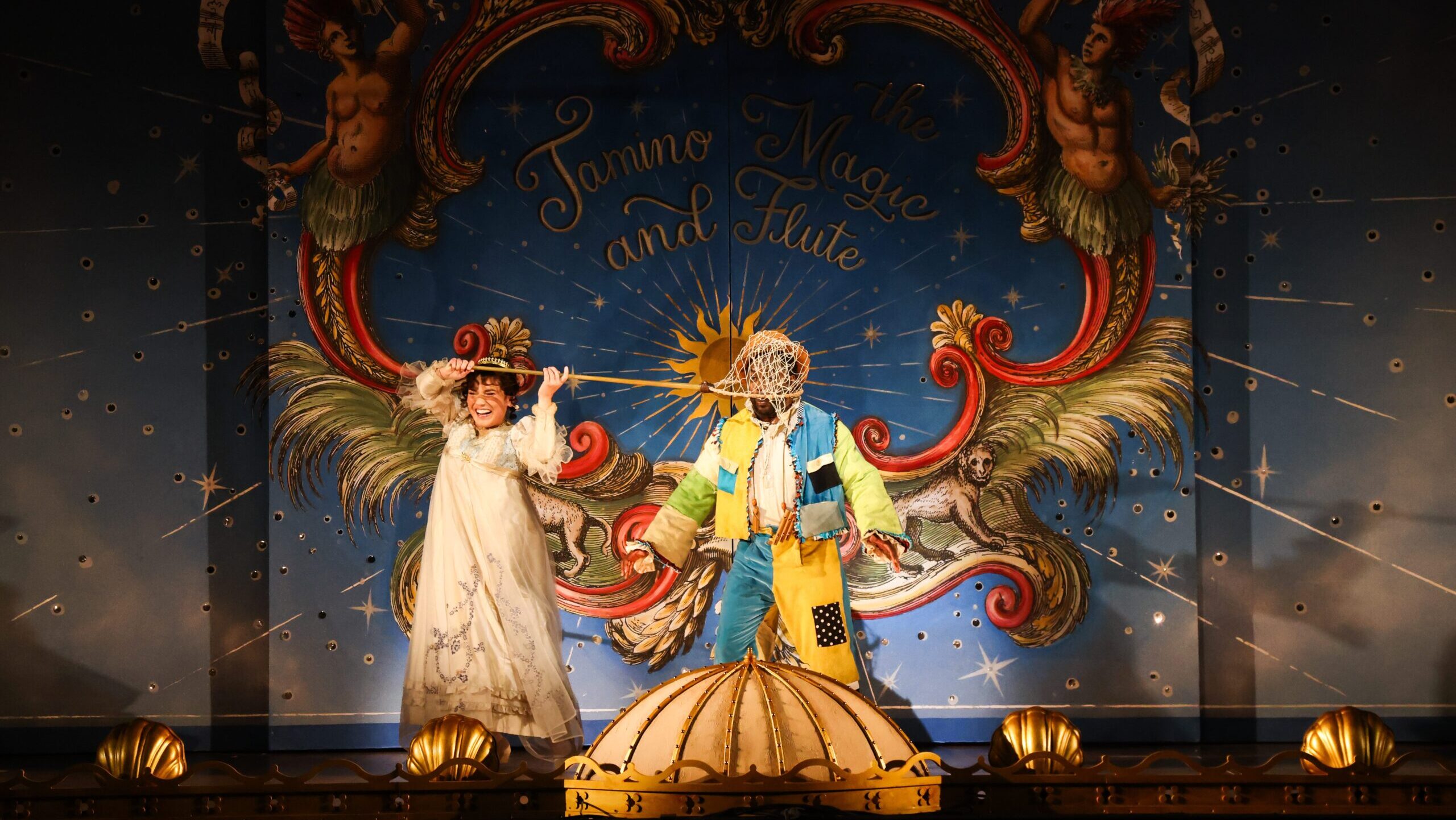
Joélle Harvey (Pamina), Will Liverman (Papageno), by Bronwen Sharp for the Santa Fe Opera
Tuesday night was something completely different, and less to my taste. Christopher Luscombe’s Magic Flute is exactly what he says it is, a British panto with Mozart’s opera for its text. If you enjoy the conventions of panto – extended gags, comedic cross-dressing, mimed actions, audience participation, and winking self-awareness – you’ll love this. It’s a cohesive, beautifully rendered example of the genre, with (of course) a much better score than most pantos can boast. Unfortunately, I found it all rather forced and unfunny.
That’s not to say there weren’t elements worth marveling at. Simon Higlett’s sets perfectly evoked a jewel box theater of the 19th century. An impressive smoke-breathing dragon gave Tamino something worth running away from (a surprising rarity among Magic Flutes). The airship on which the three boys arrived had a steampunk flair, and it was impossible not to be charmed by the circus animals that appeared when Tamino played his flute. This is also a doubly magical flute: not only does it tame ball-balancing seals and top-hatted bunnies, it also levitates. Astounding illusions (by Chris Fisher) provoked awed gasps every time.
In keeping with pantos’ tradition of accessibility, the production was sung (and spoken) in an English translation by Jeremy Sams. Inevitably, pieces of the text lost some of the power of the German original, but overall, this English version landed smoothly on the ears. The transladaptation enabled this production to sidestep some of the text’s thorniest issues of racism and misogyny, and to add panto-style self-references (e.g., Papageno to Pamina: “Shall we do some dialogue?”). Less successfully, this script added backstory on Pamina’s father and the motivation for the Queen of Night’s feud with Sarastro. Sams presumably thought he was filling plot holes. But making sense of The Magic Flute’s plot is a quixotic task, so adding detail only further confuses matters.
At least this Flute was a joy to listen to. After an initially tentative overture, the orchestra (conducted by Harry Bicket) gained assurance and energy, without ever overwhelming the singers. Tamino’s (Josh Lovell’s) bright tone and clear diction suited the panto hero, while Will Liverman’s Papageno hammed it up both facially and vocally. In his more lyrical moments, he displayed a steely-cored voice that beautifully complemented Joélle Harvey’s soprano. Harvey has a thicker sound than many Paminas, and an impressive trick of thinning it out to the merest wisp and then letting it re-blossom – an effect she used frequently (and well). Jeni Houser’s quick runs, light tone, and cutting precision above the staff made for an elegantly evil Queen of Night. As her nemesis Sarastro, Alexander Köpeczi had nice droning bottom notes but some vocal hitches in the middle range.
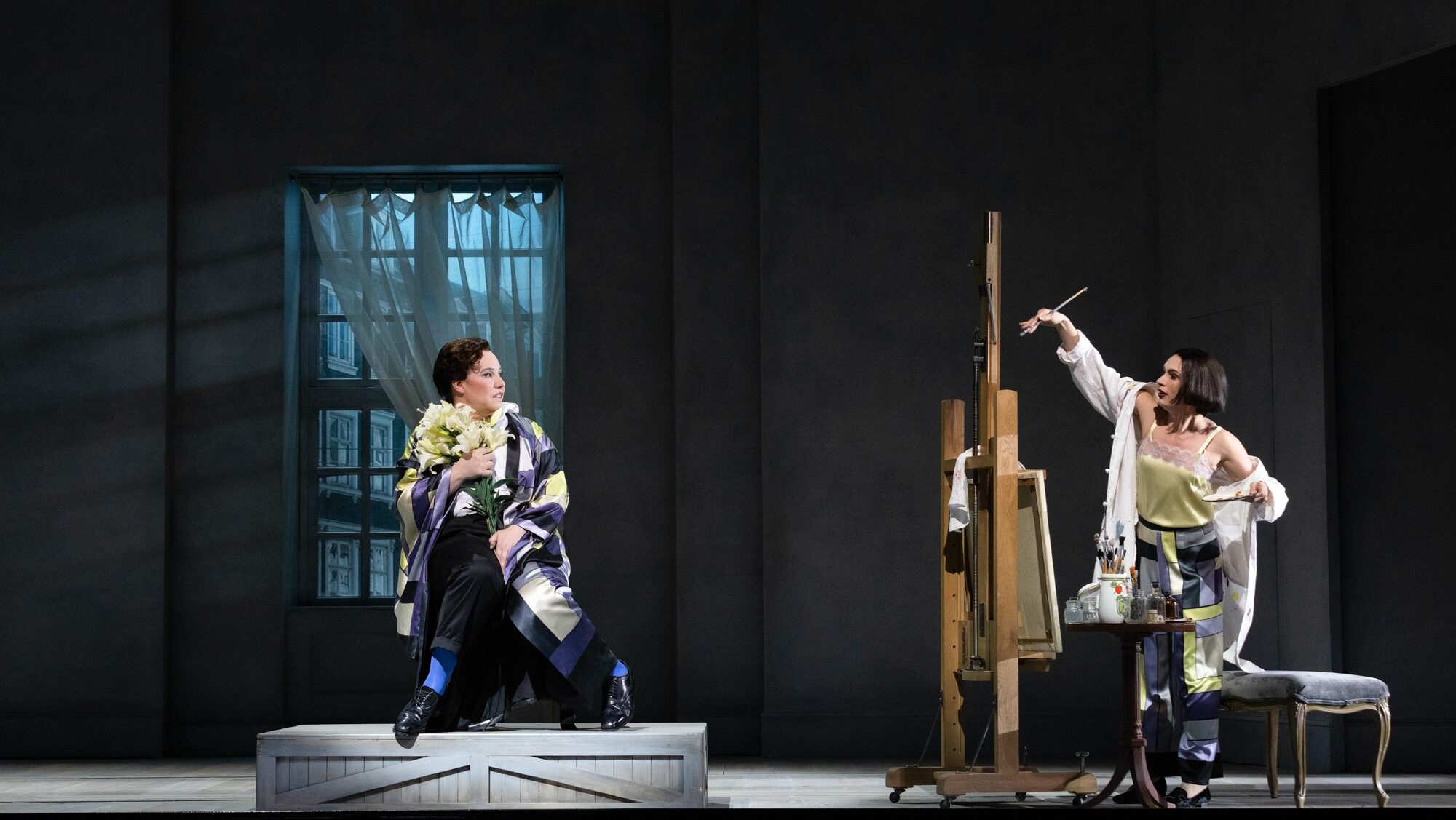
Lucia Lucas (Lili Elbe), Sylvia D’Eramo (Gerda Wegener), by Bronwen Sharp for the Santa Fe Opera
The midpoint of the week was Tobias Picker’s newest opera (an American premiere): Lili Elbe. Lili, a celebrated landscape painter and one of the first trans women to undergo gender reassignment surgery, is best known to modern audiences through the 2015 film The Danish Girl. Picker’s opera, with a libretto by Aryeh Lev Stollman, follows her explorations of identity, her increasingly complicated relationship with her wife Gerda Wegener, her legal recognition as a woman, and her death due to surgical complications. The work opens with Lili and Gerda attending a production of (a new, Berg-like setting of) Orpheus and Eurydice. It uses the myth as a recurring touchpoint, both for troubling the concept of gender, and for the theme of “not looking back.”
As a queer writer who has written a lot about gender play in opera, I wanted to love this opera. But I didn’t. For me, its fatal flaw is that Stollman’s libretto paints Lili as monstrously narcissistic, making it hard to sympathize. Throughout the opera, she upstages or ignores her devoted, supportive wife. She is so monomaniacal in her pursuit of “real womanhood” that she neglects to ask questions about the price of getting there (for instance, the source of the uterus the doctor will transfer – which, in fact, comes from an unwilling donor). The opera also centers Lili’s identity struggle so strongly that there is hardly a moment of lightness. Every scene is Lili, Lili, Lili, and it’s always existential: the elation of affirmation or the despair of rejection.
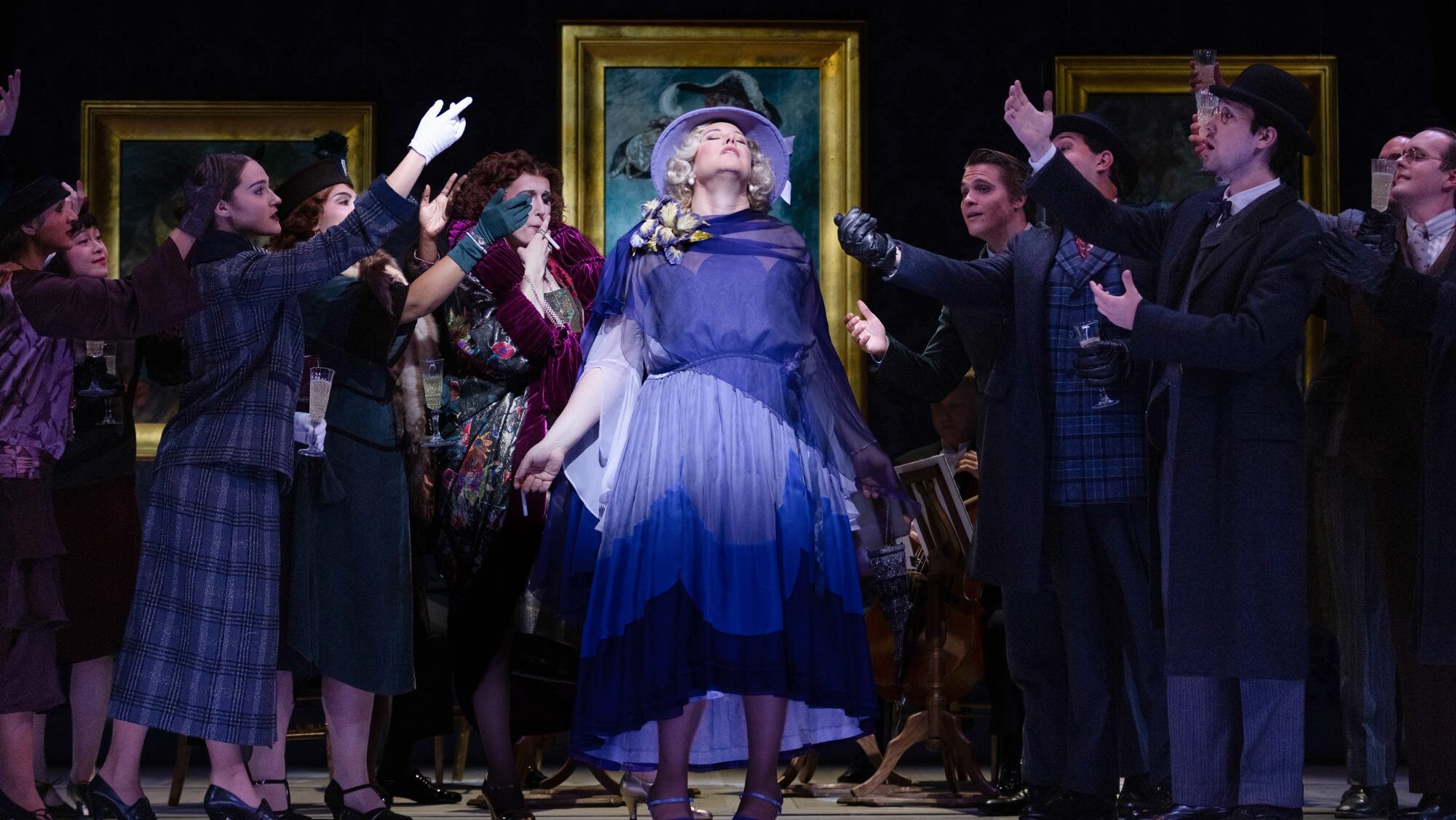
Lucia Lucas (Lili Elbe), The Santa Fe Opera Chorus, by Bronwen Sharp for the Santa Fe Opera
Picker’s solo vocal writing also created a sense of distance when I wanted to feel connected to the characters. Jagged intervals and halting rhythms neither allowed for transcendent lyricism nor followed the cadences of speech. I found the orchestral and choral writing more effective. The orchestra evoked the opera’s 1920s setting with jazzy sound and playful weaving in-and-out of melodies. Different cities got distinct sonic worlds. Paris sounded most fun, a fast waltz with blaring brass and climbing scales that threatened to run away. The Act I chorus “Everything everywhere transformed” was the musical highlight of the opera, with its layered harmonies and watery ebb and flow. In Act II, the dissonant and largely a cappella chorus “I wonder if someday…” also wowed. With this varied and challenging score, conductor Roberto Kalb, chorus director Susanne Sheston, and the entire Santa Fe Opera Orchestra and ensemble proved their impeccable musicianship.
So too the solo cast. The role of Lili was written for Lucia Lucas, and it beautifully displays her smooth, rolling baritone. As her beloved Gerda, Sylvia D’Eramo sang with full tone and shimmering wistfulness. As the doctor Professor Warnekros, Andrew Harris’s rich, hollow resonance and reassuring presence inspired confidence. (No wonder Lili trusted him far more than he deserved!) Over a dozen supporting solo roles were ably filled. Standouts included Lindsay Martin’s reedy Anna/Orpheus, Deanna Ray Eberhart’s sharp-edged Dagmar, and Lindsay Ammann’s ringingly authoritative Mother Wegener.
I certainly can’t blame my distaste on the production, either. Director James Robinson kept the action focused and easy to follow. Allen Moyer’s sets were mostly practical and realistic, with the occasional moment of evocative drama (e.g., ornate opera boxes that appeared not just for the opera-within-an-opera scene, but also in the “operating theater” of Lili’s surgeries). Ghostly projections of Orpheus and Eurydice (by Greg Emetaz) chased each other across the walls during scene transitions. Marco Piemontese’s sumptuous costumes seemed to be pulled straight from a period magazine: A velvet cocoon coat for the diva, art deco block patterns for Gerda, wispy lavender concoctions for Lili, a fantastic peacock-feather headdress for the party-loving countess… every piece told its wearer’s story — and made me long to steal it for my closet!
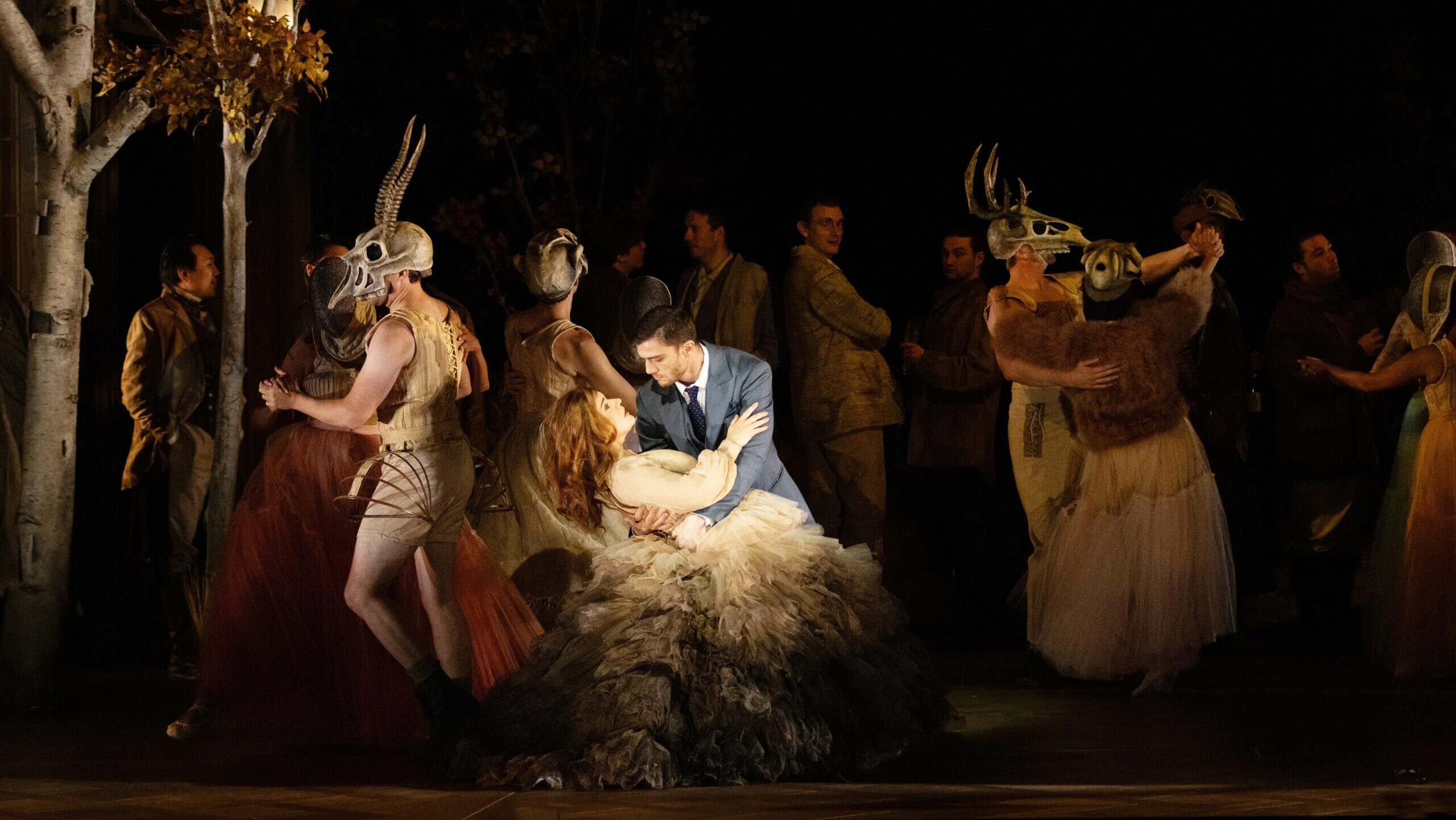
Olga Kulchynska (Tatyana), Mattia Olivieri (Eugen Onegin), The Santa Fe Opera Chorus, Supernumeraries, by Bronwen Sharp for the Santa Fe Opera
Next up was a familiar friend, Alessandro Talevi‘s production of Eugene Onegin, which I last saw here in 2021. Talevi stages this opera as a memory play: Tatyana looking back, sometimes on a romantic dream and sometimes on a nightmare. There is nothing subtle about the production. The trees growing inside the house, the corps of dancers wearing skull heads or fencing masks (sometimes playing animals, sometimes crowds), the debauched chaos of the ball that causes Lensky’s challenge – all of it has the oversaturated tint of recollection. Conductor Keri-Lynn Wilson led the orchestra in a similarly unrestrained interpretation, from the sensuously swelling overture, to the knife’s-edge frenzy leading up to the Act I confrontation, to the energetic polonaise and gallop of Act III. It borders on schmaltzy, but it’s the right choice to match this staging. The chorus got the same memo, delivering vigorous sound and physicality in their scenes.
There’s just one problem: it’s impossible to understand why Tatyana falls in love with this Onegin. Every Onegin is haughty and careless, but this one was consistently, gratuitously cruel. He ended his lecture to Tatyana with a sneer, dropped her mid-dip at the ball, and in Act III switched from humble pleading to violent command at her first sign of weakness. Mattia Olivieri’s voice also failed to seduce. He is certainly handsome, and parts of his range hold an attractive brassiness, but syllabic singing and faltering top notes undercut the effect.
On the other hand, Olga Kulchynska’s Tatyana sparkled. Her letter scene showed a full palette of tones: in turns light, plaintive, meaty, and whisper-soft. Despite its title, Onegin is more Tatyana’s opera than Onegin’s, and Kulchynska carried it. The rest of the cast was a mixed bag. Lindsay Ammann (Olga) had crunchy low notes but an artificially dark timbre. Susan Graham’s (Larina’s) text-forward, matter-of-fact delivery contrasted with Meridian Prall’s (Filipyevna’s) sonorous legato, but the two still blended beautifully in their duet. Iván Ayón-Rivas sang a young, earnest Lensky in a pleasant tenor, full of squillo but free from strain. In “kuda, kuda,” he allowed a breathy wistfulness into his tone. Ya-Chung Huang made a foppish, mincing, pretty-sounding Triquet, and Tzvi Bat Asherah was in fine, full voice as the scrupulous Zaretsky. My verdict on Alexander Köpeczi’s Prince Gremin matched my impression of his Sarastro: crackling low notes but a muddled middle.
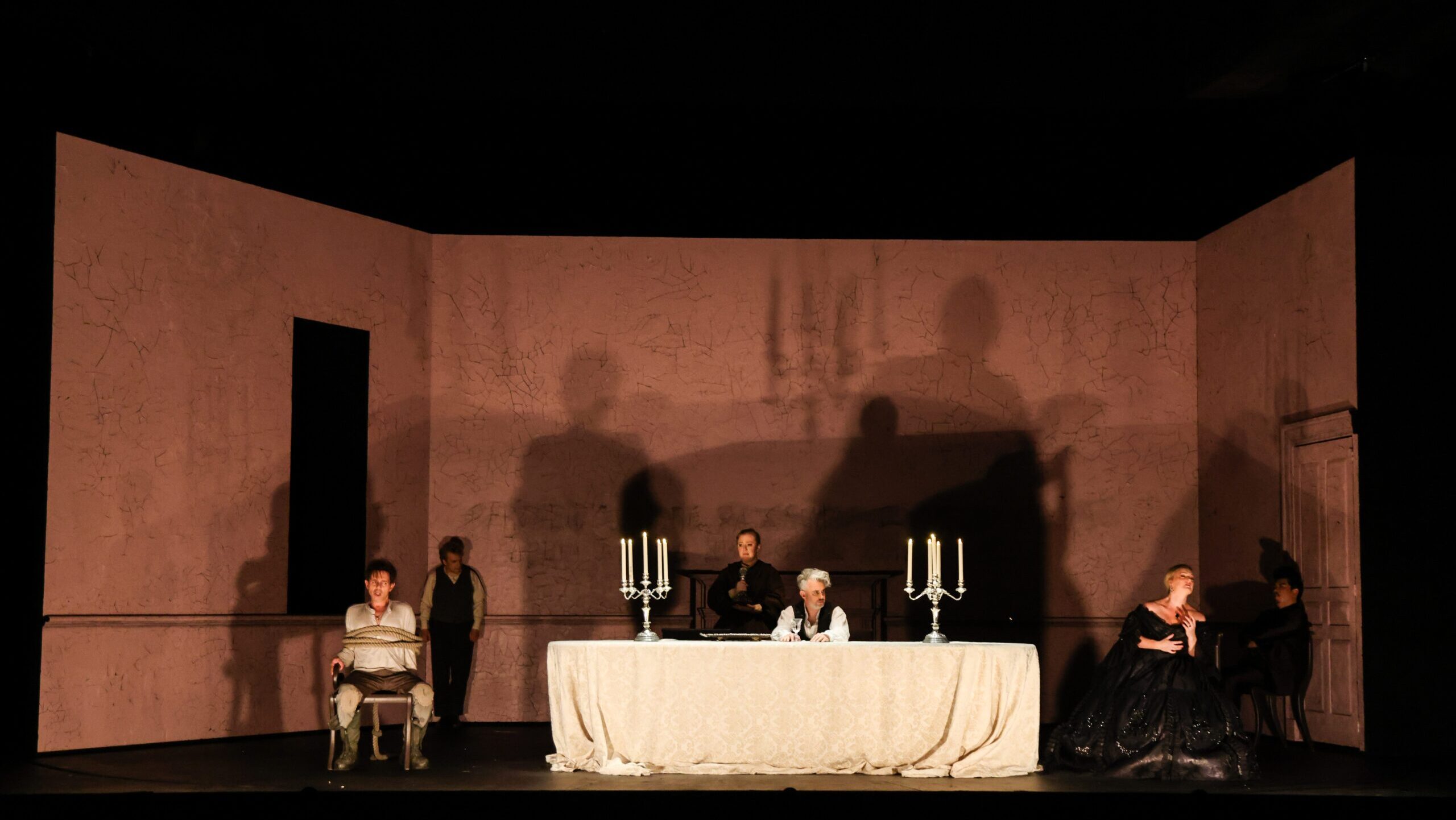
Iestyn Davies (Bertarido), Hugh Cutting (Unulfo), Meridian Prall (Eduige), Anthony Gregory (Grimoaldo), Lucy Crowe (Rodelinda), William Guanbo Su (Garibaldo), photo by Bronwen Sharp for the Santa Fe Opera
A final treat to round out the week: Handel’s Rodelinda. As Michael Clive’s program notes reminded operagoers, this is the opera that (in 1920) brought Handel back into the repertoire after over 150 years of neglect. R.B. Schlather’s Victorian-melodrama-meets-film-noir staging, sung by an outrageously talented cast, made it easy to see why Rodelinda could spark a revival. Emotions and stakes ran high throughout, and I found myself riveted by anticipation, even though I knew exactly how it would end. (This is opera seria, after all; the conventions of the genre are strong.)
The scenario is rather mixed. Bertarido, King of Lombardy, has fled and is believed to be dead. His widow, Rodelinda, is being wooed by the usurper, Grimoaldo – much to the chagrin of his ex-fiancée (and Bertarido’s sister), Eduige. Two aides complete the cast: Bertarido’s loyal servant Unulfo, and Grimoaldo’s evil sidekick Garibaldo. After a roller coaster of arias expressing despair, love, and vengeance, virtue triumphs. Bertarido saves Grimoaldo’s life by killing Garibaldo mid-assassination-attempt, and the grateful Grimoaldo renounces his pretensions to both the throne and Rodelinda’s hand.
Schlather’s staging heightens the tension. All the action takes place in a single room and the hallways just outside it (with a revolving stage offering seamless transitions). Pseudo-Victorian costumes by Doey Lüthi prioritize vibes over accuracy; Rodelinda’s mourning outfit complete with a gauzy black veil and long vinyl gloves is a particular triumph. But the star of the production is Masha Tsimring’s masterful lighting. Deep shadows and sudden transitions create the noir aesthetic, and projected silhouettes make the audience dread each approaching eavesdropper or assassin.
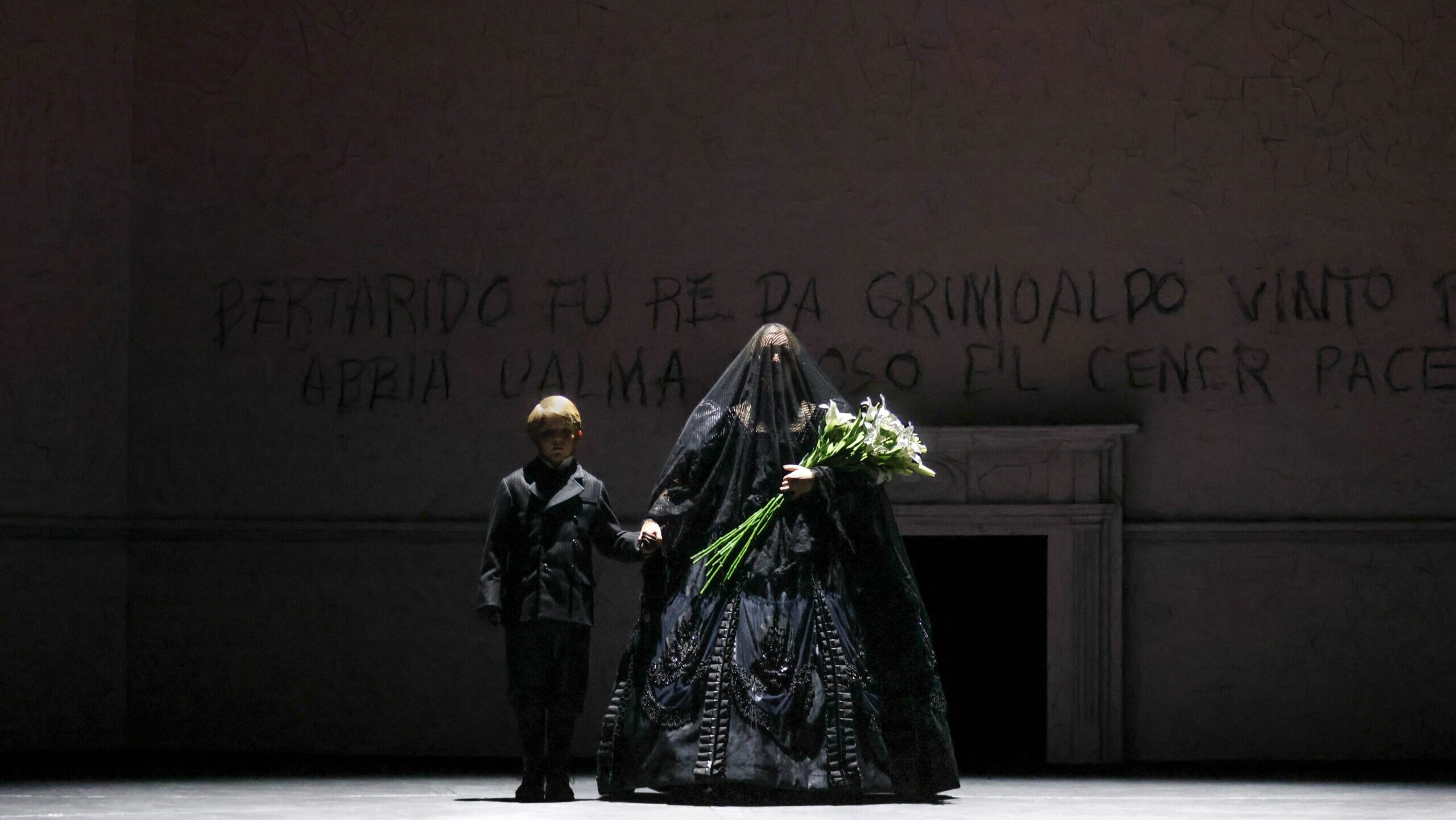
Maximilian Moore (Flavio), Lucy Crowe (Rodelinda), photo by Bronwen Sharp for the Santa Fe Opera
Musically, this was Handel as it deserves to be heard. As Rodelinda, Lucy Crowe deployed absolute straight tone to eerie effect, sometimes sounding more like a flute than a singer. She rattled off her role’s wild runs and trills with careless ease. Crowe made an ideal pairing with countertenor Iestyn Davis as Bertarido. From his first aria, he showed off an angelic, pure timbre and flawless dynamic control. His role also posed plenty of tests of agility (none more than his final aria, “Vivi, tiranno!”), which he passed with distinction. When Lucy and Iestyn finally sang a duet (after nearly two hours of nothing but recitative and da capo arias), I had to close my eyes. As wonderful as the staging was, I wanted no distractions from the perfection of those two voices together.
William Guanbo Su gave the evil Garibaldo swaggering glee, vain self-absorption, and husky tone; you could see why he was able to get away with villainy for so long. As Eduige, Meridian Prall moved seamlessly from a chesty lower range to soaring top notes. Hugh Cutting made an engagingly chipper, bright-voiced Unulfo. As Grimoaldo, Anthony Gregory often sounded a bit underpowered, though his final aria (“Pastorello d’un povero armento”) displayed solid tone and well-executed trills. Conductor Harry Bicket made the Santa Fe Opera Orchestra sound like they play Baroque repertoire every summer (I wish!), giving Handel’s score a stately elegance and staying tightly coordinated with the singers throughout fast-moving pieces.
With such a strong start and finish, plus plenty of vocal and dramatic delights in between, my week in Santa Fe left me with an opera high – and the desire to return, summer after summer.

Ilana Walder-Biesanz
Ilana Walder-Biesanz, based in Houston, Texas, is a longtime opera fan and critic with a particular affinity for opera seria, trousered mezzos, and unhinged directorial choices. After an undergraduate degree in engineering from Olin College, she ran away to Europe for an M.Phil. in European Literature and Culture at Cambridge (with a thesis on La clemenza di Tito) and a Fulbright year investigating contemporary stagings of classic theater and opera in Germany. By day, she is CEO of the education nonprofit National Math Stars. On non-opera nights, you can find her ballroom dancing, assembling historically accurate outfits for reenactments, or vegging with her wife (Ellen) and their two cats (Cherubino and Muñeca).
-
Topics: Review, the santa fe opera
-
People: Alessandro Talevi, Alexander Köpeczi, Allen Moyer, Andrew Harris, Anthony Gregory, Aryeh Lev Stollman, Brigette Reiffenstuel, Chris Fisher, Christopher Luscombe, Deanna Ray Eberhart, Doey Lüthi, Greg Emetaz, Harry Bicket, Hugh Cutting, Iestyn Davies, Iestyn Davis, Iván Ayón-Rivas, James Robinson, Jarrett Ott, Jean-Marc Puissant, Jeni Houser, Jeremy Sams, Joélle Harvey, John Fiore, Josh Lovell, Karen Chia-ling Ho, Keri-Lynn Wilson, Lee Blakeley, Lindsay Ammann, Lindsay Martin, Lucia Lucas, Lucy Crowe, Marco Piemontese, Masha Tsimring, Mattia Olivieri, Melanie Bacaling, Meridian Prall, Michael Clive, Olga Kulchynska, R.B. Schlather, Roberto Kalb, Simon Higlett, Stephen Costello, Sun-Ly Pierce, Susan Graham, Susanne Sheston, Sylvia D’Eramo, Tobias Picker, Tzvi Bat Asherah, Will Liverman, William Guanbo Su, Ya-Chung Huang
-
Works: Eugene Onegin, Lili Elbe, Madama Butterfly, Rodelinda, The Magic Flute
-
Places & Organizations: Santa Fe Opera, Santa Fe Opera Orchestra