Ma queer immortelle
San Francisco Opera hosts an exuberant tribute to queerness past and present.
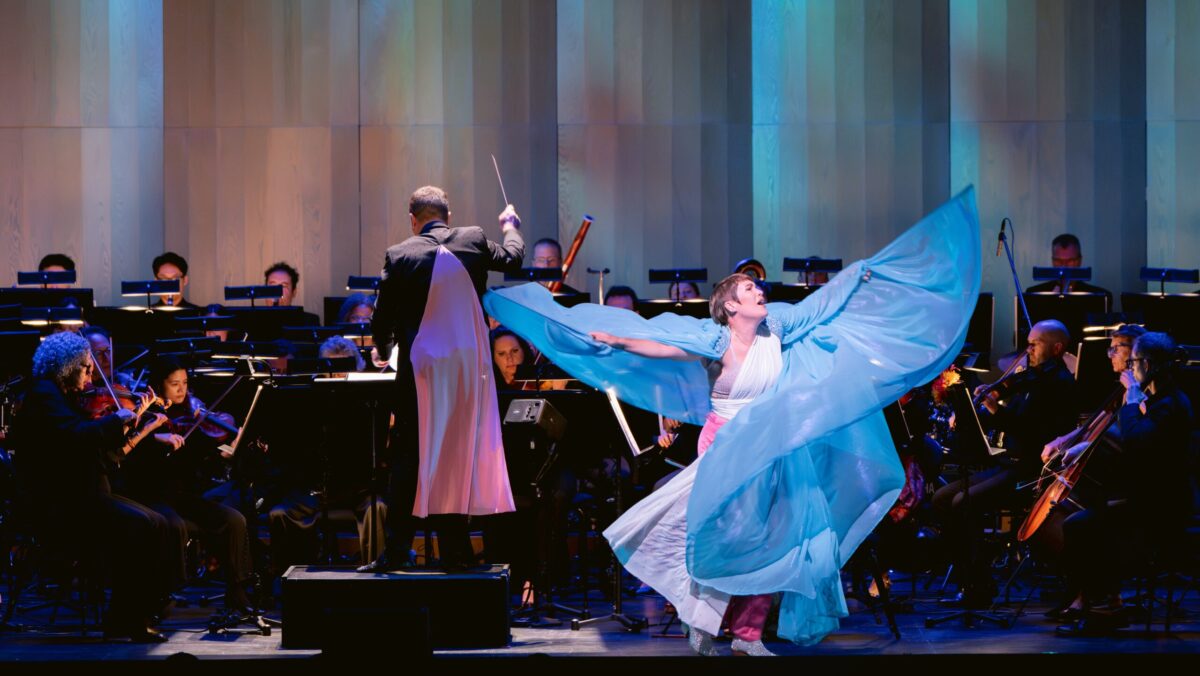
Photo: Kristen Loken/San Francisco Opera
Opening night of the San Francisco Opera. September 8, 1989. In a little more than a month, the opera house would sustain significant damage in the Loma Prieta Earthquake. That night, however, it was a different type of earthquake that rocked the building: Just before the baton dropped on Verdi’s Falstaff, members of the activist groups ACT UP San Francisco walked down the aisles of the orchestra section, blew whistles, and unfurled a banner that read “You have the power to stop AIDS!” The Los Angeles Times would dub the event a “melée” as police escorted the protestors out and the opera began.
While the audience was filled with philanthropists who funded AIDS research, and the San Francisco Opera had hosted AIDS benefits, even in San Francisco queer activism was not looked upon kindly.
35 years after that infamous opening night, the company produced its second Pride Concert last weekend to coincide with the city’s world-famous SF Pride celebration.
While queerness does not always need to be associated with death, it was humbling to walk into the War Memorial Opera House on a night devoted to queer visibility and feel the ghosts of the choristers, costumers, wig-makers, technicians, office staff, and patrons—many of whom succumbed to what was most fearsome pandemic since the Spanish Flu. Ironically, San Francisco Opera was founded in the aftermath of that public health disaster, a century almost to the year that the company closed due to COVID-19. And we heal.
Hosted by drag queen (and RuPaul’s Drag Race alum) Sapphira Cristál, the Pride Concert was a full circle moment. Queerness was in the audience and onstage this time around.
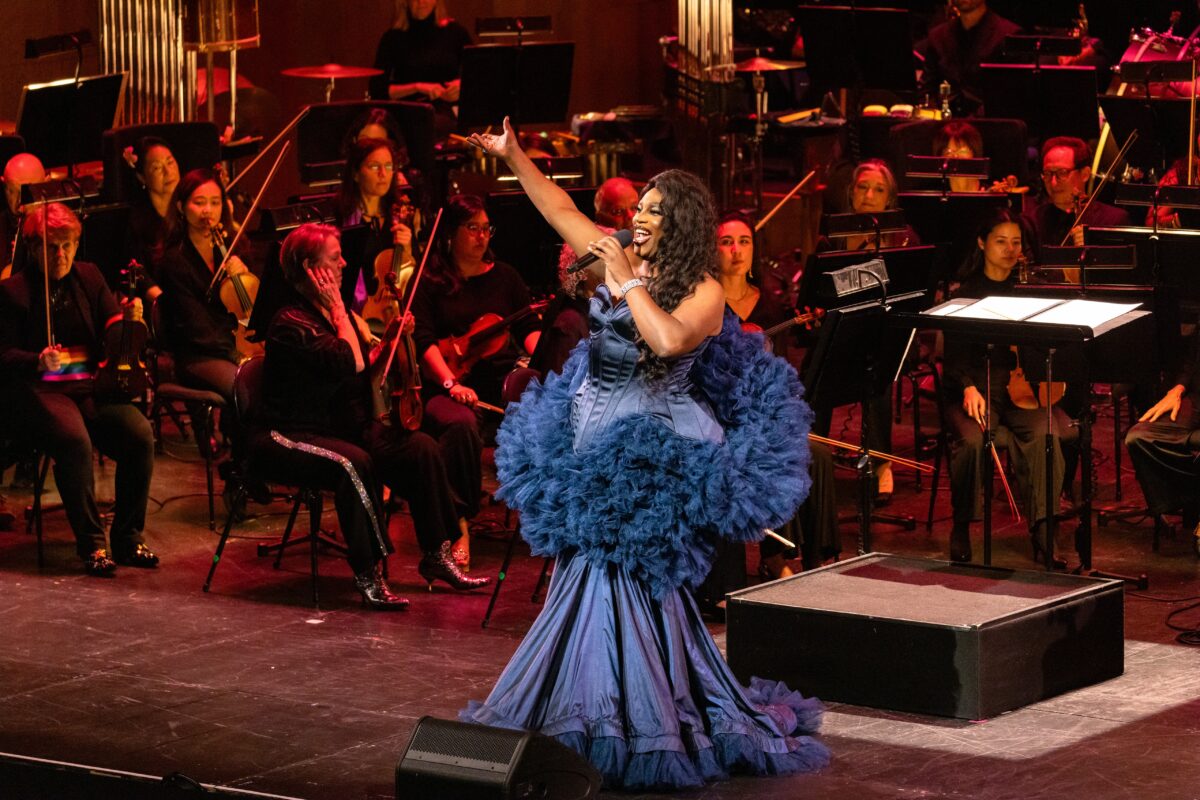
Photo: Reneff-Olson Productions
The concert opened with a classy and welcome tribute to a queer icon: Michael Tilson Thomas. A justly revered figure here in San Francisco from his years as music director of the San Francisco Symphony, Thomas was also out and openly married to his husband Joshua Robison long before it was safe to be so (they died months apart within the past year).
San Francisco Opera’s general director Matthew Shilvock honored Thomas in his opening remarks, and conductor Robert Mollicone led the San Francisco Opera Orchestra in Thomas’ tone poem Agnegram. Tuneful and melodic and, like Thomas, approachable yet puckish, it bore the imprint of composers whom Thomas had championed in San Francisco and across the globe–notably Charles Ives and George Gershwin. As we listened, we all, in a sense, sat shiva and both mourned and celebrated. Kudos to the company for including this in the program.
The evening was a standard opera concert, mixing in arias and duets with pop music and contemporary music theatre. Soprano Melody Moore, mezzo-soprano Nikola Printz, and baritone Reginald Smith, Jr. were the headliners, with monologues by Cristál interspersed and with support from Adler Fellowship participants Sadie Cheslak, Alexa Frankian, and Thomas Kinch.
The through-line of the evening’s repertoire was clever: different aspects of the queer experience as experienced by different genders, ages, locations, even eras. The curation was smart without making it all seem like a master’s thesis.
Of the operatic repertoire, perhaps the most affecting performance was Smith’s rendition of the aria “Peculiar Grace” from Terence Blanchard’s opera Fire Shut Up in My Bones. Smith’s lithe baritone is free of any woolliness or bluster. It’s a lyric instrument perfect for the trickiness of operatically sung English. As a set piece, the aria is gorgeous, with Kasi Lemmons’ poetic libretto making an effective pair with Blanchard’s anxious tonal lushness as Charles describes how his queerness was a difficult fit with the culture of the American South. Smith approached the piece without resorting to maudlin histrionics. It was a classy rendition of what could have been over-the-top.
Taking operatic arias out of context made me appreciate the words (and the various levels on which they operate) more than I might if watching them within their larger works. Such was the case with “La mamma morta” from Umberto Giordano’s Andrea Chénier. When I saw it on the program, I wondered why it was included. Then emcee Cristál reminded me and the audience that it featured prominently in Jonathan Demme’s film Philadelphia, the first mainstream film to speak directly to the AIDS crisis.
After opening the concert with a sweet rendition of a rather forgettable aria from Stephen Schwartz’s opera Seance on a Wet Afternoon, Melody Moore returned for the Giordano. Moore has the perfect voice for verismo scorchers. A vivid memory is seeing and hearing Moore sing Mimí at the War Memorial Opera House nearly two decades ago. Since then, her voice has both deepened and brightened (it has always had a good dose of metal in it). Like her colleague Smith, Moore refused to indulge in histrionics, singing the aria with such a command that we were allowed to listen to (and read) the words. Luigi Illica’s text is simply exquisite:
You are not alone!
I collect your tears!
I’m on your way and I support you!
Smile and hope! I am love!
In a sense, it’s what every queer kid has ever wanted to hear as they negotiate a world so hostile to them: the words of a trusted ally. Moore’s sizable instrument meant that she could meet the bigness of the moment, but it also meant she had some trouble keeping it fully under control, sliding just slightly above or below the pitch at times. Not that it really mattered. It was as arresting a moment as we’ll get in a program of concert arias.
Nikola Printz’s operatic contribution was “Ma lyre immortelle” from Charles Gounod’s let’s-salvage-one-aria-for-concerts opera Sapho. Sapphira Cristál, in introducing the piece, noted the wonkiness of a Sappho who, in Gounod’s telling, is pining over…a man. Gounod also scored the long prelude to the piece using a flute (not a lyre or even a harp). The whole thing is a lovable mess. It’s also rapturous music with a showstopping ending. Printz, in a contemporary Grecian gown of tricolored pink, light blue, and white (the colors of the trans flag) is another singer with a big voice. Their Sappho was no weeping willow, but a woman of thunderous presence. Printz dispensed with some of the more traditional elements of the French lyric opera style (the voice is Italian in timbre and heft) and gave Gounod a verismo edge. As such, the big ending Gounod gives the singer makes sense—though the sheer force of Printz’s voice made that ending a bit of a nail-biter (they got there!).
The operatic part of the evening ended with the Barcarolle from Offenbach’s The Tales of Hoffmann, an opera in which gender-bending and shapeshifting are part of its very fabric. Moore and Printz played it for laughs. It’s a concert, after all, and the preceding arias were all quite serious. That said, I missed the gentle beauty of the duet among all the coyness and cutesy performing. And the busy-ness of the staging (a meet-cute sort of romance) sent the singers into some pitchy waters throughout.
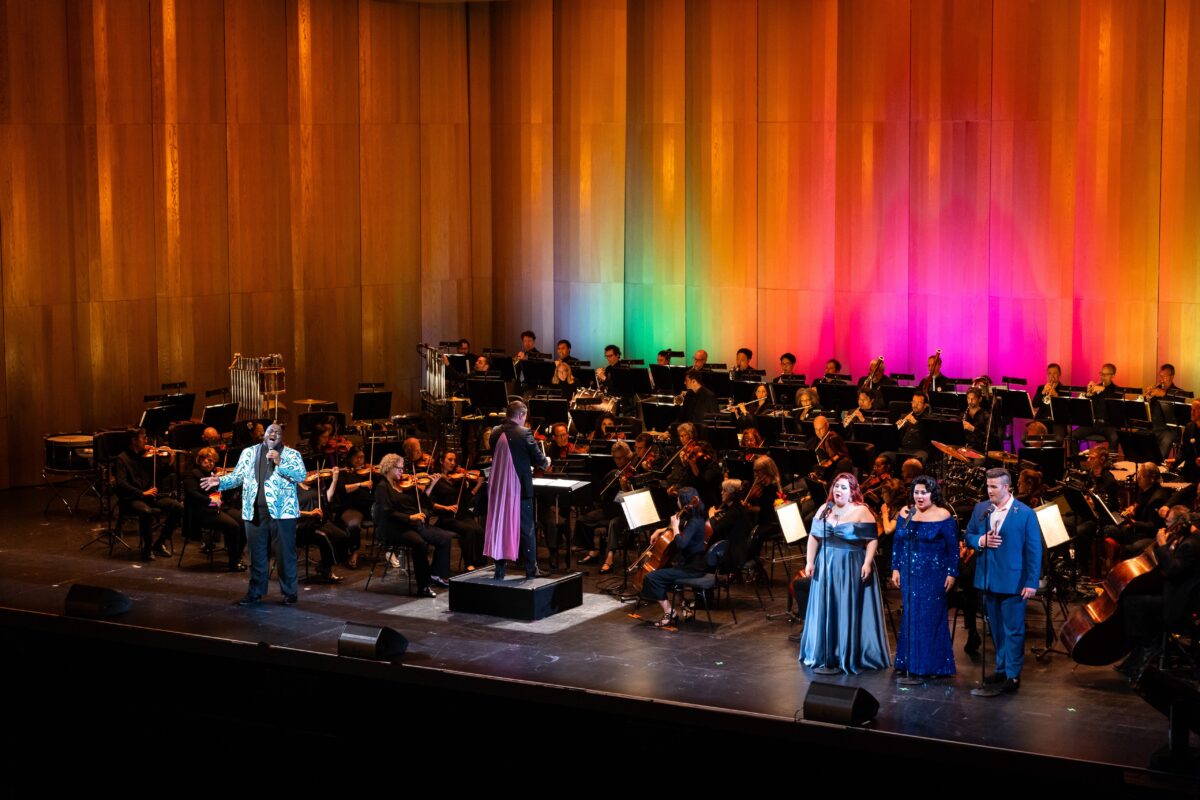
Photo: Reneff-Olson Productions
The rest of the program was devoted to pop music of various genres. Highlights were Melody Moore’s classy and simultaneously raw performance of Brandi Carlile’s “The Joke”, which showed off Moore’s gorgeous chest voice. Moore paired with Nikola Printz for a blazing rendition of kd lang’s hit “Constant Craving”. Reginal Smith, Jr. gave an endearing performance of the Whitney Houston classic “How Will I Know”. It began as a sweet torch song which played up the fumbling awkwardness of the character before becoming the up-tempo charmer we all know and love. Smith returned for a generous account of the Luther Vandross hit “Any Love”.
A constant throughout the evening was Robert Mollicone’s deft leading of the San Francisco Opera Orchestra. We here in San Francisco are blessed with three top-tier large orchestras (San Francisco Symphony, San Francisco Opera Orchestra, San Francisco Ballet Orchestra). At the Pride Concert, the Opera orchestra continued to remind us that they are every bit the equal of any opera orchestra in the world. Mollicone, sporting a pink triangle cape cleverly sewn into this jacket (so on display all evening), was a chameleon, providing expert support in countless genres of music. His tempos allowed the singers room while keeping the evening moving. His command of dynamics was impressive, never overwhelming the singers but giving the orchestra its rightful chance to shine.
Host Sapphira Cristál did her best Whoopi Goldberg-hosting-the-Oscars impression by coming out in a different costume between each set. What made it drag was impishly demanding affirmations from the audience (and chastising them if they were not sufficiently affirming). Cristál has a sweet and, simultaneously, awkward stage presence. She gamely memorized all of the introductions. But there was a certain swagger, a certain elan missing. The concert slowed down quite a bit when it was her turn on stage. However, she also issued some stirring rallying cries at a time when our nation is retrenching on queer rights, with anti-trans hysteria and polls suggesting that support for gay marriage is softening.
I first attended a San Francisco Opera production in 1996. In that year, the AIDS Memorial Quilt was displayed for the first time in its completed form (some of which was on display at the concert last Friday). In that year, the company presented its co-commission of Stewart Wallace’s and Michael Korie’s opera Harvey Milk. And I came out. At the time, I could never have imagined attending anything like the Pride Concert at any opera house or concert hall in America.
Better late than never.
Matthew Travisano
Matthew is a San Francisco-based educator and actor. He has taught and lectured on the performing arts for more than two decades. He has trained a generation of actors in the greater Bay Area at both Oakland School for the Arts and Ruth Asawa School of the Arts, where he has also taught literature, composition, literary theory, and aesthetics. He holds a BA in English from UC Berkeley and a Master's in Teaching (MAT) from San Diego State University.
-
People: Alexa Frankian, Charles Gounod, Jacques Offenbach, Kasi Lemmons, Luigi Illica, Matthew Shilvock, Melody Moore, Michael Korie, Michael Tilson Thomas, Nikola Printz, Reginald Smith, Reginald Smith Jr., Robert Mollicone, Sadie Cheslak, Sapphira Cristál, Stewart Wallace, Terence Blanchard, Thomas Kinch, Umberto Giordano
-
Works: Andrea Chénier, Falstaff, Fire Shut Up in My Bones, Les contes d'Hoffmann, Séance on a Wet Afternoon
-
Places & Organizations: San Francisco Opera, San Francisco Opera Orchestra, San Francisco Symphony, War Memorial Opera House