Nun the wiser
Matthew Travisano has such doubts about Douglas Cuomo‘s opera recently seen at Opera Parallèle.
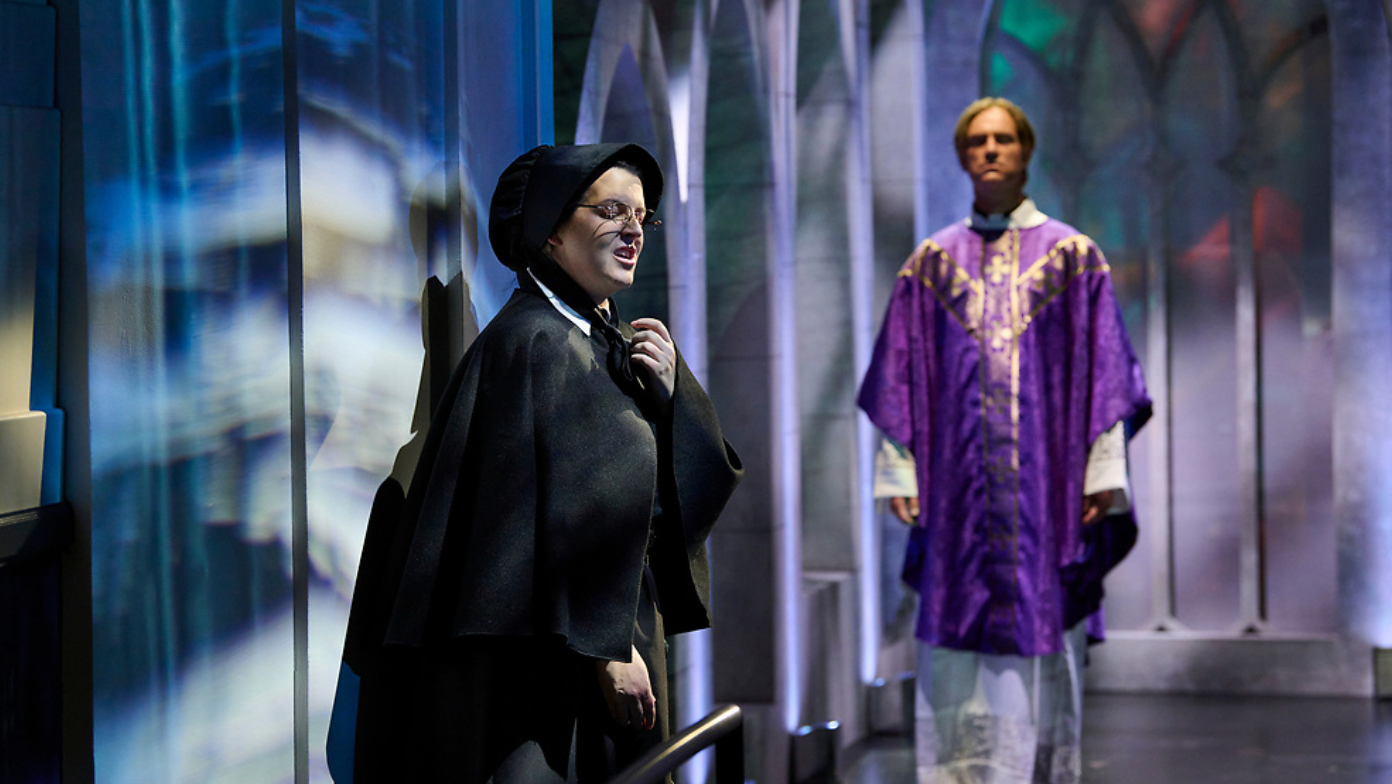
Rhoslyn Jones (Sister Aloysius) & Matthew Worth (Father Flynn) / Photo: Stefan Cohen
Sister Aloysius is all about rules, old fashioned rules, seemingly arbitrary rules. Cough drops are too close to candy. Ballpoint pens make life too easy (while fountain pens teach character). In Douglas Cuomo’s opera Doubt, based on the Pulitzer Prize-winning play by the opera’s librettist John Patrick Shanley, rules are everywhere. Nuns obey priests. Students obey the principal.
This is the world Sister Aloysius understands.
While Sister Aloysius’ rules can be debated, there are rules which still hold up. One of the basic rules is: a great play does not often make a great musical or a great opera. The converse is true as well. Giuseppe Verdi knew this. His Falstaff is a great opera based on Shakespeare’s less-than-brilliant The Merry Wives of Windsor. Il trovatore takes one of the worst plots imaginable from Antonio García Gutiérrez’s El trovator and keeps it but makes it all tuneful and fun and a crowd favorite.
For Opera Parallèle’s final main stage production of their 2025-26 season, the company offered the west coast premiere of the chamber version of Doubt (the fully scored original was commissioned and premiered by Minnesota Opera in 2013). Based in San Francisco, Opera Parallèle intrepidly focuses on contemporary opera and less-often-performed 20th century works.
Douglas Cuomo chose a great play for his opera. He also chose a play that broadly defies the opera genre. In collaboration with John Patrick Shanley, the two created a passionate and vital work of music theatre, but an opera that struggles to be convincingly an opera.
In Doubt, we get a power struggle between Father Flynn, the pastor of St. Nicholas parish in the Bronx (baritone Matthew Worth) and the principal of the parish school Sister Aloysius (soprano Rhoslyn Jones). The opera is set in 1963 at the dawn of the social upheaval that brought us the Summer of Love and Vietnam War protests. When the action starts, it’s clear the two have had any number of run-ins. Father Flynn wants to be looser, more fun, more engaging. Sister Aloysius does not see how loosening up certain traditions help educate kids.
When Sister Aloysius hears concerns from a fellow educator Sister James (mezzo-soprano Naomi Steele) that Father Flynn might be engaging in an inappropriate relationship with a student named Donald Miller, the power struggle becomes a reckoning. The narrative never answers the question of whether Father Flynn is guilty of anything. When Sister Aloysius summons Donald’s mother (mezzo-soprano Deborah Nansteel) to the school, things only devolve further and become that much more muddied. Shanley’s play is what the visionary playwright Henrik Ibsen would call a conversation piece. We leave the theatre wondering if Father Flynn did it, but we also leave the theatre wondering whether Sister Aloysius’ motives are entirely pure. After all, she does not like Father Flynn and resents his new way of approaching what a parish should be. She admits to lying to entrap Father Flynn into admitting his guilt (he never does). Yet these sins are forgivable if she can ultimately triumph over evil.
Opera is a tricky genre for such moral quandaries. I can think of a handful of examples—maybe Peter Grimes, maybe The Dialogues of the Carmelites among them—in which an opera can successfully wrestle with the grey areas of morality without becoming ponderous. Cuomo’s Doubt struggles here. It’s basically a play turned into an opera, rather than a truly operatic piece.
Shanley’s approach to dramatic writing is very much a New Yorker’s approach. His plays and screenplays are quick. Dialogue is never leaden or needlessly important. Ideas and emotions explode and then characters are left to deal with the aftermath. Just watch any scene from Moonstruck or see a production of Danny and the Deep Blue Sea. Doubt is no different. The play version of Doubt moves fast. It’s never still. Even in moments of quiet and reflection, there is a forward push toward an idea or a clash or a revelation (or a doubt).
Opera is slower. Opera takes time. Music takes time. The singing voice cannot spit out big ideas or big emotions at the same clip that the spoken voice can. If plays are air, then operas are water. The atoms in water don’t dart about. The flow and glide. In taking on Doubt, Cuomo must slow things down to allow the music time to set the mood and the voice the time to spin out the notes he’s written. The effect is something moodier and grander than the narrative calls for.
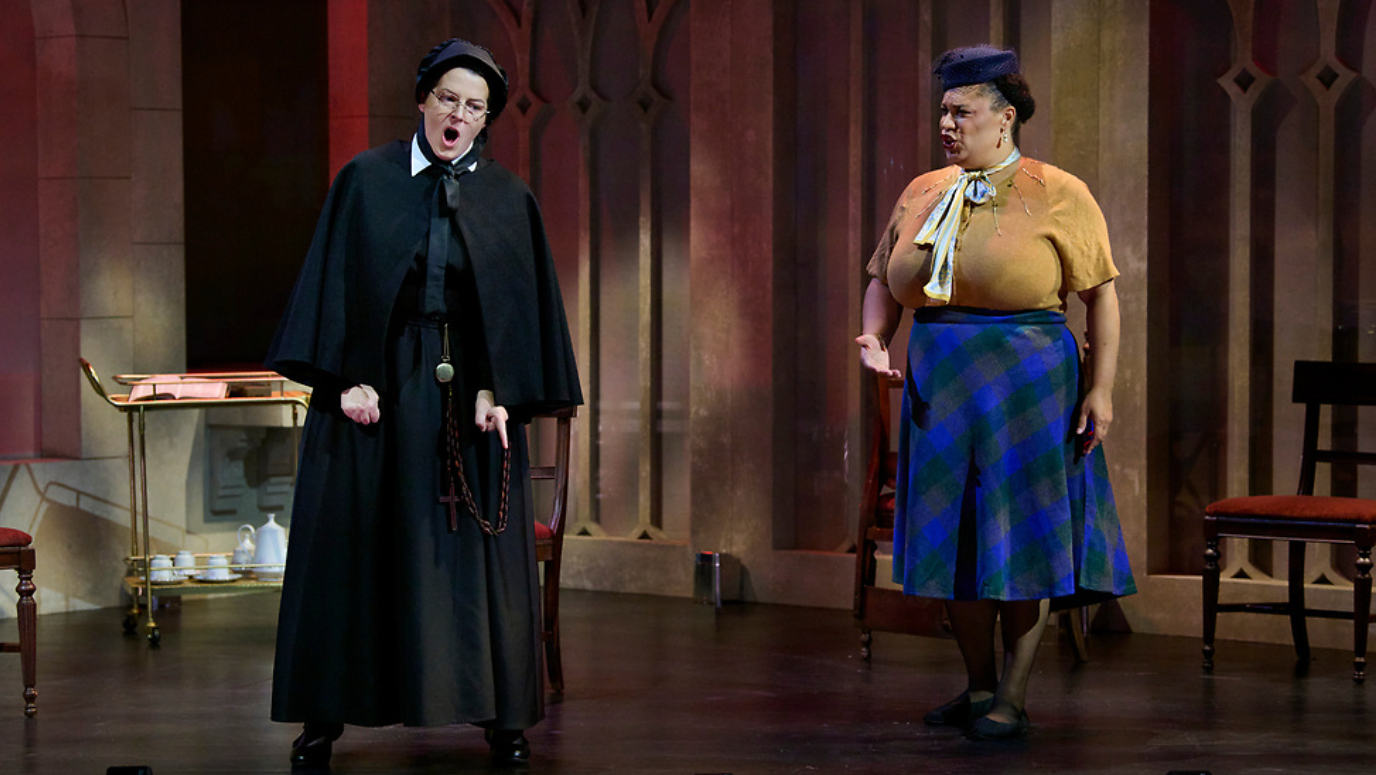
Rhoslyn Jones (Sister Aloysius) & Deborah Nansteel (Mrs. Miller) / Photo: Stefan Cohen
Cuomo’s musical vocabulary is similar to other contemporary American composers like Jake Heggie (who, coincidentally, was in attendance at the final performance the Sunday before last at the Presidio Theatre in San Francisco). For the majority of the evening, each vocal line went something like this: short note, short note, short note, looooooooong note, short note, hard consonant. Then like a typewriter on to the next line of text. The opera’s final line: “I have such douuuuuuuuubts” summed up the rest perfectly.
Shanley’s libretto preserves most of what makes the play great, but it’s very chatty for an opera. It makes for a piece of music theatre that is almost entirely recitative (the conversational singing in between scenes common in earlier operas by composers like Handel and Mozart). But what definitely came across was Cuomo’s gift for instrumental writing. I found myself wishing Doubt were a tone poem instead of an opera. Not every talented composer can write convincingly for the voice. A composer no less talented than Beethoven never got the knack of the human voice, mistakenly writing for it as if it were a horn (so many A-naturals over and over again). Cuomo seems to have a similar issue. But his instrumental writing is gorgeous. The brief prelude was arresting and his ability to create moods and atmospheres through underscoring was a highlight of the afternoon.
Leading the 13-player Opera Parallèle ensemble was Opera Parallele’s founder and artistic director Nicole Paiement. She gave a masterful reading of the score, leading the orchestra in perhaps the most flawless performance by an opera orchestra I can remember hearing. If the opera felt leaden and heavy in places, it was no fault of Paiement’s. She did everything possible to keep Doubt moving without ever rushing the singers. She brought out the tensions in the score without turning the afternoon into a maudlin melodrama. Paiement harnessed her forces into a reading so confident, that I would pay just to hear her conduct chamber music.
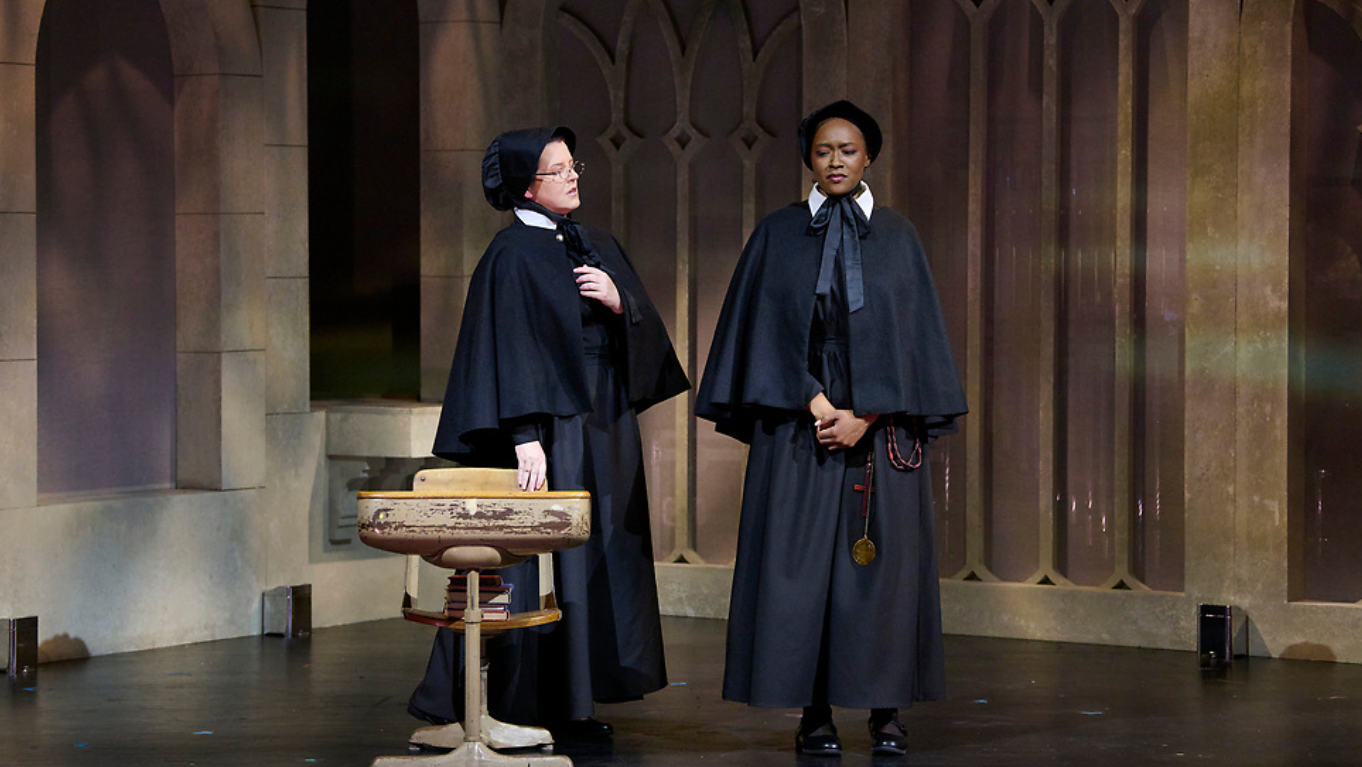
Rhoslyn Jones (Sister Aloysius) & Naomi Steele (Sister James) / Photo: Stefan Cohen
Kyle Bruckman on the English horn reminded me why Wagner so loved the instrument. Michael Taddei on the double bass got a workout in several places and shined in his solo turns (I will always love a double bass moment). In fact, I could call out all 13 players, several of whom doubled on other instruments.
The production’s director was Opera Parallele’s creative director Brian Staufenbiel. I appreciated his attempt to make chamber opera into grand opera, but the problem was that he was trying to make chamber opera into grand opera. His approach, and the company’s approach, was earnest and clearly impassioned.
Staufenbiel nobly tried to couch the production in visuals that mirrored the opera’s dark unsettling subtexts (though the genius of Shanley’s text is how so much of its power comes from what characters stop themselves from saying).
Staufenbiel really wanted us to feel the heaviness of the topic. So we got portentous projections (created by Jessica Drayton) of purple water (?) or holy oil (?) cascading down the walls in the play’s climactic scene. Or projections of a cavernous and looming Gothic cathedral instead of a Bronx parish church. All were well done and some were effective, such as the ones used to set the scenes in an adjacent park. In an opera so laser focused on the relationships between the characters, and in which the words do so much of the scene-painting, I don’t think the projections were necessary.
In terms of directing the action, Staufenbiel went far beyond park-and-bark. The use of rear projection meant a shallow playing space, so he used it as best he could, creating appropriate tension through the blocking. At times there was almost too much tension.
Part of the problem is that the central issue of the opera (the potential abuse of a boy by a possibly predatory priest) is a very serious one. But Shanley understands that for an audience to be able to engage with that, they also need moments to not deal with it. Since the opera libretto condenses the play, and since Staufenbiel makes most everything crucial, there were moments I found myself just looking away to catch a bit of a break.
In terms of pacing, I appreciated how efficiently Staufenbiel could create a classroom, conference room, principal’s office, and an adjacent park with a few pieces of furniture. Kudos to stage manager Bethanie Baeyen for scene changes that were fleet and flawless.
Jacquelyn Scott’s set design was realistic, with an arcade of Gothic stone arches on stage right to separate the playing space from the orchestra on stage left. It was a smart way to differentiate the two spaces, but it was odd watching the action on one half of the stage and the orchestra on the other. With the hyper-realistic stone arches, the black-clad orchestra, and the projections, the whole thing had an oddly corporate look to it.
I felt for baritone Matthew Worth as Father Flynn, who was mere inches from the lintels of any doorway he walked through. An imposing figure with an elegant voice that belied his towering stature, Worth was consistently in fine form in a role that calls for him to do a lot of singing loudly…and often. Worth is clearly up to the challenge. He originated the role at Minnesota Opera.
Kevin Newbury’s abridgement of Shanley’s libretto (used for this chamber version) has Father Flynn on the defensive from beginning to end, so the vocal writing can be punishing. Worth’s high-lying baritone gave Father Flynn a youth that made his attempts to modernize how the church interacts with the community seem the earnest project of a young priest. Worth could also summon wrath when he needed, especially as he made it very clear that the Catholic Church is a patriarchy that can never be questioned.
As Sister Aloysius, Rhoslyn Jones was put through her paces no less than Worth was, and she faced the challenge head-on. Jones is squarely a soprano, but her sound reminded me more of the mezzo-sopranos who move into soprano territory later in their careers. In fact, I thought she was a mezzo until I read her bio. Cuomo’s writing does not particularly flatter the soprano voice, asking the singer to sing in the middle of the voice then lurch upward for climactic moments. There was some metal at the top of Jones’s voice which fits Sister Aloysius’s flinty persona, and I applaud Jones for taking on the challenge.
Naomi Steele as Sister James was no chirpy sidekick (in productions of the play, she’s often cast small and bird-like). Thankfully, in this production she’s very much a woman of integrity and fortitude, with Cuomo making a smart choice to score the role for mezzo-soprano instead of a soubrette soprano. Steele’s was the most effortless sound, but it was also the role where the music didn’t push the voice too hard. Steele’s Sister James was no pushover, but she also did nothing to pull focus or upstage anyone. I found myself wishing she had more to do.
Deborah Nansteel as Mrs. Miller deployed a big, burnished mezzo-soprano during the opera’s horrific climax, begging Sister Aloysius not to expel her son just to protect him from a potentially predatory priest when that priest is the only ally the boy has. Nansteel made the most of her singular scene. However, hearing Mrs. Miller and Sister Aloysius sing over each other became fatiguing in a theatre so small.
Having seen the play with most of its world premiere cast (I will never forget Cherry Jones’s brilliant turn as Sister Aloysius) and having seen the film, I still left the theatre debating with my companion all of nuances of the narrative and the moral morass that Shanley leaves us with at the end. I appreciated the chance to encounter this story again in a production so earnest and so unafraid of the assignment. I also left channeling a bit of Sister Aloysius’s adherence to rules. Great plays make for a tough task in the opera house. Then again, by the end of Doubt, Sister Aloysius isn’t sure she’s correct. Maybe I’m not either.
Matthew Travisano
Matthew is a San Francisco-based educator and actor. He has taught and lectured on the performing arts for more than two decades. He has trained a generation of actors in the greater Bay Area at both Oakland School for the Arts and Ruth Asawa School of the Arts, where he has also taught literature, composition, literary theory, and aesthetics. He holds a BA in English from UC Berkeley and a Master's in Teaching (MAT) from San Diego State University.
-
Topics: opera paralléle, Review
-
People: Antonio García Gutiérrez, Brian Staufenbiel, Cherry Jones, Deborah Nansteel, Deborah Nansteen, Douglas Cuomo, George Friedrich Händel, Giuseppe Verdi, Jacquelyn Scott, Jake Heggie, Jessica Drayton, John Patrick Shanley, Kevin Newbury, Ludwig van Beethoven, Matthew Worth, Naomi Steele, Nicole Paiement, Rhoslyn Jones, Richard Wagner, Wolfgang Amadeus Mozart
-
Works: Doubt, Falstaff, Il trovatore, Les Dialogues des Carmélites, Peter Grimes
-
Places & Organizations: Minnesota Opera, Opera Parallèle