In my end is my beginning
Die Walküre heralds the end of an era for the Los Angeles Philharmonic — and the arrival of a new generation of Wagnerians.
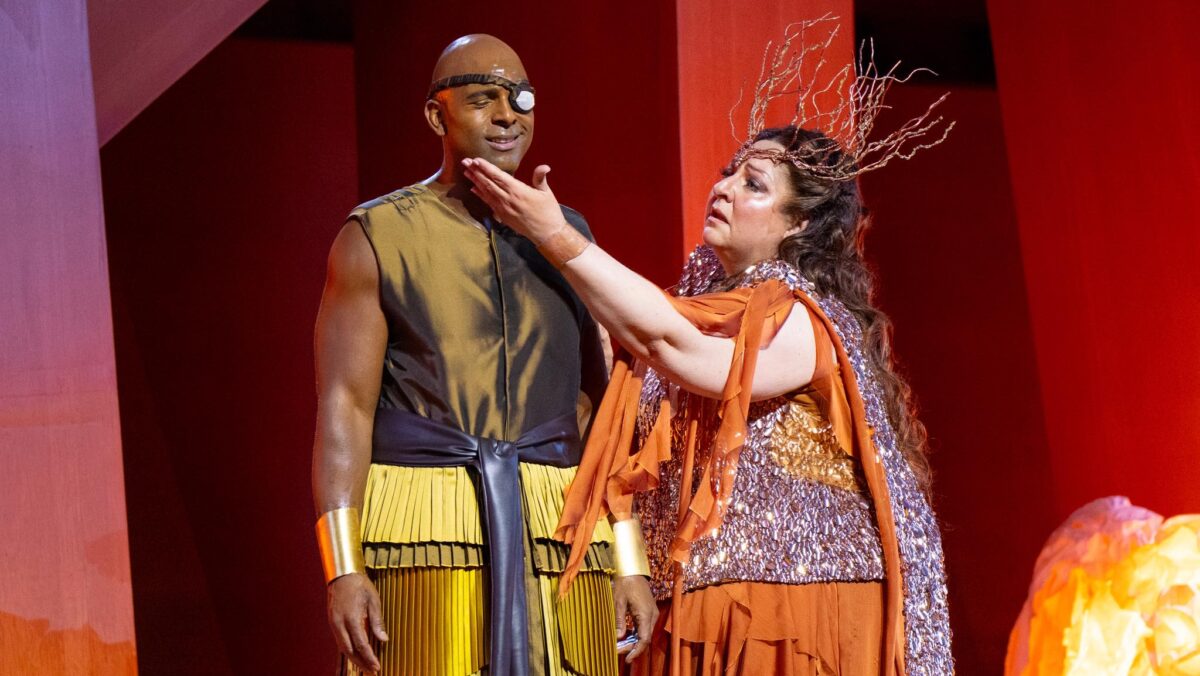
Photo: Elizabeth Asher
The Los Angeles Philharmonic (LA Phil) is entering the final few weeks of its outstanding 2025-26 Season with a presentation of Richard Wagner’s Die Walküre, the second music drama in his monumental Der Ring des Nibelungen. Over three nights, the opera was performed in one act per night, beginning on Tuesday, May 19, and the cycle was repeated twice.
The current season marks the final one for Music & Artistic Director Gustavo Dudamel and is intended to celebrate his transformative 17-year tenure with the LA Phil. The season was affectionately dubbed Gracias Gustavo, mirroring the nickname for his first concert as Music Director at the Hollywood Bowl (¡Bienvenido Gustavo!) in 2009.
The partnership between Dudamel and the LA Phil is certainly one for the books. Not only did it transform the orchestra into one of the world’s most renowned, but it also made the young prodigy from Barquisimeto, Venezuela a bona fide celebrity (in the City of Angels, no less!), earning a spot on Time’s 100 Most Influential People list in 2010 and even a star on the fabled Hollywood Walk of Fame in 2019. Nevertheless, Dudamel’s greatest gift to the community was undoubtedly the YOLA (Youth Orchestra Los Angeles) initiative, which provides free instruments and intensive music training to thousands of young musicians from historically marginalized communities, inspired by Dudamel’s own training in El Sistema.
Die Walküre showcased Dudamel’s passion for opera and for artistic partnerships. This presentation was dedicated to the memory of another giant, Frank Gehry, who died last December. Gehry’s set design graced the stage in this production, marking it as his final work. The collaboration between Gehry and the LA Phil spanned more than 55 years, beginning when Gehry designed the sound system for the Hollywood Bowl in 1970 and culminating in the Walt Disney Concert Hall’s sail-like design, their greatest achievement. In 2021, Gehry also designed the Judith and Thomas L. Beckmen YOLA Center (BYC) in Inglewood, YOLA’s first permanent home.
The close connection between Dudamel and Gehry harked back to 2012, when Gehry designed the sets for the LA Phil’s production of Mozart’s Don Giovanni, directed by Christopher Alden, as part of a three-year project presenting the Mozart/Da Ponte operas in collaboration with renowned architects and clothing designers (Rodarte in Don Giovanni’s case). Twelve years later, they teamed up again for the first installment of Wagner’s Ring cycle, Das Rheingold, directed by Alberto Arvelo (who also directed here) and starring Ryan Speedo Green as Wotan. In the program notes, Dudamel wrote a loving tribute to Gehry, calling him “my friend Pancho” and ending with “Gracias por todo, mi queridísimo Pancho.”
Arvelo detailed that for both Das Rheingold and Die Walküre, Gehry “became obsessed with the creation of an abstract space that was simultaneously “nowhere” and “everywhere,” bringing the characters down to earth and focusing on their mortality, inspired by Wieland Wagner’s vision. Gehry addressed the hall’s shortcomings for presenting fully staged opera (such as the lack of a proscenium arch and proper entrance points for the singers) by adding layers of wooden platforms. Dynamic clusters of paper, placed strategically atop the Disney Concert Hall, became canvases for projections depicting moods in various colors, from a tempestuous sky to a ring of fire. For the final act, eight gorgeous paper sculptures of horses (designed by Tomas Osinski) were laid on the elevated platform to denote the Valkyries. Gehry understandably situated the orchestra front and center on the stage, and the singers sang and acted on the platforms behind and on the narrow apron in front of the orchestra.
While the setting was beautiful to look at and made sense given the constraints, I think it presented some challenges as well, chief among them the balance. I was fortunate to sit in the back and side orchestra on the first and last nights, and in the front terrace on the second night. The sound was largely fine and balanced most of the time, at least to my ears. Nevertheless, I couldn’t help but wonder about the balance for the audience in the first two sections of the orchestra, since they were actually seated lower than the orchestra.
Arvelo emphasized physical interactions among the singers in his direction, which was well-suited to the semi-staged nature of the presentation and aligned with Gehry’s intention. There was a lot of running around, up and down the back platforms and along the front apron, using the side steps. It was well-choreographed (quite surprising for just six performances) and not distracting. There were moments of absolute beauty, particularly in the final moments of Act III, when Wotan laid Brünnhilde to sleep before conjuring the fire to protect her. Shutter Cut Lighting Design’s lighting for that scene was equally magnificent; not only did they place red LED lights on those platforms that gradually brightened, but they also lit the paper horses in red and orange hues, making the scene particularly unforgettable. Cindy Figueroa completed the creative team with her costumes from an unspecified era, full of color and glitter.
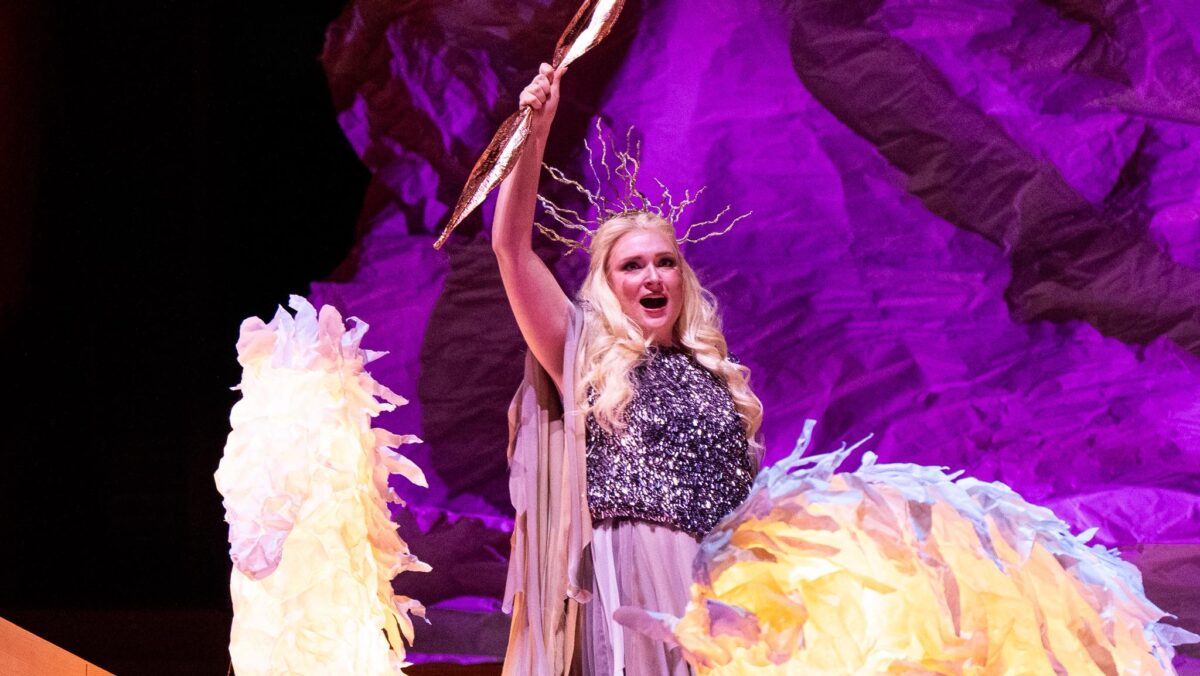
Photo: Elizabeth Asher
While it was certainly a challenge to fight rush hour to come to Downtown LA for three consecutive nights, presenting each act nightly paid dividends for those brave enough to try, namely, much fresher-sounding singers in each act. LA Phil assembled a fine collection of mostly younger-generation Wagner singers, largely Americans. Interestingly, more than half of the principals made their role debuts together during last summer’s Santa Fe production, so much so that my colleague Lisa Hirsch there quipped, “a new generation is coming to the fore.” Their familiarity and camaraderie were a great asset here, particularly because the production placed so much emphasis on interactions among the singers.
On the first night last Tuesday, Dudamel literally conjured a storm at the beginning of Act I with his forceful, rapid tempi, which almost came as a shock to the audience. It was quite a sight to watch the LA Phil launch into the Wagner score with such ferocity, especially since most of the time the orchestra was hidden in the pit. In fact, to my ears, Dudamel was at his best during the moments when the orchestra played in full splendor and during the climaxes, as he could get a tad loose during the expositions. The end of Act 1, in which Siegmund triumphantly pulled the sword out of the tree/wall, was jaw-dropping in its intensity, as the moment was purely realized in the sound of the orchestra rather than in the staging, and Dudamel completely pulled it off.
Jamez McCorkle embodied a more lyrical Siegmund, emphasizing legato phrasing and beautiful delivery rather than full vocal power. An intelligent singer, he wisely used his bright sound, with a slightly dark undertone, to depict a man worried about his predicament yet curious about the lady who was kind enough to offer him help. McCorkle found more than his equal in Jessica Faselt’s Sieglinde, who moved up from singing Helmwige in Santa Fe. Faselt, one of the bright points in the starry cast, developed a chameleon-like persona in her voice, ranging from a scared housewife to a rebellious lover, and she moved with elegance even when Figueroa dressed her in a ragged brown costume. Soloman Howard completely blew my mind as the menacing Hunding, both in his acting and particularly in his dark, booming voice. The three of them played a deadly game of cat and mouse, and a sense of doom hung in the air. My only quibble was that they spent most of the act in the makeshift hut on the back platform, with McCorkle only moving up to the front apron after Hunding figured out who he was. The sound was noticeably different when he sang from the back and when he was right in front!
After the white-hot intensity of Act I, I guess it didn’t come as a surprise that the second night felt a little disappointing, largely because of the nature of Act II. The longest of the three acts, Wagner styled this act as a bridge between the story of Hunding’s household in Act One and Wotan’s familial drama in Act Three. In my opinion, this was the act in which Valhalla and Earth needed to be clearly defined, and the actions (such as the death of Siegmund) needed to be properly carried out, as the success of the act, especially in a standalone like this, depended heavily on the execution of all of them. It was almost impossible to employ an abstract concept to encompass this dichotomy between gods and men.
Act II was also full of exposition, whether in the lengthy confrontation between Wotan and Fricka, the subsequent conversation between Wotan and Brünnhilde, or the exchange between Brünnhilde and Siegmund. Dudamel, who, as far as I know, led the full Die Walküre for the first time in these performances, seemed rather slack with the orchestra during those moments, letting the singers guide the proceedings rather than the other way around, resulting in slowish, almost sluggish tempi at times. I am confident that he would improve with more performances under his belt.
Act II introduced Christine Goerke, a veteran Brünnhilde, into the mix, in what appeared to be her only staged performances this season, alongside Green’s Wotan and Sarah Saturnino’s breathtaking Fricka, my favorite performance in this run. Last Wednesday’s performance found Goerke in great shape, brandishing high notes with ease. Her familiarity with the role was evident in her movements, down to the way she looked and the glances she gave. I was among the few who weren’t too convinced by Green’s King Marke in the recent Met Opera’s Tristan und Isolde, so I was happy to find that his Wotan was a definite improvement. Nevertheless, I couldn’t help but think this was a role in progress; Green got all the notes and sang admirably, but his complex characterization wasn’t fully realized yet, particularly in this act, where Wotan was essentially a man imprisoned by his own ambitions, torn between his love for his son (and eventually daughter) and the need to uphold power.
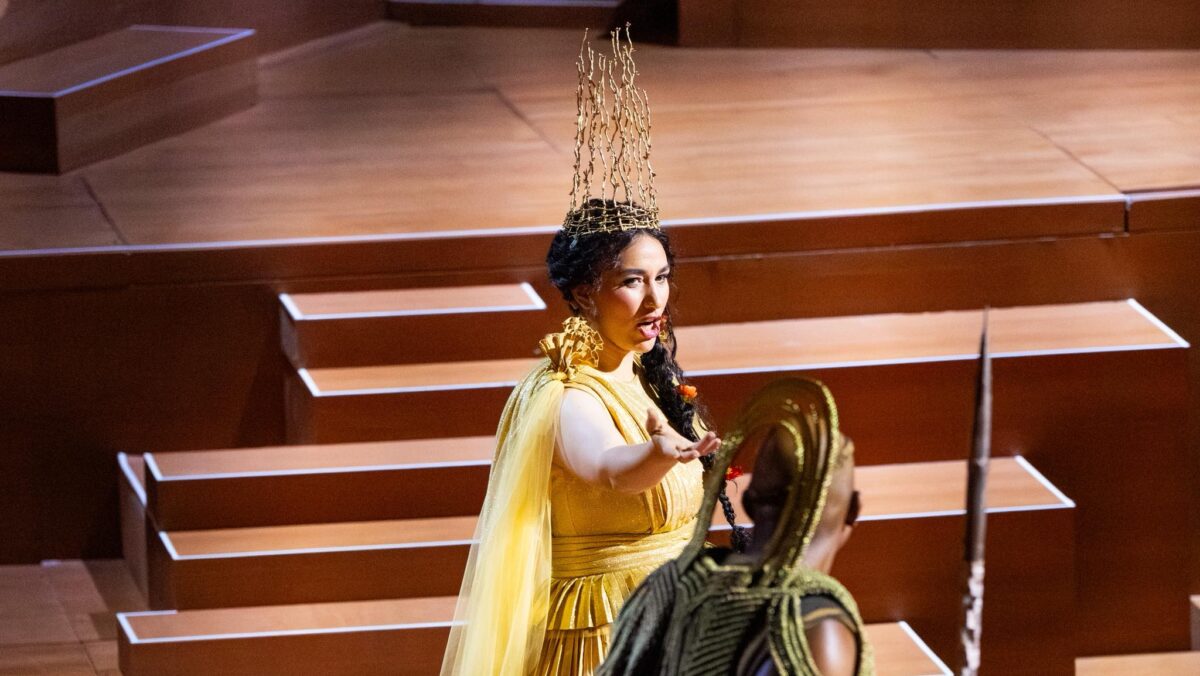
Photo: Elizabeth Asher
Green’s lack of dramatic specificity was particularly evident during the confrontation with the force of a storm, namely Saturnino’s Fricka. With a dark, bold sound, a round, velvety center, and a commanding presence, she caught my ear during last month’s LA Opera’s Falstaff (as Meg), but her Fricka was a whole different ball game, giving true meaning to being a scene stealer. It was rather unfortunate that Figueroa dressed her as if she were going to the Met Gala instead!
The final act last Thursday could only be described as absolute perfection, one of those rare nights at the Opera when everything went right. Everyone played in supercharged mode, as if realizing this was the end. Dudamel’s reading brought enhanced clarity and power this time around, from the first note of the famous Walkürenritt (The Ride of the Valkyries). The eight Valkyries, including both established and new singers (Alexandria Shiner, Lindsay Ammann, Ronnita Miller, Teresa Perrotta, Zoie Reams, Taylor Raven, Siphokazi Molteno, and Laura Wilde), sang in harmony. Faselt stepped up her game, producing her best sound of the run, and Green and Goerke’s lengthy final scene was unbelievably heartbreaking and haunting, beautifully aided by the aforementioned setting.
A production of Die Walküre is a major undertaking for any opera company, and this production was a historic achievement for LA Phil, given the event’s significance and the loving care lavished on its creation. I felt an enormous sadness wash over me at the end of last Thursday’s performance, knowing I would never experience Gehry’s visions for the final two operas of The Ring cycle. In previous interviews, Dudamel expressed interest in completing the cycle, so I do hope he will return to Disney Concert Hall to finish it.
So, goodbye, Maestro Gehry, and farewell, Maestro Dudamel!
-
People: Alexandria Shiner, and Laura Wilde, Christine Goerke, Christopher Alden, Frank Gehry, Gustavo Dudamel, Jamez McCorkle, Jessica Faselt, Laura Wilde, Lindsay Ammann, Lisa Hirsch, Ronnita Miller, Ryan Speedo Green, Sarah Saturnino, Siphokazi Molteno, Soloman Howard, Taylor Raven, Teresa Perrotta, Wieland Wagner, Zoie Reams
-
Works: Das Rheingold, Der Ring des Nibelungen, Die Walküre, Die Walküre, Don Giovanni, Falstaff, Tristan und Isolde
-
Places & Organizations: Hollywood Bowl, Los Angeles Opera, Los Angeles Philharmonic, Metropolitan Opera, Santa Fe Opera, Walt Disney Concert Hall