Big man in town
A strong revival of Falstaff at the Los Angeles Opera proves a fitting farewell vehicle for Music Director James Conlon.
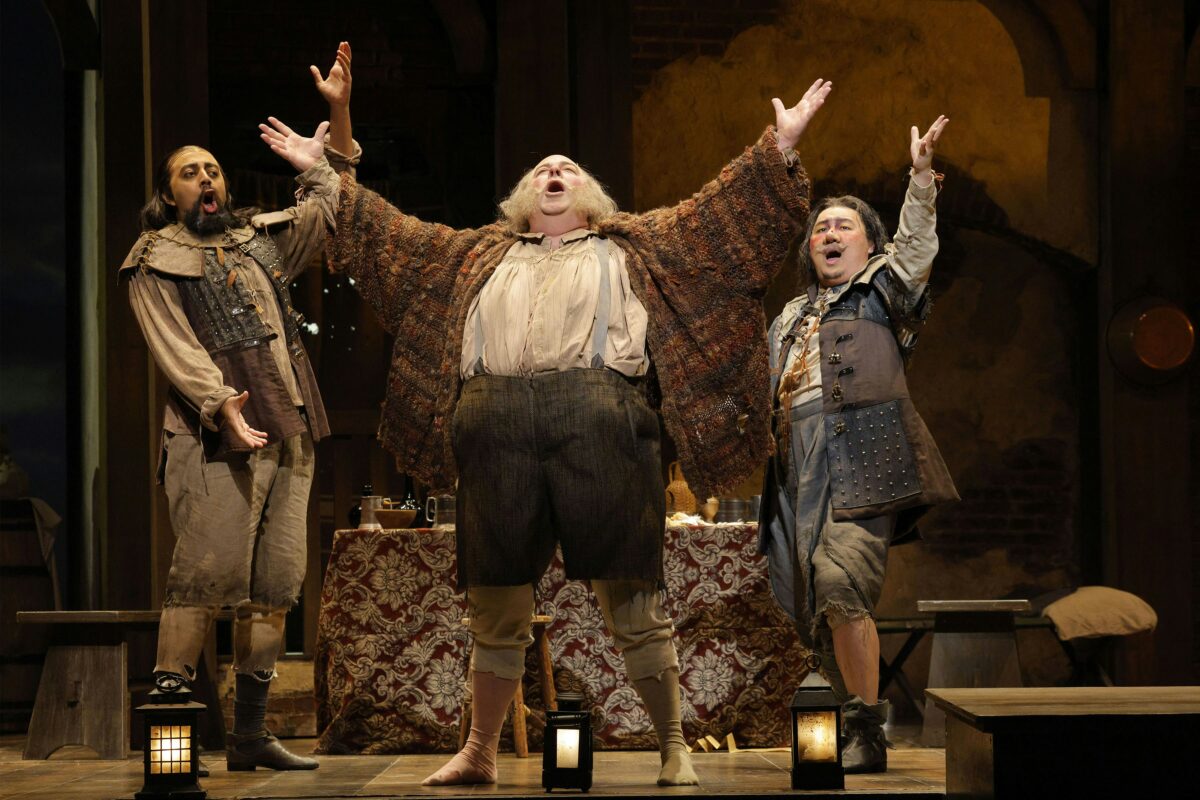
Photo by Cory Weaver
It is interesting to note that while both the Los Angeles Opera (LAO) and the Los Angeles Philharmonic are celebrating their farewell seasons with their Music Directors, the celebrations take different forms: One is more introverted and introspective, while the other is exuberant and festive. After 20 excellent years, James Conlon, the second Music Director in the company’s history, will retire at the conclusion of this season and assume the lifetime title of Music Director Laureate.
Conlon’s impact on the LA music scene cannot be overstated. Over those twenty years, he conducted 68 operas by 32 composers in nearly 500 performances. Most importantly, he introduced LA audiences to the “Recovered Voices” series, a multi-year project featuring operas by composers affected by the Third Reich, including works by Alexander von Zemlinsky, Viktor Ullmann, Walter Braunfels, and Franz Schreker. Conlon also conducted LAO’s first presentation of Richard Wagner’s complete Der Ring des Nibelungen in 2009-10 and, in 2015, a new production of John Corigliano’s The Ghosts of Versailles (the first major US staging in 20 years). No wonder Conlon was inducted into the American Classical Music Hall of Fame in 2009.
Conlon is concluding his farewell season with two final works by opera masters, Giuseppe Verdi’s Falstaff and Wolfgang Amadeus Mozart’s Die Zauberflöte, both of which hold particular meaning for him. In a heartfelt blog post, he detailed what Falstaff meant to him personally, from the time he saw the “now legendary Zeffirelli/Bernstein production” to his first professional engagement with the piece.
For this occasion, LAO dusted off Lee Blakeley’s 2013 Globe Theatre-inspired production, complete with Adrian Linford’s sets and costumes; this time it was directed by Shawna Lucey, the General Director & CEO of Opera San José. Despite showing its age, Linford’s sets effectively transported the audience to the opera buffa era, aided by period-appropriate costumes. I particularly loved the candle lanterns placed around the stage in the first two acts.
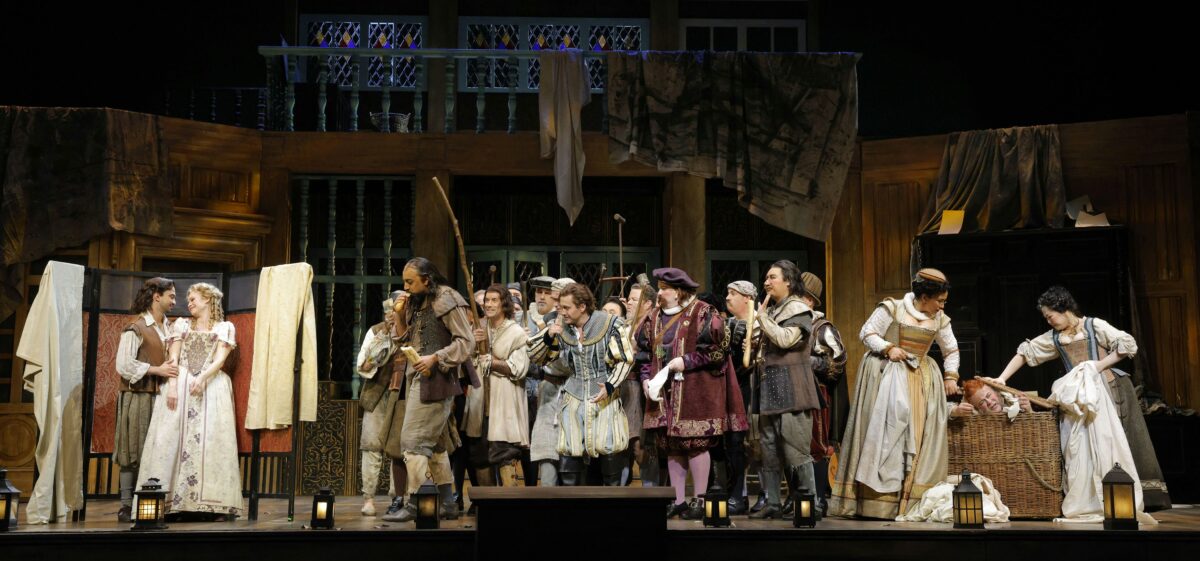
Photo by Cory Weaver
Lucey emphasized the physicality of everyone on stage. There were many coordinated movements, exaggerated even, to bring out the fun and maximize the laughs. On the one hand, it made the show absolutely delightful to watch, and the audience lapped it up wholeheartedly on Saturday, the opening night. Nevertheless, such decisions also somehow robbed the opera of its more serious moments, particularly during Falstaff’s “L’onore” monologue in Act One, which librettist Arrigo Boito adapted from Henry IV, Part 1.
In her Director’s Note, Lucey argued that “Falstaff belongs to Alice Ford and Meg Page,” and that they didn’t just outwit him—they “design[ed] his humiliation with the precision of military strategists.” Such a feminist point of view was front and center in her direction and choreography of the onstage traffic, bringing a fresh perspective to the proceedings. In fact, so effective were the four women (Alice, Meg, Mistress Quickly, and Nannetta) in orchestrating Falstaff’s downfall that, in my opinion, the show inadvertently highlighted the piece’s inherent problem, something that had never crossed my mind before. All the name-calling and fat-shaming, delivered gleefully by the ladies facing the audience, made me think they weren’t just trying to teach “the old buffoon” a lesson; it was pure, premeditated bullying, and doing it twice made it even worse. Such a realization, unfortunately, rendered their actions much less funny and almost too cruel, at least to me! Surely we’re not celebrating bullying in 2026? (A similar question has been asked among Shakespearians.)
The Globe-inspired stage was stripped bare, adorned only by the trunk of an old oak tree, for the final scene at Herne’s Oak in Windsor Park, Verdi’s version of nachtmusik. While the procession-like entrance of the spirits might lack a dreamy or magical quality for some, to me it marked a shift into the verismo era (akin to “Regina coeli” from Cavalleria rusticana or “Te Deum” from Tosca). Interestingly, it also brought to mind a direct parallel to the ending of Richard Wagner’s comic opera Die Meistersinger von Nürnberg, a work with which Falstaff was often compared.
On the musical level, last Saturday’s performance had much to recommend. After a somewhat tentative start, the show gained strength with the arrival of the four ladies, culminating in an absolutely thrilling third act. Conlon brought a wealth of knowledge to his masterful reading of the score, detailing every nuance, contradiction, and irony while steadfastly maintaining the momentum of this fast-paced comedy. The final fugue was especially breathtaking, greatly aided by Jeremy Frank’s direction of the chorus, a perfect finale that celebrated not only human folly but also the opera company Conlon has built.
Falstaff is essentially an ensemble piece, and its success depends on how tightly the ensemble works together. LAO assembled a fine cast for this revival, and they established a great rapport with one another, visibly having a lot of fun as they sang and acted their roles on stage. First and foremost, the four ladies, Nicole Heaston, Sarah Saturnino, Hyona Kim, and the debuting Deanna Breiwick, shone brightly both individually and collectively as Alice Ford, Meg Page, Mistress Quickly, and Nannetta, respectively. They carried out Lucey’s vision brilliantly while each maintaining their own take on the role.
I have seen Heaston a few times before in lighter roles, so I was intrigued by how she coped with Alice. She certainly didn’t disappoint. Her bright, fine instrument soared gloriously above the orchestra, effortlessly floating notes while skillfully acting as the chief orchestrator of Falstaff’s ruination. Alice is central to the story, and Heaston lit up the stage each time she appeared. Her voice blended extremely well with Saturnino’s dark, velvety sound, particularly when they compared their letters from Falstaff.
Kim mesmerized as the agent provocateur Mistress Quickly, using varied colors and phrasing in her voice to suit the situation. She moved with ease and had perfect comic timing, especially in her interactions with Falstaff. While her voice might be a tad brighter than the usual Mrs. Quickly, it sounded round and warm, with a fully supported middle register, easily distinguishable from Saturnino’s Meg. Breiwick, on the other hand, projected innocence with her delicate, sparkling voice, which morphed into an ethereal radiance during the Fairy Queen aria, “Sul fil d’un soffio etesio”. She paired beautifully with Anthony León‘s lyrical delivery as her lover, Fenton, and their haunting call-and-response stuck with me long after the opera ended. León also performed his little aria “Dal labbro il canto estasiato vola,” which opened the final scene, with such aching tenderness that it delighted the audience.
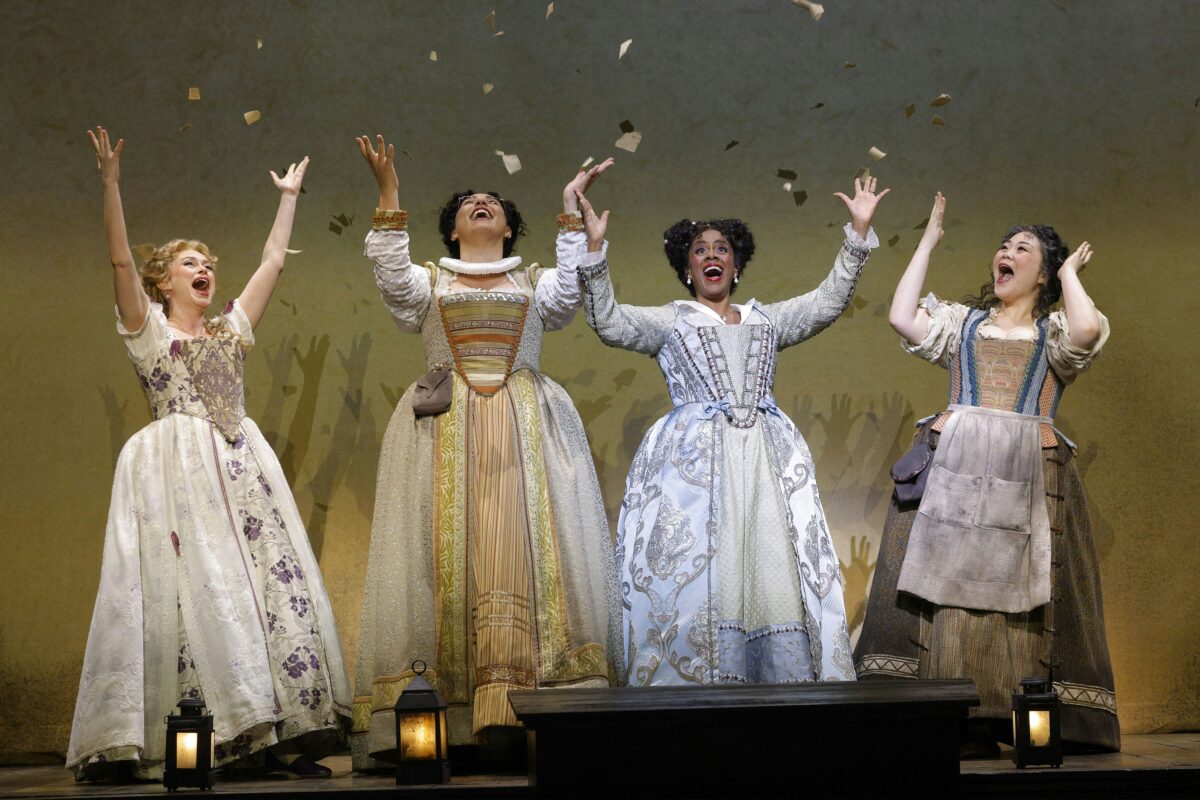
Photo by Cory Weaver
The men also performed handsomely, not far behind the ladies’ high standards. Italian baritone Ernesto Petti made his presence felt as Ford. There was a slight sense of menace and danger in his voice, particularly in his Act 2 aria “È sogno o realtà?”, which made his characterization of Ford complex and interesting. Three current members of the Domingo-Colburn-Stein Young Artist Program, Yuntong Han, Vinícius Costa, and Nathan Bowles, made significant (and funny) contributions in the small roles of Bardolph, Pistol, and Dr. Caius, respectively.
That left us with Craig Colclough in the title role, his fifteenth at LAO since his 2008 debut. On Saturday, Colclough took a while to warm up, but he eventually settled into a burnished tone that proved highly adaptable. He adopted an extremely playful persona as Sir John Falstaff from the get-go, both in his actions and especially in his voice. As a result, his “L’onore!” monologue, for example, sounded less convincing. It wasn’t until Act 3 that he turned serious (only to be conned once again). All of this made his Falstaff such a good-natured figure that, in my opinion, he almost didn’t deserve to be so badly humiliated.
Despite all the nitpicking, Saturday’s show was a definite success, and I have no doubt it will improve in future performances. The audience saved its loudest cheer for Conlon, a fitting tribute to the man who has shaped LAO’s history over the past twenty years.
-
People: Alexander von Zemlinsky, Anthony León, Arrigo Boito, Cory Weaver, Craig Colclough, Deanna Breiwick, Ernesto Petti, Franco Zeffirelli, Franz Schreker, Giuseppe Verdi, Hyona Kim, James Conlon, Jeremy Frank, John Corigliano, Lee Blakeley, Leonard Bernstein, Nathan Bowles, Nicole Heaston, Richard Wagner, Sarah Saturnino, Shawna Lucey, Viktor Ullmann, Vinícius Costa, Walter Braunfels, Wolfgang Amadeus Mozart, Yuntong Han
-
Works: Cavalleria Rusticana, Der Ring des Nibelungen, Die Meistersinger von Nürnberg, Die Zauberflöte, Falstaff, The Ghosts of Versailles, Tosca
-
Places & Organizations: Los Angeles Opera, Los Angeles Philharmonic, Opera San Jose