Less is more
Vanessa is spare and compelling in Heartbeat Opera’s production.
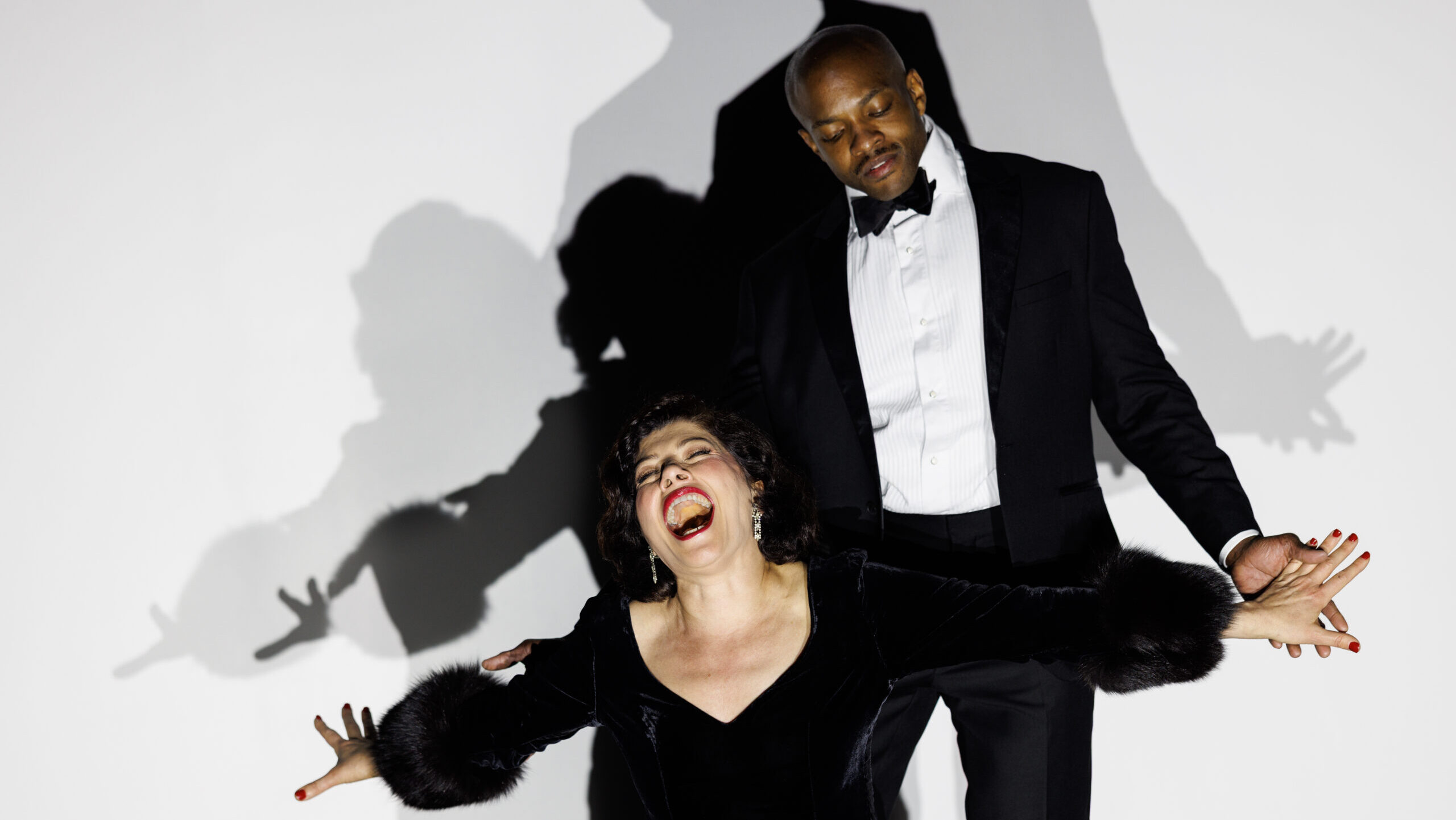
Inna Dukach as Vanessa and Freddie Ballentine as Anatol / Photo: Maria Baranova
Heartbeat Opera’s production of Samuel Barber and Gian Carlo Menotti’s Vanessa, directed by R.B. Schlather, shows how sometimes less is more. With only seven instrumentalists and five singers, Heartbeat’s hundred-minute adaptation, which was developed last year at Williamstown Theater Festival, nonetheless makes a compelling argument for the under-performed opera’s revival.
The hyper-minimalist set consists of a black velvet chair against a white backdrop, upon which the singers cast their shadows. “Sometimes I am her niece,” says Erika about Vanessa, “but mostly her shadow.” These film noir elements make even more sense remembering that Barber was a contemporary of Alfred Hitchcock.
Menotti’s libretto feels, likewise, like something out of a Daphne du Maurier novel. At her family estate, Vanessa waits for her long-lost lover Anatol. When Anatol arrives, however, he is not the one she expected; he is the older Anatol’s son. The younger Anatol has a tryst with Vanessa’s niece Erika, then starts an age-gap relationship with Vanessa. The whole thing feels very incestuous. (Early on, Oedipus is even quoted.)
The re-orchestration, by Dan Schlosberg, sounds lush despite the pint-size of the band, expertly conducted by Jacob Ashworth. Especially present are the dark and shadowy sonorities of trombone (Sam George) and cello (Thapelo Masita). Even with limited numbers, the band was able to make some staggeringly fortissimo swells.
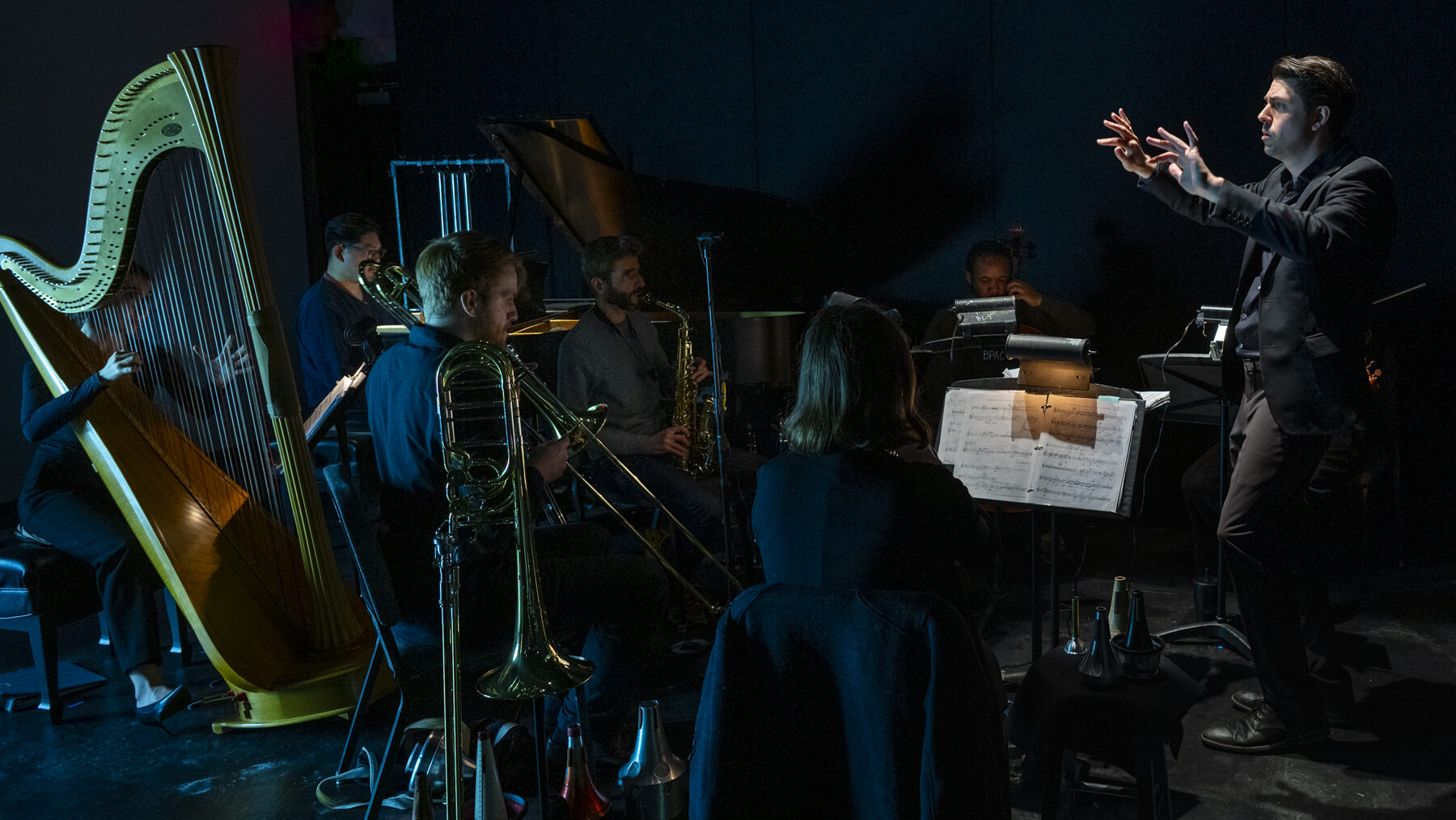
Jacob Ashworth and the band / Photo by Russ Rowland
The mezzo-soprano Kelsey Lauritano, as Erika, starts pure-voiced and tuneful. Her aria “Must the winter come so soon?” has moments that evoke Barber’s Knoxville. The soprano Inna Dukach, as Vanessa, starts jarring and piercing, with dissonant leaps.
But by the end of the opera, they’ve changed places. Lauritano’s voice has turned bitter; Dukach’s has sweetened. Both characters sing more melodiously when happy. When, towards opera’s end, Lauritano reprises “Must the winter come so soon?” the same words are given such tragic inflection.
The tenor Freddie Ballentine, as Anatol, is uncannily seductive. His voice is deep yet shiny; golden. It is beautiful but almost frightening in its power, which relates to his character, who has an supernatural sway over the others. He is equal parts magnetic and repulsive.
For reasons Menotti leaves mysterious, the Baroness (mezzo-soprano Mary Phillips) refuses to speak to her daughter, Vanessa. But even with few lines, Phillips’s wide-eyed performance is full of emotional intensity.
Least developed, perhaps because of some of Heartbeat’s cuts, is the Doctor, sung admirably by baritone Joshua Jeremiah. We learn that the Doctor, who is astonishingly bad at his job, is also a failed poet. Is this character supposed to represent Menotti or Barber?
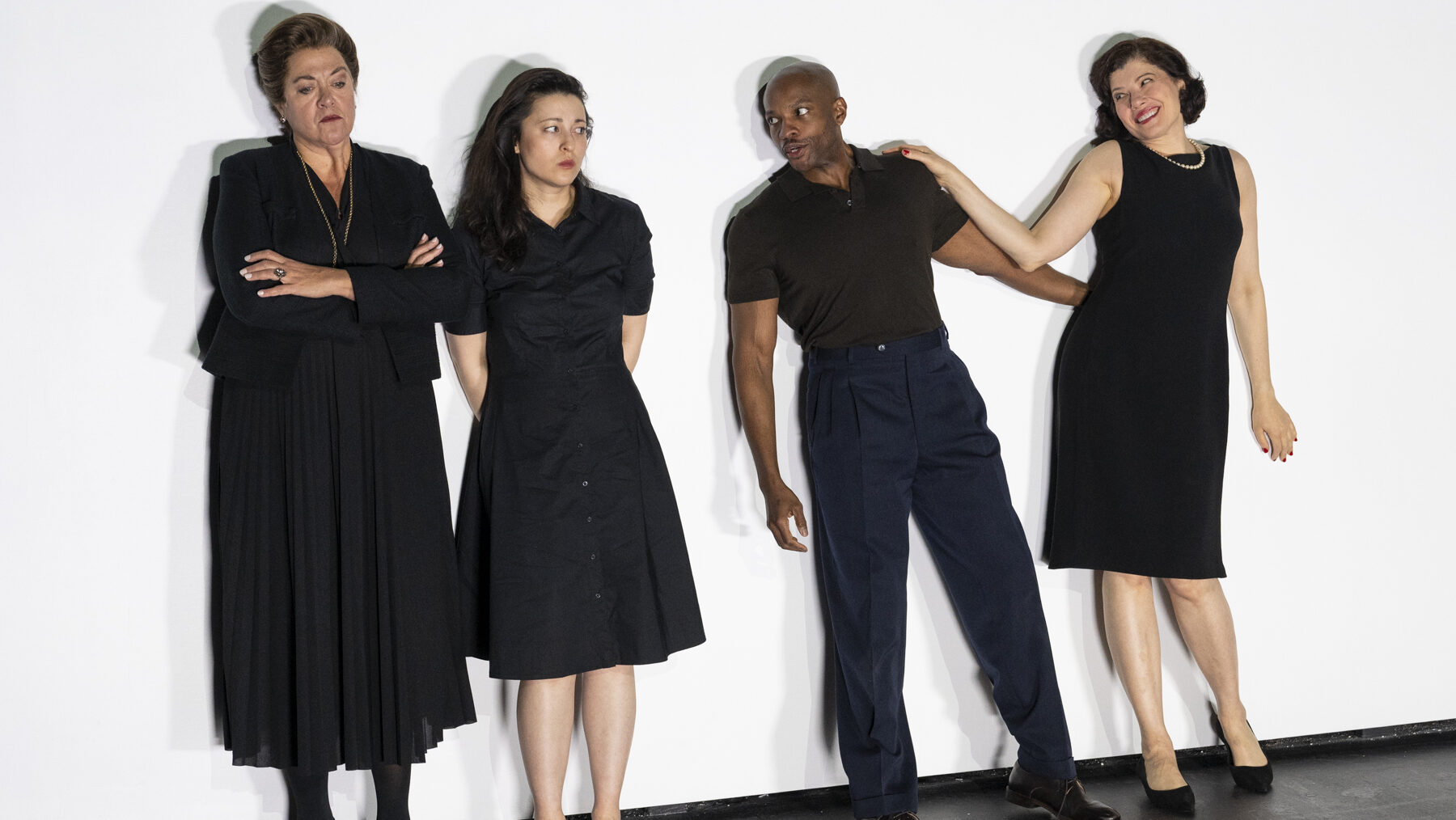
Mary Phillips as the Baroness, Freddie Ballentine as Anatol, Kelsey Lauritano as Erika, Inna Dukach as Vanessa / Photo by Russ Rowland
In an awkward moment, with unclear homoerotic intentions, the Doctor tries to dance with Anatol. Slurred by alcohol, his aria “Under the willow tree” turns into an off-kilter waltz, picked up, almost Klezmer-like, by the violin (Sunny Sheu) and clarinet (Louis Arques).
Though the Doctor is, ostensibly, a comic character, his last aria is one of the most touching. “You, too, were once a child, Vanessa,” sings Jeremiah tenderly. “Do you remember? The mumps, the chicken pox… Will you ever think of your old doctor now?” And then there is that heartbreaking quintet: “To leave, to break, to find, to keep…”
But what makes Menotti’s libretto, as adapted by Ashworth, good? It is not without cliché. But it comprehensible. The vowels are buzzingly pure. Vanessa, as performed by Heartbeart, accomplished for me something never before experienced in opera in English: I clung onto every word. I didn’t even need to look at the supertitles.
The libretto is full of evocative motifs. Recurring words, like “silence” and “bitterness,” seem to haunt the text. Opposites merge: love turns to hate, past becomes present. At one point, Anatol says to Erika, “You belong to another age.”
One theme of the opera is the power of a name: “Vanessa” is heard by the Anatol throughout his youth. It calls to him. Destiny governs Erika, too. By the end, she has all but become Vanessa. She even wears her dress. The shadow has come to life. Meanwhile, Vanessa is living a lie.
-
Topics: heartbeat opera, Review
-
People: Dan Schlosberg, Freddie Ballentine, Gian Carlo Menotti, Heartbeat Opera, Inna Dukach, Jacob Ashworth, Joshua Jeremiah, Kelsey Lauritano, Mary Phillips, R.B. Schlather, Samuel Barber
-
Works: Vanessa
-
Places & Organizations: Heartbeat Opera, Williamstown Theatre Festival