Joie de vivre
Erin Morley, Lawrence Brownlee, and Malcolm Martineau put on a jolly good show at the 92nd Street Y.
 By
Emma Hoffman
By
Emma Hoffman
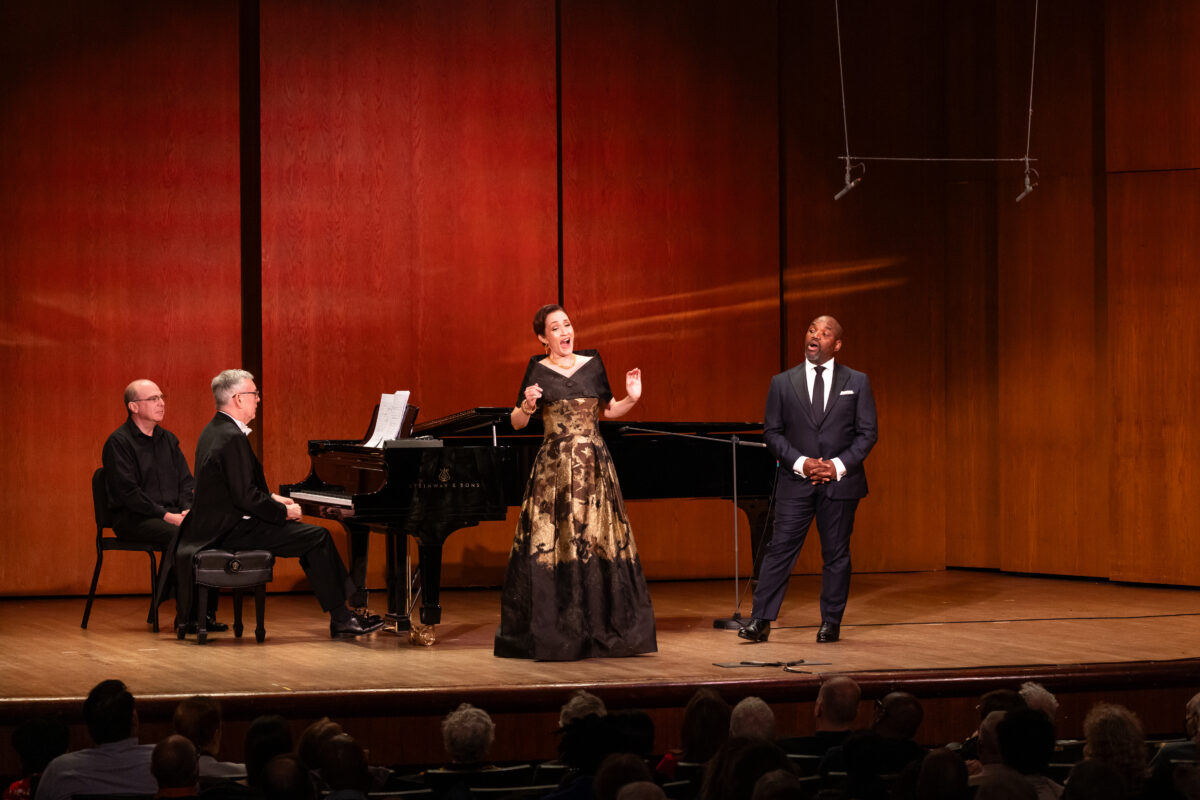
Photo: Jenny Gorman
If you peruse the shelves of your local bookshop for long enough, you’ll find that “joy” has become a genre in and of itself. The Joy of Cooking. The Joy of Quilting. The Joy of Quitting. The Joy of Consent (that one’s about sex). It is unsurprising that (to my knowledge) The Joy of Classical Music Criticism has not yet found its way onto the shelf; aren’t we critics, with all our mid-concert scribbling and opinions, a bit averse to that feeling? Can’t we hacking cranks just put down the pen and enjoy? And yet, as Erin Morley and Lawrence Brownlee’s recital at the 92nd Street Y proved, perhaps we need to be reminded that our job is also to let others in on the joy.
Reuniting in New York after their winning run in La fille du regiment at the Metropolitan Opera last autumn, Morley and Brownlee, accompanied by the superb Malcolm Martineau, presented selections from 19th-century French and Italian opera, many of which they recorded for their album, Golden Age. Early in the program, the two explained that the evening would be a compilation of standards, unknowns, and pieces they simply love: “After all, isn’t it great to sing what you like?” Their affection for this repertoire was evident from the opening duet, a crisp, animated “Ah, quel respect … Ce téméraire qui croit nous plaire” from Rossini’s Le comte Ory, which proved their chemistry in Fille was no fluke. Underpinned by Martineau’s effervescent playing, the duet popped the cork on what would be an evening of fizz – and full-bodied vocal flavor.
Morley, dressed in an off-the-shoulder gown of black and gold brocade, performed the evening’s first solo number, “Caro nome” from Verdi’s Rigoletto. In her appearances here at the Y and at the Metropolitan Opera, Morley has demonstrated a potency of sound; if other coloraturas have a glockenspiel-like quality, then her soprano is closer to a church bell in its timbre and intensity. For Gilda’s aria, the soprano interwove a warm, throbbing pulse amid the delicately parsed phrases of the aria’s opening verses, and her top notes blazed as her heroine blossomed into her desire.
Brownlee, in a de rigueur tux, prefaced his performance of Bizet’s “Je crois entendre encore” with a short reflection on Alfredo Kraus’s influence on his singing. Like the Spanish tenor, Brownlee prioritized clarity, resisting crooning and other such indulgences. Having heard Benjamin Bernheim sing the same aria just a few weeks prior, Brownlee’s approach struck me as more muscular than melting, with dynamics that never dipped below a mezzo forte.
Martineau led an inevitably crowd-pleasing rendition of Debussy’s “Clair de lune,” before rejoining the pair for another duet, “D’où viens-tu? … C’est le dieu de la jeunesse” from Delibes’s Lakmé. They were natural storytellers; Brownlee coarsened his tenor as he stalked Morley’s tentative priestess downstage until she relented, her cry of “C’est l’amour” breaking into a sigh of release. Their voices melded in a thrilling conclusion.
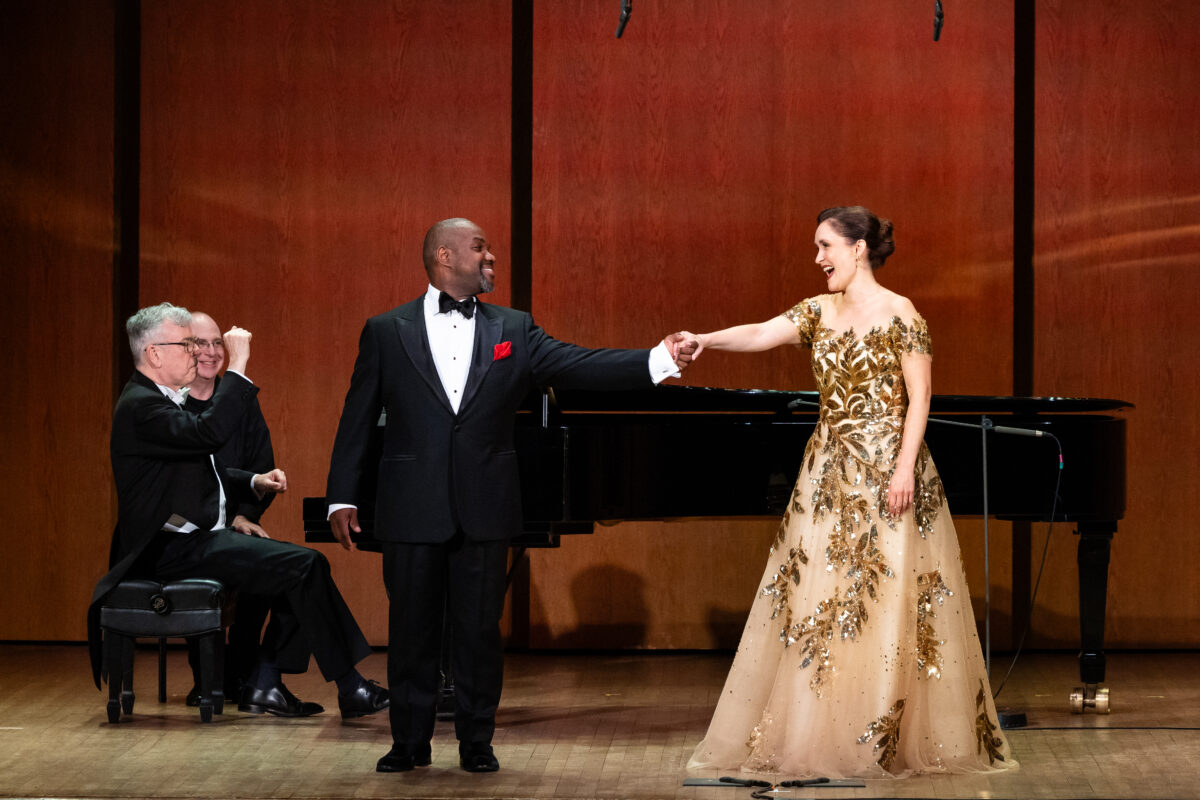
Photo: Jenny Goodman
The second half opened with an outfit change from Morley – gold laurel appliques on chiffon – and another duet, “Ils verront si je mens!” from La joile fille de Perth, a Bizet rarity. While its vaguely gothic strains were not the most inspired of Bizet’s output, the duet nonetheless situated the pair in a vocal sweet spot wherein they could spin their phrases into pure lyricism. More inspiring was when Morley joined Martineau at the piano for a spirited rendition of the “Chanson bohème,” arranged for four hands, from Carmen, where she showed herself to be just as adept a duet partner on keyboard as on voice.
Brownlee returned the program to Rigoletto with “Ella mi fu rapita!”. It was the pristine, gimmick-free singing at which Brownlee excels, even if one wished for slightly more nuance in his delivery of the aria. The cabaletta, however, was suitably lusty, and his high notes were full and vibrant throughout. Brilliance in high notes was also on full display in Morley’s rendition of the “Bell Song” from Lakmé, though it did not come at the expense of her subtler vocal shadings in the aria’s less exuberant moments. Her performance combined technical virtuosity with an atmospheric, variegated dynamic palette – truly the highlight of the evening.
The two closed the program on a comic note with “Quoi! Vous m’aimez?… De cet aveu si tendre” from Fille, where they referenced the staging and charming characterizations they developed during their Met run. Riding high off the audience’s enthusiastic response, they returned for more Donizetti for an encore of “Tornami a dir” from Don Pasquale.
It was the kind of program and performances that put a spring in your step as you leave the auditorium – a joy from top to bottom.
Emma Hoffman
Emma Hoffman is a graduate of Barnard College. In 20 years she’ll be a crusty Upper West Sider in a babushka.
-
Topics: 92nd Street Y, erin morley, lawrence brownlee, recital, Review
-
People: Alfredo Kraus, Benjamin Bernheim, Erin Morely, Erin Morley, Lawrence Brownlee, Malcolm Martineau
-
Works: Carmen, Don Pasquale, La fille du régiment, La jolie fille de Perth, Lakmé, Le Comte Ory, Rigoletto
-
Places & Organizations: 92nd Street Y, Metropolitan Opera