Bloodless revolution
Bluebeard’s Castle and Erwartung at Canadian Opera Company deliver on fine performances even if Robert Lepage‘s production skimps on horror.
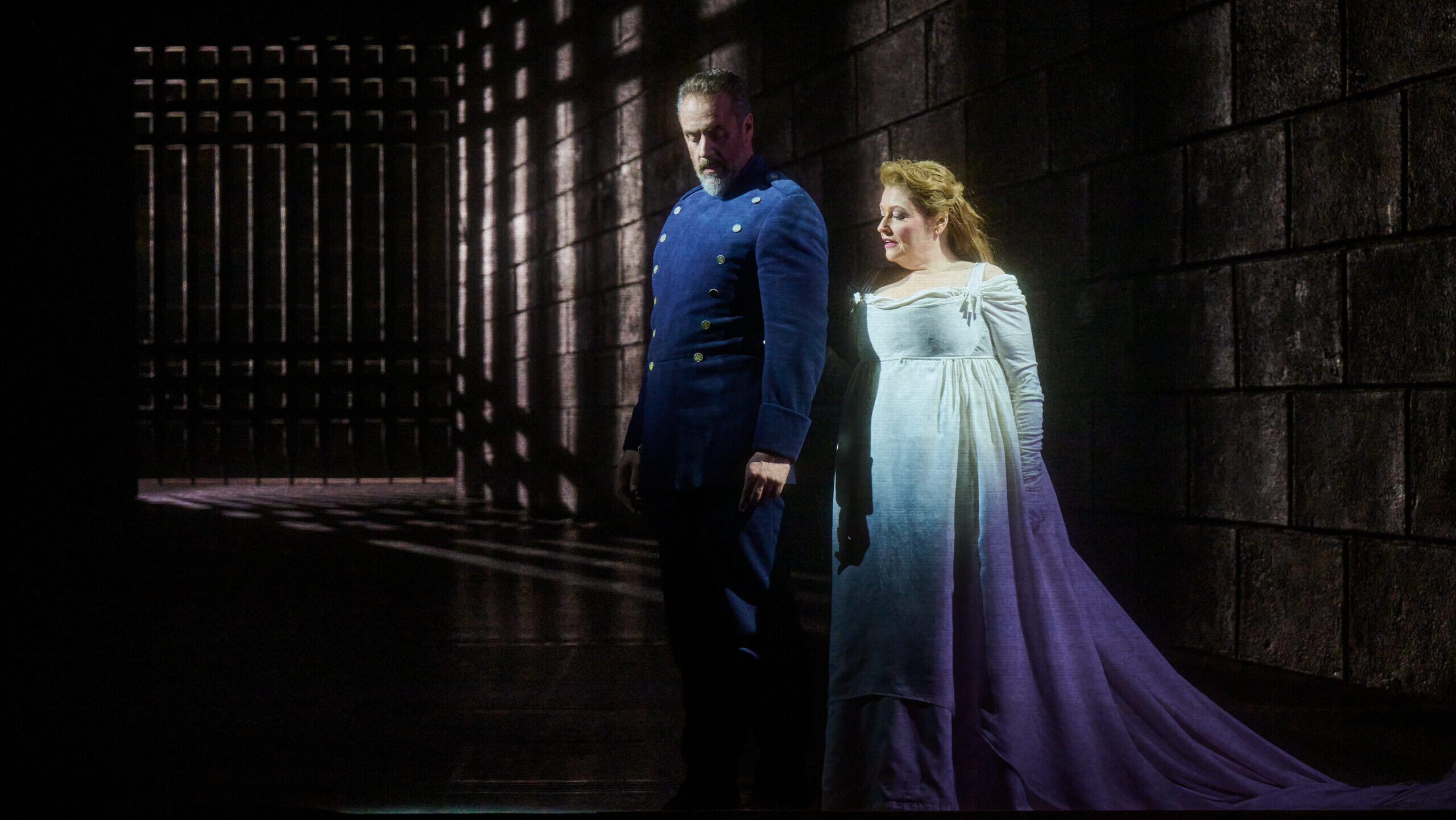
Christian Van Horn as Bluebeard and Karen Cargill as Judith in the Canadian Opera Company’s production of Bluebeard’s Castle, 2026 / Photo: Michael Cooper
A holographic castle emerges from the abyss, rotating slowly, glowing gold as through a mist. The proscenium arch, a Klimtian mosaic of gold tiles, glints in the footlights. A murmur of strings groans from the pit. The auditorium’s interior, a sleek Scandinavian design of blonde wood and beige seating, seemed innocuous enough before the show, but now the lights are down. We’re deep in the bowels of some empty, dank, dark lair. Suddenly, a white light burns through portcullis bars to reveal a pair of long, inverted-V-shaped stone walls. It’s in this hushed shadow that Canadian Opera Company’s (COC) revival of Robert Lepage’s 1993 double bill of Bela Bartok’s Bluebeard’s Castle / Arnold Schoenberg’s Erwartung begins.
I first saw Bartok’s only opera in movie form (available on YouTube and starring Robert Lloyd and Elizabeth Laurence). I wanted to see it, in part, because Christian Van Horn raved about the work on his podcast. The production he was talking about, from 2023 by Des Moines Metro Opera, featured a huge LED screen the size of a proscenium. The projections flooded the auditorium. “It feels like the future of opera,” Van Horn said. “It feels like we can compete with anything – we can compete with movies and television. We can compete with your Netflix account.”
Maybe I was spoiled, but between the baroque imagery of the movie version and glimpses of Des Moines Metro Opera’s production, my companion and I felt somewhat let down. Led by revival director François Racine, COC’s Bluebeard dabbles in the minimal, maximal, and multimedia, with mixed results. COC could learn, perhaps, from the technical virtuosity of Des Moines in a future presentation of Lepage’s storied production.
The story begins with Judith newly wedded to the mysterious and taciturn Duke Bluebeard. Judith is played by the typically excellent – though, on that night, somewhat uneven – mezzo soprano Karen Cargill alongside Van Horn. Judith pleads with her husband to open the doors of his castle to let in light. She’s horrified to find the walls weeping. In a striking visual effect, both turn in sync, illustrating in choreographed movement their thrall to each other. Seven keyhole projections appear. The first door opens on Bluebeard’s torture chamber, the orchestra erupting in trilling flutes and bleating horns – the nightmarish “blood motif.” “Give me all the keys,” Judith demands. The orchestra pulses with Bluebeard’s agony. The sound of a clarinet leaps from the pit, dancing crazily, arching and grotesque.
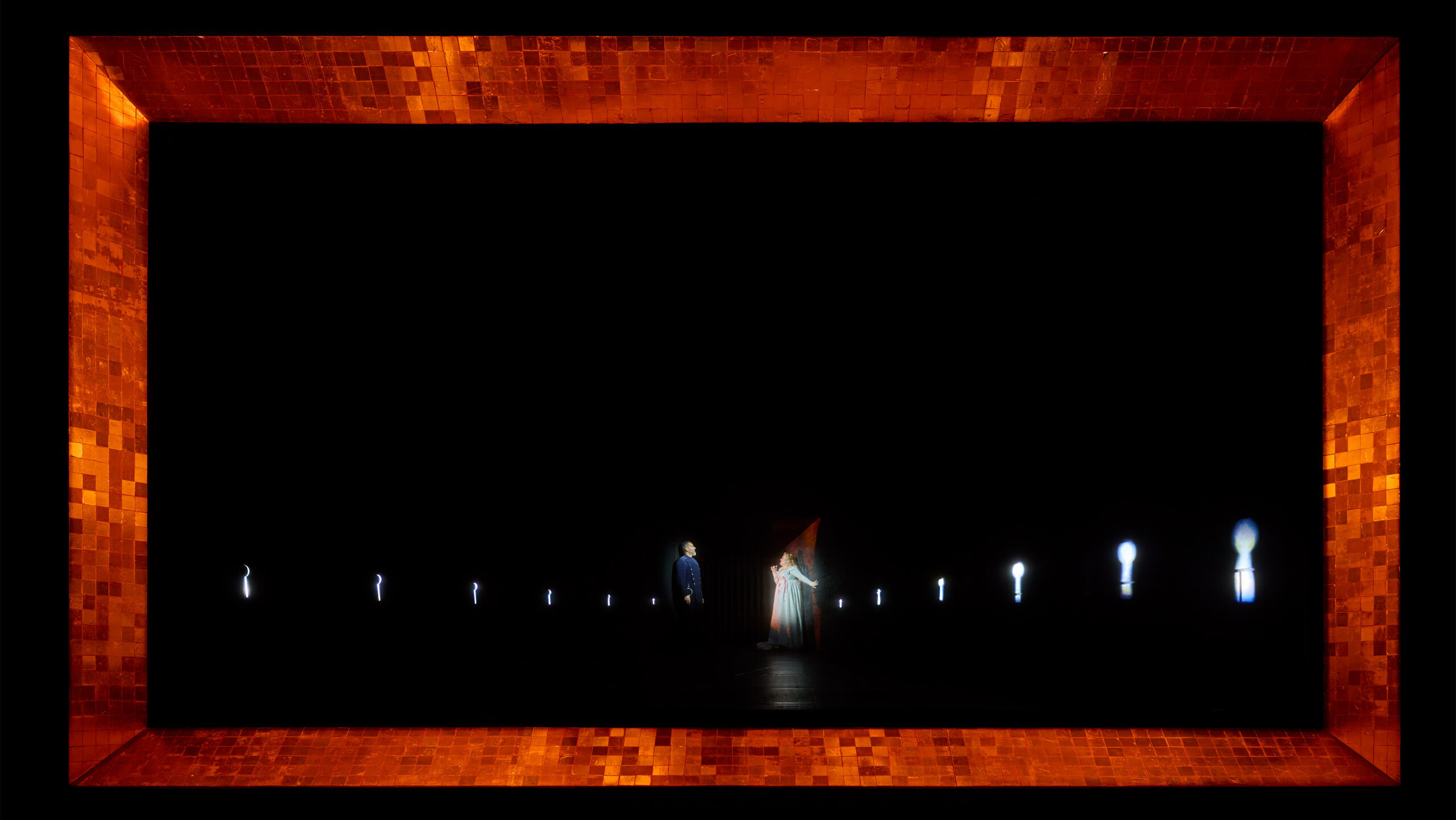
Christian Van Horn as Bluebeard and Karen Cargill as Judith in the Canadian Opera Company’s production of Bluebeard’s Castle, 2026 / Photo: Michael Cooper
Trumpets, proud and martial, announce the opening of the second door – Bluebeard’s armory. Flashing lights suggest (key word) blades of all kinds. The third door opens on Bluebeard’s jewels. Horns in the pit float clear, noble whole notes; tinkling percussion simulates the glitter of precious stones. The strings, meanwhile, raise an eyebrow. “This treasure is all yours,” Bluebeard intones. Here Van Horn came into fuller relief, lavishing the hall with a warm, virile sound. At the fourth door, shadows play on the walls; woodwinds probe; we are in Bluebeard’s garden, watered with blood.
And then, in what is perhaps the greatest C-major chord in history, the fifth door opens. The orchestra surges in a huge escarpment of sound reminiscent of Strauss’s Also sprach Zarathustra. Cargill, so consistently good for so many years, didn’t quite nail the high C this moment deserves. (It should be said that Cargill has had plenty of examples of orbital laser, eardrum-popping recordings throughout her career.) It merits remarking that I have seen Christian Van Horn live twice now, once at Winspear Opera House in Dallas, and now at the Four Seasons Theater in Toronto – yet here, his vocal power and squillo seemed contained while Cargill’s voice sounded startlingly small; the sound seemed somehow swallowed. I did some digging; as far back as 2006, when the house opened, critics have been skeptical about the acoustic of the venue itself. Canadian Architect quoted music critic Robert Everett-Green as saying “a certain punch was being left out. You can’t say bingo–that they’ve hit the mark.”
Regardless of how the singers sounded, this scene is the first of two moments where the projections pay off. A huge image of Earth from space suffuses the stage, complementing the singular grandeur of the score.
Upon opening the sixth door, Judith reaches down and splashes a small pool of water. They are tears – the tears of Bluebeard’s victims. Cargill is exceptional here, filled with tangible disillusionment and horror. The splash of water is a welcome visual change of texture to the mis-en-scène. In a chilling moment, the creative team – led by Robert Thompson’s lighting design – magnifies the pool in a red projection against the stone wall. Like blood spurting and clouding under water, it expands and grows with the trilling clarinets.
Finally, at the opening of the seventh door, a grotesque procession of women in bloody gowns – indistinguishable from each other, despite their fate as trophies of morning, noon, and evening – rises on a set of stairs to march steadily across the stage. A heartbeat of dissonant woodwinds thumps in the pit. This is the second scene in which the reason for the production’s worldwide acclaim becomes apparent. The orchestra, the undeniable soul of Bluebeard’s Castle gasps and slouches through the night (kudos to the orchestra, sensitively led by conductor Johannes Debus). Moments like these, where music and visuals connect on multiple sensory planes, leave one in slack-jawed wonder. It also highlighted, paradoxically, the lack of such effect at other points in the show. During intermission, my companion and I overheard someone saying “more blood!”, and – perhaps spoiled by more consistently cinematic productions – we agreed.
The evening’s second show was Arnold Schoenberg’s Erwartung (Expectation). Schoenberg was deeply influenced by the Expressionist movement and Freudian theory, and the libretto was written by the Austrian physician Marie Pappenheim, who drew on her experience with patients undergoing psychoanalysis. The monodrama features a single singer, The Woman, who navigates the hellish landscape of a quasi-dream.
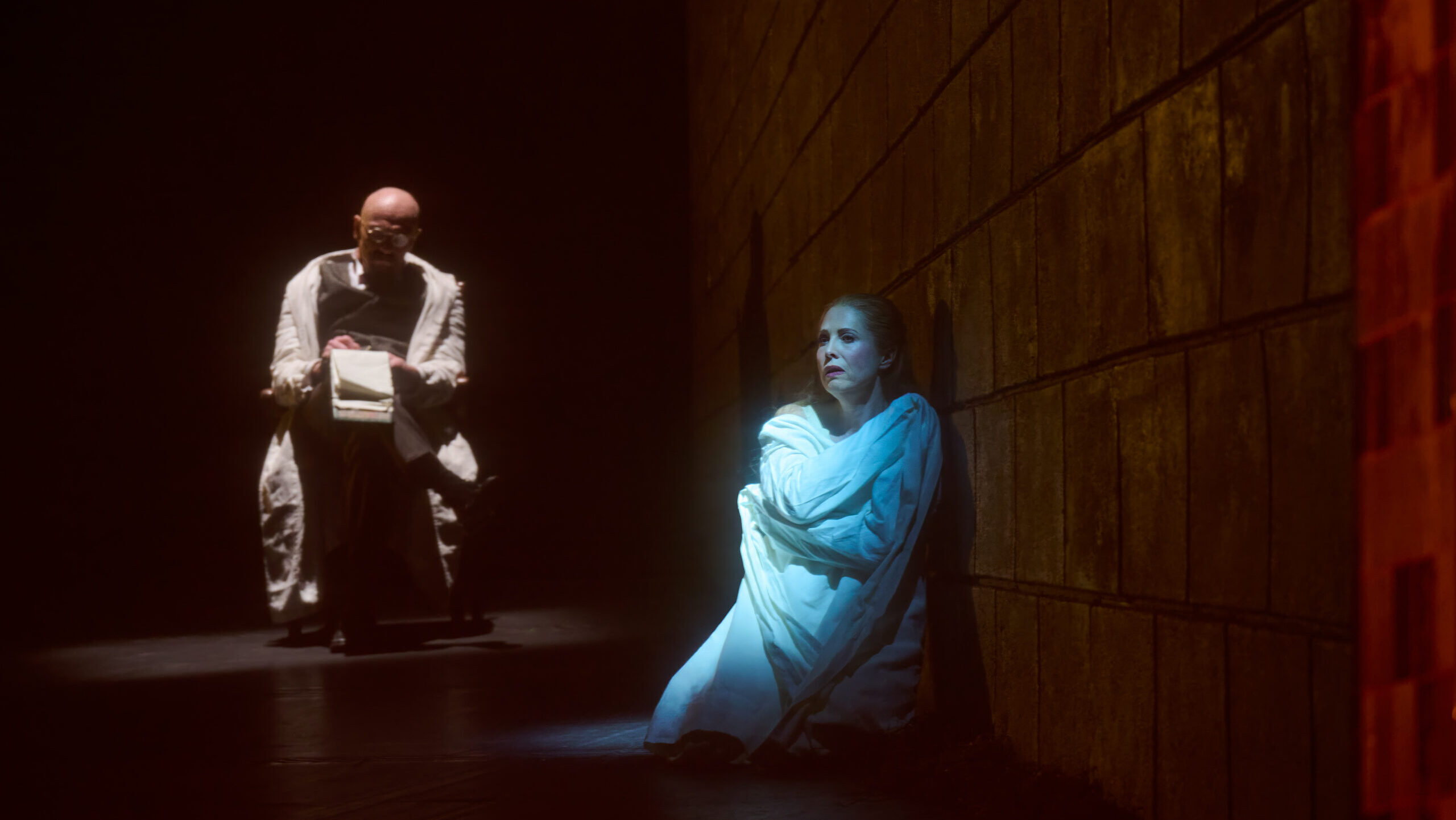
Mark Johnson (back) and Anna Gabler as The Woman in the Canadian Opera Company’s production of Erwartung, 2026. / Photo: Michael Cooper
She appears in a straitjacket; a white-coated doctor sits behind her with a pencil and pad. There are memories of forest, thoughts spiraling in a long night of horrific visions. At one point, The Woman swings a scythe down towards two body doubles on a bed, suggesting that this woman – as noted by Racine in the program – has more in common with Bluebeard than Judith. Something has gone terribly wrong with her lover. When she swings the scythe, the stage is bathed in red, and the man doubles over in pain, tumbling down the stage, naked, in slow motion. The effect is one of singular dread and foreboding.
Schoenberg’s music is wild, jagged, and distressing. Deborah Voigt has said it was the most difficult role in her repertoire, citing nearly impossible vocal intervals illustrating the woman’s psychological torture – bewilderment at what the man has done, helplessness at her own deeds. The production treats the material with an experimental approach that was at once surreal and accessible. A huge blinding white spotlight, perhaps symbolizing the moon, beams into the audience, moving up and down chaotically, burning red at times, gently fading out completely at others. Anna Gabler was spectacularly unhinged, creating a tortured emotional core as the surrealist elements – including a doctor sitting, at different junctures, in horizontal position against the wall, and slow-motion backflipping onto the stage, as if played in reverse – swirled around her.
If we were to judge, as I think is reasonable, a double billing on the world they create together, the night was a resounding success. Both pieces explore the limits of control and the psychological devastation of loneliness. Other double billings with Bluebeard’s Castle have included everything from Alma Mahler’s Four Songs (Boston Lyric Opera, 2023) to Tchaikovsky’s gorgeously lyrical Iolanta (Metropolitan Opera.) This one, I think, rhymes best with each other.
In the end, I fully recommend seeing this production at COC. It is a night featuring mostly excellent singing, innovative stagecraft, and thematic resonance — if a little light on the blood and guts.

Brendan Latimer
Brendan Latimer is a writer and urban planner based in Baltimore, MD. He invented the dark chocolate with orange juice combo. You can find him on Instagram at @b_lat_ and @operanoises.
-
Topics: canadian opera company, Review
-
People: Anna Gabler, Christian Van Horn, Deborah Voigt, Elizabeth Laurence, François Racine, Johannes Debus, Karen Cargill, Robert Lepage, Robert Lloyd, Robert Thompson
-
Works: Bluebeard's Castle, Erwartung, Iolanta
-
Places & Organizations: Boston Lyric Opera, Metropolitan Opera