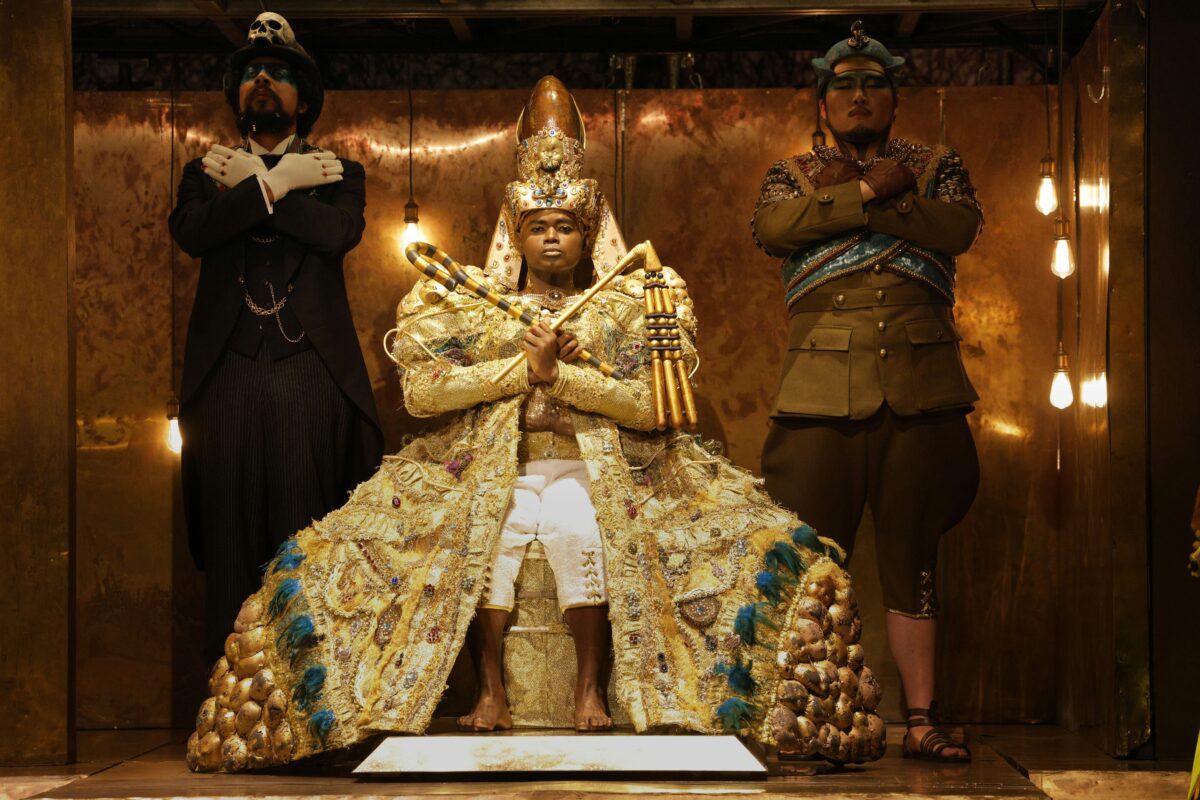
John Holiday (center) in the title role of LA Opera’s 2026 production of Akhnaten, with Vinicius Costa (left) as Aye and Hyungjin Son (right) as Horemhab. Photo credit: Cory Weaver
Phelim McDermott’s hypnotic production of Philip Glass’s opera Akhnaten made a spectacular return to the Dorothy Chandler Pavilion last Saturday, ten years after its premiere. Boosted by a (mostly) new, youthful cast, the fan-favorite spectacle was an excellent addition to Los Angeles Opera’s 40th Anniversary Season, resulting in brisk business for LAO. In fact, LAO announced that they added a new performance of Akhnaten even before opening night!
A co-production with English National Opera in collaboration with Improbable, Akhnaten premiered at the London Coliseum on March 4, 2016, and then traveled to Los Angeles that fall. ENO revived the show in 2019, the same year the Metropolitan Opera mounted the acclaimed production. The Met even recorded the opera live in 2019, which went on to win the 2022 Grammy Award for Best Opera Recording. That superlative recording has since become my go-to recording of Akhnaten. Thus, LAO’s revival was long overdue.
The third of Glass’s “The Portrait Trilogy” – a trilogy of biographical operas about visionaries who radically changed the course of history in science, politics, and (in Akhnaten’s case) religion – Akhnaten chronicles the rise and fall of Egyptian pharaoh Akhenaten (Amenhotep IV), who reigned in Egypt between 1351 and 1334 BCE. In those 17 years, Akhenaten moved away from the traditional polytheistic ancient Egyptian religion and embraced the monotheistic Atenism, centered on Aten (the Sun Disc). The libretto was by Glass in association with Shalom Goldman, Robert Israel, Richard Riddell, and Jerome Robbins. The texts were drawn from many sources and sung in their original languages, including Akkadian, Egyptian, and Biblical Hebrew, and were juxtaposed with English (or German) texts by the narrator.
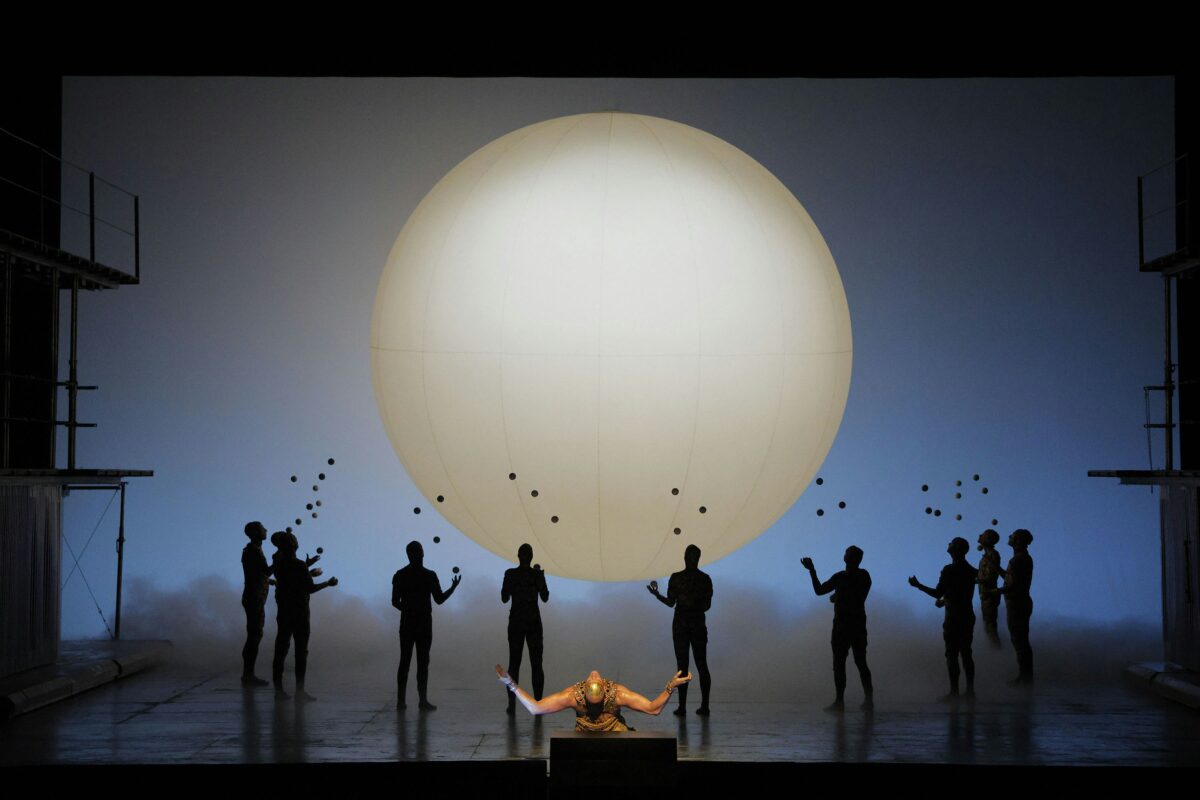
I saw Akhnaten during its first run at the Met in 2019. At the time, I was utterly dumbfounded by the visceral power and jaw-dropping beauty of McDermott’s vision, realized immaculately through Tom Pye’s scaffold set pieces and the impressive giant orb sun, Kevin Pollard’s extraordinarily rich costumes, and, the show’s main selling point and also its heart and soul, Sean Gandini’s group of jugglers. Seven years later, the production remained a profound meditation on power and religion, and given the current affairs of that particular weekend, the story of a ruler hell-bent on elevating himself to god status (Akhenaten means “Beneficiary of Aten”) and eradicating the nation’s religious system had become awfully relevant to the modern world. Even though there were many juggling failures on the opening night, and “The City” scenes with the balls in Act II were rather messy (signs of limited rehearsal time, perhaps?), the production’s overall effect remained spellbinding, bathing the stage in an otherworldly glow.
For me, the allure of catching this revival was the chance to hear the new cast, and on Saturday, they certainly didn’t disappoint. McDermott’s production was built largely around Anthony Roth Constanzo in the titular role, who had sung in all previous iterations. Having assumed the role last year at Berlin Komische Oper (in Barrie Kosky’s juggling-free mounting), John Holiday was truly a sight to behold. Stoic and eerily calm, with kindness and terror simultaneously evident on his face, he personified the ruler with an almost terrifying charisma. All of that stood in stark contrast to his bright, ringing voice, whose purity and clarity almost suggested innocence. Holiday comfortably handled the demands of Glass’s score, singing effortlessly while meeting many of the role’s physical demands onstage. “Hymn to the Sun” sounded particularly robust and evocative.
Fresh from returning as Rosa Saks in the highly successful The Amazing Adventures of Kavalier and Clay at the Met a few weeks ago, mezzo Sun-Ly Pierce dazzled in her LAO debut as Nefertiti, Akhnaten’s wife, bringing a warm, dark sound that complemented Holiday’s bright timbre beautifully, particularly in the Act II love duet. Pierce’s take on Nefertiti was an interesting case study; as suggested by her glances, she wasn’t content merely to be a wife but was also actively involved in politics (Nefertiti was rumored to ascend the throne after Akhenaten’s death, after all), which made sense of her presence in the young Tutankhamun’s scene. On the other hand, her short scene with her six daughters in Act III (sung harmoniously by Emily Damasco, Julia Maria Johnson, Katie Trigg, Abi Levis, Erin Alford, and Kristen Choi) was full of tenderness, emphasizing the familial isolation that eventually cost Akhnaten his life.
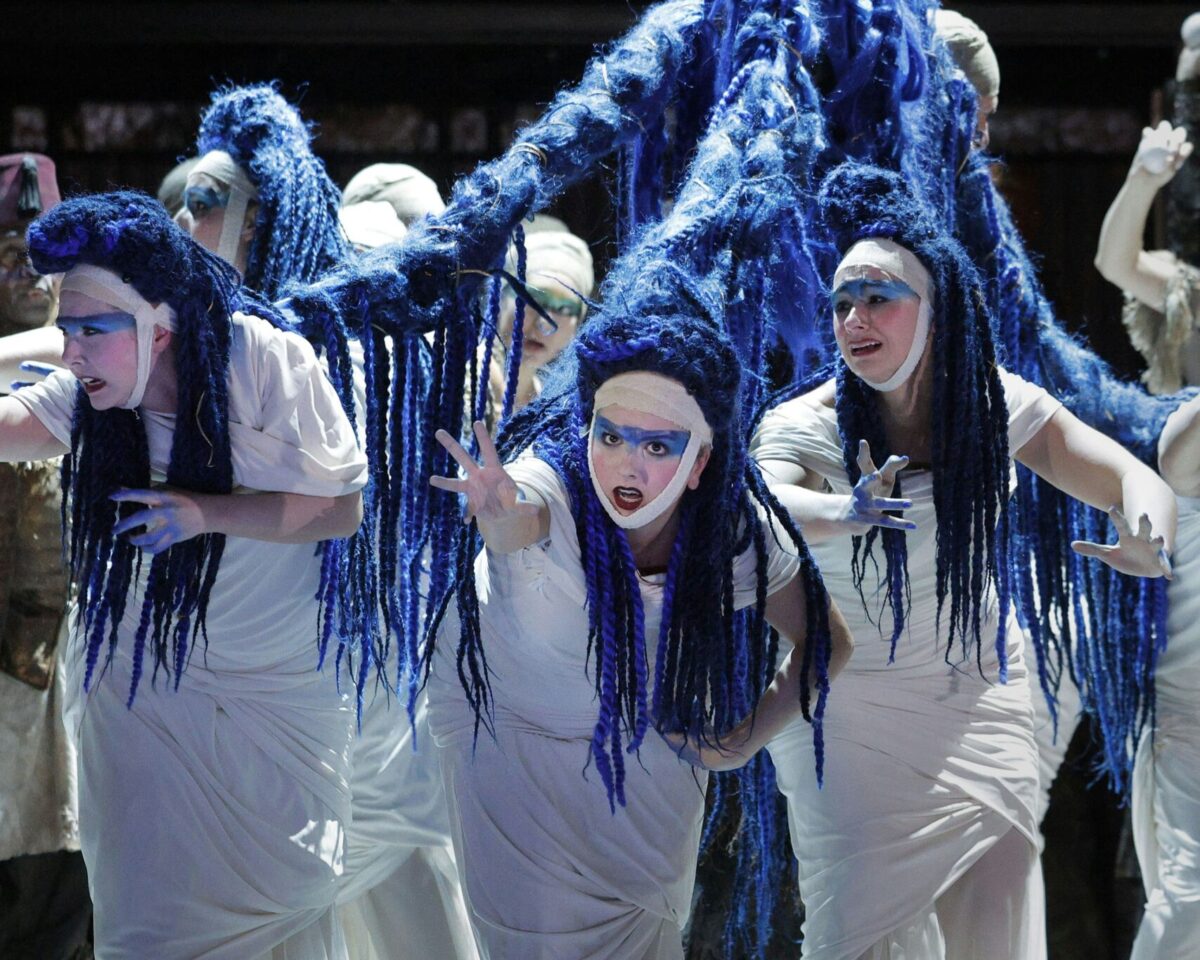
Julia Maria Johnson (Meretaten), Emily Damasco (Bekhetaten), and Erin Alford (Neferneferuaten) in LA Opera’s 2026 production of Akhnaten. Photo credit: Cory Weaver
Korean soprano So Young Park returned gloriously as Queen Tye, Akhnaten’s mother, in a performance marked by equal measures of care and ambition for her son’s success – in other words, just like most Asian mothers (yes, it reminded me of mine as well). A former Queen of the Night (in 2016 and 2019) at LAO, Park’s sparklingly bright tone attacked the role’s spiky high notes fearlessly, a fact she joked about in the short video below. Similarly, Park’s voice blended smoothly with both Holiday and Pierce while remaining individually discernible, especially in the climactic “The Window of Appearance” that closed Act I.
The royal presence of Zachary James in the central non-singing role of Amenhotep III (Akhnaten’s father) remains the greatest asset of this production. In nearly every iteration, James was said to be “stealing” the show, and that was true here. This time around, I felt that James’ performance was less campy (he’s still tall, handsome, and covered in gold, after all) and even more Shakespearean than before, as if he imbued the role with a sense of regret and powerlessness to stop his son’s actions. There was something about his declamatory delivery that made him so otherworldly, yet regal.
Three current members of the Domingo-Colburn-Stein Young Artist Program filled the roles of the antagonists, namely Vinícius Costa, Yuntong Han, and Hyungjin Son, as Aye (Nefertiti’s father and Akhnaten’s advisor), the High Priest of Amon, and Horemhab (Akhnaten’s general), respectively. On Saturday, Costa took a while to warm up, but the three collectively contributed significantly to the success of the night. Similarly, the LA Opera Chorus, under the direction of Jeremy Frank, sounded full and robust, particularly during climaxes, and even participated in single-ball juggling for a while.
The most puzzling aspect of the show for me was the conducting by Dalia Stasevska in her debut. On the one hand, there was no doubt that Stasevska brought out an exciting reading of Glass’s score, injecting so much vigor and clarity into the whole proceeding while highlighting the intricacies of Glass’s violin-less scoring. She seemed to revel in big, sweeping gestures, and the martial tunes of “Funeral of Amenhotep III” and particularly “Attack and Fall” came with such formidable force that they stunned the audience (it was a pity that she completely drowned Costa for “Funeral of Amenhotep III” amidst all the excitement).
My biggest problem with her conducting was her tendency to speed up and slow down mid-phrase. Glass’s score thrives on repetition and modulation, and to my ears, the constant changes were jarring, especially when my brain expected consistency. She also tended to end each section abruptly, destroying the opera’s overall arch and making Glass’s score sound episodic at times. The most striking example was the love duet in Act II; amid the duet’s “ahs,” the orchestra sounded labored, almost as if competing rather than providing the heartbeat of the moment. Fortunately, she improved significantly in that regard by the third act, and the ending was particularly haunting.
In the end, Akhnaten remains an extraordinary piece of theater that offers much food for thought. I, for one, am very grateful that LAO brought it out for their Anniversary.