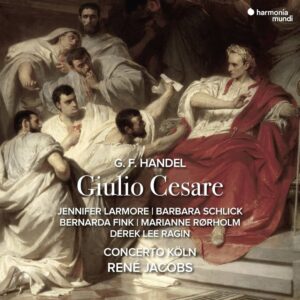
Since the very complete Harmonia Mundi CD was released, it has generally been regarded as the opera’s essential recording. However, that recommendation overlooks its crucial flaw: a white-voiced, charmless Barbara Schlick as Cleopatra.
I once read somewhere that Nelly Miricioiu was originally to perform the role when countertenor-turned-conductor René Jacobs led a live performance of GC before taking it into the recording studio. While no doubt the Romanian diva might have been more dramatically compelling than Schlick, I wonder how sure her grasp of Handelian style would have been: her Agrippina at New York City Opera in 2007, for example, wasn’t a success.
Jennifer Larmore, Jacobs’s Cesare, is often brusquely impressive but my mixed feelings about her are probably colored by my live Larmore experiences at the Met. As both Rosina and Cesare, her voice had virtually no impact at all in the house. Jacobs does have a superb Cornelia in Bernarda Fink and a potent Tolomeo in under-rated American countertenor Derek Lee Ragin along with the ever-delicious Dominique Visse as Nireno. Marianne Rørholm is a vigorous Sesto, but her mezzo remains rather colorless.
Jacobs’s vibrant conducting of Concerto Köln is the recording’s greatest strength, but since its release we’ve heard well-conducted recordings under Marc Minkowski, Alan Curtis and George Petrou. Though in general his early-HIP recordings are now often dismissed, I retain a fondness for the GC led by Jean-Claude Malgoire despite the ever-hooty James Bowman in the title role. Malgoire’s ladies, Lynne Dawson, Guillette Laurens, and Eirian James, are very fine and Visse handily transitions to Tolomeo.
If I had to recommend Cesare recordings, I must include the much-cut and -transposed version with Beverly Sills and Norman Treigle. I first it heard during sixth or seventh grade and was completely bewitched, and it triggered my lifelong passion for Handel. Sills is magnificent and the noble yet agile Treigle presents the best-possible case for taking the music down an octave, unlike Dietrich Fischer-Dieskau in the grimly serious Karl Richter recording. I don’t even care for Tatiana Troyanos, its Cleopatra, whose mezzo is too dark and heavy for the role. Unsurprisingly, she later became a splendid Cesare.
I still remember first seeing the Jacobs CD—I spotted it as a new release on sale during my weekly canvas of the classical department of Tower Records on lower Broadway. Prior to that purchase, my GC of choice had long been a 1979 broadcast from the English National Opera starring a blazing Janet Baker in the title role.
Baker’s studio audio and video recording again with Valerie Masterson as Cleopatra made years later is not nearly as effective as the live one.
For a Cesare by Jacobs, I prefer a Paris broadcast from 2008. If it’s not absolutely complete like the Harmonia Mundi, it brims with life and its consistently strong cast is led by the captivating Cleopatra of Sandrine Piau.
I’ve been told that Harry Bicket and The English Concert recorded Cesare following last year’s tour with Christophe Dumaux and Louise Alder. The CD will feature the work complete rather than with the cuts that marred their Carnegie Hall performance.
This month the forces who will likely record yet another Cesare for CD have been touring Europe. My suspicion arises from the fact that its popular stars, Jakub Józef Orliński and Sabine Devieilhe, are both exclusive Warner/Erato artists. Two of the tour’s performances featuring the excellent Il Pomo d’Oro led by Francesco Corti have been streamed. The casts for both are identical except for the Cleopatra: one features Devieilhe, the other Piau, her alternate.
Piau, who turns 61 in June, remains a consummate Handel stylist though the voice is naturally less rich than previously. Devieilhe’s lightweight interpretation reminds me quite a bit of Battle’s. Beth Taylor sings a sumptuous Cornelia and young British mezzo Rebecca Leggett, replacing the originally announced Sophie Rennert, emphasizes Sesto’s impetuous anger.
The performances feature three countertenors: Orliński and Yuriy Mynenko and Rémy Brès-Feuillet as Tolomeo and Nireno. To my ears, they sound all too similar, a bit colorless and verging on hooty. That said, I was rather impressed by Orliński (despite some unorthodox ornamentation) whom I expected to be miscast, but I still prefer a mezzo in the opera’s title role.