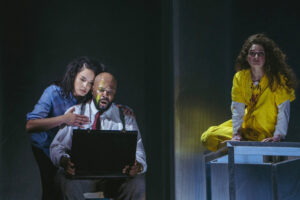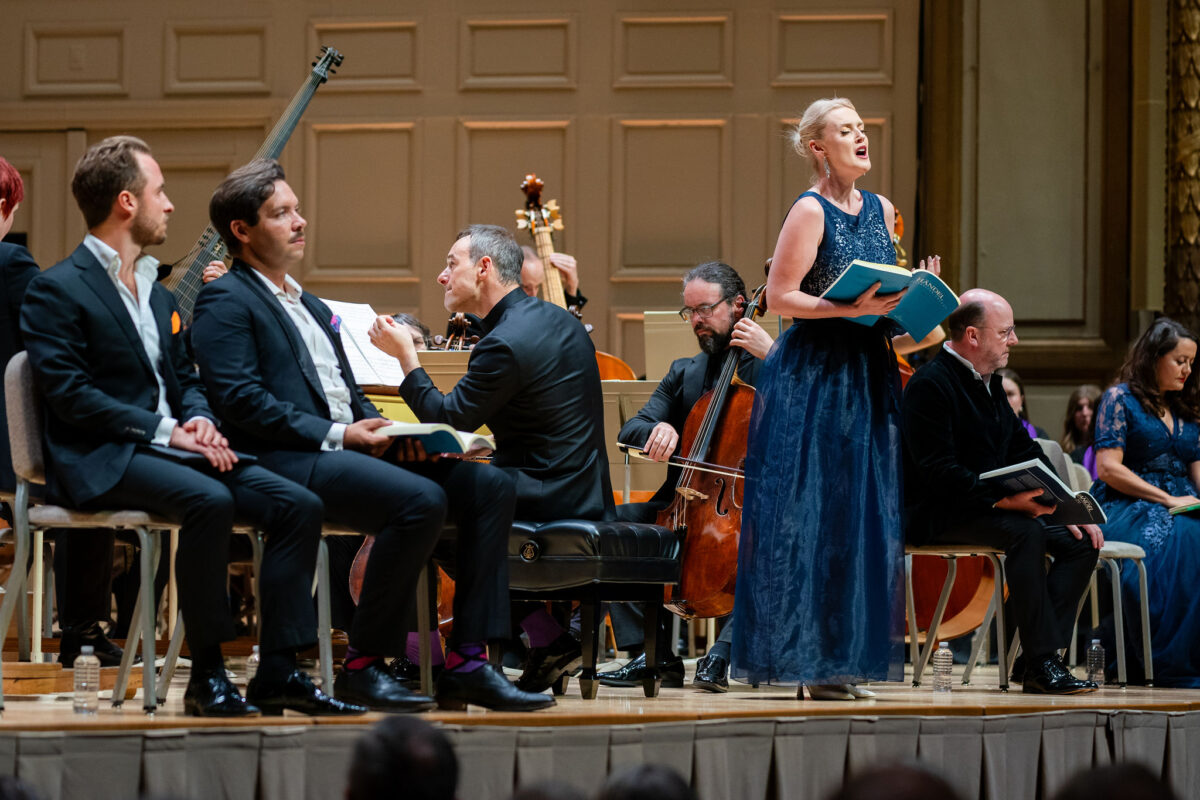
Soprano Sarah Brady sings the role of Merab in the Handel and Haydn Society’s performances of Handel’s Saul.
Since I first heard a recording decades ago, Handel’s Saul has remained for me one of the most complex and grandest music dramas of the 18th century. But, until last month, I’d never attended a performance that matched its magnificence. At Boston’s gorgeous Symphony Hall, Jonathan Cohen led his sterling Handel and Haydn Society forces in a thrilling reading of Saul that left me on such a high that even frustrating delays at Logan Airport afterward couldn’t ruin it.
After I moved to New York City in late 1990, I was excited that the first Handel performance I attended in my new hometown was Saul, performed by the Sine Nomine Singers at Alice Tully Hall. It turned out to be disappointing as its rendition of Handel’s compelling portrait of King Saul’s horrifying fall proved a pleasant rather than stirring evening. Six years later, San Francisco’s Philharmonia Baroque brought a two-night oratorio-fest of Saul and Hercules to the Brooklyn Academy of Music. Dominique Labelle as Saul’s daughter Michal and, especially, David Daniels as the future King David were superb, and Nicholas McGegan’s forces were much more polished than the Sine Nomine crew, but old favorite Jennifer Smith’s off-form Merab and a pallid David Thomas in the title role were cruel let-downs.
As Handel’s oratorios have been staged with increasing frequency lately, I was excited to see Christof Loy’s production of Saul at the Bayerische Staatsoper on my way to the 2005 Salzburg Pfingstfestspiele. Loy’s very gay-forward concept was far more convincing than David Alden’s perverse new La Calisto that I attended several nights earlier. After all, Charles Jennens’s libretto has Jonathan call David “thou darling of my soul,” and David, mourning Jonathan’s death, proclaims “Great was the pleasure I enjoy’d in thee/And more than woman’s love thy wondrous love to me!” However, Brian Asawa’s disastrous David made little of this relationship. His poorly sung, detached portrayal tainted the evening, nearly negating Ivor Bolton’s strong conducting and fine portrayals by Rebecca Evans, Susan Gritton, and John Mark Ainsley (in his day, the finest Handel tenor).
In the intervening two decades, I’d been Saul-less, making do with effective recordings led by René Jacobs and Paul McCreesh. Saul has lately been much identified with Barrie Kosky’s flamboyant staging, first seen at the 2015 Glyndebourne Festival when it was filmed for release on DVD and BluRay. One can understand its acclaim as it makes a very strong case for Saul, but it’s ultimately way too busy and noisy for me. It was revived in 2019 by Houston Grand Opera; I was tempted to catch it there, but I was still recovering from knee surgery and I’ve not been convinced by conductor Patrick Summers’s Handel. On home video, I prefer Claus Guth’s more elegant, contemporary approach.
When the H+H announced that it was opening its 211th season with Saul, I knew I must attend, particularly after listening to Cohen’s marvelous new recording of three of Handel’s underrated Chandos Anthems with Arcangelo, his other group. This summer, Cohen had led the second Glyndebourne revival of Kosky’s production, and his majestically propulsive reading in Boston clearly indicated how profitable that Sussex experience had been. With him, he brought Sarah Brady and Linard Vrielink as Merab and Jonathan; both rarely consulted their scores. The Irish soprano brought a big sound and a bold temperament to Saul’s eldest daughter, who rejects the offer of marriage to new hero David. After the first act, Merab recedes from the increasingly doomed action which unfortunately left Brady little to do. The intense Dutch tenor left little doubt of Jonathan’s love for David infusing his music with a hectically defensive ardor that occasionally struck me as a bit over-the-top.
Christopher Lowrey’s smooth countertenor excelled as David, whose seductive music ensnared both Jonathan and his sister Michal but failed to soothe the seething Saul. David’s success against Goliath and his subsequent acclaim may have gone a bit to his head as Lowrey didn’t evince much chemistry with either of Saul’s devoted offspring. This was a bit disappointing as Amanda Forsythe (substituting for an absent Julie Roset) was such an endearing Michal singing with her trademark limpid expressiveness. Familiar from the 2002 McCreesh recording, veteran British bass-baritone Neal Davies returned to the title role and vividly charted the once-noble king’s descent into jealousy and madness. Davies brought his biting diction and still agile voice to an exceptionally creepy rendition of Saul’s encounter with the Witch of Endor, embodied by wily tenor Stefan Reed.
As fine as the committed soloists were, the greatest success of the afternoon was H+H’s very fine HIP orchestra, who shone in Saul’s unusually large number of instrumental movements and the three vigorous choruses. I was initially alarmed when I saw the stage almost overflowing with the nearly eighty singers of the H+H Chorus, the H+H Youth Choruses Chamber Choir, and H+H CitySing. But Cohen sometimes chose to use just one or two of the groups, all of whom sang with invigorating energy. The three most memorably united in the soul-stirring “Hallelujah!” that concludes the stunning opening welcome sequence.
In a lucky accident of scheduling, just a month after Saul, Juilliard415 and the Yale Schola Cantorum joined for a pair of performances of Jephtha, Handel’s moving final oratorio. Heard November 8 at Alice Tully Hall, they were joined by six soloists from Yale’s Institute of Sacred Music, all under Nicholas McGegan’s wise and seasoned direction. While Cohen went for urgently unfolding drama, McGegan’s more mellow approach occasionally slighted the evolving tragedy of the consequences of Jephtha’s unwise pledge to ensure his military victory by sacrificing the first person he encounters, who turns out to be his only child, Iphis.
While the earlier Saul (1738) consistently breaks with the opera seria conventions that had formed the spine of Handel’s operas for so long, Jephtha (1751) reverts to a more traditional scheme of da capo arias (and a duet) framed by mighty choruses. To rein in the running time, McGegan unfortunately sanctioned numerous cuts including some in which only the AB of arias were performed rather than the full ABA’.
The always-adept Juilliard415 orchestra seemed smallish for this occasion but played with invigorating energy and polish. Initially, the Yale chorus also sounded underpowered but by the end of the first act and its stirring “When His loud voice in thunder spoke”, the group of 26 were doing full justice to Handel’s transcendent writing.
The soloists were less consistently successful at coping with the steep dramatic and vocal challenges presented by their roles. Sam Denler towered above his colleagues with an exceptional Jephtha, initially firm in his conviction of being right, then shattered by fate’s intervention. His bright tenor dealt handily with the difficult coloratura, spinning out a lovely, comforting “Waft her angels.” As his frantic wife Storgè, female countertenor (!) Scottie Rogers attacked her warnings with urgent energy, but her voice lacked the cutting edge her arias needed.
Mezzo Gwendolyn Delaney as Iphis’s unlucky suitor Hamor sounded more like a soprano yet blended nicely with Isabel Barbato’s lovely Iphis, but occasionally, the florid writing proved too daunting for her. Barbato’s sweetly guileless approach was just right for one of Handel’s most radiant heroines. As Iphis accepts her fate with resignation, Barbato’s light soprano rose to the occasion with rapt dedication.
As Zebul, Matthew Dexter’s strong bass-baritone negotiated the florid writing with enviable élan. Eden Bartholomew stepped out of the chorus (and into a shiny gown) for a fetchingly joyful Angel, who appears at the last moment to save Iphis from succumbing to her father’s oath.
Carnegie Hall steps up in 2026 to continue this rare Handel oratorio season with (the very secular) Hercules in March. This year’s annual English Concert visit stars Ann Hallenberg, who repeats her acclaimed Dejanira. Oratorio Society of New York then revives the rarely heard (also secular) Alexander’s Feast in May featuring recent Met debutante Lauren Snouffer and rising tenor Richard Pittsinger (son of noted singers Patricia Schuman and David Pittsinger).
Meanwhile, farther uptown, there’s been no Handel at the Met since Rodelinda in 2022. However, the company has been announced as co-producer of three (!) Handel masterpieces with prominent opera companies across the pond: Alcina with London’s Royal Opera; Ariodante with the Paris Opéra; and (another very secular oratorio) Semele with Munich’s Bayerische Staatsoper directed by Richard Jones, Robert Carsen, and Claus Guth, respectively. But who knows when or if any of these will make their way to Lincoln Center?