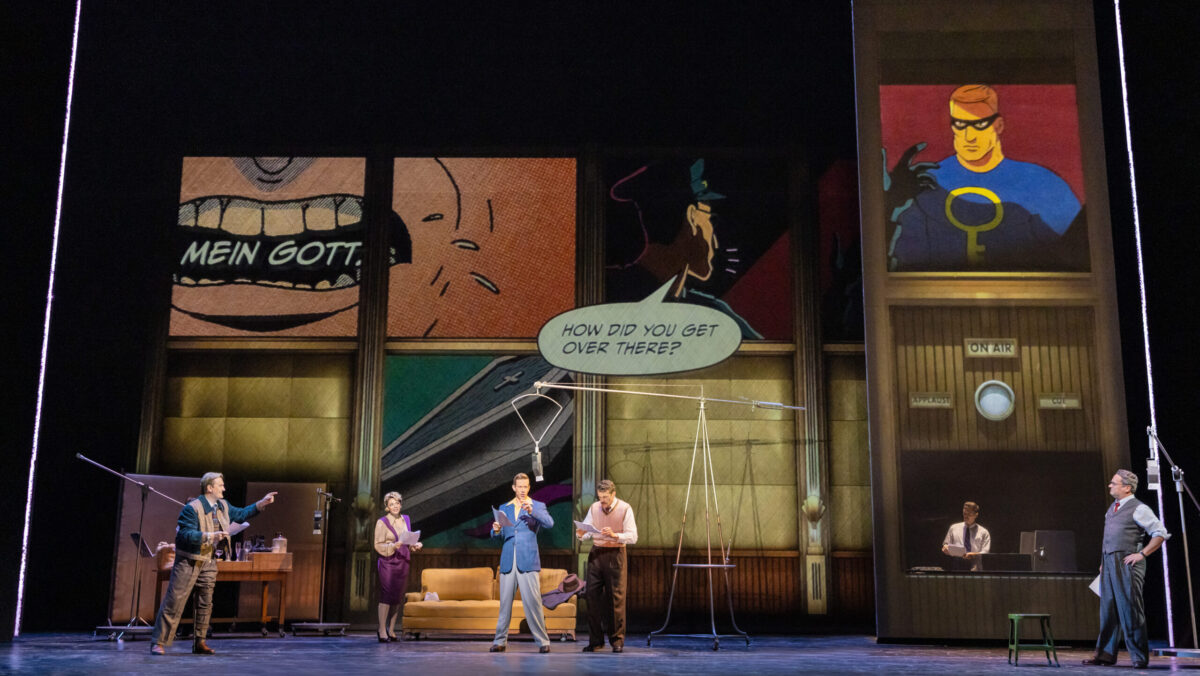
A scene from Mason Bates’s “The Amazing Adventures of Kavalier & Clay.” Photo: Evan Zimmerman / Met Opera
If you, like me, were once an avid reader of the novelist Michael Chabon, you may have reacted like I did to the news that an operatic adaptation of The Amazing Adventures of Kavalier & Clay was to debut at the Met—namely, by asking “why would anyone want to make an opera of that?” Kavalier & Clay is long and densely plotted. It has the ambitious scope of one print medium—the novel—and is a love letter to another—the comic book. Nothing about it screams “opera.”
Well, the opera is here, and it gives as its answer to the question, “why make an opera of Kavalier & Clay?” a resounding “we don’t know, either.” Bolstered by the efforts of a committed cast, Mason Bates’s Kavalier & Clay is a reasonably enjoyable time, but it never delves beneath the surface level of its source text and never really justifies its own existence.
Kavalier & Clay tells the story of two cousins, Josef “Joe” Kavalier (Andrzej Filonczyk), an artist and refugee from Nazi-occupied Prague, and Sam Clay (Miles Mykkanen), a copywriter with a love for superhero comics. When Joe comes to live with Sam in Brooklyn, the two invent the Escapist—a superhero who uses his powers to aid those living under the tyranny of Nazism.
Each cousin has his romantic entanglements, Sam with the star of the Escapist’s radio drama, Tracy Bacon (Edward Nelson), and Joe with the artist and activist Rosa Saks (Sun-Ly Pierce). Rosa secures passage for Joe’s sister Sarah (Lauren Snouffer) on the Ark of Miriam, a ship evacuating Jewish children from Europe. But when a Nazi submarine sinks the Ark, and Sarah with it, Joe starts to go off the rails.
All of this—plus Joe’s daring escape from Prague, a cameo appearance by Salvadore Dali, and multiple art gallery gala fundraisers—was crammed into the first act of Bates’s and librettist Gene Scheer’s opera. Scheer’s libretto rendered this excess of plot in a fast-paced, conversational style with plenty of jokes, many of which were even funny.
Act II, which diverges significantly from the novel, concerns the emotional fallout of Joe’s decision to flee his life in America. Joe and Tracy join the army, with Sam and Rosa left behind to tend to both the Escapist and to Joe and Rosa’s daughter.
Neither Act I’s whistle-stop tour through many of the novel’s key plot events nor Act II’s invented, less complicated plot ultimately offered much of substance to the viewer. Act I’s barrage of short scenes made it hard for any one sequence to accrue emotional depth.
The loss of the Ark of Miriam, for example, should have been the opera’s tragic emotional core—or an opportunity for Kavalier & Clay to speak to its current moment. For me, the Ark evoked still ongoing tragedies: the refugee crisis, in which hundreds of migrants have lost their lives in capsized vessels, or the efforts of Israeli military forces to halt the aid-carrying boats known as the Freedom Flotilla. But these resonances felt unintentional. The Act’s unvaried pace and the generic quality of Bates’s vocal writing made it hard to feel as though the Ark mattered more than, say, the recording of a new Escapist radio play.
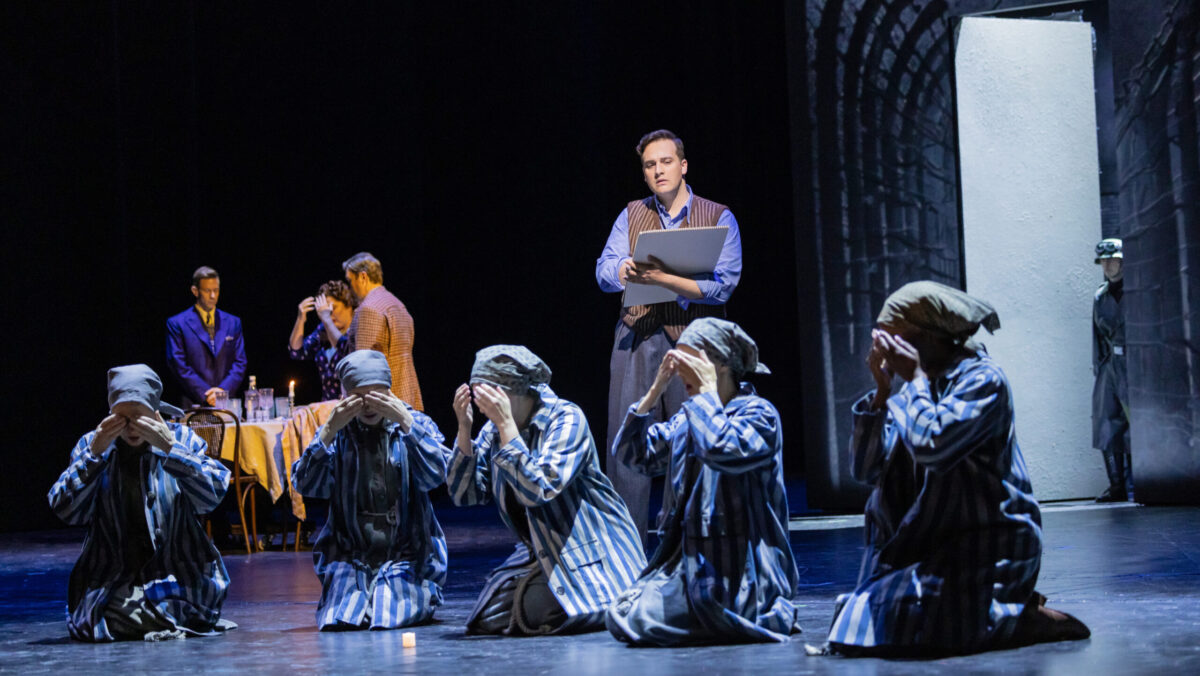
Andrzej Filończyk as Joe Kavalier in a scene from Mason Bates’s “The Amazing Adventures of Kavalier & Clay.” Photo: Evan Zimmerman / Met Opera
Act II, while more effective in giving its emotional beats room to breathe, resorted to some cliches so hackneyed they verged on offensive: the broad and clunky handling of Sam and Tracy’s gay relationship, for example, or several sequences in which Jewish Holocaust victims were rendered as generic wraiths in striped uniforms, menaced by movie-villain Nazis.
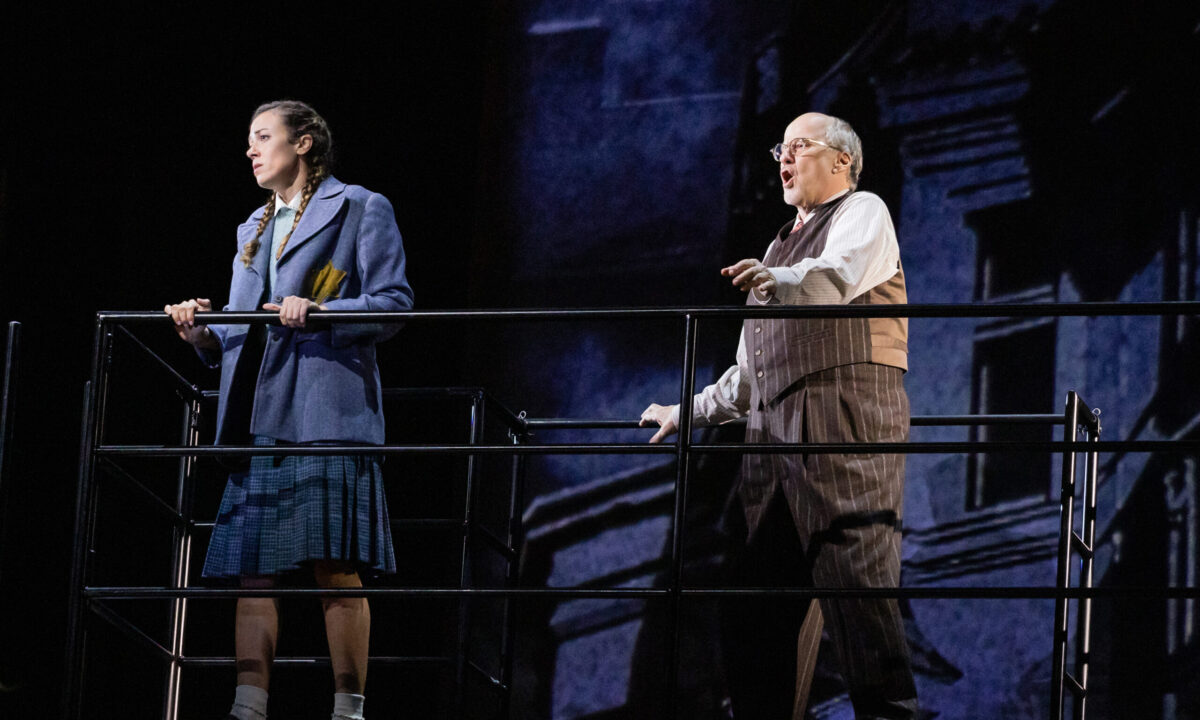
This generic quality was sadly enhanced by Bartlett Sher’s production, and, in particular, the projections by 59 Studio, which were relentlessly generic, whether rendering uninspired comic book art or stock images of bombed out Western front landscapes. They were also curiously unfocused, both in that they lacked coherent visual style and in that they were often literally blurry.
A scene in which Filonczyk bent over a drafting board while sketches appeared like magic on the wall behind him was compelling at first, until I realized that the video wasn’t a plausible facsimile of sketching at all; the lines didn’t appear in anything like the order in which an artist would have drawn them. If this sounds like nitpicking, maybe it is. But the sequence reflected the laziness that productions built around extremely literal projections are prone to. We should have been watching Joe and Sam’s vision take form before our eyes and feeling the magic of that vision! Instead, the projections only evoked the general idea of a vision taking form—much like the opera itself only evoked the general idea of historical tragedy, without much of the specific textures of its characters’ suffering.
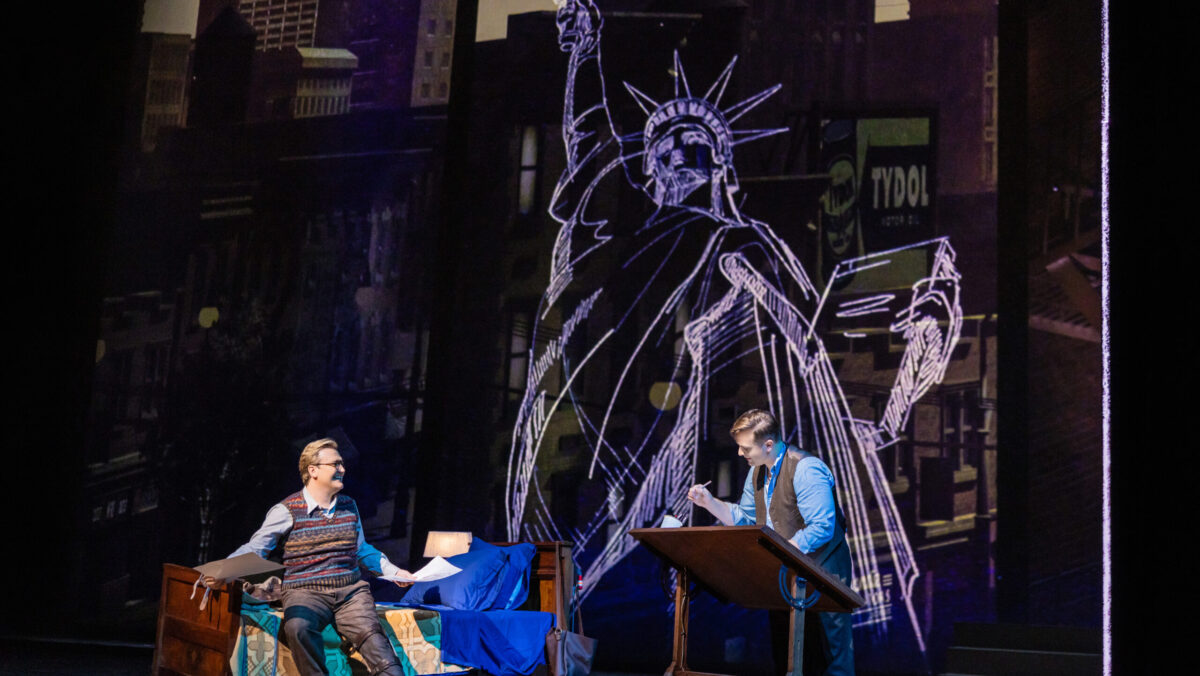
Miles Mykkanen as Sam Clay and Andrzej Filończyk as Joe Kavalier in a scene from Mason Bates’s “The Amazing Adventures of Kavalier & Clay.” Photo: Evan Zimmerman / Met Opera
Given this surface-level treatment of the novel, it was to the credit of the cast that they were able to make this glut of material feel, for the most part, charming. Andrzej Filonczyk, in his Met debut, brought pathos and passion to Joe Kavalier despite a slightly-covered quality to his middle voice that made him sound curiously recessed from duets with Miles Mikkanen’s clarion-voiced Sam Clay. Filonczyk sounded his best when dueting with Sun-Ly Pierce as Rosa Saks; her full and rounded mezzo voice brightened the corners of his blunt and stormy baritone, to romantic effect.
As Clay, Mikkanen was all wholesome and earnest appeal, with a tenor voice as bright and eager as his stage presence. He, too, sounded his best when singing with his love interest, Edward Nelson, who as Tracy Bacon paired a warm, leading-man’s baritone with an effortless, leading-man’s charm. Their similarly clear, open timbres paired well and their duet atop the Empire State Building was a high point in more ways than one.
The cast also contained two standout singers in smaller roles: Patrick Carfizzi, as the cousins’ boss and eventual publisher Sheldon Anapol, whose wry, comedic affect and agile bass-baritone voice brought character and uniqueness to a small part; and Lauren Snouffer, who, in her Met debut as Sarah Kavalier, showcased a sparkling soprano and a confident, naturalistic handling of the libretto.
Lauren Snouffer as Sarah Kavalier and Richard Croft as Solomon Kavalier in Mason Bates’s “The Amazing Adventures of Kavalier & Clay.” Photo: Evan Zimmerman / Met Opera
Mason Bates has made a name for himself as someone interested in incorporating synthesizers into classical composition and, indeed, the score of Kavalier & Clay hummed and crackled with blurts of synthesized sound alongside twinkling dulcimers, cinematic sweeps of strings and brass, and movie-montage jazz drumming. Yannick Nézet-Séguin kept the pulse of the music propulsive; the energy never lagged across the nearly three hours of runtime.
But, as in the treatment of the novel, there was something about Bates’s score that neither delved beneath the surface-level nor reached up towards the truly operatic. The synthesizers had a bloodless quality, at times arpeggiating thinly in a way that evoked a TV documentary—maybe one about the Big Bang. The jazz touches suited the setting and led to some truly fun musical sequences, such as Bacon’s going away party, where a chorus of gay men sang and danced and toasted the political career of the provocatively-named Dick Johnson. (Could this have been a reference to my own favorite opera of all time, La fanciulla del West?)
Despite its over-crowded plot and projections that looked weirdly AI-generated, The Amazing Adventures of Kavalier & Clay was, somehow, a fun night at the opera—just not one that felt specifically operatic. In fact, Bates’s jazz influences, along with his vocal lines that tended towards the light-weight and accessible, pointed towards what would have been a better venue for this work. What this opera really wanted to be was another one of the few authentically home-grown American art forms, alongside jazz, the blues, hip-hop and, of course, the comic book: the Broadway musical.