
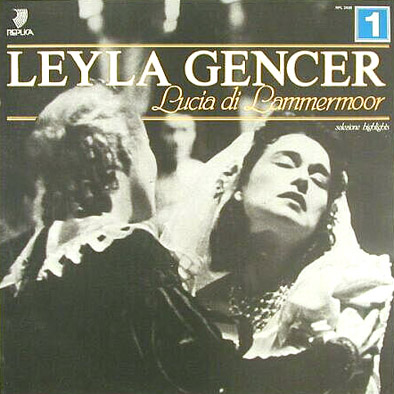
[This article originally appeared in the print zine precursor to this site, one of a series of surveys of live recordings by critic Leila de Lakmé.]
Leyla Gencer. The very name is exotic. She was an artist of Turkish ancestry who, during the 1950s and 60s, held her own despite the presence of Maria Callas, Renata Tebaldi, Renata Scotto, Montserrat Caballe, and Magda Olivero, all of whom shared roles in her repertoire. Ironically, Gencer has a number of important credits attached to her name that many tend to forget. Wrongly viewed as the poor man’s Callas, the Turkish soprano actually showed more versatility.
Born in 1924, during the early part of her career she was known as a champion of modern works and sang in the world premiere of a number of operas, including Poulenc’s Dialogues of the Carmelites (Mme Lidoine), Pizzetti’s Assassinio nella Cattedrale (Murder in the Cathedal), Prokofiev’s Fiery Angel (the Italian premiere at Spoleto) and Rocca’s Monte Ivnor. During her career, she had a repertoire of some 70 roles, from Monteverdi and Bellini to Pizzetti and Weinberger.
OK, so sometimes she sounds like your grandmother on a bad day. Or a banshee in heat. But, you gotta admit there is something about that voice….something about the oddness of mezzo-tinged middle and low registers contrasted by a pure and sweet, flute-like, high pianissimo. But it is not only the voice but also the way in which it was used. The committment, the poised grandeur contrasted by moments of frailty and demonic fury. Looked at objectively, the soprano certainly did not have the genius of Callas nor the natural endowment of Tebaldi. So why was she so popular?Â
Gencer was a mass of contrasts. In order to remain in the race that was dominated by Callas (in the bel canto repertoire) and Tebaldi (in the verismo repreotire), she took her basically sweet, light spinto voice, twisted it, shoved it and pushed it out to the extremes. She molded it into the instrument that she wanted. Truth be known she was left with an odd, unequal instrument, but one of infinite colors and one capable of great gradations of volume which contrasted an often wild, unfocused quality of the top register. It wasn’t until 1957 that she began to branch out and embrace the bel canto works that had become so favored with Maria Callas.
By the mid 1960s Gencer had established herself as the leading Donizetti specialist. Indeed the documents of her performances in such works as Belisario, Anna Bolena, Caterina Cornaro, Lucrezia Borgia, Roberto Devereux, Maria Stuarda, and Les Martyres are models of their kind. During an extremely fertile period of individual soprano artists, Gencer remained a unique entity offering listeners the (at times confusing) combination of a Greek Fury’s intensity and the fragile, delicate hauntingly-sweet pianissimi of an Amelita Galli-Curci. At her best she represented the glory of humnaity in opera. At her worst she was high camp.
There were problems with the instrument from the beginning. Not surprising since it had been manipulated into a dramatic d’agilita. Especailly iffy was the passaggio into her top register – that area around f and g at the top of the staff. It was always a bit suspect as to pitch. She also had a tendency, when excited and in the midst of dramatic utterances to sing off hte breath so that her tone not only curdled but also completely dissipated. Like others, however, she used her faults to her benefit – incorporating them into the fabric of her interpretations. She is a perfect example of both the merits and detriments of vocal compromise.
Gencer was an artist that often went over the top I do not mean to infer that she could not be a singer of restraint and finesse. Indeed, a number of her documented performance offer classic examples of bel canto phrasing and articulate musicianship. She was, however, erratic; sometimes during the same performance. And yet, oddly, it is that very inconsistency that draws one back to her performances time and time again. As William Ashbrook wrote of her: “(She is) a singing actress of imagination, one who pushes herself to the limits, one who prowls a stage like a wild thing confined behind bars, and that restless energy permeates what she does.” Indeed the 5′ 4″ soprano hurls imprecations like no one else in the business.
Gencer was the mistress of contrasts. Like Magda Olivero, she was an intellectual singer. By that I mean that although her dramatic effects may seem spontaneous and immediate, they are actualy very well plotted and planned. If they were not she would never have made it through a performance of such works as Medea and Macbeth. Like Olivero, Gencer intuitively knew the value and emotional impact of contrasting dramatically vivid, at times gutteral, vocalism with soft, elegant pianissimi. Her piainissimi were actually Gencer’s most appealing feature. One often has difficulty in describing vocal sounds, but in this case it is easy: they resemble the wispy sweet sounds that Galli-Curci emitted on many of her 1920 recordings. This peculiar sound coming from a dramatically-used instrument is as striking as it is odd. As was her peculiar way of thrusting up to such tones with force only to suddenly float them. A mannerism, it was extremely clever for its shock effect. Then of course there is Gencer’s liberal use of the glottal stroke. It is obvious that Caballe learned many of her tricks from Gencer. But for the unique combination of the coarse glottal stroke and elegant soft singing, you can’t beat Gencer.
Unfortunately, as mentioned before, Gencer arrived on the operatic scene at a time that boasted Tebaldi, Callas, and then, Caballe, Sutherland, and Sills. And she was overshadowed by all of them. Speaking of the incredible irony of the situation, Gencer once remarked: “I discover the opera, Sills sings them and Montserrat records them.”
Perhaps, also contributing to her lack of true “star” status in the international arena was her dislike of travel. As she said in interviews, “Io son pigra.” (No, that doesn’t mean “I am a pig.”) It means is that she considered herself lazy because she does not like to travel. Financially comfortable, she was in the position to pick and choose what and where she sang. Although negotiations began with the Metropolitan as early as 1956, they eventually fizzled out.
 Gencer’s rise during the 1950s paralleled the rise of private tape recording and specifically the ability to tape performances on portable tape recorders. Also, although never considered a probing actress, Gencer was a perfect singer for the medium of recording. Ironically this was a situation that went largely unnoticed by recording companies. (A 10″ cetra disc of arias recorded in 1956 seems little more than an extended “test” for the artist. Another 10″ disc of songs and a few arias recorded in 1974 – towards the end of a rather long decline have done little to affix her name or reputation in the record books.) As if compensating for that gross error, her work on stage was faithfully captured by fans and “professional” pirates and fortunately provides us with an honest portrait of this proud diva. Because of her popularity with opera pirates and also with fans Gencer has garnered the title of “Queen of the Pirates.” As her reputation rose so did the number of the available Gencer recordings on “pirate labels” or tape. There are over 80 performance preserved of this singer – many of which have never been put onto LP or CD.
Today, as of this writing, there are about 30 Gencer performances that can be found on CD. Because of the nature of the small business of Pirate recordings, items are constantly going in and out of print. Today you will look in vain for her Aida, Monte Ivnor, La Vestale, Attila, Lucrezia Borgia, Beatrice di Tenda, Due Foscari, Schwanda the Bagpiper, Puritani, Rigoletto, Tosca, Madama Butterfly. Yet at one time they were available. Gencerians should keep their eyes peeled, however, because undoubtedly they will reappear in other editions. Some of them not too bad, some of them pretty damn good and a few of them absolutely indespensible for any collection.
Lately performances of Leyla Gencer have been making a re-appearance – primarily on two labels – Myto, from Italy, arguably the premiere”pirate” label in today’s market, and Opera D’Oro a budget label which is rapidly vying with the Dutch label, Gala as one of the best buys around for opera lovers.
In this survey I can only concentrate on a few works and so my choices are only my own. Readers are urged to get any of her releases that appeal to them. Be assurred that any Gencer performance you pick up will have some fascinating moments. To be honest, I have yet to find a Gencer performance that I did not find interesting in some way or another.
Il trovatore RAI Milan 5/29/57
Recorded as the soundtrack for the RAI film of Trovatore this captures the Gencer voice in its youth. Although one can hear how she is already pushing her light instrument to its limits in order to match (what she perceives to be) the role’s weight, there is enough of her naturally youthful sound to create a sympathetic and colorfull character.
 Leonora was an excellent role for this singer and her elegant concept of legato and artistic nuances are much in evidence. Her famous glottal stroke is less in eviidence here than later in the 1960s but appears at some well-judged moments. In the opening “Tacea la notte placida” she surprises the listener with a beautifully floated high D flat picked out of the air and decides to interpolate the note again at the close of the act. Surrounded by such veterans as Bastianini, Barbieri and Del Monaco (an excellent high D flat at end of Act I and an excellent Di quella pira -who cares if it is lowered a half-step, it is well-sung), Gencer gives a performance that is idiomatic and white hot. Her finest moments come in Act IV with a moving “D’amor sull’ ali rosee” and a rousing “Miserere”. Although Gencer never had even the semblance of a trill, she nods in its direction and instead, concentractes on a sweet, lyrical, flowing line which carerrses the listener’s ear. There are many beautiful pianissimi not the least being another, sustained top D flat. Who could ever forget her singing of the such lines as “le pene, le pene dell‘ mio cor” with its deliberate shifting in and out of deep chest voice.
Taken from a Turin broadcast in December of 1957, this is certainly a CD to have. Although not a Lucia in the same league as Callas or Sutherland, Gencer imbues the part with her own ideas and some truly haunting singing. It’s available on both Melodram and Arkadia CDs (and as filler for the Myto issue of Donizetti’s Les Martyres (1975). This is a worthy addition to any Gencerian’s library. Although the E flats are the obvious limit to her top register they are respectable – and certainly a lot better than Cheryl Studer’s pig noises in October 1989 Philadelphia performances – which must be heard to be believed. Party tapes par excellence, her squeals are a singer’s nightmare, a Queen’s dream.
This Palermo performance was the first time Gencer essayed the famous donna. Although Mondo Musica has recently released the more famous 1968 performance, I prefer this 1960 revival with the wonderful Taddei and Gui’s magisterial conducting. Gencer performed this role relatively few times but she was famous for her interpretation. It was one of her favorites and one can see that she is having the time of her life. Different from the performance 8 years later, here her voice is more unified and she relies less on awkward shifts into registers (that quickly became her trademark) to supply drama but rather concentrates on singing the role. Another difference (of little consequence) is that in the later, 1968 performance Gencer eschews the high D flat in the Sleepwalking Scene.
Gerusalemme – 9/24/63– Venice
 Gencer was always a favorite with Venetian audiences and this September, 1963, performance shows why. It is one of the most remarkable performances in the Gencer canon. In good broadcast sound, it presents Gencer at her best- having an extraordinary night with the voice completely responsive to all the dramatic demands of the role. She shows herself to be an imaginative artist of elegance and earthy thrusts. In addition to the peculiar, “thrusted” pianissimi and gossamer glissandi there are glottal strokes and rough shifting of registers – all of which she cleverly weaves into the fabric of her interpretation. The interpolated high Cs and D’s are superbly done. The Act I prayer of Giselda (track 4) and the Act II duet with Aragall (tracks 23-24) are magnificent with all sorts of pianissimo shadings and dramatic, glottaled fortes. The “D’un padre oime! l’imagine” section of the duet (with its Aida-like, high, piano finish) is a very special moment. The following, short “Fuggiamo” duet-cabaletta is a perfect finish to the Act. Not to mention Gencer’s spectacular final high D. Act II has the massive, dramatic scena “Son vanni i lamenti”. A vocal obstacle course of great difficulty, Gencer sails through it with ease and follows it with a cabaletta of frightening ferocity capped with a magnificent, penultimate high C – which she sails up to to conclude the opera as well.
 Myto remedied the problem of no Gencer Norma on CD by releasing, in 1998, this 1966 perfromance from Lausanne Switzerland. Surrounded by such fine artists as Cossotto, Vinco and Limarrilli, Gencer certainly gives each of them a run for their money. Using her trademark pianissimo to its best advantage, she gives a perf of the title role that is all Gencer and not at all a Callas copy. Some of the finest moments include the Act I duet with Adalgisa where the runs and high Cs are sung with an ease that belies their difficulty. Cossotto, too, shows the beauty and ease of her high C. Actually, their blend during the duet is excellent. The finale to the Act is also rousing with Gencer sailing off on an excellent penultimate top D. As one would expect, she pulls out all the stops during the last two acts – especially the confrontation with Pollione and the exquistite pleading with Ovoreso in the last minutes of the opera. Indeed “Deh voleri vittime” is a remarkable performance of tremndous glottal strokes and dramatic intensity couched in some beautiful floated pianissimi. If you like Norma and individual interpretations you should have this.
This was a perfect part for Gencer’s dramatic abilities, yet, surprisingly, she sang it only a few times during her career. A performance from Venice in 1971 has been documented in very good sound on Mondo Musica. Although that has much to recommend it, I prefer one that tips the scales when it comes to Gencer’s performance. This can be found on Mike Richter’s remarkable “Tribute to San Francisco” CD Rom. Playable on any Windows or Mac computer with a CD Rom, (it will not play on a regular CD player) this remarkable disc has about 20 live opera performances – mostly in-house- including this La Gioconda with Gencer (her return to S.F.) Grace Bumbry, Renato Cioni, Maureen Forrester and Chester Ludgin.
This 1967 performance is much more exciting than the 1971 Venice effort and the combination of Bumbry and Gencer is not to be missed. Gencer’s liberal use of her chest register is used with imagination and a number of lines stand out – especially the desperate lines following the conforontation duet with Laura. In clear, clean and wonderful sound you cannot go wrong with this.
Cherubini: Medea – 12/15/68 Venice
Ironically, although, I Leila de Lakme, am a self-confesssed high note empress, of all the Gencer perofrmances, this Medea is probably my favorite. (Next to the outrageous Belisario, of course!) . Unfortnately it is out of print – although I a sure it will return soon. Even so I cannot resist talking about it none the less.
If one likes one’s Medea sung with intense dramaticism, there are 3 versions that you must not be without. One is the famous 1958 “Callas in Dallas”, then, as if part of a series there is the 1967 “Magda does Dallas”. Both women give searing performances of the title role. Then there is the Gencer in Venice 1968. Available on Claque CD, (and hopefully to be released by La Fenice as part of their series) it is a performance of countless colors and singing that rivals the most intense and finest of both Callas and Olivero. Gencer only sang the role in the Venice production and from this performance one understands why. Her singing of the Greek sorcerss is far too intense and dramatic to allow the singer to keep the role in her reperotire.
But how grateful we should be that a broadcast performance was preserved. Gencer provides more tonal beauty than either Callas or Olivero – with some truly stunning pianissimi, but is just as dramatic. All the big moments do not dissapoint and like Callas, she takes her chest voice dangerously high.
There are many individual moments of fascination on this recording. For example, the differing ways Gencer sings “fuggir” during the duet with Jason in Act I. Her final, desparate “fuggir” perfectly evokes shock, incredulity and disgust. All within a single tone. The opening of Act III is as harrowing as one would expect. Indeed, the entirety of Act III is a frightening exhibition of pure vehemence. Gencer’s use of her well-produced chest voice is almost psychotic in its delivery.
Ironically, despite the obvious excellence of this 1967 Naples performance, the work was not revived again until the 1980s where it was sung by another fascinatingly-flawed singer, Adelaide Negri. Like Gencer, Negri acquited herself well especailly considering the role’s cnsiderable dramatic and vocal demands.
 In 1967, Capuana and Gencer made a strong case for revivals of this work. Also excellent is the young Louis Quilico, whose softly-grained, beautiful voice is a definite plus. As is true with any Gencer performance she illuminates phrases with individual, unforgettable colorations and vocal tricks. Her pianissimo was in especially good estate this evening and she gives many examples of its haunting quality. Like Caballe, it was a sound that hung like a canopy over the house’s acoustics. Of special note is the extended Norma-like Act II, duet “Di quai soavi lagrime” between the two female protagonsts, Saffo and Climene (Franca Mattiucci). It is followed by a rousing cabaletta, which Gencer caps with another of her fabulous high Ds.
Paccini follows this with a long, white-hot, Donizettian-like ensemble that concludes the Act, finding Gencer at her most ferocious. Who could forget her desperate rendition of the line: “D’altra donna…no Giammai” with its intentional shits shifts of register. Or her intense, almost out of control denunciation: “Infame altar!” (Once heard never to be forgotten). One can almost see her tearing at her (very carefully-coiffed) 1960s buffant hairdo in horror. The Naples audience certainly enjoyed it.
A contemporary of Bellini and Donizetti, Paccini’s score is an interesting setting of the Saffo story with some novel orchestral effects. Like Mercadante, Paccini often surprises with his modulations and orchestration. The extended finale of the opera, “Teco dall’are pronube” with its harp accompaniment, is delicately traced by Gencer and then concluded with a rousing cabaletta-like finish in which Gencer interpolates yet another top D. If you don’t know this work but like Donizetti and the early-Verdi period of operatic writing, you can’t go wrong with this one.
Donizetti: Belisario – 5/14/69 Venice
 Now we come to my favorite Gencer entry – although there are quite a few runners up. This Venice Belisario was one of Gencer’s most important revivals and fortunately, also one of her best preserved performances. Now available on Mondo Musica (LC1507) if you don’t know this work or Gencer’s contributions, go and buy it. It will be a pleasant surprise. Forget about Taddei and that other female singer, who cares! Gencer’s opening scene (recorded by Caballe on her “Donizetti Rarities”) is immediately arresting for her intense declamation and forceful delivery which immediately establishes the character within moments. Her singing throughout the evening covers everything from excitingly coarse, to sweetly elegant to virtuostically brilliant. The final scene – one of the great works of its type- is a complex, extended scena with a double aria and a final cabaletta for the contra-heroine. Gencer delivers the goods and more. Of special note are the Galli-Curci-like pianissimi suspended over the chorus, the smooth-flowing legato, gutteral, dramatic accents, and a mighty, exalted finish capped by a stunning, very long high D.
In 1990, Hunt CD released the 1970 Bergamo performance with Bruson as Belisario. Although his work in the performance is wonderful, for Gencer fans this 1969 Venice performance says all that need be said of the bitch-role of Antonida.
 One of Rossini’s most florid scores, Gencer acquits herself with honor and manages to convey a strong, realistic character as well. Indeed the final aria is an intricate display of florid work that shows Gencer’s superb ability to sensitively phrase such music and invest it with meaning. The only drawback is the evident unravelling of her top register. Pianissimi are still exquiste but forte high notes are a trial – one which she loses. It can be especially offensive if one is not familiar with her voice and its idiosyncratic faults. Gencer manages a loud – if not pretty top D at the end of a very long Act I. This is a fascinating performance of Gencer’s only Rossini role and like so much of her live legacy it was an important revival at the time.
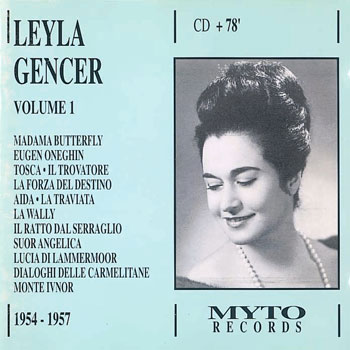
At the time of this writing there are 3 volumes in the Myto Gencer Series taking the listener from the year of Gencer’s Italian debut to just before her ascendancy as a Donizetti specialist. I urge you to get these volumes (Myto promises more) because they serve as a perfect complement to her complete performances. Gencer – like Callas was not a miniaturist but rather painted in broad strokes. To get the full flavor of her art one needs to hear the entire scene. Myto, however, has been extremely clever in their selections. There are too many wonderful tracks to go into any depth here but I would like to mention a few surprises. On volume one there is the “Un bel di” from her 1954 Italian debut as well as selections from unusual repertoire for this diva – Onegin, Entfuhrung (an excellent Martern aller Arten from a 1957 concert) as well as a creator’s recording from Dialogues of the Carmelites and an exquiste aria from Rocca’s Monte Ivnor. This last is the sleeper of the album. An odd, exotic piece full of Moorish, almost chant-like inflections it is capped by a remarkably beautiful, pianissimo high C. This is not to be missed.
Volume two has another creator’s performance – Pizzetti’s Assassinio nella Cattedrale. Perhaps the most important excerpts, however, are from Naples performances of Suor Angelica and Il Tabarro. They leave one wishing the complete performances had been released. The Suor Angelica is especially moving. It takes the listener from a lovely “Senza mama” to the end of the opera and Gencer is incredibly moving providing not only hefty top notes but also a softly spun high C that puts to shame a number of commercially recorded efforts. Conducted by Serafin these excerpts alone are worth the price of the disc – which is usually around $17.99.
With Volume III we get into more well-documeted performances, although some are not currently available. If nothing else get Volume 1&2 and look for volume 4.
The Donizetti Queens
 At this time Roberto Devereux (1964) and Anna Bolena (1958) are available (only $10.00 each on Opera D’Oro.) I am sure the Maria Stuarda (1967) and the Edinburgh Bolena (1965) will soon again be available. Gencer’s performaces of these roles are certainly worthy of close inspection and study. Although personally I prefer the ornate, uniquely individual recordings of Beverly Sills and Edita Gruberova in these roles, it is an idiosycratic preference on my part. You should hear the Gencer performances if only to remind yourself of how well-constructed these roles are when (basically) sung come scritto. Aside from an occasional top D or so, Gencer indulges in little ornamentation or interpolations. The Stuarda, especially, is well suited to her voice and she is partnered by a forceful, exciting Shirley Verrett as Elisabeth. Their scenes together are worth any price.