
Voygage from Italy
A survey of recent performances of Verdi, Puccini, and Rossini north of the Italian alps.
Sometimes Marco Armiliato’s Met appearances can sound tired and routine, but he was in top form for Ballo, prompting his top-flight orchestra and chorus to support his excellent cast in a richly satisfying Ballo in Maschera.
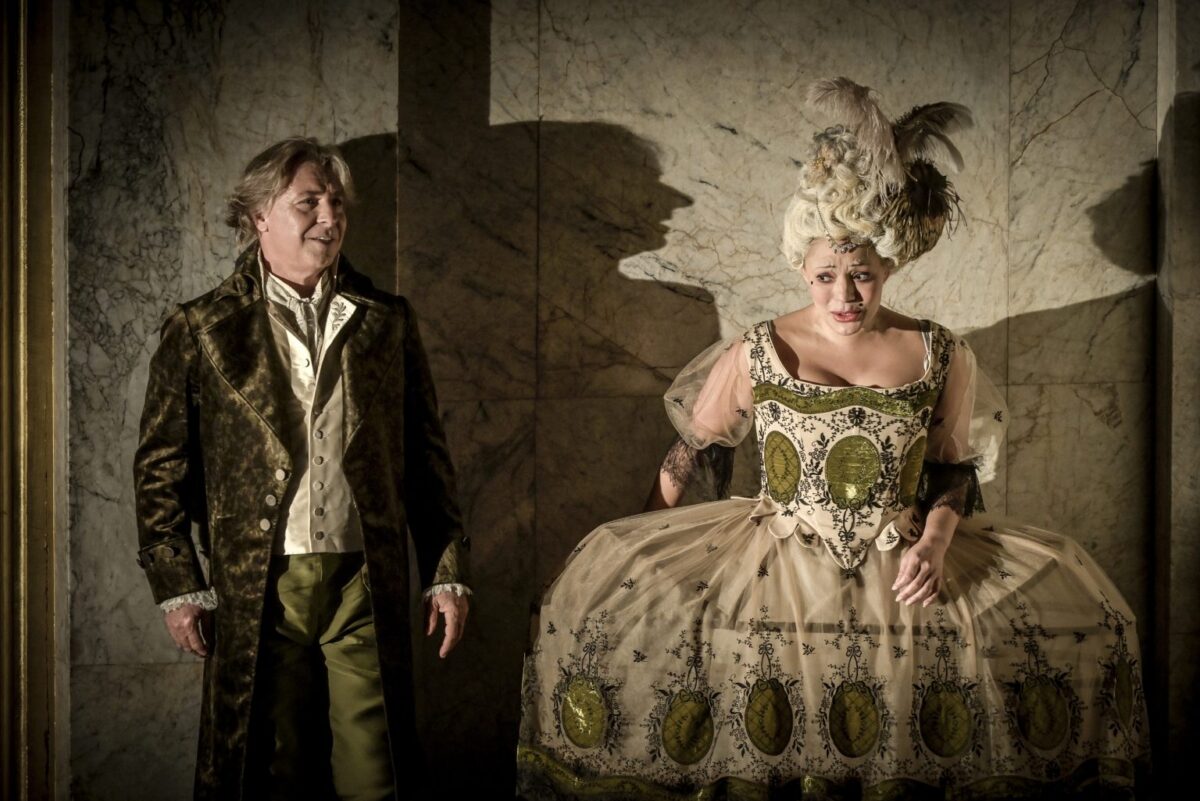
Photo: Victor Pontet
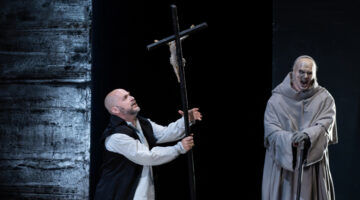
Nigel Wilkinson has already shared his thoughts about the new Manon Lescaut offered at Paris’s Thèâtre des Champs-Élysées, but at a later date I too attended the Puccini, awkwardly produced by Oliver Mears, Covent Garden’s newish Director of Opera. When I got home from TCE, I mentioned to the friends that I was staying with that Mears’s version had only a few new ideas, all of them bad! I wasn’t necessarily objecting to his choice to set each of the opera’s four acts in succeeding centuries, staring with the eighteenth, but what exactly was the point of beginning each act with an elaborate silent vignette concerning Manon’s coiffure? Also, Manon (like Offenbach’s Hoffmann, for example) apparently requires a mysterious nemesis, so Mears asked Léo Vermot-Desroches to perform all three of the opera’s minor tenor roles while skulking about menacingly until he finally manifested as Manon’s menacing pimp in Act IV’s lurid cowboy bar. Unfortunately, Vermot-Desroches was barely audible most of the time.
Unlike Nigel, who was hearing Ailyn Pérez for the first time, I’ve encountered the soprano numerous times at the Met: from an increasingly stylish Juliette and Thaïs, to tentative stabs at Blanche de la Force and Tatyana, and a truly sublime Verdi Requiem. But her shattering Cio-Cio-San earlier this year made me eager to experience more of her Puccini: in this case, her first-ever Manon Lescaut. She fiercely attacked Mears’s concept of an increasingly degraded Manon with breathtaking commitment despite Annemarie Woods’s garishly unbecoming costumes. Her rich soprano relished “In quelle trine morbide” and put across a truly frightening “Sola, perduta, abbandonata.” Mears has Des Grieux abandon his lover during her last moments, so the achingly vulnerable Pérez had to die in front of the now-closed red curtain in just a sliver of harsh light—shattering.
One wished she had an equally eager partner, but Roberto Alagna, in quite good voice, turned in yet another generic portrayal that could have been easily dropped into other operas in his repertoire. Though Mears spoiled Des Grieux’s second-act entrance by allowing Alagna to observe Pérez entertaining her band of admirers, the lovers reunited with full-throated ardor, although the horny calisthenics they executed looked as awkwardly staged as their fatally delayed escape. It didn’t help matters that Alagna lost his place just before “No! Pazzo son! Guardate!” signaling the conductor to stop the orchestra. After a moment to collect his thoughts (there was no prompter), the act proceeded, but the propulsive momentum provided by fine conductor Lorenzo Passerini was lost.
Lionel Lhote’s rather too stentorian Lescaut often made himself the center of attention, but the tall, robust Nicola Ulivieri made a dangerous Geronte to be feared. Mathilde Ortscheidt led the madrigal with an unusually lush, attention-grabbing mezzo. Passerini, who just shared the Rising Star Award at the International Opera Awards began with a chaotic first act but by the white-hot Intermezzo was drawing sumptuously sensuous playing from the Orchestre National de France.
Mears will eventually bring this Manon Lescaut to his home theater; let’s hope he does a better job with it there.
But my most memorable Italian opera experience occurred at the Staatstheater am Gärtnerplatz, a venue I scarcely knew existed, let alone that it presents a very full season of opera, operettas, musicals and dance. After Rossini’s Il Viaggio à Reims was resurrected at Pesaro’s Rossini Opera Festival in 1984, it was most often presented featuring a phalanx of the best bel canto specialists. However, in Munich, the virtually plotless 1825 pièce d’occasion made do with a game crew of nearly unknown singers in the many fiercely demanding roles.
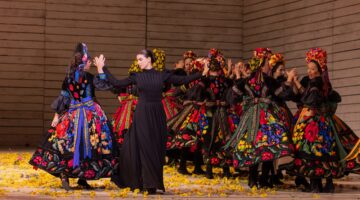
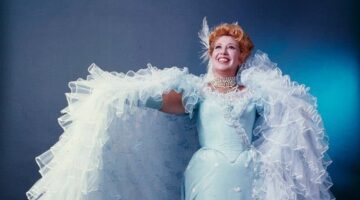
The unfortunate exception was the Corinna, a soprano with a thin, wiry voice who was tasked with playing her role as a simpering ninny trapped in a large harp case. Her character was a rare lapse in the otherwise deliriously amusing production by Dirk Schmedling. He followed tradition by presenting the opera’s first half as a parade of zany guests arriving at a busy hotel. But after intermission we saw that the anarchic hotel staff armed with machine guns had taken over the place and eventually installed Mme Cortese as queen of their reconfigured domain.
I was surprised to discover that after just three performances, Viaggio already had a new conductor, New York City-born Eduardo Browne, who led his large forces with such brisk command that the many extravagant ensembles crackled with energy and panache. Despite his wan partner, Belfiore’s marvelous duet with Corinna still sparkled as Andrés Agudalo’s stylish tenor took the stage. The sizzling duet for Melibea and Libenskof became a hilarious age-gap seduction between Anna Agathonos’s eager cougar and Gyula Rab’s tall, high-note-popping boytoy. American soprano Jennifer O’Loughlin showered the ensembles with bright acuti, while Andreja Zidaric’s dazzling turn in Comtesse Folleville‘s florid tantrum over her lost hat made one wish she had more to sing.
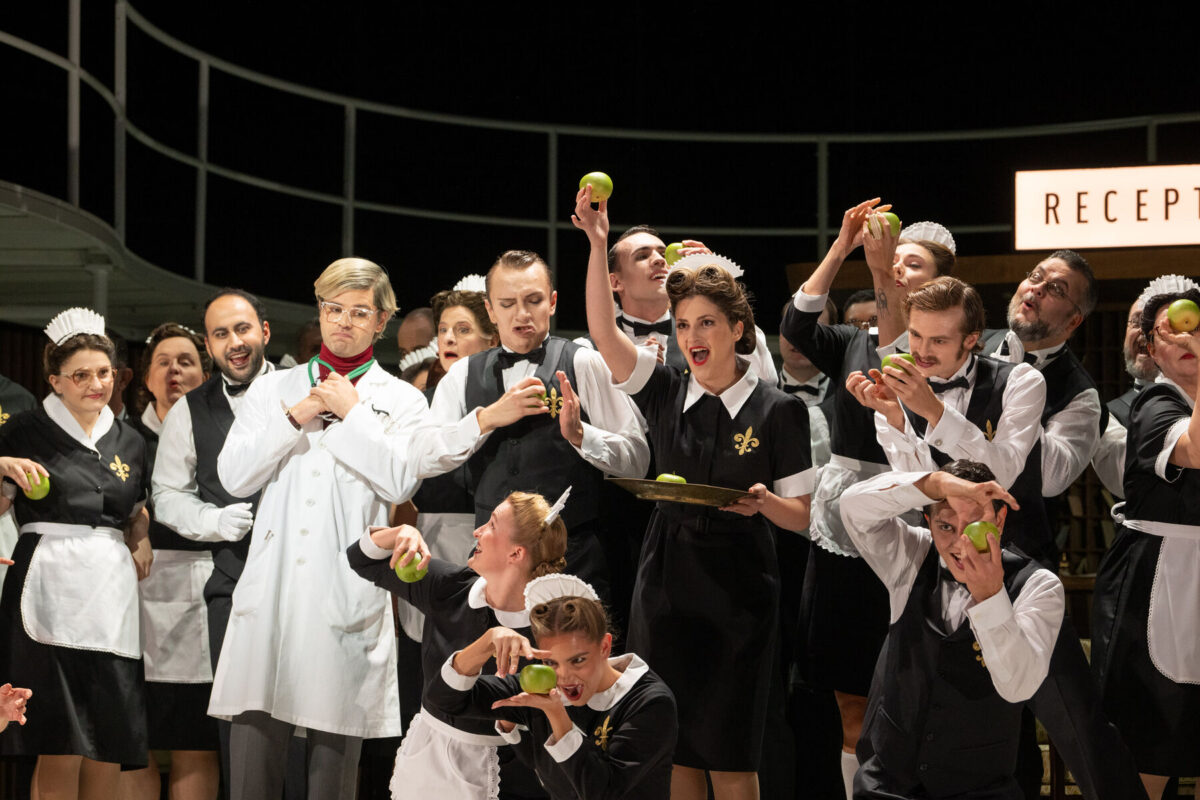
Photo: Anna Schnauss
Dishy baritone Ludwig Mittelhammer in tennis whites provided lots of amusing flute-syncing to begin Lord Sidney’s long scena, which he then concluded with scads of ebullient coloratura. Timos Sirlantzis delivered Don Profondo’s brilliant patter quite handily while Lavente Páll made much of little as Baron Trombonok. The finale’s amusing parade of national anthems was definitively won by Matija Meić’s flamboyant Don Álvaro.
Four more Viaggio performances remain in December at the Gärtnerplatz; it’s too bad one isn’t scheduled for New Year’s Eve as it would be the perfect opportunity to celebrate with the explosion of gold streamers that showered the audience during Viaggio’s final notes.
Boris Pinkhasovich seethed passionately as Renato, suggesting that he deserves to be seen again at the Met in something more challenging from his Italian and Russian repertoire than was displayed at his debut in the fall of 2024 as Marcello in the Franco Zeffirelli production of La Bohème that has introduced so many singers to the company. Perhaps some other interpreters of the role have bitten into their music with more brutal incisiveness, but Pinkhasovich’s beautiful instrument gave much pleasure.
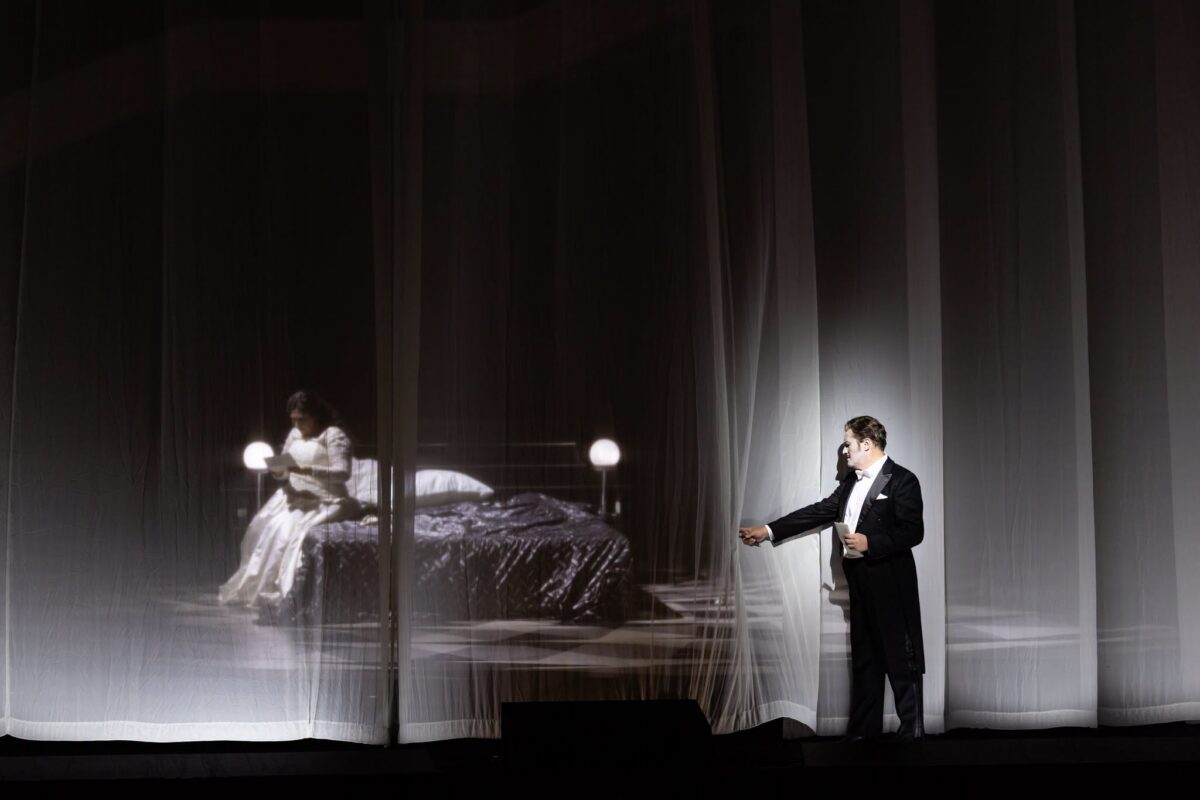
Photo: Geoffroy Schiedx
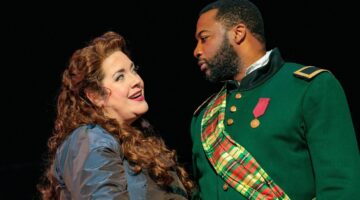
Amelia was to have been Anastasia Bartoli, but the young Italian may have decided the role was too heavy for her still-developing soprano. So instead of stepping into the Met’s Medea as some had hoped, Anna Pirozzi became Ballo’s sympathetic yet conflicted wife. She began edgily in the trio with Ulrica and Riccardo, but soon the galvanizing top notes she’d displayed as the Met’s latest Turandot arrived to thrill the Munich audience. She conquered both “Ma dall’arido stelo divulsa” and “Morrò, ma prima in grazia” with a sweeping vocal grandeur that one so rarely hears these days in Verdi, suggesting that her upcoming Met Aïdas in April may prove something special.
After a succession of missteps including canceling the premiere of Carrie Cracknell’s godawful new Carmen on New Year’s Eve 2023, followed exactly one year later by croaking through the new Aïda, another misbegotten production, Piotr Beczala has given Met audiences real cause for concern. He recently made it through the company’s Andrea Chénier revival without convincing many that it was really his role, but his effortlessly refulgent Munich Riccardo had the tenor who turns 60 next month sounding at least twenty years younger. He readily conveyed the character’s easy charm and romantic obsession with ringing high notes to spare, so it was gratifying to experience Beczala back on form.
Sometimes Marco Armiliato’s Met appearances can sound tired and routine, but he was in top form for Ballo, prompting his top-flight orchestra and chorus to support his excellent cast in a richly satisfying Ballo in Maschera.
Photo: Victor Pontet
Nigel Wilkinson has already shared his thoughts about the new Manon Lescaut offered at Paris’s Thèâtre des Champs-Élysées, but at a later date I too attended the Puccini, awkwardly produced by Oliver Mears, Covent Garden’s newish Director of Opera. When I got home from TCE, I mentioned to the friends that I was staying with that Mears’s version had only a few new ideas, all of them bad! I wasn’t necessarily objecting to his choice to set each of the opera’s four acts in succeeding centuries, staring with the eighteenth, but what exactly was the point of beginning each act with an elaborate silent vignette concerning Manon’s coiffure? Also, Manon (like Offenbach’s Hoffmann, for example) apparently requires a mysterious nemesis, so Mears asked Léo Vermot-Desroches to perform all three of the opera’s minor tenor roles while skulking about menacingly until he finally manifested as Manon’s menacing pimp in Act IV’s lurid cowboy bar. Unfortunately, Vermot-Desroches was barely audible most of the time.
Unlike Nigel, who was hearing Ailyn Pérez for the first time, I’ve encountered the soprano numerous times at the Met: from an increasingly stylish Juliette and Thaïs, to tentative stabs at Blanche de la Force and Tatyana, and a truly sublime Verdi Requiem. But her shattering Cio-Cio-San earlier this year made me eager to experience more of her Puccini: in this case, her first-ever Manon Lescaut. She fiercely attacked Mears’s concept of an increasingly degraded Manon with breathtaking commitment despite Annemarie Woods’s garishly unbecoming costumes. Her rich soprano relished “In quelle trine morbide” and put across a truly frightening “Sola, perduta, abbandonata.” Mears has Des Grieux abandon his lover during her last moments, so the achingly vulnerable Pérez had to die in front of the now-closed red curtain in just a sliver of harsh light—shattering.
One wished she had an equally eager partner, but Roberto Alagna, in quite good voice, turned in yet another generic portrayal that could have been easily dropped into other operas in his repertoire. Though Mears spoiled Des Grieux’s second-act entrance by allowing Alagna to observe Pérez entertaining her band of admirers, the lovers reunited with full-throated ardor, although the horny calisthenics they executed looked as awkwardly staged as their fatally delayed escape. It didn’t help matters that Alagna lost his place just before “No! Pazzo son! Guardate!” signaling the conductor to stop the orchestra. After a moment to collect his thoughts (there was no prompter), the act proceeded, but the propulsive momentum provided by fine conductor Lorenzo Passerini was lost.
Lionel Lhote’s rather too stentorian Lescaut often made himself the center of attention, but the tall, robust Nicola Ulivieri made a dangerous Geronte to be feared. Mathilde Ortscheidt led the madrigal with an unusually lush, attention-grabbing mezzo. Passerini, who just shared the Rising Star Award at the International Opera Awards began with a chaotic first act but by the white-hot Intermezzo was drawing sumptuously sensuous playing from the Orchestre National de France.
Mears will eventually bring this Manon Lescaut to his home theater; let’s hope he does a better job with it there.
But my most memorable Italian opera experience occurred at the Staatstheater am Gärtnerplatz, a venue I scarcely knew existed, let alone that it presents a very full season of opera, operettas, musicals and dance. After Rossini’s Il Viaggio à Reims was resurrected at Pesaro’s Rossini Opera Festival in 1984, it was most often presented featuring a phalanx of the best bel canto specialists. However, in Munich, the virtually plotless 1825 pièce d’occasion made do with a game crew of nearly unknown singers in the many fiercely demanding roles.
The unfortunate exception was the Corinna, a soprano with a thin, wiry voice who was tasked with playing her role as a simpering ninny trapped in a large harp case. Her character was a rare lapse in the otherwise deliriously amusing production by Dirk Schmedling. He followed tradition by presenting the opera’s first half as a parade of zany guests arriving at a busy hotel. But after intermission we saw that the anarchic hotel staff armed with machine guns had taken over the place and eventually installed Mme Cortese as queen of their reconfigured domain.
I was surprised to discover that after just three performances, Viaggio already had a new conductor, New York City-born Eduardo Browne, who led his large forces with such brisk command that the many extravagant ensembles crackled with energy and panache. Despite his wan partner, Belfiore’s marvelous duet with Corinna still sparkled as Andrés Agudalo’s stylish tenor took the stage. The sizzling duet for Melibea and Libenskof became a hilarious age-gap seduction between Anna Agathonos’s eager cougar and Gyula Rab’s tall, high-note-popping boytoy. American soprano Jennifer O’Loughlin showered the ensembles with bright acuti, while Andreja Zidaric’s dazzling turn in Comtesse Folleville‘s florid tantrum over her lost hat made one wish she had more to sing.
Photo: Anna Schnauss
Dishy baritone Ludwig Mittelhammer in tennis whites provided lots of amusing flute-syncing to begin Lord Sidney’s long scena, which he then concluded with scads of ebullient coloratura. Timos Sirlantzis delivered Don Profondo’s brilliant patter quite handily while Lavente Páll made much of little as Baron Trombonok. The finale’s amusing parade of national anthems was definitively won by Matija Meić’s flamboyant Don Álvaro.
Four more Viaggio performances remain in December at the Gärtnerplatz; it’s too bad one isn’t scheduled for New Year’s Eve as it would be the perfect opportunity to celebrate with the explosion of gold streamers that showered the audience during Viaggio’s final notes.
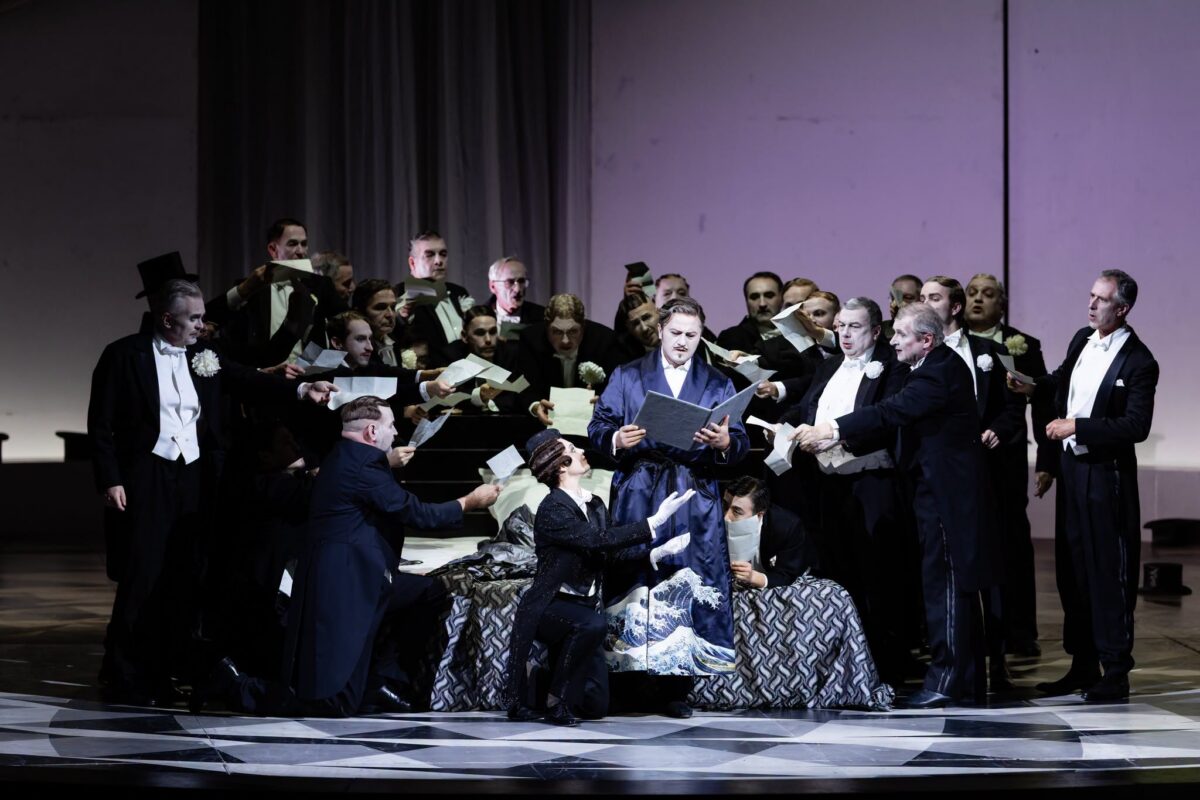
Photo: Geoffroy Schied
After Russian opera in Zurich, I had planned to visit Strasbourg for the first time and catch the new Ariadne auf Naxos at the Opéra national du Rhin. However, news that a one-day rail strike was planned for my travel day as well as continuing student demonstrations, persuaded me to skip Strasbourg and instead head to Munich on my way to Frankfurt and Köln. Instead of Strauss, I enjoyed big Bavarian productions of Rossini’s Il Viaggio à Reims and Un Ballo in Maschera, plus I caught Manon Lescaut when I finally arrived in Paris. The Verdi and Puccini featured top-flight international stars, but I enjoyed best of all the brilliantly bustling Rossini with a talented cast of unknowns (to me anyway)!
Johannes Erath’s Ballo production at the Bayerische Staatsoper was filmed when it premiered in 2016 and has been revived nearly every season since. Heike Scheele’s big blue unit set features a high sweeping staircase that leads to a large bed which functions first as Riccardo’s, then as Amelia and Renato’s. Erath’s direction basically sticks to the Boston version of Antonio Somma’s libretto with a few surprises. For example, Oscar strips to reveal himself to be a woman who then plants a big kiss on a shocked Renato at the end of “Saper vorreste.” Ulrica is portrayed as a glamorous “big blonde” rather than the usual witchy crone, but the central doomed love triangle is presented with admirably straightforward clarity.
In her years as a member of the Met’s Lindemann Young Artist Development Program, Erika Bailoff sang Barbarina, Xenia, and Tebaldo, but lately she’s become a sought-after artist in European houses. Her sizable lyric soprano wasn’t the usual piping coloratura one usually hears as Oscar, and she made her character less annoying than it can be. Someone forgot to inform Yulia Matochkina that Ulrica isn’t the star of Ballo: while pouring out richly haunting deep mezzo tones, she vamped about royally—even during the lengthy curtain calls. Bálint Szabó and Paweł Horodyski glowered menacingly as Samuel and Tom.
Boris Pinkhasovich seethed passionately as Renato, suggesting that he deserves to be seen again at the Met in something more challenging from his Italian and Russian repertoire than was displayed at his debut in the fall of 2024 as Marcello in the Franco Zeffirelli production of La Bohème that has introduced so many singers to the company. Perhaps some other interpreters of the role have bitten into their music with more brutal incisiveness, but Pinkhasovich’s beautiful instrument gave much pleasure.
Photo: Geoffroy Schiedx
Amelia was to have been Anastasia Bartoli, but the young Italian may have decided the role was too heavy for her still-developing soprano. So instead of stepping into the Met’s Medea as some had hoped, Anna Pirozzi became Ballo’s sympathetic yet conflicted wife. She began edgily in the trio with Ulrica and Riccardo, but soon the galvanizing top notes she’d displayed as the Met’s latest Turandot arrived to thrill the Munich audience. She conquered both “Ma dall’arido stelo divulsa” and “Morrò, ma prima in grazia” with a sweeping vocal grandeur that one so rarely hears these days in Verdi, suggesting that her upcoming Met Aïdas in April may prove something special.
After a succession of missteps including canceling the premiere of Carrie Cracknell’s godawful new Carmen on New Year’s Eve 2023, followed exactly one year later by croaking through the new Aïda, another misbegotten production, Piotr Beczala has given Met audiences real cause for concern. He recently made it through the company’s Andrea Chénier revival without convincing many that it was really his role, but his effortlessly refulgent Munich Riccardo had the tenor who turns 60 next month sounding at least twenty years younger. He readily conveyed the character’s easy charm and romantic obsession with ringing high notes to spare, so it was gratifying to experience Beczala back on form.
Sometimes Marco Armiliato’s Met appearances can sound tired and routine, but he was in top form for Ballo, prompting his top-flight orchestra and chorus to support his excellent cast in a richly satisfying Ballo in Maschera.
Photo: Victor Pontet
Nigel Wilkinson has already shared his thoughts about the new Manon Lescaut offered at Paris’s Thèâtre des Champs-Élysées, but at a later date I too attended the Puccini, awkwardly produced by Oliver Mears, Covent Garden’s newish Director of Opera. When I got home from TCE, I mentioned to the friends that I was staying with that Mears’s version had only a few new ideas, all of them bad! I wasn’t necessarily objecting to his choice to set each of the opera’s four acts in succeeding centuries, staring with the eighteenth, but what exactly was the point of beginning each act with an elaborate silent vignette concerning Manon’s coiffure? Also, Manon (like Offenbach’s Hoffmann, for example) apparently requires a mysterious nemesis, so Mears asked Léo Vermot-Desroches to perform all three of the opera’s minor tenor roles while skulking about menacingly until he finally manifested as Manon’s menacing pimp in Act IV’s lurid cowboy bar. Unfortunately, Vermot-Desroches was barely audible most of the time.
Unlike Nigel, who was hearing Ailyn Pérez for the first time, I’ve encountered the soprano numerous times at the Met: from an increasingly stylish Juliette and Thaïs, to tentative stabs at Blanche de la Force and Tatyana, and a truly sublime Verdi Requiem. But her shattering Cio-Cio-San earlier this year made me eager to experience more of her Puccini: in this case, her first-ever Manon Lescaut. She fiercely attacked Mears’s concept of an increasingly degraded Manon with breathtaking commitment despite Annemarie Woods’s garishly unbecoming costumes. Her rich soprano relished “In quelle trine morbide” and put across a truly frightening “Sola, perduta, abbandonata.” Mears has Des Grieux abandon his lover during her last moments, so the achingly vulnerable Pérez had to die in front of the now-closed red curtain in just a sliver of harsh light—shattering.
One wished she had an equally eager partner, but Roberto Alagna, in quite good voice, turned in yet another generic portrayal that could have been easily dropped into other operas in his repertoire. Though Mears spoiled Des Grieux’s second-act entrance by allowing Alagna to observe Pérez entertaining her band of admirers, the lovers reunited with full-throated ardor, although the horny calisthenics they executed looked as awkwardly staged as their fatally delayed escape. It didn’t help matters that Alagna lost his place just before “No! Pazzo son! Guardate!” signaling the conductor to stop the orchestra. After a moment to collect his thoughts (there was no prompter), the act proceeded, but the propulsive momentum provided by fine conductor Lorenzo Passerini was lost.
Lionel Lhote’s rather too stentorian Lescaut often made himself the center of attention, but the tall, robust Nicola Ulivieri made a dangerous Geronte to be feared. Mathilde Ortscheidt led the madrigal with an unusually lush, attention-grabbing mezzo. Passerini, who just shared the Rising Star Award at the International Opera Awards began with a chaotic first act but by the white-hot Intermezzo was drawing sumptuously sensuous playing from the Orchestre National de France.
Mears will eventually bring this Manon Lescaut to his home theater; let’s hope he does a better job with it there.
But my most memorable Italian opera experience occurred at the Staatstheater am Gärtnerplatz, a venue I scarcely knew existed, let alone that it presents a very full season of opera, operettas, musicals and dance. After Rossini’s Il Viaggio à Reims was resurrected at Pesaro’s Rossini Opera Festival in 1984, it was most often presented featuring a phalanx of the best bel canto specialists. However, in Munich, the virtually plotless 1825 pièce d’occasion made do with a game crew of nearly unknown singers in the many fiercely demanding roles.
The unfortunate exception was the Corinna, a soprano with a thin, wiry voice who was tasked with playing her role as a simpering ninny trapped in a large harp case. Her character was a rare lapse in the otherwise deliriously amusing production by Dirk Schmedling. He followed tradition by presenting the opera’s first half as a parade of zany guests arriving at a busy hotel. But after intermission we saw that the anarchic hotel staff armed with machine guns had taken over the place and eventually installed Mme Cortese as queen of their reconfigured domain.
I was surprised to discover that after just three performances, Viaggio already had a new conductor, New York City-born Eduardo Browne, who led his large forces with such brisk command that the many extravagant ensembles crackled with energy and panache. Despite his wan partner, Belfiore’s marvelous duet with Corinna still sparkled as Andrés Agudalo’s stylish tenor took the stage. The sizzling duet for Melibea and Libenskof became a hilarious age-gap seduction between Anna Agathonos’s eager cougar and Gyula Rab’s tall, high-note-popping boytoy. American soprano Jennifer O’Loughlin showered the ensembles with bright acuti, while Andreja Zidaric’s dazzling turn in Comtesse Folleville‘s florid tantrum over her lost hat made one wish she had more to sing.
Photo: Anna Schnauss
Dishy baritone Ludwig Mittelhammer in tennis whites provided lots of amusing flute-syncing to begin Lord Sidney’s long scena, which he then concluded with scads of ebullient coloratura. Timos Sirlantzis delivered Don Profondo’s brilliant patter quite handily while Lavente Páll made much of little as Baron Trombonok. The finale’s amusing parade of national anthems was definitively won by Matija Meić’s flamboyant Don Álvaro.
Four more Viaggio performances remain in December at the Gärtnerplatz; it’s too bad one isn’t scheduled for New Year’s Eve as it would be the perfect opportunity to celebrate with the explosion of gold streamers that showered the audience during Viaggio’s final notes.

Christopher Corwin
Christopher Corwin began writing for parterre box in 2011 under the pen name “DeCaffarrelli.” His work has also appeared in , The New York Times, Musical America, The Observer, San Francisco Classical Voice and BAMNotes. Like many, he came to opera via the Saturday Met Opera broadcasts which he began listening to at age 11. His particular enthusiasm is 17th and 18th century opera. Since 2015 he has curated the weekly podcast Trove Thursday on parterre box presenting live recordings.
-
People: Ailyn Pérez, Anastasia Bartoli, Andreja Zidaric, Andrés Agudalo, Anna Agathonos, Anna Pirozzi, Annemarie Woods, Bálint Szabó, Boris Pinkhasovich, Dirk Schmedling, Eduardo Browne, Erika Bailoff, Gyula Rab, Heike Scheele, Jennifer O'Loughlin, Johannes Erath, Léo Vermot-Desroches, Lionel Lhote, Lorenzo Passerini, Ludwig Mittelhammer, Marco Armiliato, Mathilde Ortscheidt, Nicola Ulivieri, Nigel Wilkinson, Oliver Mears, Pawe? Horodyski, Piotr Beczala, Roberto Alagna, Timos Sirlantzis, Yulia Matochkina
-
Works: Il viaggio a Reims, Manon Lescaut (Puccini), Un ballo in maschera
-
Places & Organizations: Bayerische Staatsoper, Staatstheater am Gärtnerplatz, Théâtre des Champs Elysées
Comments