
Goose-pimply all over
Gianandrea Noseda makes a strong case for Rachmaninoff’s operas at the Zurich Opera, despite Dmitri Tcherniakov‘s senior citizen antics.
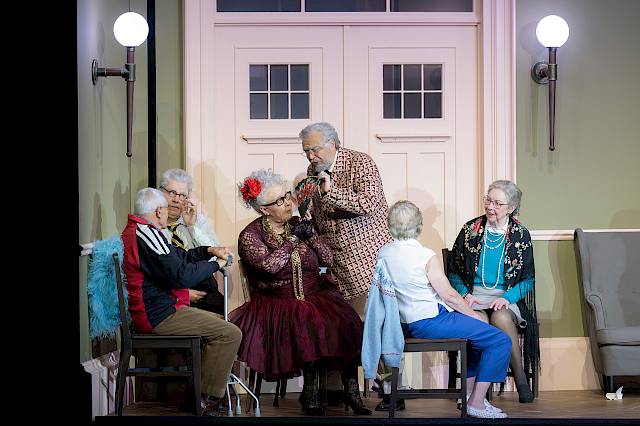
Photo: Monika Rittershaus
When I was checking out options for a brief European opera jaunt in early November, I naturally inquired into what the Zurich Opera was up to. I had only been in the Swiss city once briefly decades ago to catch a flight back to the US, but I’d long noticed with keen interest the local opera company’s always-inventive programming and starry casts. But I’d somehow never scheduled a visit, so when I saw that I could catch the company’s new Rachmaninoff triple-bill before heading to Germany, I seized the opportunity.
The composer’s symphonies and piano concerti are frequently programmed by orchestras worldwide, but his three short operas—Aleko, Skupoi Rytsar, and Francesca da Rimini—rarely turn up. That each is a bit less than one hour in length certainly contributes to their rarity, but Zurich tasked its Generalmusikdirektor Gianandrea Noseda and controversial Regietheater director Dmitri Tcherniakov with presenting them all together in Die Drei Opern which opened on November 1. I attended a later performance. The evening proved a thrilling musical success, but Tcherniakov’s fussy, distanced staging felt designed to keep emotional engagement at a minimum.
Though Rachmaninoff lived to be nearly 70, his operas date from very early in his career with Aleko premiering at the Bolshoi in 1893, just after the composer turned twenty years old. The opera, based on a poem by Pushkin, is set among a band of wandering gypsies and depicts the hulking Aleko’s dawning realization that his lovely wife, Zemfira, has grown tired of him and taken up with a younger man, repeating her own mother’s identical adulterous action years before. Aleko, angered that Zemfira’s grandfather took no revenge on his scandalous daughter, brutally takes matters into his own hands when he discovers his wife and her lover. After he murders both of them, his life is spared by the community which, however, casts him out.
Rather than presenting his audience with a straightforward retelling of this age-old story, Tcherniakov sets it (along with the other two works) in a rowdy senior-living institution. His cast doesn’t embody librettist Vladimir Nemirovich-Danchenko’s characters; instead, the Russian director has the antic seniors “play act” the drama. Belarussian baritone Vladislav Sluminsky portrays Aleko as the group’s leader who insists that his cohorts draw slips of paper from a bag to determine who will “be” Zemfira and her lover. The winners are soprano Elena Stikhina, done up as boozy broad in a big white wig and sagging breasts, while tenor Bekhzod Davronov’s shy awkward goof in short pants gets to play her lover.
While Noseda’s orchestra throbbed vibrantly from the pit and the company’s superb chorus performed rousingly high in the opera house’s top balcony, the cast made a big joke out of the tragic melodrama. This unserious tact was unfortunate, as Rachmaninoff’s wonderfully mature music could pack a real punch if performed more sincerely. Tcherniakov clearly loved his own elaborate set design—a complex interconnected series of doors and rooms on a turntable—, which must have revolved at least eighty times throughout the evening, most often with Sluminsky alone or with his boisterous bunch stomping from room to room. Its non-stop whirling attempted to give the triple-bill nearly non-stop action, but the extended play-acting of both Aleko and Francesca took place in the same spare recreation room.
Skupoi Rytsar (or The Miserly Knight), again based on a Pushkin work that the composer adapted himself, followed immediately after Aleko, featuring Ukrainian tenor Dimitro Popov as the debt-ridden, fun-loving Albert, who is desperate to be financially rescued by his parsimonious father, the Baron, played by Sluminsky in the same garb as Aleko. Albert is greeted by the senior-living home’s staff to whom he pours out his troubles. Popov’s Met appearances have left a mixed impression but his big, easy high notes suited Albert’s desperation admirably.
The evening’s sole intermission was inserted into the middle of Skupoi Rytsar, so the second half began with the Baron’s searing monologue outlining his obsession with riches which was performed with unerringly fanatical conviction by Sluminsky. One can understand why Rachmaninoff envisioned this role for Fyodor Chaliapin who nonetheless withdrew from the 1906 world premiere. The legendary bass would, however, later perform the Baron’s monologue in concert. The opera’s final scene depicts an argument between the Baron and his son that results in the Baron’s death with his dying wish that the keys to his fortune not be inherited by his deceitful son.
This opera was done in a less jokey fashion than Aleko had been, but the merry band of obstreperous seniors returned for Francesca, in which Sluminsky was the jealous deformed Malatesta and once again, Stikhina and Davronov found doomed ecstasy as adulterous lovers. Ain Anger and Alexey Dolgov ably played the roles of Virgil and Dante in the opera’s framing device. Though the comic business that had so marred Aleko was toned down in Francesca, the sumptuous rapture of Francesca and Paolo’s famous encounter while reading the story of Lancelot and Guinevere was seriously muted by the soprano and tenor’s absurd appearances.
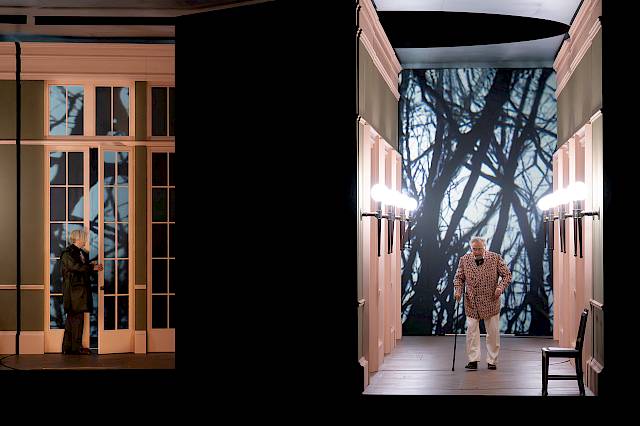
Photo: Monika Rittershaus
Happily Stikhina and Davronov once again sang with exciting ardor, the soprano’s glowing high notes in particular soared out rapturously all evening. But Sluminsky, who was onstage almost the entire evening, was the production’s undoubted revelation, his fiercely committed acting and richly nuanced baritone tirelessly rose to the challenge of his three demanding roles. His solo curtain call at the end was greeted with a long and loud roar by the dazzled audience.
The baritone has increasingly become an important player at major opera houses and festivals. Perhaps best known for his portrayal of Verdi’s Macbeth opposite Asmik Grigorian in Krzysztof Warlikowski’s production at the Salzburg Festival, Sluminsky seems to have only appeared once in the U.S. at the Dallas Opera as Germont in 2017. However, he will be Tomsky in Tchaikovsky’s Queen of Spades with the Boston Symphony Orchestra in late January under the baton of Andris Nelsons. Sluminsky and Tcherniakov will collaborate once again in March for the Bavarian State Opera’s new production of Mazeppa, in which the baritone will take on the title role alongside Davronov, Olga Kulchynska, and Ekaterina Gubanova.
While Skupoi Rytsar suffers from a lack of dramatic action, Francesca, like Aleko, should be done more often, perhaps as a Rachmaninoff double- rather than in a triple-bill, or perhaps paired with Gianni Schicchi, another short Dante-derived opera?
The current Zurich Opera season features twelve new productions. Besides the Rachmaninoff, there will be premiere stagings of John Adams’s Doctor Atomic, Handel’s Rinaldo, and Péter Eötvös’s Angels in America,in addition to likely radical reinterpretations of La Traviata, La Fanciulla del West and Samson et Dalila by challenging directors Christof Loy, Lydia Steier, and Evgeny Titov, respectively. To further international attention, in March, Noseda and his stellar orchestra and a cast led by Camilla Nylund, Klaus Florian Vogt, and Michael Volle will perform Wagner’s Ring in concert at both Paris’s Philharmonie and New York’s Carnegie Hall where the four evenings have long been sold out.

Christopher Corwin
Christopher Corwin began writing for parterre box in 2011 under the pen name “DeCaffarrelli.” His work has also appeared in , The New York Times, Musical America, The Observer, San Francisco Classical Voice and BAMNotes. Like many, he came to opera via the Saturday Met Opera broadcasts which he began listening to at age 11. His particular enthusiasm is 17th and 18th century opera. Since 2015 he has curated the weekly podcast Trove Thursday on parterre box presenting live recordings.
-
Topics: Review
-
People: Ain Anger, Alexey Dolgov, Bekhzod Davronov, Camilla Nylund, Dimitro Popov, Dmitri Tcherniakov, Ekaterina Gubanova, Elena Stikhina, Evgeny Titov, Gianandrea Noseda, Vladislav Sluminsky
-
Works: Aleko, Francesca da Rimini (Rachmaninoff), Skupoi Rytsar
-
Places & Organizations: Opernhaus Zurich


Comments