
Gender trouble
The opera singer population has a gender parity problem, and Ursula Sturgeon has a solution: blow up gender altogether.

Jamie Barton and Stephanie Blythe in Carmen at Chicago Opera Theater / Photo: Michael Brosilow
I don’t think I’ve ever seen an audition room with a gender balance.
It’s the same story in every Western theatre: there are way more women auditioning for roles than there are men. It’s the reality every high school theatre girl realizes she must fight her friends for a limited amount of female roles while the handful of boys who audition for the hell of it get lead parts virtually any time. And this pattern continues into opera. Job search website Zippia estimates that 61.4% of opera singers are women, while number crunching by MassOpera’s founder Dana Varga has found that many conservatory programs report over 70% female singers opposed to 30% or less male singers. This situation clashes up against the gender ratio of roles in opera; at best they might be gender-equal, but many operas feature a flock of men up against one or two women. This leads to fewer opportunities for female singers, increased disillusionment with young singer pipelines, and constant performances of Suor Angelica at every performing arts college until we all lose our minds.
How do we fix the problem? Well, obviously, we need to write more female roles in new operas and include more onstage representations of what being female can entail. I’m not arguing we shouldn’t do that. But also… ignoring the voice types for now (don’t worry — I’ll address this later), why couldn’t a woman play, say, Don José or Tamino?
In fact, I am going to propose a specific idea here. The best Carmen I’ve ever seen live was at the Chicago Opera Theater in 2021, with Stephanie Blythe — under her drag king alter-ego Blythely Oratonio — playing Don José opposite Jamie Barton’s Carmen. Despite the concert format, I think the cross-gendered casting was what made it so vibrantly theatrical and spectacularly acted. What struck me about Blythe/Oratonio’s depiction of Don José was that the character felt incredibly, palpably real – more so compared to many male performers’ interpretations that I’ve seen. When a woman depicts this role, that of a possessive, projecting incel who responds to rejection with violence, she is taking cues from what she’s seen and experienced — the nuances, the subtle tells, the way a man can seem charming and helpless suddenly turning to viciousness. Maybe not every man believes he’s met a Don José, but every woman knows she has.
Let’s puzzle this out a hypothetical: how about we hire a singer, say, of Blythe’s range and stage sensibility, for our cross-cast José? (And remember, we’re not changing the gender of the character, just that of the singer that usually plays the character.) And for the sake of our experiment, let’s slot this singer into the Met’s current Carmen production?
I suggest the Met here for two reasons: One, stunt-casting is all the rage in the American theatre at the moment, especially on warhorses that have gone on long enough they may need new flavoring to attract new audiences. (In fact, we know the Met has been trying to find something new to do with Carmen because of Carrie Cracknell’s disastrous modernized production.) Secondly, regardless of how we as opera fans might think about the Met as an institution, it’s a household name unlike most other opera companies. Think for example of the recent Opera for All collaboration between NYC mayor Zohran Mamdani and the Met, and the buzz it created — a smaller less-recognizable company, would never have generated that much interest. If the Met were to indulge in cross-gendered casting, not only could it drum up buzz, but more importantly, it could normalize (and even possibly codify) cross-gendered casting as not that unusual — and maybe help solve the gender disparity problem I mentioned at the outset. After all, the Met is tame. When it adopts theatre practices into opera, we are lulled into seeing those practices as the norm.
Maybe cross-gendered casting has lagged behind other experimentations with textual fidelity because it defies traditional theatrical logic. Sir Denis Forman, in his doorstopper guide A Night at the Opera, has a whole paragraph in which he opinionates on what to do with castrati roles now that castrati do not exist. One suggestion he dismisses almost out of hand:
“To give the part to a female is not a good option either, for who can believe in a female Roman emperor, general, or brigand? Also the sexual chemistry of the piece is destroyed by having two women who are clearly not lesbians making love to each other. Or if it seems they are lesbians, then it’s even more confusing.”
Now, ignoring that our friend Sir Denis here is doing the opera equivalent of when conservatives fearmonger about slightly-liberal-centrist-at-best politicians in a way that makes them sound totally awesome, he does probe at a central issue. Could audiences buy a woman playing a man in a role that was clearly not intended to be drag in the first place?
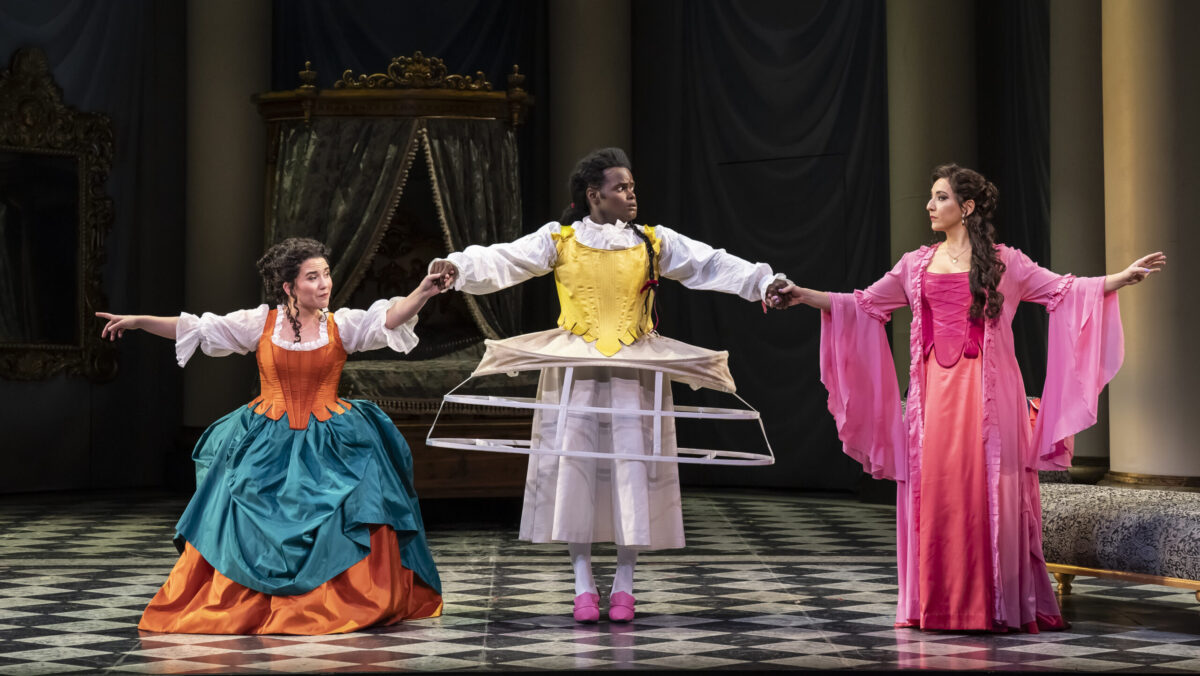
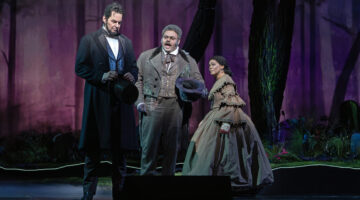
Rosa Feola, John Holiday, and Joélle Harvey in Le nozze di Figaro at Washington National Opera in 2025 / Photo: Scott Suchman
The thing is, though, suspension of disbelief is in this art form’s lifeblood. A 50-year-old woman plays a teenage girl and a 25-year-old plays her mother. A man fails to recognize his wife because she happens to be wearing a different dress. Another man drops a gun, it somehow fires, and then immediately kills someone when the bullet hits only a heel. We know intuitively there is no real death, that the plots of opera are things that scarcely happen in our own world, and that the biography of the singer does not dictate what characters can inhabit them. Tamino does not have to be played by a prince, and Escamillo need not be a bullfighter off the stage.
Cross-gendered casting sits beyond that boundary because it interrogates something beyond the specific world of opera. It destabilizes centuries of duality in a way that even other gender binary-defying practices in art do not. For example, specifically writing a role for any gender to be “able” to play does not undo centuries of performance practice surrounding representation of gender onstage – and they often end up as just detached narrators, members of an ensemble, concepts rather than identities. Taking a role previously established as to be only played by, say, a man and asking why and what about that character can allegedly only be captured through a male actor’s performance destabilizes the way we classify all roles by gender – and it reveals that the categorization can be taken away. And that’s sort of an existential threat in entertainment industries that rely on categorizations of roles that follow a gender binary inherited from patriarchal society. (Think, for example, of many award shows’ split between actors and actresses.)
The other point I can see being brought up, something I hinted back at the start of my argument, is the matter of Fach. Within my specific proposal there’s an easy way out of this: Blythe sang Don José’s part without any transpositions, as her range is so broad she can take on tenor roles without breaking a sweat. (And I briefly digress to emphasize that the Fach system describes biological vocal realities rather than character ‘types,’ but I am neither a biologist nor a singer, so I will leave that to the experts.) But of course, unfortunately for us, we are not all Stephanie Blythe, and if we continue casting women in male roles we will come across a gap in between a performer’s capabilities and a character’s textual precedents.
However, we have a historical precedent for this conundrum! Anna Milder-Hauptmann, the early 19th century soprano most famous for debuting Leonore in the Fidelio premieres, had Tamino as a calling-card role. Scores would be transposed up to fit her voice, and she was, in fact, regularly praised for the masculinity and ease in her performances by critics, despite being a soprano. While we have anecdotes of critics at the time thinking of these transpositions as betrayals of the composer’s intent, by and large the public accepted them enough that she was successful and beloved in her time. Beethoven wrote the role of Leonore across the Fidelio iterations for her specifically, and one wonders if the cross-dressing Leonore takes up in the opera was influenced by her stints as Tamino and other tenor roles from more obscure works.
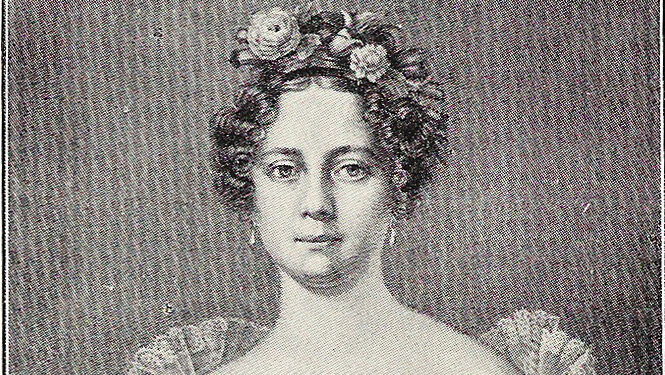
Soprano Anna Milder-Hauptmann
Furthermore, the idea of an ‘original score’ as we know it doesn’t really exist anymore. Period accurate instruments are a novelty, and roles are constantly tweaked slightly up and down to allow for tenors who can’t quite hit a high C. There are some score changes that appear much more ‘sacred’ than others, and it’s very interesting that transposing to accommodate a singer’s vocal limitations relating to gender is one of those ideas that appears to get more pushback.
But also maybe I want to hear it a different way! I like variety! Sure, if Escamillo was played by a soprano it would sound different. But I don’t go to the opera to hear the same thing over and over! I want to see it be different! I want to notice new things in the music! And transposition is a beautiful way to get there!
Last year as part of Pride Month, Parterre featured a recording of that 2021 COT Carmen – the one that got me thinking about all this to begin with- and revisiting it now, five years on, I still find myself fascinated by Blythe’s Jose. On one hand, Blythe does legitimately sound like a male tenor. (I have to wonder if her vocal range is the result of some heaven-side edition of a Faustian bargain because I am constantly in awe of it.)
But at the same time it’s what she as a woman brings to that role that fascinates me; it’s hard to describe it beyond what I’ve said beforehand — not necessarily a delicateness, but a deep sense of deliberateness and awareness of the character she is playing. If anything, the gulf in lived experience between the character and the singer makes the character more ‘real’ and there is no sense of taking the character for granted that you see with most generically brooding Josés. I invite you to listen to it yourself, and find your own conclusion. Mine, to be frank, is that of course a woman could absolutely body (and embody) this role, and many others – after all, we are expected to perform gender our whole lives.

Ursula Sturgeon
Ursula Sturgeon is a theatre dramaturg who became obsessed with opera as a toddler and has been wild about it ever since. (Most infants who listened to those Baby Mozart tapes turned out perfectly normal. She did not.) She is based in the Chicagoland area and is particularly interested in finding new ways to connect opera to modern audiences. Being one of those young Gen Z whippersnappers, she can be found on Instagram at @zauberfloting.

Comments