A little slice of death
Lincoln in the Bardo fills its inaugural Metropolitan Opera run with musical delights and vibes—but how far can those go?
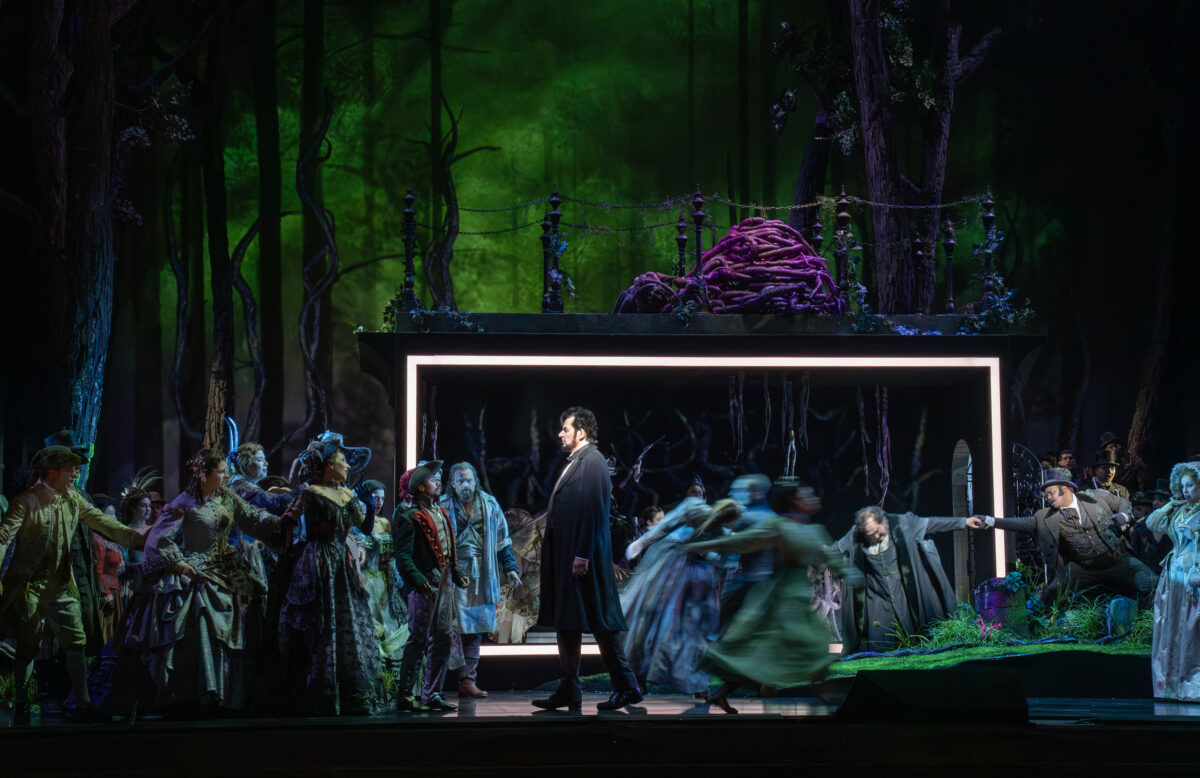
Peter Mattei (center) as Lincoln in a scene from Missy Mazzoli’s “Lincoln in the Bardo.” Photo: Karen Almond / Met Opera
Missy Mazzoli may be opera’s most dedicated chronicler of American morbidity. From the blood-soaked soil of the American frontier in Proving Up to the seductive nihilism of cults in The Listeners, Mazzoli has explored Americans’ long-standing love affair with death. Her first Metropolitan Opera commission, Lincoln in the Bardo, a work which creates a kind of American folkloric tradition for death and the afterlife, is a continuation of this project. To its credit, however, Lincoln largely avoided becoming bogged down in American mythologizing, offering instead a lushly scored and beautifully sung little slice of death.
The opera, based on the novel by George Saunders, told the story of Willie (Everett Sobers), an eleven year-old who has arrived in the Bardo—a kind of holding zone for spirits who are resisting awareness of their own demises. Willie is taken under the wings of three of the Bardo’s long-term residents: Vollman (Ryan McKinny), who was struck by a falling beam on the night he was due to finally consummate his marriage; Bevins (Jonah Hoskins), who slit his wrists after the end of an unhappy gay love affair; and the Reverend (Christine Goerke), whose cause of death is not known, but who is a spiritual leader for the community of ghosts.
Since the Bardo is no place for a child, and every moment that he lingers there risks trapping him forever, the three resolve to help Willie complete matterlightblooming—his ticket into whatever great beyond comes after the Bardo’s much littler beyond. But Willie resists their urging; he wants the reassurance of his father, Abraham Lincoln, before he moves on.
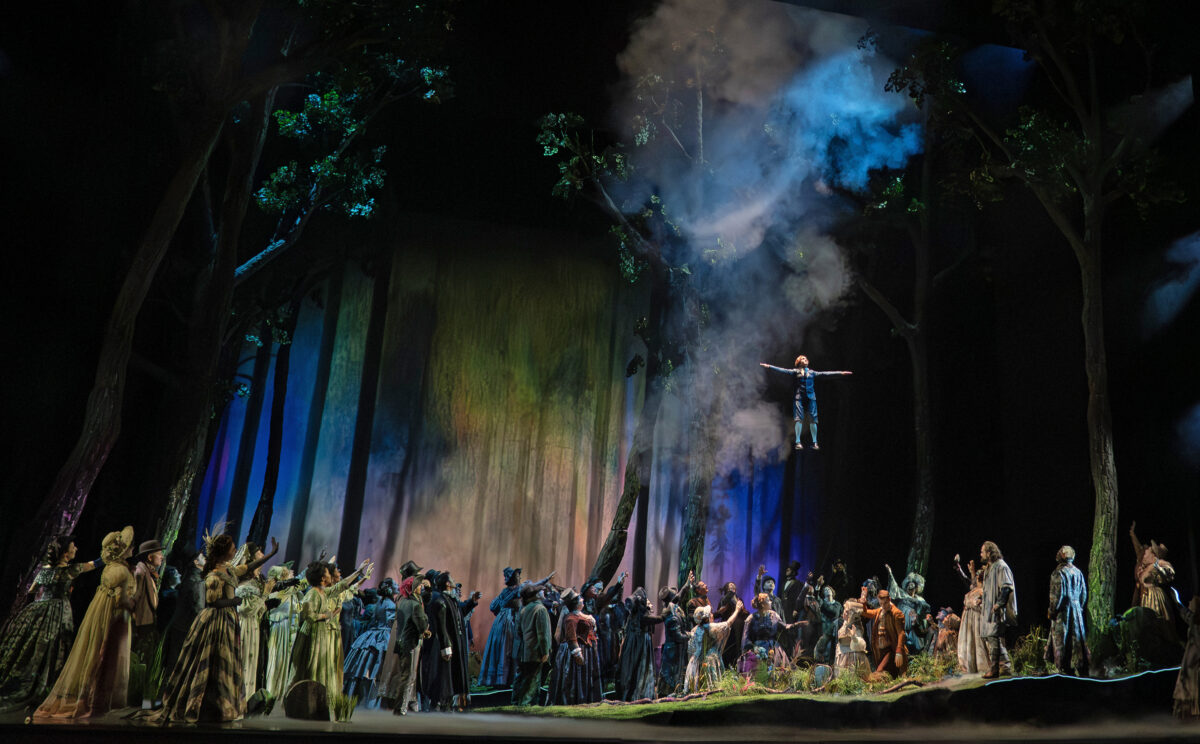
A scene from Missy Mazzoli’s “Lincoln in the Bardo.” Photo: Karen Almond / Met Opera
This weighty concept notwithstanding, Lincoln in the Bardo was actually, for the most part, a “hang-out opera,” if such a term exists. With Willie as an audience surrogate and Vollman, Bevins, and the Reverend as guides, we toured around the Bardo and took in its strange sights—misty copses of trees, washes of green and purple light, surreally funny puppets. These were the combined efforts of director Lileana Blain-Cruz, set designer Adam Rigg, lighting designer Stacey Derosier, and puppet designer James Ortiz, who came together to create an afterworld that strikingly evoked that of the movie Beetlejuice.
We also got to know its community of quirky, recalcitrant ghosts, in a series of character sketch arias which provided ample opportunity for both Mazzoli and her cast to show off. Stephanie Blythe and Craig Colclough brought some good old fashioned scenery-chewing, chest-belting fun to Mrs. and Mr. Baron, a couple of drunken louts and neglectful parents. Janai Brugger lent her fierce, vertiginous sound to Mrs. Francis Hodge, delivering her aria from a tree branch suspended over the stage, where she sat in protest, planning her revenge against the white men who stole her children.
Anthony Roth Costanzo as Miss Elise Traynor was clearly envisioned as the stand-out of these vignettes. Miss Traynor was a teenage girl who died on the cusp of erotic maturation and became immobilized in the afterlife by her inability to let go of her fantasies of an adult romantic life. Her aria was given a wild and whirling staging, with dancers wearing pig-heads and puppeteers wielding giant mouths, but Costanzo’s delivery of Miss Traynor’s kaleidoscopic, almost baroque melismas was a little overly-mannered; it never quite reached the kind of fever pitch that would justify the busyness of the choreography.
Around and between these arias, Vollman, Bevins, and the Reverend chatted in the vibrant, conversational register that librettist Royce Vavrek has been honing across his years of collaboration with Mazzoli. McKinny, Hoskins, and Goerke were all eminently suited to this material, handling it with charm, clarity, and comedic timing. Of the three—potentially, of the whole night, actually—Goerke was the standout, imbuing the Reverend with both a blasting, baritonal sound and a warm, generous tone.
This trio of spirits joked, they swore, they offered wryly funny advice for coping with the Bardo’s various torments and indignities, they bandied about a massive prosthetic phallus. You know, hang-out stuff.
Sure, the stakes were pretty high for little Willie, and his plight was a moving one, but the opera’s other significant set of stakes—Abraham Lincoln wrestling with the enormity of the task of shepherding America through a period of catastrophic rupture—never quite connected.
Lincoln’s scenes, where he visited Willie’s grave and reflected his culpability in the casualties of the Civil War, were beautifully scored and movingly performed by Peter Mattei. His long, dark lines of melody, musical depictions of grief’s shadowed and winding pathways, were well-suited to Mattei’s voice: its honeyed timbre, its subtly forceful resonance, its achingly lovely legato.
But these scenes of agonized introspection suffered by the comparison to the Bardo’s world of convivial, oddball surreality. Where, for example, Vollman’s hapless recounting of his failed wedding night felt engaging and consequential, the actual history of the Civil War seemed somehow completely theoretical, like a metaphor with no real referent.
In a way, the whole opera was experiencing the same troubling realization described by Thomas Havens in his character study. Havens, sung with sweetness and sensitivity by Joshua Blue, was the ghost of a formerly enslaved man. In his aria, he wondered at the existence of men whose whole lives are lived in the state of idleness that he experienced only in his biweekly two hours of time off.
Havens is right: it is awful to be forced to work, especially under the dehumanizing conditions of slavery. Conversely, it can be awesome to hang out and do nothing. Of course, at face value, Lincoln in the Bardo said just the opposite—to be trapped in an endless hang is a terrible, problematic thing, it asserted, a state of delusion and arrested development that must be overcome to attain peace and personal growth. But this premise was undermined by the pleasures of its own composition. It was just so fun to hang out in the Bardo with the deluded and under-developed ghosts. That material was so charming, sensitively sung and charismatically acted.
Often, it was also extraordinarily beautiful, as in the choral piece where the assembled dead sang in one pulsating voice about the lives they had once lived. There, and elsewhere in the opera, compulsively repeated phrases—”we were husbands, husbands, husbands, wives, wives, wives, wives”— formed an urgent, throbbing rhythm, even as they threatened to break into senseless sibilance, the collective language of the dead crashing and dissipating like ocean waves against a cliff face.
One of Mazzoli’s strengths as a composer has always been the way she writes for multiple voices singing in close harmony. That held true in Lincoln. A sequence where several sextets of tempting spirits appeared to lure the ghosts into the beyond—beseeching angels for the Reverend, dashing hunks for Bevins, blushing brides for Vollman, imploring mothers for Willie—was a standout; lush and spooky, sinuous and seductive, the miniature chorales wove through the dense and dreamy texture of the orchestra, a testament to conductor Yannick Nezet-Seguin’s sense of balance.
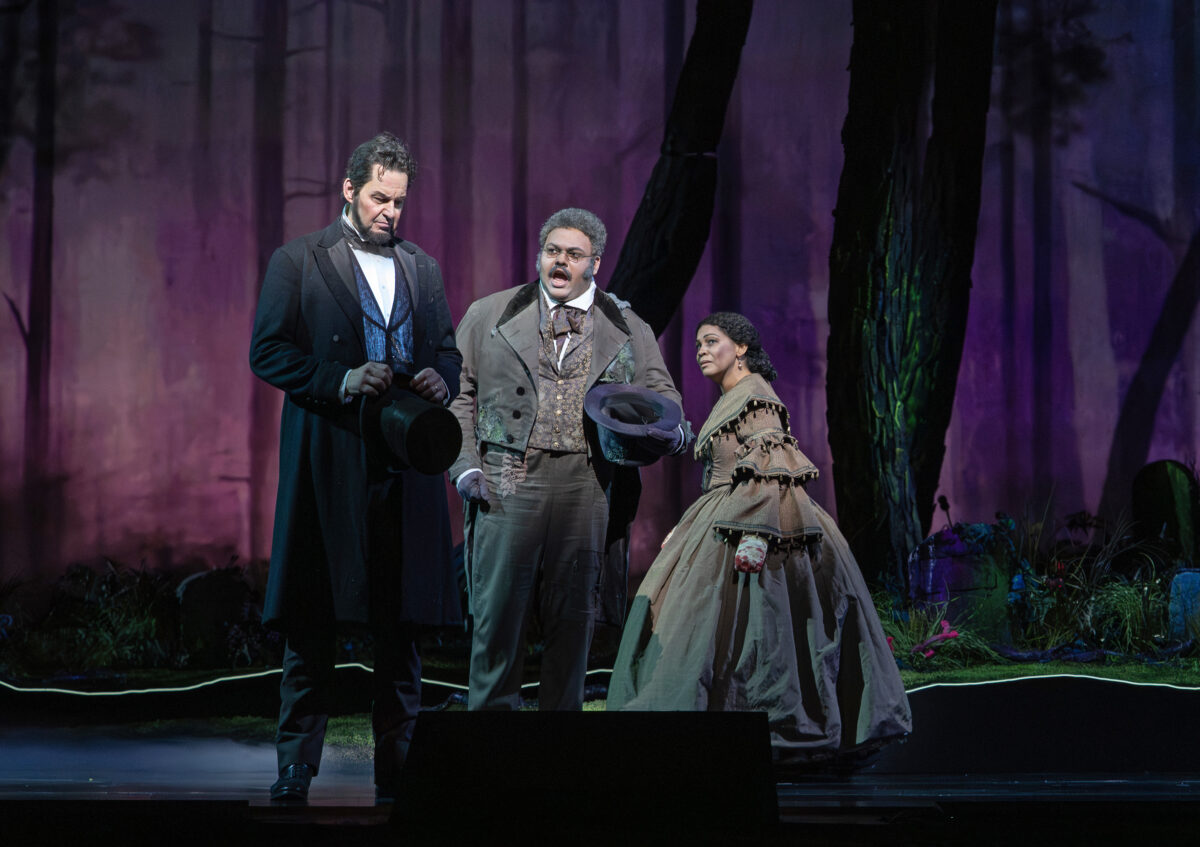
Peter Mattei as Lincoln, Joshua Blue as Thomas Havens, and Janai Brugger as Mrs. Francis Hodge in Missy Mazzoli’s “Lincoln in the Bardo.” Photo: Karen Almond / Met Opera
Ultimately, the Lincoln sections of Lincoln in the Bardo were hampered by the fact that the opposite of “hanging out” may well be “being the President of the United States during the Civil War.” Lincoln’s overwhelming sense of obligation created a matching sense of obligation in the material written for him, which occasionally attempted the task of having something to say about Abraham Lincoln: Lincoln as the avatar for the American Project, Lincoln as a conduit for the collective national unconscious, and so on.
None of it was hugely convincing, but none of it actively bothered me. That is, until the finale, in which each of the ghosts entered, one by one, into Lincoln’s consciousness, a process which caused his shirtfront to glow and pulse like a bluetooth speaker pairing to a smartphone. When the opera’s Black characters—Mrs. Hodge, Havens, and Litzie, Mrs. Hodge’s mute and traumatized companion—paired with Lincoln, they imbued him with a kind of supernatural kinship. This kinship, the opera implied, would inspire him to issue the Emancipation Proclamation. This struck me as trite at best and an offensive portrayal of Lincoln as a divinely empathetic white savior at worst.
Even the music itself seemed somewhat skeptical of this overly-neat, too-reverent repackaging of a messy and brutal history. There, the orchestra sounded hesitant, a little ominous—nothing like the gorgeous, triumphant music we heard when Willie ascended into matterlightblooming. But then again, how could it possibly have been triumphant when Lincoln left the Bardo and returned to the war? He’d know more than anyone: there was still work to be done.

Sylvia Korman
Sylvia Korman is a PhD student at the CUNY Graduate Center a recent devotee of all things opera. They like mezzos in pants, Met Opera student tickets and reading the comments sections. See their tweets at cowboyverismo and people mad at opera.
-
Topics: Review, world premiere
-
People: Adam Rigg, Anthony Roth Costanzo, Christine Goerke, Craig Colclough, Everett Sobers, James Ortiz, Janai Brugger, Jonah Hoskins, Joshua Blue, Lileana Blain-Cruz, Peter Mattei, Ryan McKinny, Stacey Derosier, Stephanie Blythe, Yannick Nézet-Séguin
-
Works: Lincoln in the Bardo
-
Places & Organizations: Metropolitan Opera