A kink in the plan
In its third revival, Lyric Opera of Chicago‘s production of Don Giovanni nails its predatory Don — but falls short dramatically with its donne.
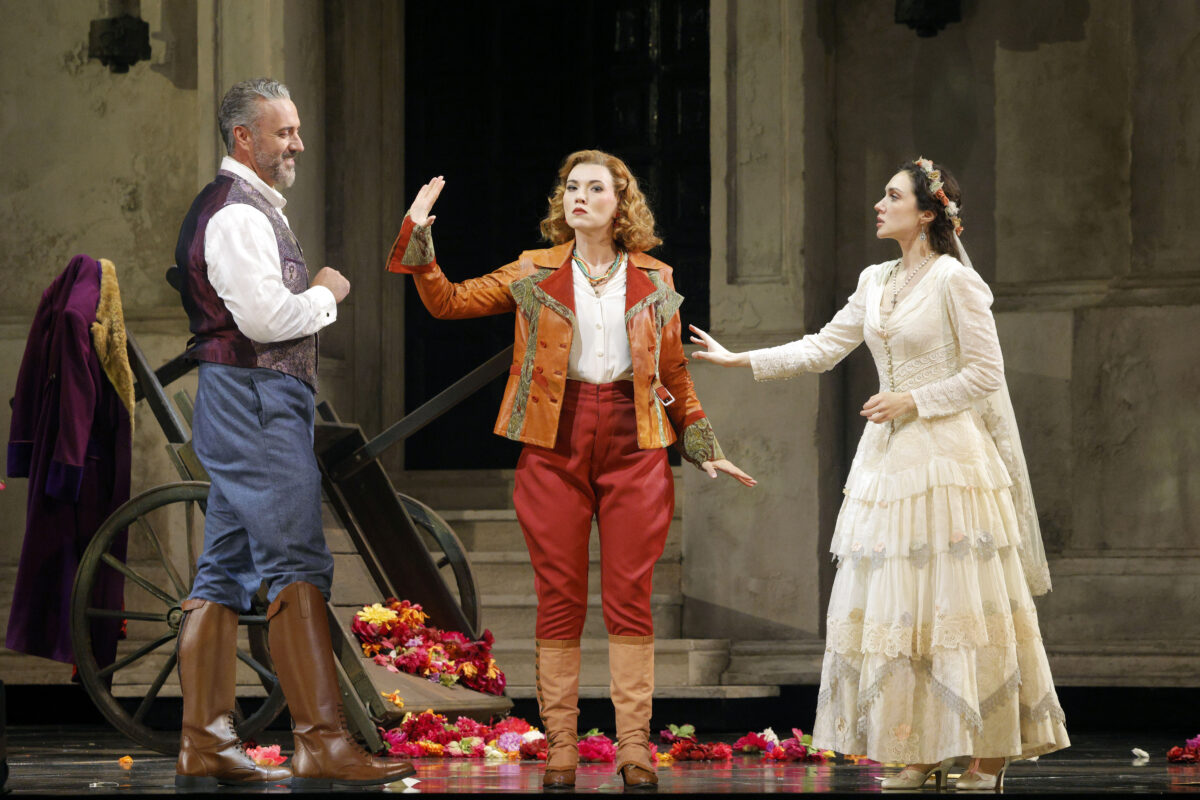
Photo: Cory Weaver/Lyric Opera of Chicago
Judging from the dozens of productions scheduled this season, Don Giovanni has weathered #MeToo just fine. Perhaps the opera was in some way ahead of its time: Mozart and his librettist, Lorenzo da Ponte, gave it the alternate title Il dissoluto punito, “The Rake Punished.” Robert Falls’s production, which opened the Lyric Opera of Chicago’s season on Saturday for its third company revival, has appeared to rapidly changing circumstances since its premiere in 2014. This publication remarked upon its last run, in 2019, that Falls’s “Don is ruthless, cruel, and narcissistic in the tradition of Epstein, Weinstein, and a long list of others”— names that would not have been household references a half-decade earlier.
Another seven years on, how does Falls’s Don Giovanni fare? Musically, Saturday evening’s performance was splendid. In the title role, Christian Van Horn was indeed ruthless, cruel, and narcissistic — and vocally magnificent. Nearly from first to last, the company turned in brilliant musical performances; the Lyric’s orchestra, under Music Director Enrique Mazzola, did, too.
But dramatically, this Don Giovanni seemed confused about what it could say about women’s desire. As the Cornell philosopher Kate Manne has recently observed, our society still so frequently fails to recognize rape as rape. Falls’s production succeeds, admirably, in telling Don Giovanni like he is. Yet it also falters in depicting the patriarchal social order in which Don Giovanni operates, and in which its Donna Anna and Zerlina could have at first been drawn to him at all.
Mané Galoyan’s Donna Anna summed up the evening’s musical strengths and dramatic weaknesses. Galoyan’s soprano was the company’s most opulent voice — a high honor in a cast that brims with vocal riches, from the grandly controlled intensity of Van Horn’s bass-baritone to Lawrence Brownlee’s shining, agile tenor in the role of Anna’s fiancé Don Ottavio. Full of feeling for her betrothed and vanishing beautifully into its piano lines, Galoyan’s “Non mi dir,” the opera’s final aria before its hellish denouement, was the production’s fullest expression of the kind of love it would have us endorse.
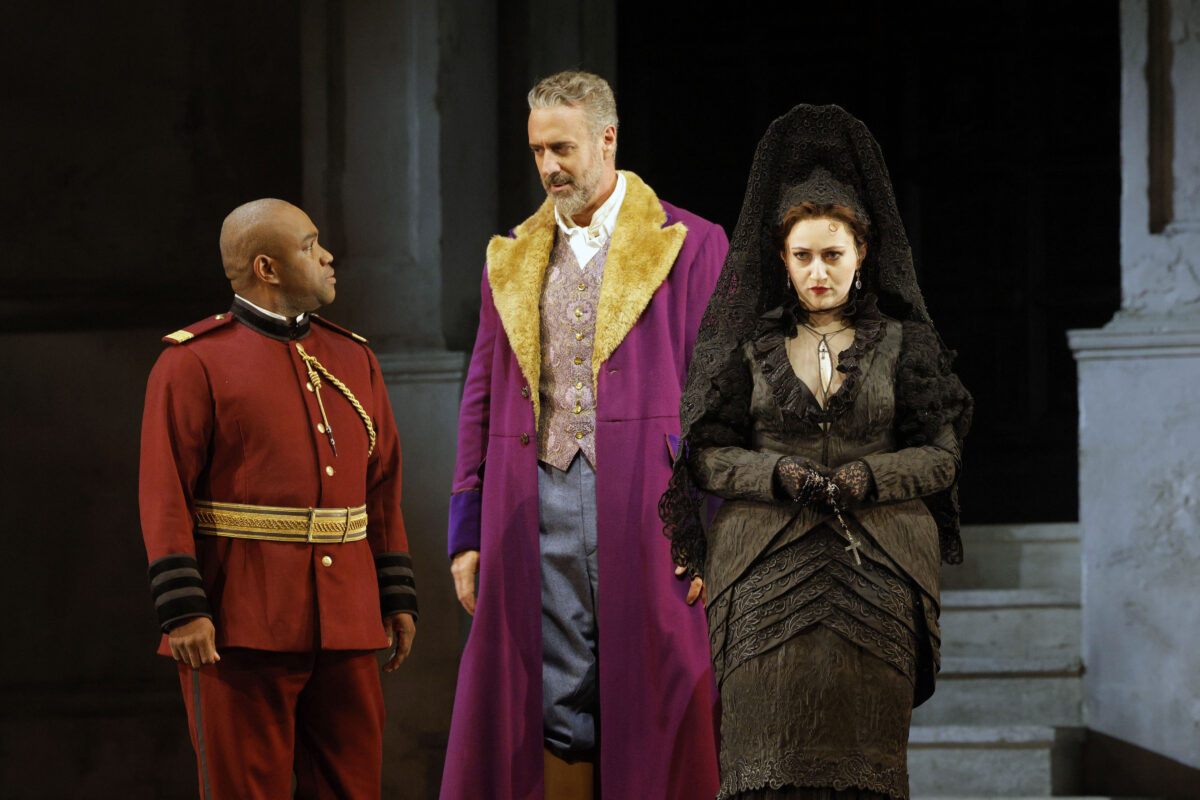
Photo: Cory Weaver/Lyric Opera of Chicago
But what kinds of desire does Donna Anna feel? The tone of Don Giovanni hinges on questions like this one, and this production never landed on an answer. The opening scene, in which Don Giovanni — well, what does he do? Does he seduce her? Rape her? Falls’s staging, which half-hides the pair behind a shutter, seems at first to hint at the former. Falls has Don Giovanni and Donna Anna emerge from the house of her father, the Commendatore, linked by boudoir cuffs in what seems to be, or once have been, consensual kink: he is the one trying to get free, she to detain him. But as Don Giovanni turned violent, Galoyan, whose acting was too frequently general, struggled to communicate her character’s developing understanding of the encounter in which she had been ensnared.
The confusion of this opening scene created a tonal problem later in the act, when Donna Anna reveals to Don Ottavio her story of that night. An outdated attempt at a comic Don Giovanni might have its Donna Anna tweaking the facts to keep her fiancé in the dark about a would-be tryst. Here, she surely must understand it, as we do, as an assault. But somewhere between Falls’s direction and Galoyan’s difficulty in revealing Donna Anna’s inner life — not aided by Brownlee’s rather bland characterization of Don Ottavio — we lose our insight into what she feels. The crucial first scene was also a rare musical misstep, as the trio of Van Horn, Galoyan, and Tommaso Barea, making an excellent Lyric debut as Don Giovanni’s servant, Leporello, failed to blend. The briefly murky sound seemed to reflect the confusion of the dramaturgy.
Falls’s staging had similar trouble with Zerlina. In another Lyric debut — the second of four in this production — Anna El-Khashem portrayed the peasant ingenue with remarkable vocal and physical sensuality. But the production often failed to resolve where Zerlina could place it. In a disturbing Act I aria, Zerlina invites her betrothed, Masetto, to beat and maim her for the infidelity (so society says) of her seduction by Don Giovanni (Batti, batti, o bel Masetto, la tua povera Zerlina: “Masetto, hit your poor Zerlina”). El-Khashem played the moment with roguish, masochistic passion, hinting that — as Donna Anna seemed to have been in the opening scene — Zerlina might be at least partly in control. In response, Christopher Humbert, Jr., who communicated Masetto’s emotional turns with remarkable clarity, seemed somewhat disturbed, and mainly lost: this was another kink that failed to find a partner.
Here’s what the production was straining to convey: the patriarchy. Donna Anna and Zerlina have fiancés to whom their desires must answer, and to whom those desires are absolutely restricted. It’s easy to see why they might initially envy — even be, at first, seduced by — Don Giovanni’s uncut libido, and then why they might find it difficult to put their traumatic experiences back into words for the men their community will deem them to have transgressed. This revival’s dramaturgical brush is too broad to paint these motivations in enough detail. It’s telling, for instance, that Don Giovanni’s pimp robes stick out among Ana Kuzmanic’s fine costumes. Is he such an anomaly in a society that enables him?
But the production has two ways out of its difficulties with female desire. The first is Donna Elvira — who, unlike Donna Anna and Zerlina, is unattached. Dressed like Bessie Coleman and wigged by John Metzner in flaming red, Nina Solodovnikova, the evening’s third debut, lent her Donna Elvira another of the cast’s outstanding voices as well as its most confident dramatic characterization. Keeping her first vow of vengeance against Don Giovanni (after Leporello’s riotous catalogue of his employer’s amorous conquests), the production establishes that Donna Elvira can repudiate the passion to which she nonetheless returns: that she controls it as much as it sometimes controls her.
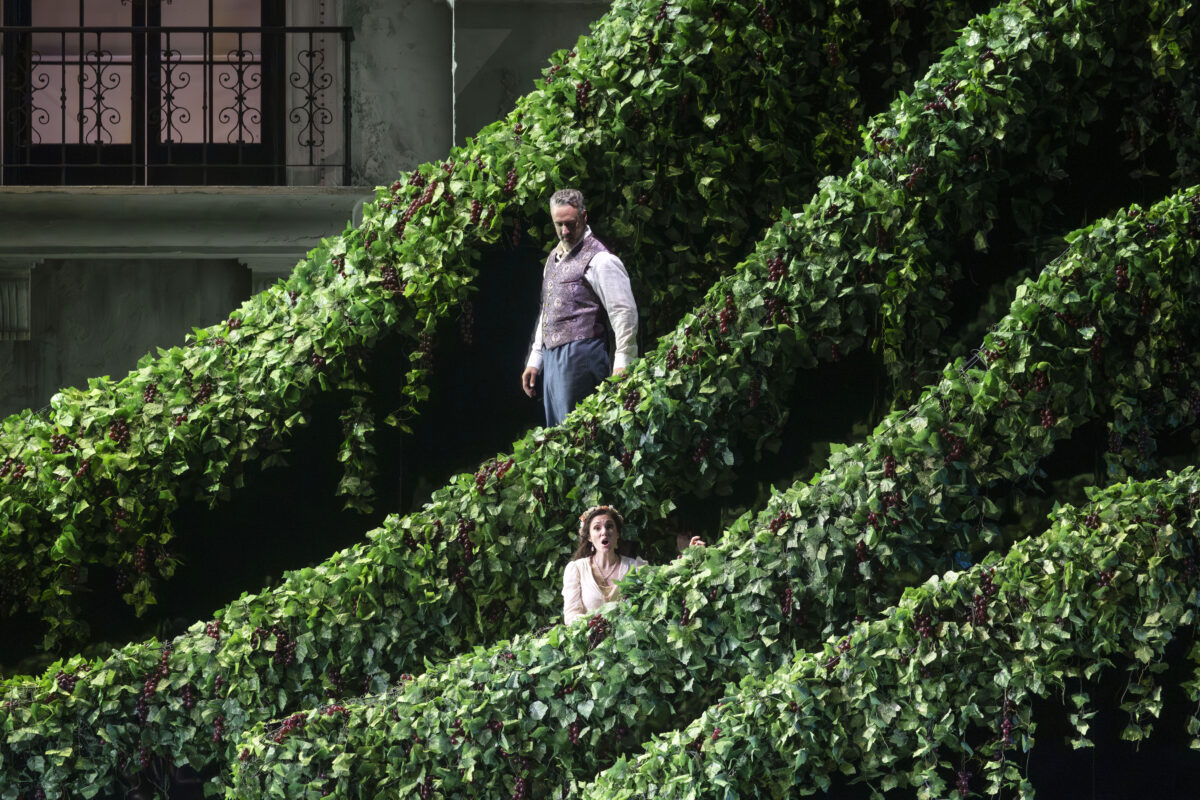
Photo: Cory Weaver/Lyric Opera of Chicago
The second of the production’s safety valves is, well, its second act. By then, no one is under any impression that Don Giovanni is anything other than a predatory cad. Uninhibited by the first act’s tightrope of maintaining Don Giovanni’s seductive appeal, Falls unleashes his production’s violence and eroticism. Don Giovanni’s treatment of Masetto becomes more shocking, and the chemistry between Masetto and Zerlina more convincing. The result on Saturday evening was a performance after intermission that was simply easier to enjoy, its musical wealth emerging in full force.
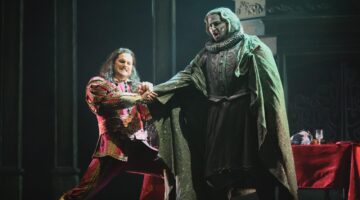
It helps, too, that the second act contains the production’s two most thrilling visual moments. The reappearance of the Commendatore (David Leigh, a strong voice and our final debut) at Don Giovanni’s dinner as a living bronze statue was Kuzmanic and Metzner’s best achievement, greatly aided by Leigh’s forebodingly machinelike gait. And Walt Spangler’s set hides a terrific trick for the nobleman’s final descent to hell.
One final coup de théâtre failed to come off. Amid the moralizing final ensemble — Questo è il fin di chi fa mal, e de’ perfidi la morte alla vita è sempre ugual: “This is the end of the evildoer: the death of a sinner always reflects his life” — Falls brought the house lights up to accuse us all of our sins. But the production’s lighting, by longtime Lyric resident Duane Schuler, cast every scene in such chilly chiaroscuro, and Spangler’s sets frequently left such large expanses of empty black, that the warm glow of the Civic Opera House’s gilded, art deco theater was a genuine relief. As with much else in this musically superb but dramatically uneven production, I wished that Don Giovanni had been illuminated more fully.

Bradford Case
Bradford Case is a PhD student in English at the University of Chicago. A bassoonist and former music director of Yale's Berkeley College Orchestra, he is currently the Editor of Chicago Review.
-
People: Ana Kuzmanic, Anna El-Khashem, Christian Van Horn, Christopher Humbert, David Leigh, Duane Schuler, Enrique Mazzola, John Metzner, Jr., Lawrence Brownlee, Mané Galoyan, Nina Solodovnikova, Robert Falls, Tommaso Barea, Walt Spangler
-
Works: Don Giovanni
-
Places & Organizations: Lyric Opera of Chicago