Because I’m not one of your FANS!
Just in time for this month’s theme of filth or dementia, a review of Terrence McNally‘s Master Class from Central City Opera.
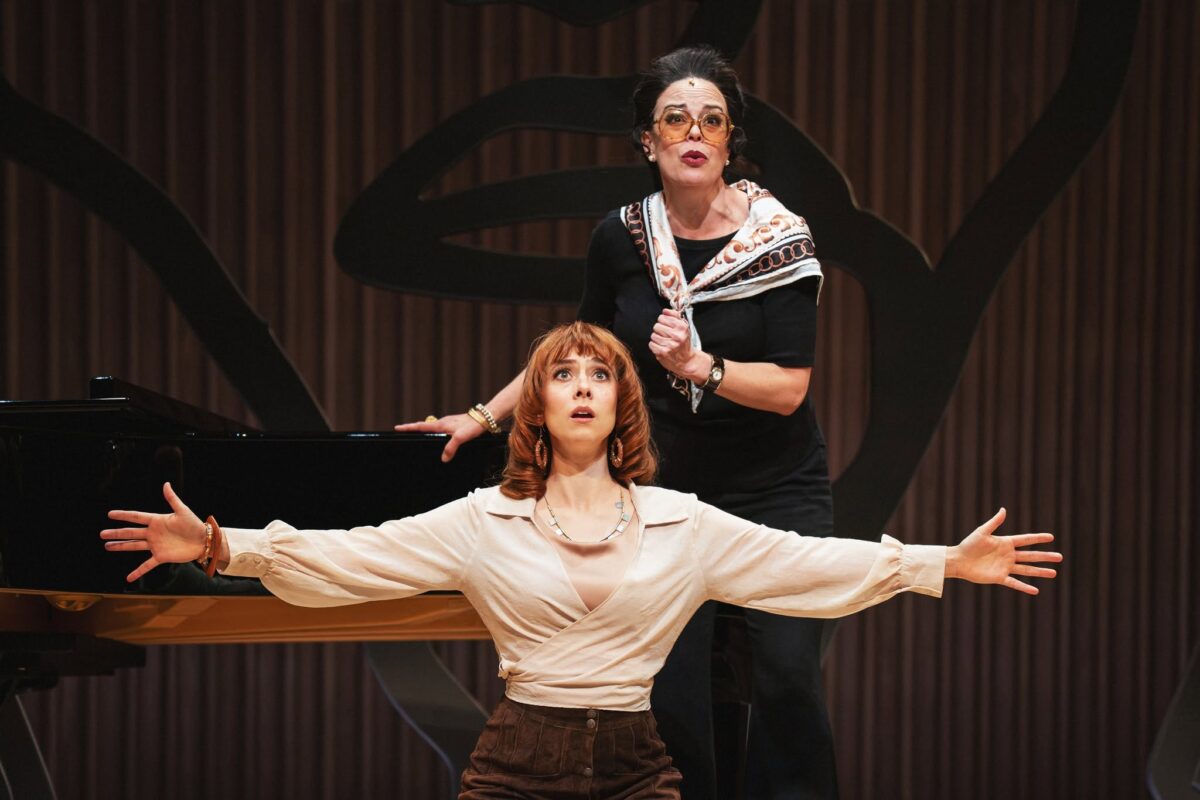
Photo: Amanda Tipton Photography
Let’s get a few things out of the way first, shall we? Terrence McNally’s Master Class is a wonderful excuse for a first-rate actress to chew scenery magnificently for however long the play lasts, but an accurate representation of Callas’ public master classes conducted at Juilliard in the 1970s it is not. It merely uses those classes as a convenient (wire?) hanger to hang its tapestry of themes— artistic sacrifice, ego, discipline, and the burden of fame. In the actual class recordings, preserved for posterity, now on YouTube (provided you’re ok with watching, like, a million adverts), Callas is businesslike, technical, and remarkably patient. She focuses heavily on breath control, diction, phrasing, and score fidelity, rather than on students’ attire or their names. Callas rarely spoke about her personal life, and likely never about her affair with Aristotle Onassis or her rivalry with other singers in those classes, which is just as it should be: she maintained a strict line between her private life and the music. She may not have done that on every occasion, but she did maintain professionalism in those classes.
At the same time, the Callas in the play — the bitchy, sardonic, insecure diva who makes students throw up and her own real or imagined tragedies and losses — did exist in real life. Her letters to her first husband during her rise to fame are full of complaints, some of them absurdly trivial and mean-spirited. Her treatment of her colleagues (not “rivals”, as she says in the play — how can they rival her if no one can do what she can do, conveniently forgetting that multiple singers have and will) sometimes verged on abysmal – for a short list of singers she didn’t get on with, see Kurt Baum, Ebe Stignani, Fiorenza Cossotto, Renata Scotto, and others. In the play, she openly denigrates Renata Scotto, Zinka Milanov, Joan Sutherland, and unnamed sopranos “weighing 500 kilos,” (probably a dig at Montserrat Caballe or Lina Pagliughi). So: the version of Callas the play highlights did exist in real life, but outside of Juilliard. Is it fair to compile anyone’s worst-behaved moments in a sort of “highlights” version, and present it as their de facto nature? Only the audience can answer that.
Central City Opera’s 550-seat house offers an exceptionally tight feedback loop between actor and audience. In larger Broadway theaters, Callas’s monologues can feel distant; here, her soliloquies feel like hushed, uncomfortable confidences shared across a small room. The acoustics amplify every sigh, snappy interruption, and piano chord, making the audience feel less like theatergoers and more like silent, nervous Juilliard auditors sitting in the front row. This is amplified by the simple, classroom-like set design, with only a sculpture-like outline of Callas’ famous “hands on face” pose paying homage to a great diva who believes she is a great artist and therefore should be a good teacher. While McNally originally wrote the piece for the spoken-theater stage, bringing this razor-sharp character study of a diva — perpetually on the verge of driving students to nervous breakdowns and the audience to hilarity — directly into a working opera company creates an electrifying layer of meta-theatrical tension. Ken Cazan, the director, does a creditable job with the resources made available to him.
The role of Callas in “Master Class” was created by Zoe Caldwell, a legendary actress known for portraying some of the same larger-than-life women that Callas name-checks in the play: Medea, for instance. Snippets of her performance in the role show her impeccable comic timing and her dry, acerbic wit. Sadly(?), the most lurid bits of the play (Callas’ reminiscences of her turbulent sex life with Onassis, for instance) do not make their way into the available clips, so I do not know how Caldwell delivered those specific lines. However, it is a safe bet that she must have done a more subtle job of it than her replacement Patti LuPone, who brought a major “bull in a china shop” energy to the role, making Callas less a tortured artist and more an angry Carmela Soprano. Dixie Carter, the final artist in this “trittico” of Callases, brought a more wistful yet crochety energy to the role, tamed some of the more lurid dialogue into submission, and was far more believable as Callas than either of her predecessors. The role has since been played by Tyne Daly (more Ethel Merman than Callas) and Faye Dunaway, who was surprisingly restrained, leaning more into the absurdity and the comic energy. Meryl Streep was supposed to have played the role in a movie version which never happened, which is just as well: like Zoe Caldwell, she’d have been too old to play Callas at Juilliard, and that would have detracted from the central tragedy of the play: Callas is giving the master class in the prime of her life, when her “rivals” are still singing opera at the great theatres across the world. A grandmotherly Callas would be forgiven a lot, especially by an audience of women and gay men, but she never lived to be a grandma: in real life, on stage, or even through her pupils. That tragedy informs some of the play, and negating that would be doing it a disservice.
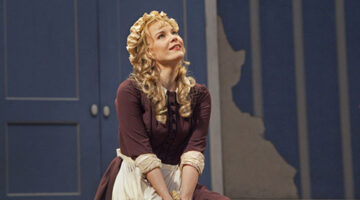
At Central City, we got Jennifer DeDominici playing Callas, and she is definitely a young Callas, channeling her rage and frustration to the very back rows. Yes, there was considerable nibbling on scenery, but that’s the nature of this particular play. Sadly, she was less effective in the more somber, introspective moments. Nor did she display the quiet moments of empathy towards the students that humanized Caldwell’s performance and saved it from shrewishness. The real Callas *did* praise the students (Sheila Nadler, for instance) during the class; although the play doesn’t exactly depict the fictional Callas as being a generous teacher, Caldwell managed to bring some of that grace into her performance. Nor were the “lurid bits” sanitized in any way by DeDominici’s interpretation of the role; they were blasted to the back of the theater and sounded exactly as cheap and as second rate as they are on the page. However, that is McNally’s fault, not hers. We can’t blame her for not rising above the material she’s working with.
Isaiah Fekken stole some of the biggest laughs of the evening as a somewhat exhausted handyman coming in with footstools and glasses of water, impatient of the diva’s antics. He is the only person in the play who has very little time for the fictional Callas’ snide comments. Arthur Bosarge as Manny the pianist is easily the most likable and courteous character on stage, but that doesn’t spare him from some of Callas’ digs. Sabina Balsamo played the somewhat fatuous Sophie de Palma with more grace and humanity than the role usually gets, making her less of a simpering ingenue and more of a gauche, nervous human being. The male student, Tony, is often played by famous up and coming tenors (Jay Hunter Morris, for instance). We shall see if Levi Adkins has an equally illustrious future in front of him. His performance was adequate, but it isn’t a particularly memorable role.
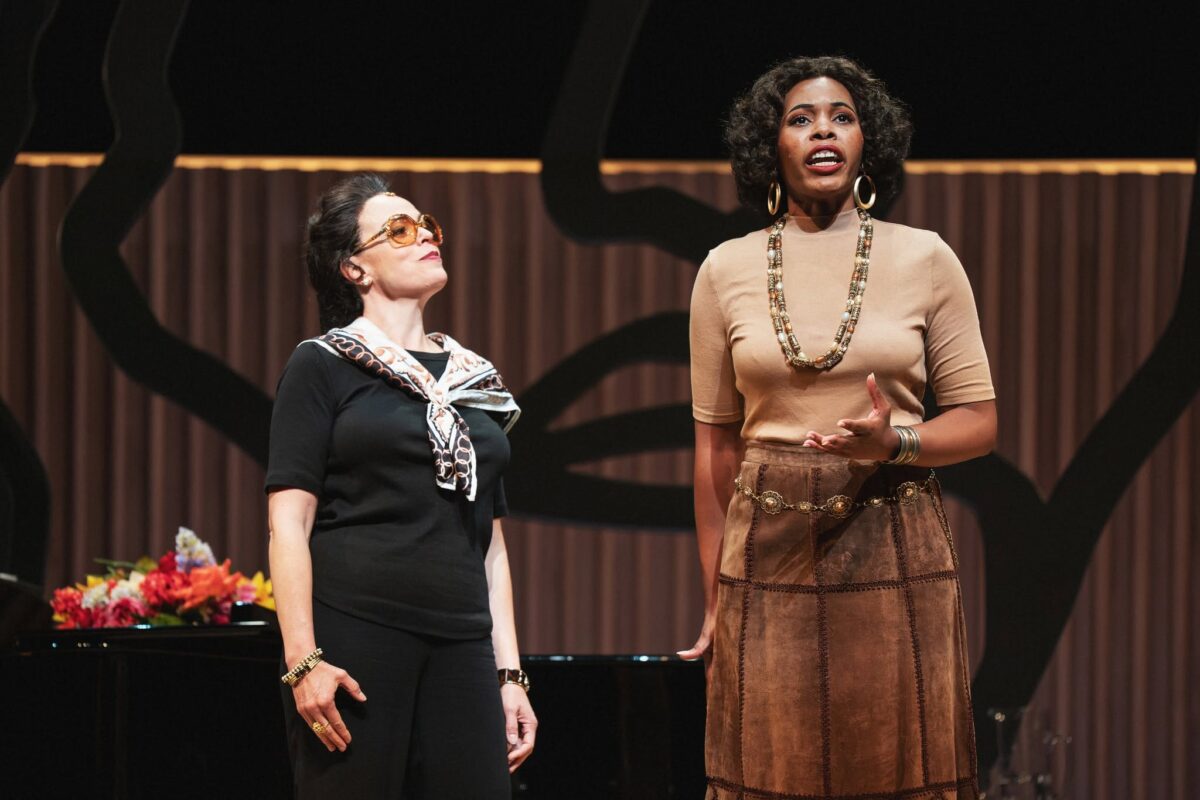
Photo: Amanda Tipton Photography
Finally, we come to the star-making role of Sharon Graham, the soprano who sings Lady Macbeth, and finally tells Callas off for being a raging b-word to all and sundry, pointing out that her reckless singing, which had ended her own career within a couple of decades, makes her a poor authority on preserving voices. Created by Audra Macdonald, the role has since not been as well cast, often becoming just a part of the ensemble of students in the play, albeit the one who finally tells Callas what everyone else in the room is thinking. Sharon’s choice of Lady Macbeth’s letter scene and cabaletta makes casting this role difficult, since we need someone who can sing the material well and hold her own with the Sacred Monster who dooms Sharon to singing Michaela for the foreseeable future. In Audra’s case, her glorious singing makes this prediction unjustifiable, at least to the lay audience — as for the actresses who replaced her in the role, one often feels that the fictional Callas has a point. Sierra Boggess in the Broadway revival brought a bratty quality to the role that really matched Daly’s energy, but it wasn’t a subtle portrayal. Ironically, Macdonald has never sung much opera in real life, despite being a classically trained opera singer, choosing instead to become a legendary Broadway star, taking an astonishing number of Tonys home, and becoming “the Meryl Streep of Broadway.” Denique Issac, who played Sharon at Central City, sang the material well and displayed both the nervous energy and the “deer in headlights” quality of a student caught in the middle of a harridan’s public ego trip. If I’m to predict a great career on stage for anyone I watched in Master Class that afternoon, it is her that I’d select.
Staged within the jewel-box intimacy of the historic opera house in the Rocky Mountains, play Master Class should find a natural, almost poetic home here. It nearly manages to convince us that it has done so. I wonder how the other Callas of the season, Marcia Ragonetti, would fare in the role, but the performances of Balsamo and Issac elevated the material and made it worthy of, say, Maugham, the other famous non-French “boulevard playwright”. Callas’ final soliloquy about art, sacrifice and posterity made me think of Donna Murphy’s calm, almost prophetically delivered version of it, recited in a New York street celebration of McNally’s life. Finally, if CCO is looking for sharp, pungent, yet deeply human depictions of chasing perfection at the cost of generosity and love, maybe the other Callas play, Charles Ludlam’s wonderfully wacky Galas, is the one it should stage next. And I’d be there for that one, too.

Ronnie Banerjee
Ronnie Banerjee is an opera-lover and a scientist. Their very first opera was a Salome at the Leipzig Staatsoper. They are a Canadian researcher with a PhD in nanobiomaterials from Saskatoon, where they worked at the Canadian Light Source (a synchrotron), and occasionally scared personnel there with bad renditions of the confrontation scene from Maria Stuarda. They are presently based in Colorado, and look forward to visiting the Met one day.
-
People: Denique Issac., Fiorenza Cossotto, Jennifer DeDominici, Ken Cazan, Levi Adkins, Lina Pagliughi, Maria Callas, Montserrat Caballé, Renata Scotto, Sabina Balsamo, Terrence McNally
-
Works: Galas, Macbeth, Master Class
-
Places & Organizations: Central City Opera