Mahler if ya hear me
Yannick Nézet-Séguin, leading the Met Orchestra, and Joyce DiDonato continue their exploration of Mahler at Carnegie Hall.
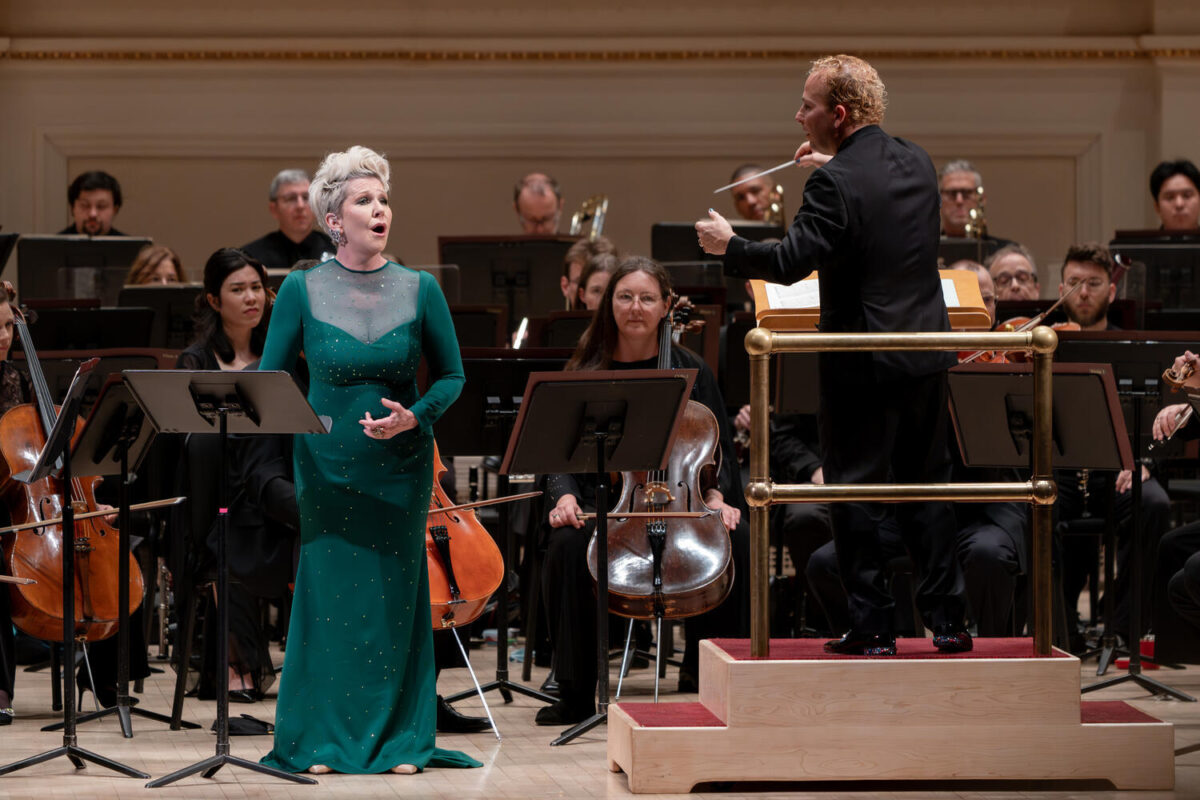
The Met Orchestra with Yannick Nezet Seguin and Joyce DiDonato. Photo: Jennifer Taylor
A glance at Yannick Nézet-Séguin’s insanely busy 2026 calendar reveals lots of Mahler with many of those concerts featuring mezzo soprano Joyce DiDonato. After having performed the Third Symphony together with the Philadelphia Orchestra in the fall of 2024, they collaborated again earlier this year—joined by soprano Ying Fang—in the “Resurrection” Symphony.
And just last month between Met performances of El Último Sueño de Frida y Diego, YNS jetted to Germany to conduct the Berlin Philharmonic with JDD again in the Third Symphony. But before Carnegie Hall (including a detour uptown to the Met) presents YNS leading all nine (!) of the composer’s symphonies next season, the peripatetic conductor briefly returned last week to the Met Orchestra to conclude their season with yet more Mahler: the Rückert-Lieder followed by the Fourth Symphony, both predictably featuring JDD, preceded by Lumière et pesanteur, a brief, shimmering morsel by Kaija Saariaho.
I don’t recall DiDonato singing such Mahler until several of the Rückert songs showed up in Eden, her very eclectic, much-traveled performance piece from several years ago. Since then, music by the composer has become increasingly prominent in the mezzo’s schedule, perhaps a wise decision as the singer, now in her late-fifties, transitions out of more flamboyantly demanding baroque and bel canto repertoire. She will again sing the Rückert and the Fourth when the Met Orchestra travels to London, Lucerne, and Paris later this summer, but I wondered if the Carnegie outing might have been her first encounter with these pieces.
She sang the Rückert positioned at the front of the stage between the first violin and the conductor with a music stand (presumably with an iPad) at her side. For the first four songs, JDD glanced so frequently at her music that it interfered with her connection to both the music and her audience. However, the relatively low tessitura of the songs largely suited the mezzo’s current vocal state only occasionally taking her to the top of her range which now routinely emerges sharp and strained. It was an enormous relief when she eschewed her score for the final song, the sublime “Ich bin der Welt abhanden gekommen.” As she had performed the song many times during her Eden tour, it was completely committed to memory and she embraced its otherworldly sentiments with transporting intensity, abetted by YNS’s hypnotically languorous tempo and John Upton’s eloquent oboe.
Of the other four, the most effective was “Um Mitternacht” during which the mezzo cannily varied each haunting iteration of the song’s title.
I suspect many Mahler aficionados must have raised an eyebrow or two when DiDonato was announced as soloist for the Fourth. The Mahler Foundation’s astonishingly extensive discography for that symphony reveals that soloist for the final movement—a Des Knaben Wunderhorn song—is nearly always a high female soprano. Along with several other conductors, Leonard Bernstein instead employed a boy soprano to embody the song’s childlike world view. But mezzos have also, if rarely, appeared on recordings: JDD’s predecessors include Ann Murray, Maria Ewing, Linda Finnie, and Magdalena Kožená.
Placed behind the orchestra and present throughout (rather than entering midway through as the soloists for the Resurrection often do), JDD, wearing glasses, sang even more intently from her score. Though the music rarely taxed her, one missed the bright wonder that one wants from “Das himmlische Leben.” The silvery soprano of Christiane Karg will take on this music next February for YNS when he tours the US (including Carnegie Hall) with the Vienna Philharmonic. Karg will also join Elina Garanča in the Resurrection: one wonders how often a conductor has led the same major symphonies on 57th Street across two consecutive seasons?
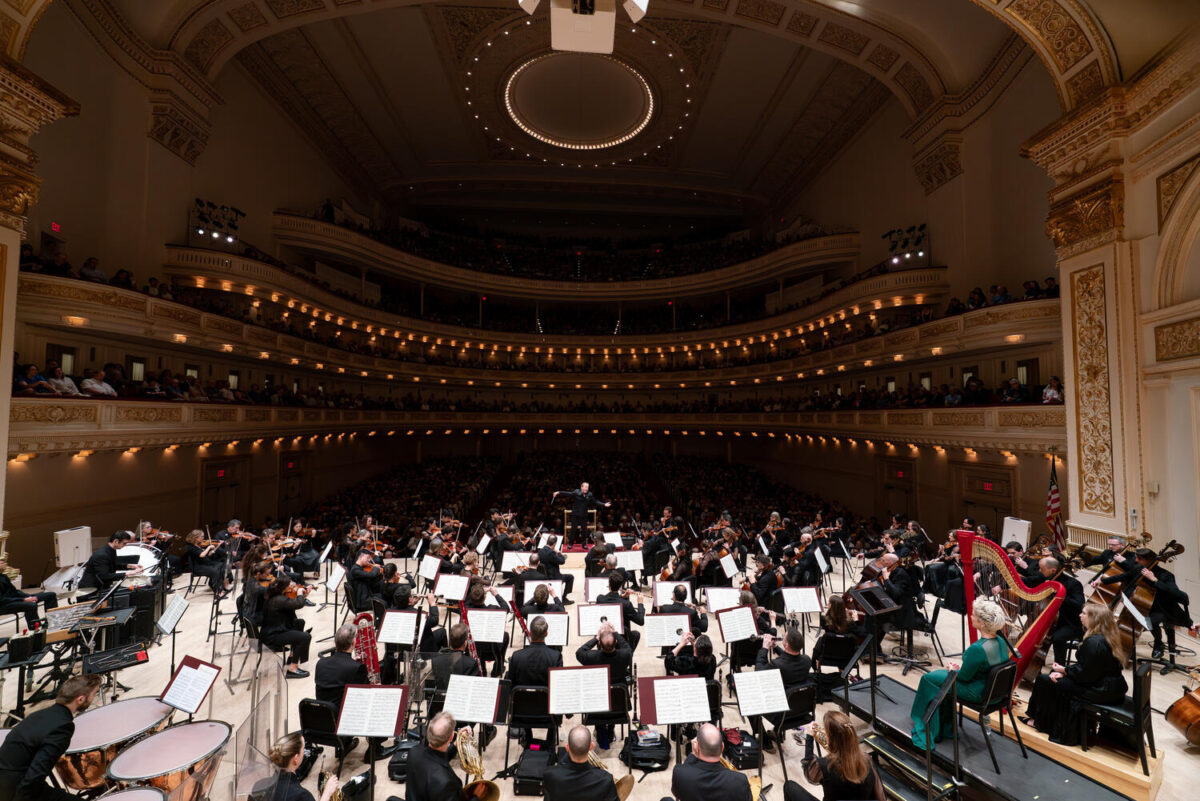
The Met Orchestra with Yannick Nezet Seguin. Photo: Jennifer Taylor
I must admit that I’m not among the many who have an unquenchable thirst for Mahler symphonies. While I’m an enthusiastic admirer of the composer’s vocal music, I find much of his purely instrumental pieces long-winded and impenetrable, although YNS brought an endearing lilt to the first movement of the Fourth before he lost me in much of the rest. But his Mahler touch has become much surer since he led the Met Orchestra in the Fifth two years ago. Having recently watched a live relay of the Eighth from the Berlin Philharmonie while I was researching Le Bu, I think I’ll skip YNS’s starry version of the behemoth when it thrice commandeers the Met stage next June.
I hope that once his ambitious symphony cycle is over, the conductor will turn his attention to Das Lied von der Erde or the too rarely done complete Des Knaben Wunderhorn.

Christopher Corwin
Christopher Corwin began writing for parterre box in 2011 under the pen name “DeCaffarrelli.” His work has also appeared in , The New York Times, Musical America, The Observer, San Francisco Classical Voice and BAMNotes. Like many, he came to opera via the Saturday Met Opera broadcasts which he began listening to at age 11. His particular enthusiasm is 17th and 18th century opera. Since 2015 he has curated the weekly podcast Trove Thursday on parterre box presenting live recordings.
-
People: Ann Murray, Christiane Karg, Elina Garanca, Joyce DiDonato, Kaija Saariaho, Leonard Bernstein, Magdalena Kožená, Maria Ewing, Yannick Nézet-Séguin, Ying Fang
-
Works: Eden, El ultimo sueño de Frida y Diego
-
Places & Organizations: Berlin Philharmonic, Carnegie Hall, Metropolitan Opera, Philadelphia Orchestra, Vienna Philharmonic