Garden leave
Brigitte Fassbaender’s acid-laced production of La finta giardiniera leans into the absurdities of Mozart’s early dramma giocoso.
Nothing says comedy quite like an attempted murder and two accounts of temporary madness. La finta giardiniera, first presented in Munich at the 1775 Carnival, is a work of extremes: the opera is three hours of frothy, over-the-top silliness, while the dramatic impetus for its plot springs from what the 18th century audience would have called a crime of passion, and what Fassbaender rightly names a femicide. The tonal messiness is nestled in a libretto (of uncertain parentage, attributed to prolific buffa librettist Giuseppe Petrosellini) that could have done with a good bit of pruning before making it to Mozart’s desk. The end result does show, as Christian Schubart’s review of the Munich premiere once put it, “flashes of genius”, while leaving no doubt about the difference between a work of budding creative forces, rather than ones in full bloom.
This is not to just gleefully bash Giardiniera. Even with its extraordinary douchebag of a tenor lead and its excruciatingly paced middle act, it’s a delightful piece, the usual buffa tropes of mistaken and disguised identities, class clashes, and love polygons involving a colorfully portrayed, buffonesque cast, and genuinely hilarious, sharp, quick-witted dialogues. And if the Mozart of 1775 is not yet the Mozart of Figaro, Don Giovanni, or Così, he’s an immense talent already, with a great sense of style and impeccable comic instinct – the action-finales of Act I and II (particularly the ever-growing imbroglio of the former) clearly prefiguring its famous successors.
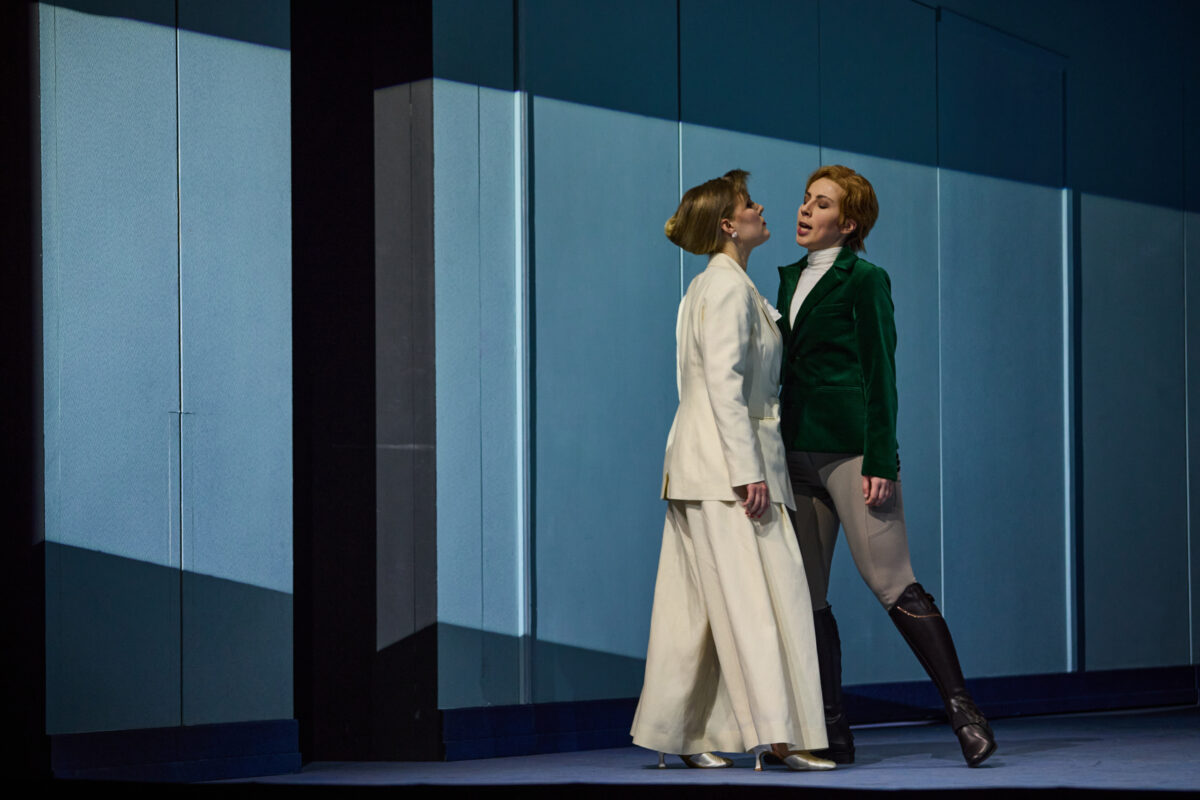
A strong directorial hand, nevertheless, is more than welcome here – and Brigitte Fassbaender, no stranger to the piece and going strong in her fourth decade of directing, certainly provided one. Heavily trimming Acts II and III, she was not only content to leave the work purely comical, but exaggerated its farcical aspects to an almost absurd extent – physical comedy and gags dominated the dizzyingly active stage action, letting no moment pass by without trying to get a joke in. Characters and conflicts, too, were pushed towards the ridiculous: most notably, the titular giardiniera (Countess Violante/Sandrina). She did ultimately get to dole out some outlandish final punishment to her wayward lover (Count Belfiore) in a cutting coup de théâtre, but from the overture’s mock funeral onwards, she came across more as prone to caprice and hissy fits than wounded and dignified, the portrait of a proto-Contessa that the opera itself paints.
While Fassbaender’s approach is understandable given the work’s own outlandishness (especially as it often veers into the satirical in depicting its higher-class characters), the staging was trying so hard to be funny that it often tripped over its own feet in doing so. Some of its elements were simply confused (whatever the “American Gothic” pair of old servants are meant to add, I’ve not figured out), some in its nonstop succession of gags plainly grated. But others did land extremely well: the Personenregie was unmistakably sharp and followed with complete commitment by the ensemble (including an extended bit of communal rope-play as they stumble around in the dark). Dietrich von Grebmer’s wonderful stage design – facilitating the busy stage action well and lending each character distinct, vibrant visual personalities – conjured a distinctly and increasingly surreal atmosphere, combined with Thomas Schlegel’s ingenious lighting. Giant fruits and vegetables kept invading the clean, neatly ordered space of the Podestà’s palace, at turns serving up some very pointedly genital imagery (a stalk of asparagus and a bundle of bisected strawberries accompany Belfiore and Arminda), and offering the magic mushrooms that kick off Belfiore and Violante’s episodes of “madness”, their joint acid trip giving way to their reunion. But Fassbaender’s topsy-turvy stage universe did, ultimately, take some emotional damages incurred through the opera seriously: the Podestà sulked, Ramiro rejected Arminda’s repeated entreaties for reconciliation, and Violante, finally restored to both her proper rank and her lover, ended the opera commandeering Nardo’s garden sheers and, after shooting a pointed look to Belfiore, chopping off the tip of the giant asparagus stalk.
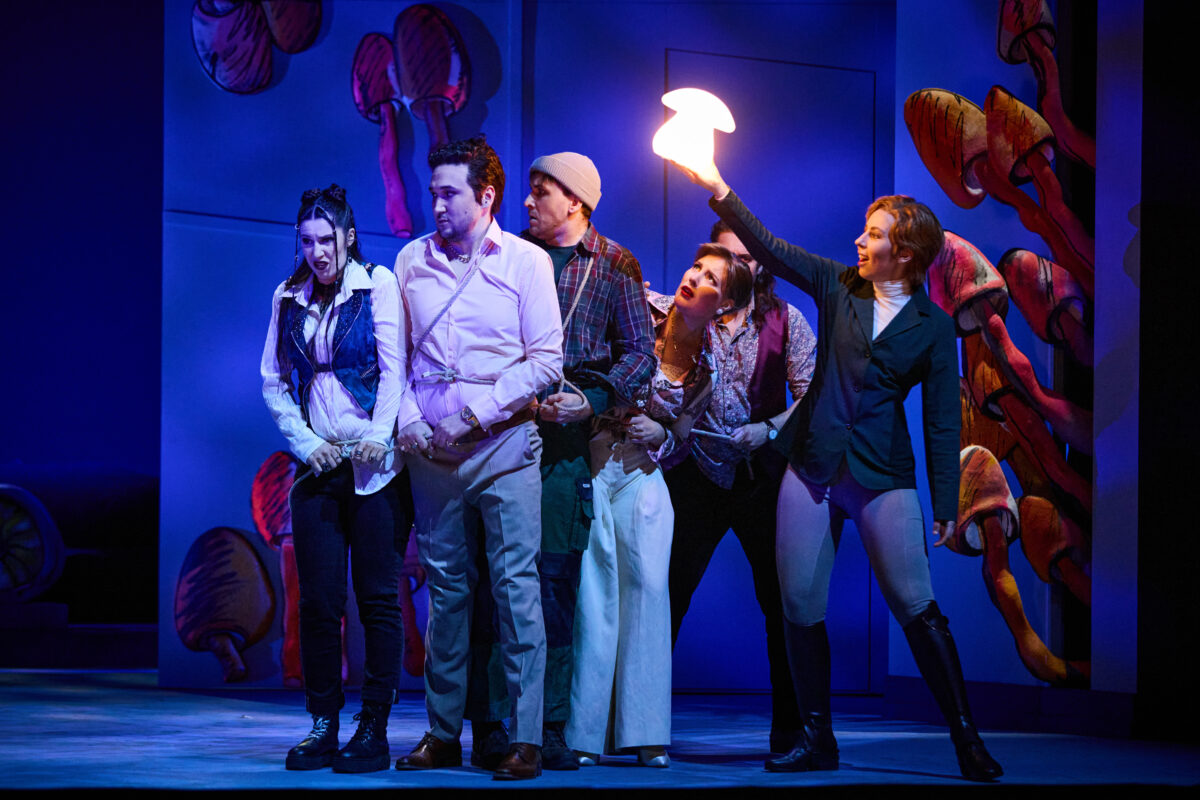
The Staatstheater Nürnberg’s young ensemble members carried this show with remarkable verve and all-around genuine chemistry and team spirit. In the title role, Chloë Morgan gamely clowned along, showing off an elegant, crystalline-toned soprano and great sensitivity of phrasing (displayed wonderfully in “Geme la tortorella”) that lent Violante a good bit of her grace and dignity back, even between the musical bits the staging demands of her (including the interpolation of “È strano” and the runs of “Der Hölle Rache”). As the object of her affections and ire, Sergei Nikolaev’s Belfiore was more caddish playboy than pompous ass (thanks, in no small part, to “Da Scirocco a Tramontana” getting cut), helplessly ardent and clueless to how to fix the hurt he keeps causing. Nikolaev’s tenor was darker and less flexible than one might wish in this repertoire, but he nevertheless negotiated the role’s demands securely and convincingly. Caroline Ottocan was as deliciously bossy and bratty an Arminda as they come, with a brighter voice than usual in the role, but with plenty enough bite and vehemence for “Si promette facilmente” and “Vorrei punirti” both to thrill. Sara Šetar’s Ramiro matched her intensity with a rich, supple, velvety mezzo, cavalier and flirtatious in “Se l’augellin” and blazing with rage in “Va pure ad altri in braccio.” (That the role’s characterization avoided clownish overwroughtness that many stagings prefer and that Šetar went to the Fassbaender school of manspreading were both much appreciated.) Though their contributions were cut down to one and a half aria each, there was much to delight in the proto-Figaro/Susanna pairing: Miha Brkinjač’s puppyish Nardo offered a warm, charming baritone and impeccable comic chops, while Clarissa Maria Undritz lent Serpetta a darker tone, matching her rebellious appearance, and sailed through her role with a delightfully sharp, vivacious spirit. Paul Schweinester’s Podestà rounded off the cast with a suitably characterful Charaktertenor.
Benjamin Schneider led the Staatsphilharmonie Nürnberg with a skillful hand (though with the occasional hiccup between pit and stage), rolling buoyantly along with a generally swift choice of tempi and tight pacing (only the slower arias getting a touch too leisurely). The Act I finale, with recognition upon recognition and confrontation upon confrontation between the abandoned lovers, was masterfully coordinated and utterly gripping. There was much to admire in the pit, in the orchestral vibrancy of tone, energy, and humor: the sighing shimmer of the strings in “Geme la tortorella”, the fiery blaze of the horns in “Va pure”, the enchanting playing of the woodwinds and the wicked continuo throughout – a testament to the considerable quality of “small-house” music-making.
Orsolya Gyárfás
Based in Budapest, Orsolya Gyárfás has been publishing opera reviews in English and Hungarian since 2016. Currently wrapping up a PhD focusing on Metastasian opera seria; general interests and obsessions include all things Baroque, queer, Regietheater, and any given combination of the above.