The Pennsylvania Dutchman
Verdi’s Stiffelio goes Amish in Vienna, featuring a stellar Luciano Ganci in the title role.
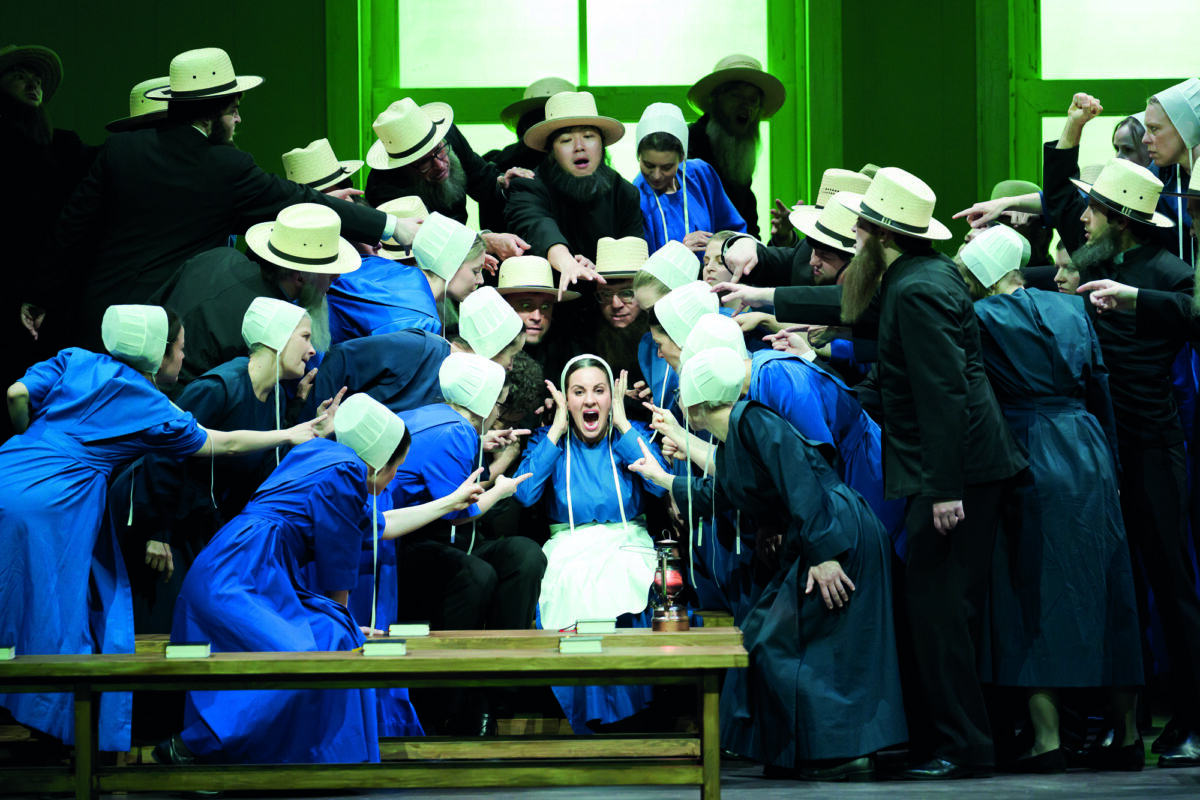
Photo: Werner Kmetitsch
Verdi’s Stiffelio, first performed in Trieste in 1850, came just after Luisa Miller (1849) and just before a spectacular string of hits—Rigoletto (1850), Il Trovatore (1853), La Traviata (1853)—, which makes it all the more remarkable that Stiffelio remains relatively underperformed and therefore unknown to much of the opera public. Trieste was a Habsburg city in 1850, ruled from imperial Vienna, as were such other Italian opera capitals as Milan and Venice. The unsuccessful revolutions of 1848, including Italian revolts against Habsburg rule, left Vienna nervous and led to the reimposition of censorship which contributed, Verdi believed, to the unimpressive premiere of Stiffelio. The opera was based on a French play about a Protestant minister confronting his wife’s infidelity (set in contemporary Austria, near Salzburg), but Roman Catholic censorship was uncomfortable with every aspect of the religious subject, including the modeling of a married clergy. The censorship of Francesco Maria Piave’s libretto meant that the main character (Stiffelio) could not even be designated as a minister. Verdi was at odds with La Scala in the 1850s and wrote to his friend and publisher Giulio Ricordi refusing to consider a Milan production of Stiffelio unless the company could promise (as they certainly could not) an uncensored version (“with no alteration or castration”).
By 1854, after Rigoletto, Il Trovatore, and La Traviata had triumphed in Venice, Rome, and Venice respectively (no premiere for La Scala) and were everywhere in demand, Verdi was ready to turn to Les vêpres siciliennes for Paris, but wrote to his friend Cesare de Sanctis, “Among my operas that are not played, some I abandon because the subjects were mistaken, but there are two that I would like to not forget: Stiffelio and the Battaglia di Legnano.” Stiffelio would be revised as Aroldo, the hero no longer a Protestant minister but a medieval English crusader, unfortunately no more successful than the original version and, still more unfortunately, recomposed by using the autograph score of Stiffelio which was thus partially lost. The first modern performance took place in 1968 in Parma, but it was the later rediscovery of missing parts which allowed for more fully authentic revivals in 1993 at the Metropolitan Opera (with Placido Domingo) and Covent Garden (with José Carreras), presented, we suppose, as originally intended by Verdi. Yet, Stiffelio today remains a Verdi rarity, which is part of what made the new and very interesting production at Theater an der Wien, starring the young Roman tenor Luciano Ganci, a special Verdian occasion in 2026. The production opened on March 13, just as the Eurovision contest was playing out in Vienna.
Ganci gave a stellar performance beginning with Stiffelio’s first aria, “Di qua varcando,” singing an arching phrase that rises an octave to high F-sharp before descending again. His clarion top was evident from the first measure of the aria, and throughout the opera he almost eagerly ascended to the passaggio and beyond with an exuberance that almost belied the dark anxieties of his character. Verdi played freely here with operatic forms; as this first aria opened out, with Bellinian expressiveness, into a septet, Ganci’s voice sailing above the ensemble to reach high A.
There is perhaps no other Verdi opera in which the tenor is so musically and dramatically central to the entire opera, though the character of Stiffelio clearly bears some relation to the much later tenor figure of Otello, who is also driven dramatically by his suspicions and who must also musically navigate an exceptionally volatile range of tenorial emotions. Stiffelio, by the end of the first act, finds himself among the ensemble and the chorus in the community chapel (to which he will return in the finale of the third act), leading the Largo opening of the concertato finale which meditates on the “fatale misterio” not yet discovered and revealed; he then initiates the ensuing Allegro, “Chi ti salva” (Who could save you), sounding a vivid descending phrase that begins on high A. Ganci’s performance was thrilling and beautiful from beginning to end, French conductor Jérémie Rhorer skillfully shaping the musical forces around his talented star. The latter sang with the cocky conviction that everyone loves a tenor, and he seemed to be enjoying himself as he showed off his irresistible top notes.
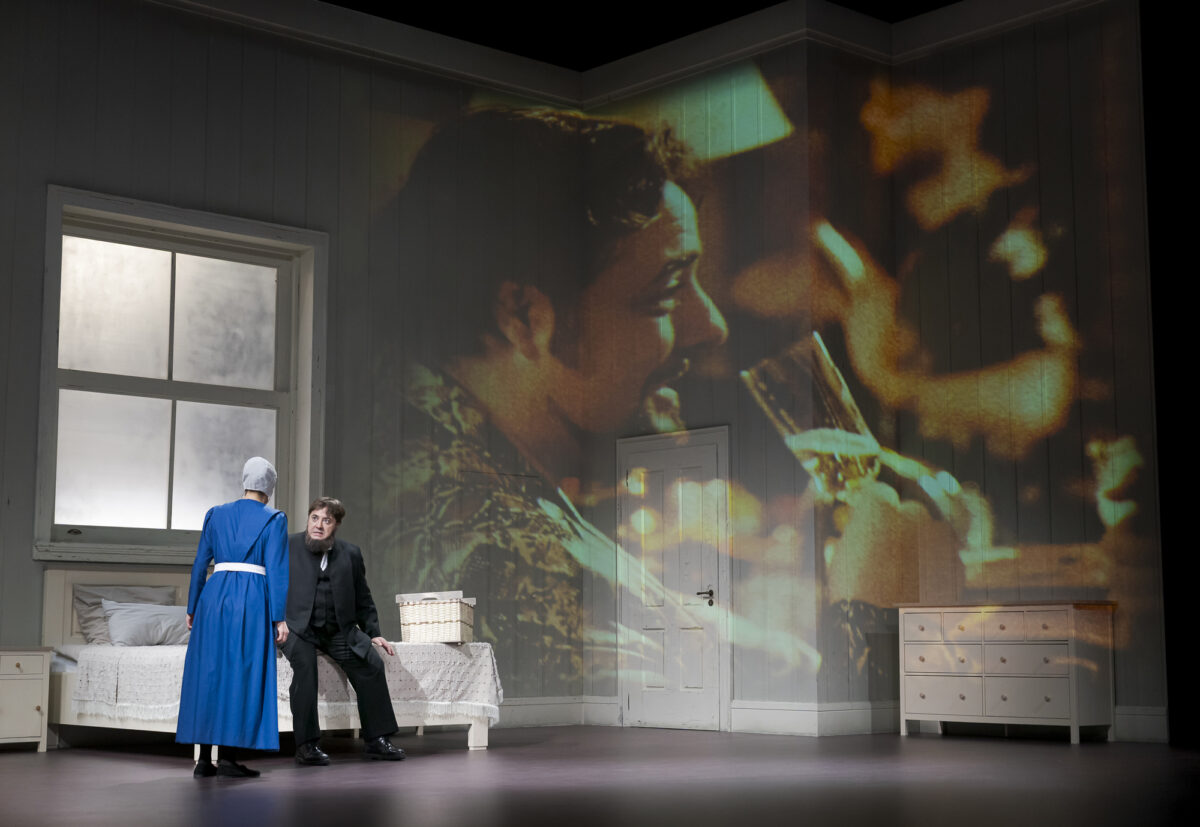
Photo: Werner Kmetitsch
The role was created in 1850 in Trieste by the legendary Pavian tenor Gaetano Fraschini whose voice was particularly suited to the tenor roles created by both Donizetti and Verdi; Fraschini apparently possessed both the force of a heroic tenor and the refined agility of bel canto style. Ganci has those same virtues, and has been singing Verdi all over Italy for the last decade, making his La Scala debut on opening night 2024, in La Forza del Destino, when he replaced Brian Jagde who was himself replacing Jonas Kaufmann. In 2025 Ganci sang Pinkerton at the Staatsoper in Vienna before moving across the Ringstrasse to sing Stiffelio in 2026 at the Theater an der Wien. Ganci is not yet a particularly subtle dramatic actor, and he lacks the baritonal timbre in the middle range that enabled Domingo to put this role over so forcefully. None of this mattered in Vienna, where Ganci’s Italianate vocal charisma carried the evening magnificently. Last year he sang Pollione in Toulouse, and this year he will sing Otello in Liège. I heard him in the more ardently lyrical role of the Dauphin in Verdi’s Giovanna d’Arco in Parma in 2025, and I admired his performance but did not quite anticipate the heroic dimensions of his voice as Stiffelio in Vienna. He has not yet sung in New York, to the best of my knowledge, but it would be almost scandalous if he were not signed up for something very soon. The night before the Stiffelio premiere at the Theater an der Wien, the Staatsoper, in an ostentatious display of luxury tenor casting, had the Met Tristan Michael Spyres singing the first-act Italian aria in Der Rosenkavalier. He was good enough, but Ganci would have been better.
Opposite Ganci in Stiffelio, in the somewhat ungrateful role of the unfaithful and repentant Lina, was the Lebanese-Canadian soprano Joyce El-Khoury, whose Verdian calling card, till now, has been Violetta. Unlike the party-ready courtesan Violetta, Lina belongs to a morally oppressive religious sect, and has to spend the opera regretting her fall from virtue . Even her music is subordinated to that of her husband, as she sometimes echoes his musical phrases and sometimes merely adds her voice to his arias with short musical interjections (pertichini). She has a striking dramatic aria to be sung in a cemetery in Act 2 (though the Vienna production eliminated the cemetery), somewhat anticipating Amelia’s dramatic arias in Un Ballo in Maschera which was composed at the end of the decade in 1859. Lina also has a full and complex duet with Stiffelio in the third act as she pleads for pardon and reconciliation, singing obbligato with the English horn, but the soprano is probably never likely to emerge as the star of this opera. El-Khoury was oddly mismatched with Ganci, for her middle voice produced tremulous Verdian emotions, perhaps more subtle than his, and she offered some fine pianissimo phrasing, which was not, so to speak, his forte, but she was strained and sometimes shrill in her top notes, precisely where Ganci was most exuberantly brilliant. He was also, perhaps unsurprisingly, much clearer in his Italian enunciation.
Veteran Milanese baritone Franco Vasallo had a more successful night in the role of Lina’s father, Stankar, singing with a splendid sense of Verdian phrasing. Stankar’s first-act duet with his daughter anticipates the emotional dynamics of Rigoletto (though Stankar is the sterner father), and his third-act aria, reflecting on the dishonor brought about by his daughter’s sexual activity, points the way toward the misguided implacability of Renato with his not-actually-unfaithful wife in Ballo. In Vienna Stankar sang the aria while crafting a simple pine coffin.
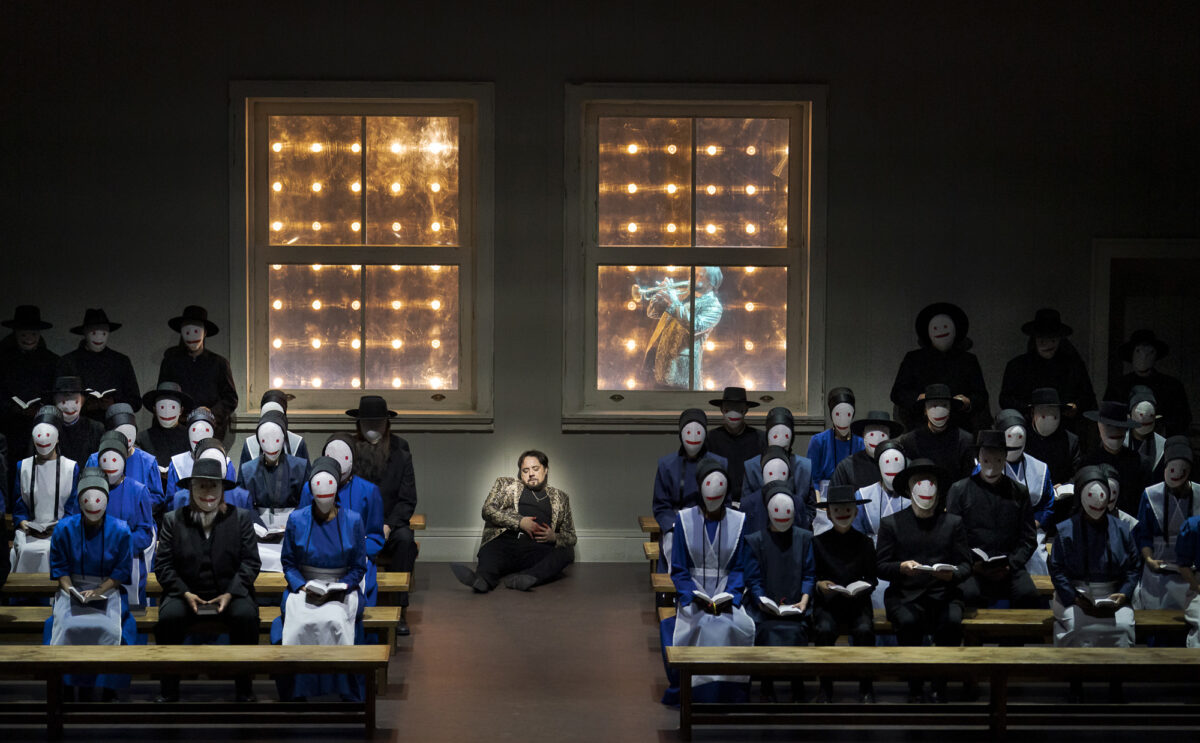
The production by Russian director Vasily Barkhatov moves the setting, and therefore the cult, to contemporary America and sets the opera among the Amish, very legitimately emphasizing that the religious repression of sexuality and patriarchal oppression of women remain part of the contemporary social landscape in many parts of the world, including Pennsylvania. Verdi, in a letter of 1850, noted that the costumes for Stiffelio would be “sempre meschino” (always wretched), and in 2026 all the men were dressed in black and all the women in blue smocks with white aprons and bonnets. There was no cemetery, because the whole opera was set in what seemed to be a single apartment with many rooms, including a chapel-like meeting room for liturgical services; the rotating stage continually moved from room to room even as the performers were singing. There was no easy escape from this constricted world, though an interpolated scene of mime (during Lina’s “cemetery” aria) showed Lina’s mother long ago abandoning the cult and forced to leave her child behind.
The most memorable feature of the Stiffelio overture is a broad and syncopated melody for solo trumpet, and, taking his cue from that, Barkhatov showed a 10-minute video during the overture which presented an ingeniously invented back story to the opera: Stiffelio is a Las Vegas trumpeter (we see him playing in front of neon lights in a silvery jacket with a python pattern) whose one-night stand with a seductive model gets him into trouble with mobsters, so that, fleeing for his life, he takes refuge. . . . among the Amish. Five years later he has become their minister and the opera begins with no trace of his former life except a trumpet case hidden under his bed, the symbol of his former life as a musician and his formerly wayward sexuality.
The mesmerizing final scene of Stiffelio, set in the meeting room, opens with organ music, adds a choral liturgical “Miserere” (suspiciously un-Protestant), punctuated by Lena’s rhythmic rising to a repeated high F-sharp, until Stiffelio enters and we hear the trumpet sounding in the orchestra. In Barkhatov’s production (spoiler alert) Stiffelio has come out of hiding, is now wearing his Las Vegas jacket, and is being trailed by the hit men who were hunting for him during the overture video. As he sings the gloriously moving conclusion to the opera, reading the Gospel text of Jesus on the casting of the first stone, absolving Lina with the repeated word “perdonata,” finally rising to a sustained high A on the penultimate syllable of that word. The assassins stab him to death right in front of his congregation, and the opera ends.
Some will feel that this is a powerful directorial intervention, and others will feel that this ending undercuts (literally) one of Verdi’s most beautiful scenes, and while I would usually be in the latter camp, I will say that I was more moved by the interpolated murder than I would have expected to be. At the party after the premiere, celebrating this rather little-known opera, several people expressed surprise that the murder was in no way connected to Piave’s libretto. Yet the assassination of the tenor, thoroughly unindicated for Stiffelio in 1850, would be the absolutely prescribed ending for Un Ballo in Maschera in 1859. The same tenor Fraschini, who sang Stiffelio in Trieste in 1850, would go to Rome in 1859 and succumb to the assassins in the premiere of Ballo. One might wonder whether some of the catharsis that Verdi achieves in Stiffelio, as the tenor sings the Gospel words of Jesus, suggests that the role possesses not only a sacerdotal but also a sacrificial aspect. Just as Stiffelio pardons Lina with his final lines of music, Riccardo also absolves his assassins as he lies dying.
At the moment of the revolutions of 1848 Karl Marx, in The Communist Manifesto, denounced not just capitalist exploitation but also the hypocrisy of religious morality and the bourgeois family. One might perhaps understand Stiffelio’s final sermon from the pulpit in 1850 as not just about forgiving his errant wife and rejecting moral hypocrisy, but also about healing and reconciling the whole community which, as minister, he guides and governs. The prototypical operatic spiritual leader was usually a basso, most famously Sarastro in Mozart’s Magic Flute ( 1791), the high priest of the Masonic temple cult, and this basso religious role was fully evident in the cases of Oroveso, the Druid high priest in Norma (1831), and Verdi’s own Zaccaria, the Hebrew high priest in Nabucco (1842).
In Stiffelio, however, Verdi shifted the burden of spiritual leadership to the tenor voice with the moving tensions of the passaggio and the inspirational impact of the tenor top notes instead of the solemnity of the basso depths. In this regard one might consider that the premiere of Stiffelio in Trieste in November 1850 followed closely on the premiere of Lohengrin in Weimar in late August, an opera that celebrates the spiritual leadership of a tenor knight of the Holy Grail. The concluding tenor aria “In fernem Land,” sometimes known as the Gralserzählung (Grail narrative), might be viewed in relation to Stiffelio’s final redemptive declamation from the pulpit. Parallel to Stiffelio, Lohengrin pardons his wife (for her violation of trust, rather than failure of fidelity) and offers redemption to the riven political community of Brabant. The tremendous impact of Ganci in Vienna as Stiffelio is perhaps a reminder of how much we might still be susceptible to the kind of redemptive promise that a great tenor can sometimes convey to an apprehensive public in a world fraught with dangers and suspicions.
-
Topics: giuseppe verdi, rarity, Review
-
People: Brian Jagde, Francesco Maria Piave, Franco Vassallo, Giulio Ricordi, Giuseppe Verdi, Jérémie Rhorer, Jonas Kaufmann, José Carreras, Joyce El-Khoury, Luciano Ganci, Michael Spyres, Plácido Domingo, Vasily Barkhatov
-
Works: Aroldo, Der Rosenkavalier, Die Zauberflöte, Giovanna d'Arco, Il trovatore, La battaglia di Legnano, La forza del destino, La traviata, Lohengrin, Luisa Miller, Madama Butterfly, Nabucco, Norma, Otello, Rigoletto, Stiffelio, Un ballo in maschera
-
Places & Organizations: Metropolitan Opera, Staatsoper, Teatro alla Scala, Theater an der Wien