All the lovely things you are to me
To celebrate the 100th anniversary performances of Turandot at the Met starting next week, Patrick Dillon gives a listen to seven versions of “Signore, ascolta!” for Perspectives on an Aria.
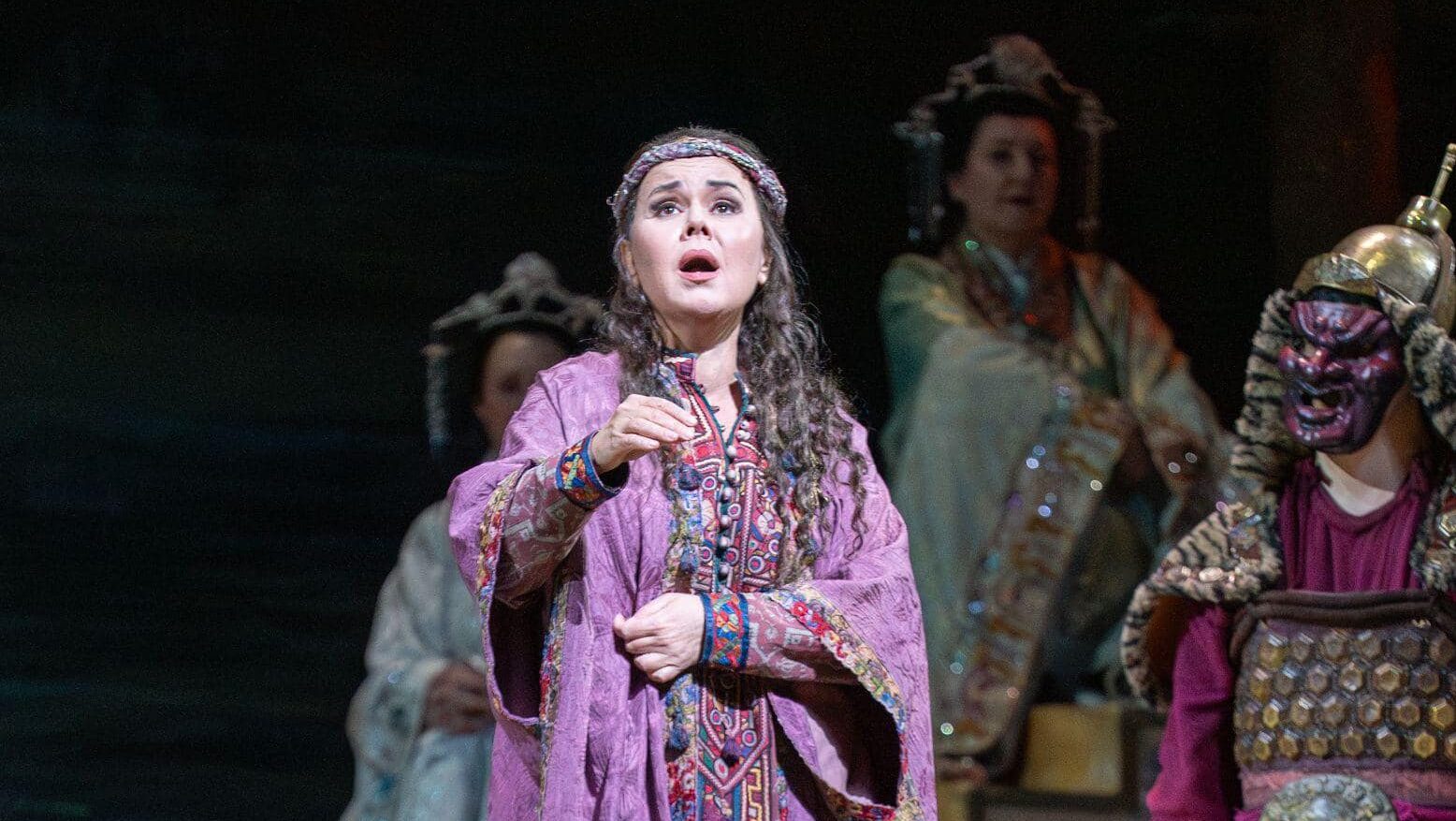
Aleksandra Kurzak as Liù in Turandot at the Metropolitan Opea in 2014 / Photo: Karen Almond
Q: What does Puccini’s Turandot share with the 1966 Grammy-winning Song of the Year?
A: The shadow of a smile.
I knew the opera before I knew the song. I was still a grade-schooler when I discovered Turandot, a year or two ahead of MGM’s June 1965 release of The Sandpiper, the Liz-and-Dick flick (that’s Taylor and Burton, if you need the nudge) whose theme song—music by Johnny Mandel, lyrics by Paul Francis Webster—nabbed not just that much-coveted Grammy but an Oscar to boot. Its title? “The Shadow of Your Smile.”
Did Webster, I wondered at the time, know Turandot? There’s no way I could hear those words without thinking of Puccini’s opera and the character with whom I’d, at first hearing, easily fallen in love: Liù.
“Liù, who are you?” inquires the incognito Prince Calaf a few minutes into Act I, having just discovered his deposed, blind father in her faithful care. “I’m nothing…just a slave,” she replies. And why, he queries her further, is she willing to suffer so for the old man, begging for alms, drying his tears? “Because one day, in the palace,” she tells Calaf, “you smiled at me!”—a small oasis of quietude amid the opening scene’s prevalent clangor, her voice rising to (one always hopes) a celestial pianissimo high B-flat. Her entire backstory is contained in that one exquisitely sculpted phrase. It’s the shadow of his smile that, toward the Act’s end, she evokes in her, and the opera’s, first aria: the short, achingly lovely “Signore, ascolta!”
Much has happened in the meantime. Touched as he is by Liù’s devotion, Calaf’s vulnerable head has been turned at the first, moonlit sight of the death-doling Princess Turandot, and he’s determined to risk it in pursuit of her bejeweled hand. The dire warnings of imperial ministers Ping, Pang, and Pong, the ghostly interjections of Turandot’s decapitated suitors, the paternal pleading of the hapless Timur—nothing can dissuade him. So Liù, with soft-spoken urgency, adds her tear-soaked voice to the cautionary mix. The two librettists, Giuseppe Adami and Renato Simoni (it’s hard to credit one over the other), supplied a text that inspired Puccini’s perfect musical capture of the straightforward, openhearted, strong-willed Liù—the character whom he, like his audiences-to-be, would embrace with a fervor denied the titular ice princess and her stubbornly oblivious prince:
| Signore, ascolta! Ah, signore, ascolta! Liù non regge più! Si spezza il cuor! Ahimè, ahimè, quanto cammino col tuo nome nell’anima, col nome tuo sulle labbra! Ma se il tuo destino doman sarà deciso, noi morrem sulla strada dell’esilio! Ei perderà suo figlio… io…l’ombra d’un sorriso! Liù non regge più! Ah, pietà! |
My lord, listen! Ah, my lord, listen! Liù can’t bear any more! My heart is breaking! Alas, how long have I traveled with your name in my soul, your name on my lips! But if your fate will be decided tomorrow, we will die on the road to exile! He will lose his son… I…the shadow of a smile! Liù can’t bear any more! Ah, have pity! |
Beginning in a halo of muted strings, it’s a brief piece—only three pages of the Ricordi vocal score, roughly two and a half minutes of music. It’s in common time, with a brief excursion into 2/4 at “strada dell’esilio,” and marked adagio, with a further slowing down (ritardando, rallentando) for the two simple “echo” phrases (“col nome tuo sulle labbra” and “io…l’ombra d’un sorriso”) and a final expansion to lento for the climactic “Liù non regge più! Ah, pietà!”—capped by (again one hopes) another exquisite pianissimo high B-flat. While Turandots are prized for their blazing fortes, Liùs score their points at the opposite end of the dynamic range, quietly asserting their skills at spinning out a long legato line. (For anyone in search of an exhaustive musical dissection, there’s Nicholas J. Baragwanath’s “Analytical Approaches to Melody in Selected Arias by Puccini.”)
In the hundred years since its first performance—Turandot celebrated its centenary on 25 April—“Signore, ascolta!” has shown a gently persuasive knack for eliciting the best from its sopranos. I’ve listened, via YouTube over the past two weeks, to more than forty of them, literally from A (Agresta) to Z (Zeani), and chronologically encompassing every decade but one—the 1940s were lean years for Turandot recordings. I’ve narrowed my focus down to a lucky seven versions—not necessarily my favorites, but each with something interesting to say. I’ve regretfully excluded such special performers as Olivero (the first soprano to record the complete opera), Moffo (my very first onstage Liù), Price, Tucci, and Scotto; the surprising outings of Stich-Randall (on a very enjoyable complete recording auf Deutsch) and Gruberová; and the notable, more recent ventures of the Met’s current pair of Violettas, Jaho and Feola. I apologize to them all for my sin of omission. My regrets, too, to four singers I very much admire—Pampanini, Favero, Carteri, and Freni—whom I demoted for their failure to muster a properly soft ending for their otherwise well-sung renditions. That final phrase is an all-or-nothing clincher for me.
So here, in more or less chronological order, are the select seven.
Maria Zamboni
Zanboni (1895–1976) was history’s very first Liù, and according to every source I could find seems. somewhat implausibly, to have recorded her version on the day of the opera’s premiere. In any case, its significance is undeniable. The voice is very period-Italian—darkish, with a pronounced (but not intrusive) vibrato, and she’s unabashedly emotive in a way that’s slightly startling to modern ears: she’s taken to heart the librettists’ “piangente” even before her chesty sob at the final “Liù non regge più,” and she offers a veritable feast of rolled r’s (“non rrrregge più,” “ei perrrrderà suo figlio”). The tempo is notably expansive, but she takes the final phrase in a single breath, as the score indicates, and though she hits the final B-flat mezzo forte, she tapers it down to a winning pianissimo to pass my acid test.
Lotte Schöne
Schöne (1891–1977) was another of the role’s originators, in Berlin in October 1926 (under Bruno Walter) and then in London the following June. A native of Vienna, with a career based largely in Austria and Germany, her “Signore, ascolta!” (recorded in Berlin in January 1928) offers a striking vocal and stylistic contrast to Zamboni’s. The emotion is there, but it’s not overt; the tone is sweet and heady and the line lovingly sculpted, with plenty of echt-Viennese portamenti. I was introduced to Schöne, as I was to so many wonderful singers of the past, via John Steane’s The Grand Tradition, and it’s only fair that I give him the last word: hers, he says, “remains the classic performance, touching as a characterisation, the last lines floated with heavenly lightness and perfect control.”
Elisabeth Schwarzkopf
Twenty-nine years later, Schöne found a worthy successor in this eminent soprano, whose art—or is it artifice?—still provokes debate. Schwarzkopf was considered an unorthodox choice for Liù when her husband, producer Walter Legge, cast her opposite Callas on EMI’s complete recording of 1957; but she’d actually sung a pair of German-language performances in Vienna in 1949, and in London in 1951 she’d recorded, in Italian, a lovely “Signore, ascolta!” But her later account is easily the better. Perhaps it was the conductor’s doing: Tullio Serafin had led the Met premiere in 1926 and clearly knew a thing or two about Turandot and Italian style. The beautiful tone is essentially Germanic, but the emotional current is effectively Italianate, with a touch of a sob at “ahimè” and a notably wider dynamic range. The two echo phrases are beautifully softened, and the final “Ah, pietà!” is taken, Schöne-like, in a single breath, now capped with a fine messa di voce on the high B-flat.
Renata Tebaldi
Tebaldi never sang Liù onstage, but she recorded it twice: for Decca, under Erede, in 1955, and four years later, under Leinsdorf, for RCA. She’s in slightly plusher voice in the former, but (a reversal of Serafin’s hand with Schwarzkopf) the Austrian-born Leinsdorf coaxes a subtler approach from her, with the echo phrases handled even more effectively and the B-flat attacked and held pianissimo—not her most dulcet sound, but certainly the right intention. And it’s a rare delight throughout to hear the music sung by so beautiful, so warm, so ample a voice, with her native Italian so clearly and lovingly inflected. The RCA recording was my introduction to Turandot, and with Nilsson and Björling also in prime form, I still revisit it with pleasure.
Montserrat Caballé
And speaking of beautiful voices…is there any more sheerly beautiful than Caballé’s? Her first recorded “Signore, ascolta” opened her splendid 1970 Puccini recital under Mackerras, and it’s gorgeous. Two years later she recorded the role complete, under Mehta, and it’s sentiment that prompts my slight preference for that account: before either of these studio outings, in February 1969, I was lucky enough to catch the second of her two Met Liùs, with Mehta in the pit—surely the most ravishingly sung Liù I’ve ever heard onstage. (It was notable extramusically, too: the curtain was lowered after her death cortège, to facilitate her departure from the stage, and went back up a minute later for Nilsson and James King’s climactic duet.) The final “Ah, pietà” is taken in one very long breath, with the soft B-flat held, it seems, forever. If the word “pietà” gets sacrificed in the process, so be it: that’s Caballé.
Mariella Devia
I was surprised to discover Devia in my YouTube deep dive into the aria: Puccini seemed (as it did for Gruberová) unlikely turf for this queen of bel canto. The concert performance here dates from 1993. but she sang the whole role onstage as late as 2012, at age sixty-four—not as remarkable a feat, I admit, as singing Donizetti’s Roberto Devereux at Carnegie Hall at sixty-six, but pretty notable nonetheless. And what’s so special about this “Signore, ascolta!”? There’s the lovely, clear Italian voice and diction, to begin with, and the sheer technical skill. I can nitpick—the echo phrases could be better contrasted dynamically—but as it unfolds, this rendition exudes a basic rightness that’s wholly disarming.
Aleksandra Kurzak
There’s a similar rightness to Kurzak’s Liù. Trained in her native Poland and later in Germany, Kurzak arrived at the Met early on, as the high-flying Olympia in Les Contes d’Hoffmann in 2004, and for the next decade of her international career she kept her roles on the light side. But ever since her first Mimì in 2016, she’s become more and more of a Puccini specialist, her voice and temperament maturing to encompass Butterfly, Tosca, and even, just recently, Turandot–a venture I hope proves a one-off stunt, because she’s so lovely and eloquent a Liù. This video dates from her debut in the role, at London’s Royal Ballet and Opera in 2017, and along with her beautiful singing, there’s the pleasure of watching her simple, straightforward acting, with a minimum of gestures and facial expressions employed to maximum effect. I caught one of her Met Liùs in 2024, and there’s no one these days I’d rather see and hear in the role.
So many shadows, and shades, of that fateful smile!
And what about “The Shadow of Your Smile”? I’ve never been tempted to audition forty versions of that song; in fact, I haven’t heard it in years. But for the curious, off the top of my head, I’d say you can’t go wrong with Tony Bennett.

Patrick Dillon
Patrick Dillon discovered opera as an eleven-year-old Detroiter, saw his first staged opera at twelve, and was a regular, highly opinionated operagoer by the time he hit his mid-teens. He came to opera journalism three decades later, writing for Canada's Globe and Mail, the Chicago Tribune, American Record Guide, and Opera News and settling down as the longtime New York correspondent for Opera Canada and Scherzo in Madrid, doing his darndest not to live in the rosy operatic past.
-
Topics: perspectives on an aria
-
People: Aleksandra Kurzak, Birgit Nilsson, Bruno Walter, Charles Mackerras, Elizabeth Schwarzkopf, Elizabeth Taylor, Erich Leinsdorf, Fausto Cleva, Giacomo Puccini, Giuseppe Adami, James King, John Steane, Jussi Björling, Leontyne Price, Lotte Schöne, Maria Callas, Maria Zamboni, Mariella Devia, Montserrat Caballé, Renata Tebaldi, Richard Burton, Tullio Serafin, Walter Legge, Zubin Mehta
-
Works: La bohème, Les contes d'Hoffmann, Madama Butterfly, Tosca, Turandot
-
Places & Organizations: Metropolitan Opera, Royal Ballet and Opera