Don’t tread on Marie
Boston Lyric Opera’s Revolutionary War-set Daughter of the Regiment prioritizes accessibility without losing its charm.
 By
Harry Rose
By
Harry Rose
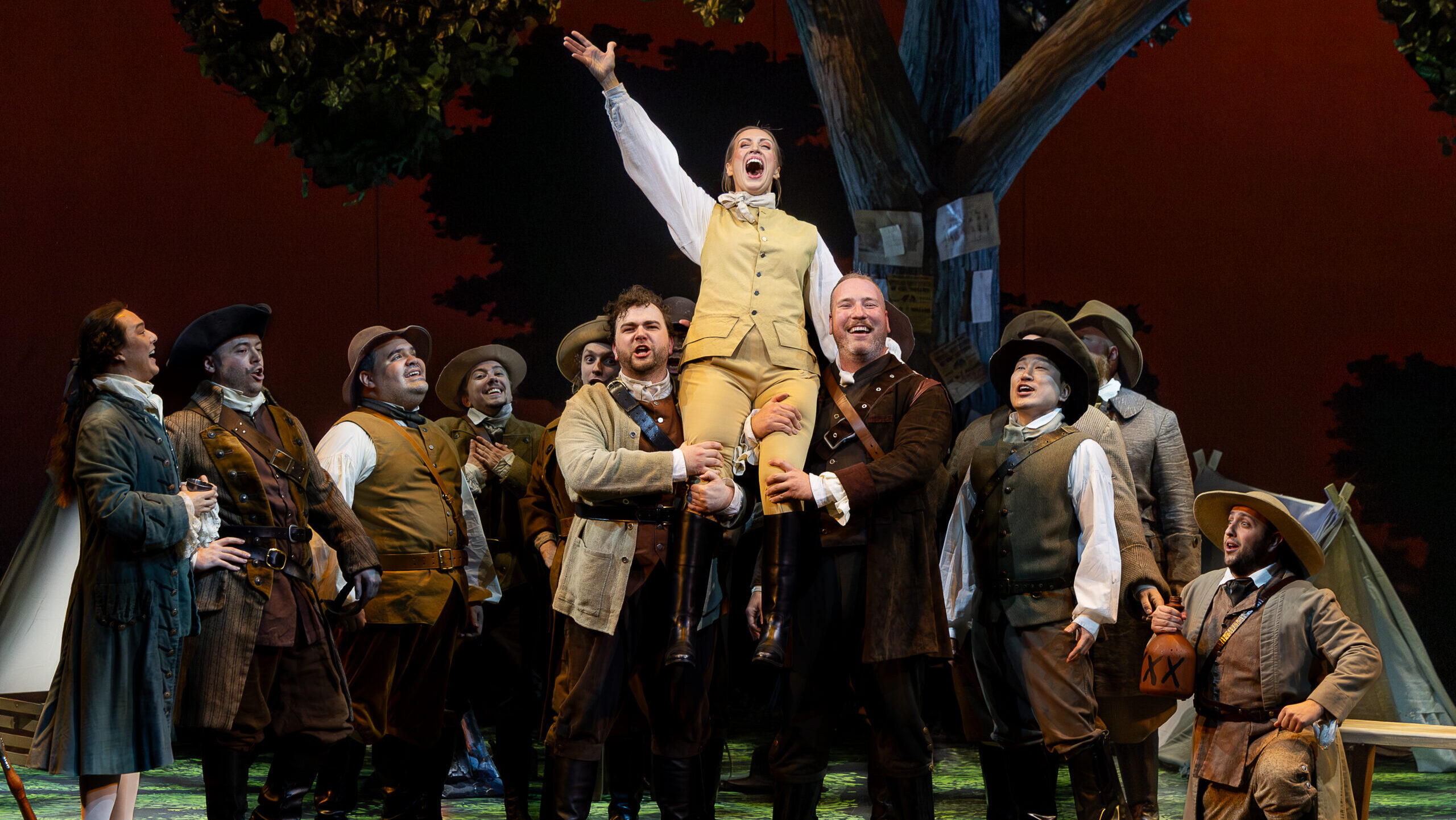
Brenda Rae (center) as Marie and members of the regiment in Boston Lyric Opera’s Daughter of the Regiment / Photo: Nile Scott Studios
While the Boston Symphony Orchestra’s season-long approach to this year’s semiquincentennial (that’s 250) of the United States, subtitled “E pluribus unum,” has been heady (featuring everything from Barber to Adams), Boston Lyric Opera’s Daughter of the Regiment, which closed last weekend, was delightfully middlebrow.
Performed in an English translation by Kirsten Greenidge that was just the right amount of unpretentiously hokey, the company updated Donizetti’s martial comedy to the era of the American Revolution. John De Los Santos’s production takes inspiration, according to a program note by BLO Artistic Associate Anne Bogart, from the real-life Deborah Sampson, who disguised herself as a man named Robert Shirtliff and fought against the British with the Continental Army for 17 months in 1782.
Though De Los Santos’s production is funny and detailed (owing especially to Liliana Duque Piñeiro’s suggestive sets and Oana Botez’s detailed costumes), it stays on the surface of Sampson’s peculiar story of being a woman plopped into a combat regiment rather than plumbing the complex gender dynamics it implies. And all things considered, that’s probably for the best, because what emerged from the performance was very much still, recognizably, La fille du regiment but with a fun, even retro Americana flavor the likes of which one is surprised to see from the hyper community-conscious BLO. Here, Marie, a hard-working Brenda Rae, has been brought up by a Continental Army regiment and Tonio, here a historically plausible Frenchman sung by Spencer Britten, gets to both enlist to fight the redcoats and keep his “Ah! mes amis” in its original language. (The other arias I’ll call by their original French titles.)
Britten made the strongest impression of the cast; a former member of the Berlin Staatsoper Studio, he has a burlier sound than your stereotypical bel canto tenor and projects cleanly. That French “Ah! mes amis!” was undoubtedly his high point and despite the gravity of his sound, he managed to maintain it not only up to the Cs, but also ornamenting up to a D, for which he was rewarded with big applause and an encore. But the quieter moments of the score found him less inspired, and the more introspective moments in the second Act featured piano singing that had minimal lift.
Paradoxically, it was the quieter moments that elicited the most engaging singing from Brenda Rae, with “Il faut partir” having the most dynamic interest. Yet despite an assured acting performance, dynamics are the only type of vocal interest she can muster, and her monochromatic voice sounded both caustic and wobbly across its top-heavy range.
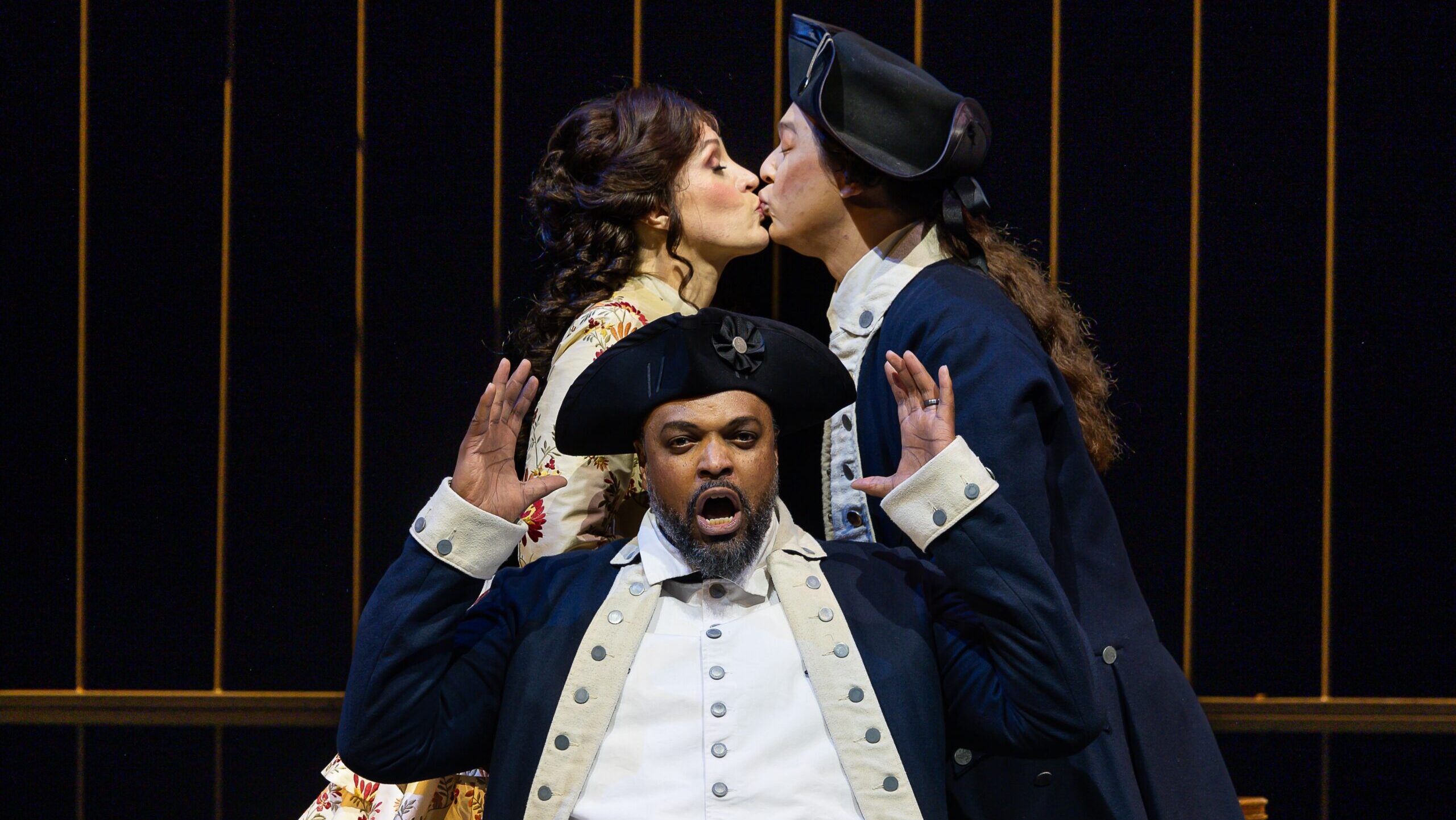
Colonel Sulpice (Kenneth Kellogg, c.) relents to allow Marie (Brenda Rae) and Tonio (Spencer Britten) to marry in Boston Lyric Opera’s Daughter of the Regiment / Photo: Nile Scott Studios
Sandra Piques Eddy mugged with vigor and an excellent Boston accent (“Marie is my daughtah!”) as the Widow Berkenfeld, who here has an explicit romantic side-plot with the gallantly sung Colonel Sulpice of Kenneth Kellogg. Angela Yam shuffled around the stage as Berkenfeld’s servant Hortensia, giving zero idea of the type of performance of which she is capable, while Neal Ferreira gave a very broad drag performance, including a nice interpolated “If you give me your attention” from Princess Ida, as the Royalist snob, the Duchess Crakenthorpe, who comes to fix Marie’s marriage to her nephew (and who is later revealed as an English spy and tarred and feathered at the final curtain).
Conductor Kelly Kuo moved through the afternoon at a measured pace, making the afternoon feel substantial rather than fleet, but the numerous public school students sitting near me didn’t seem to mind; in fact, this sort of rethinking of an opera to make it accessible to families, one that remains true to the score, the spirit of the piece, and the place it’s being performed, is leagues worthier (and smarter and more fun) than Three Little Pigs: The Opera or taking a hacksaw to The Magic Flute.
Harry Rose
Harry Rose, based in Providence, Rhode Island, is currently pursuing a PhD in Italian Studies at Brown University. Starting out blogging independently as Opera Teen in 2013, he holds the auspicious distinction of being the youngest writer to ever contribute to parterre box (at age 14) and has had the pleasure and challenge of writing for the rigorously discerning cher public since 2012. Increasingly niche hobbies and interests include opera, ballet, theatrical goings-on of the fin-de-siècle, and gatekeeping Camp.
-
Topics: boston lyric opera, Review
-
People: Angela Yam, Anne Bogart, Brenda Rae, John de los Santos, Kelly Kuo, Kenneth Kellogg, Liliana Duque Piñeiro, Neal Ferreira, Oana Botez, Sandra Piques Eddy, Spencer Britten
-
Works: Die Zauberflöte, Iolanta, La fille du régiment
-
Places & Organizations: Boston Lyric Opera, Boston Symphony Orchestra