As a hero going to conquest
A joint Beethoven–Adams program conducted by Dima Slobodeniouk suggests a way forward for the embattled Boston Symphony Orchestra.
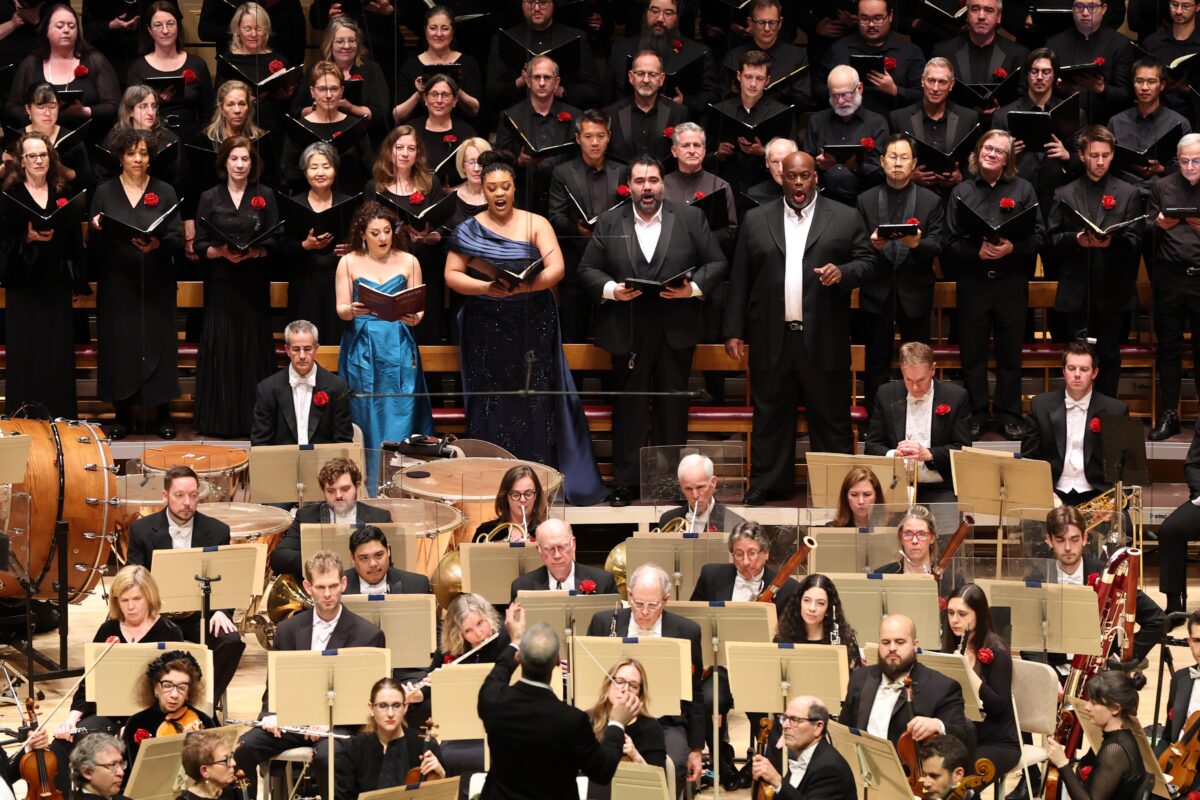
Photo by Winslow Townson
One season since the Boston Symphony Orchestra and Music Director Andris Nelsons tackled the Beethoven symphony cycle and a few months since they presented Missa Solemnis for Symphony Hall’s 125th anniversary, the orchestra closed its regular season with an “Ode to Joy” in very different, turbulent institutional circumstances.
The concert began with John Adams’s Harmonium. With textures that not only draw from his early interest in Minimalism, as in Shaker Loops (1978), but also look ahead to his more lyrical works like Nixon in China (1987) and Harmonielehre (1985), Adams’s setting of John Donne and Emily Dickinson’s poems is a daunting challenge for any ensemble. The BSO and conductor Dima Slobodeniouk, alongside the Tanglewood Festival Chorus prepared by Jean-Sébastien Vallée, were largely up to the task. The New England native’s works are not often performed by the BSO, yet this season they tackled his fiendish Violin Concerto (1993) with artist-in-residence Augustin Hadelich, adapted scenes from Nixon in China for their annual Carnegie Hall trip, and lastly performed Harmonium for the first time since 1981 (the year of its premiere).
Slobodeniouk opted for a well-paced, slow crescendo as swirling flutes and clarinets introduced Donne’s “Negative Love,” a meditation on the unknowability of love. More minimalist textures, like the pulsating string tremolos, were occasionally muddled, but the TFC’s clear diction and enunciation and warm orchestral playing pervaded the middle movement, Dickinson’s poignant “Because I could not stop for Death.”
After an ominous double-bass and cello interlude, Slobodeniouk brought out appropriately sharp accents for the chorus’s declaration of “Wild Nights.” Here, the chorus and orchestra were a bit disjointed in the ecstatic repetition of “with thee” and “luxury,” while the closing section, a maritime canvas of “rowing in Eden,” was more plodding than propelling across the calm, undulating instrumental texture. Yet this rendition of Adams’s 30-minute triptych still conveyed a powerful transcendental journey.
Like Harmonium’s nebulous opening, which Adams described as “a single tone emerging out of a vast, empty space,” Beethoven’s Ninth Symphony began with a humming G-E open fifth. Yet instead of Adams’s placid texture, Slobodeniouk took the symphony’s tempestuous first movement at a relatively brisk tempo, with little vibrato or sentimentality from the strings. In fact, this lean approach was characteristic of the whole symphony, preferring a restrained Biedermeier rather than a lush Romantic tone. This was evident in the third movement, “Adagio molto e cantabile”; Slobodeniouk ditched his baton and opted for a muted, almost sleepy atmosphere.
Yet moments of action nonetheless permeated the performance. In the second movement, Slobodeniouk brought out the agility of the leaping woodwind lines rather than the string-driven dance rhythm underneath (emphasizing the latter was much more the case in Nelsons’s rendition last year). As the three-note motif then passed around the orchestra, Slobodeniouk brought down the rest of the orchestra to provide timpanist Timothy Genis a rip-roaring solo, almost a micro-concerto in itself.
While last year’s performance featured baritone Andrè Schuen’s warmer, clearer diction heralding Beethoven’s call for “pleasant song,” this time Morris Robinson’s powerful, true bass provided an altogether more imposing injunction against “these tones” of the finale’s stormy opening, conveying with gravitas Beethoven’s preamble to Friedrich Schiller’s “Ode to Joy.”
Another noticeable difference from last year was the decision to move the vocal quartet behind the orchestra next to chorus rather than at the front of the stage. While this meant a more blended sound overall, tenor Andrew Haji’s declamatory “wie ein Held zum Siegen” (“like a hero to victory”) was unfortunately covered by the choir. Nevertheless, Slobodeniouk managed the balance between orchestra and choir well, allowing the TFC to shine as they hailed the “canopy of stars” beyond which “a loving Father dwells.”
Soprano Andrea Carroll and mezzo Zoie Reams blended nicely together during the vocal soloists’ quartets, while Robinson’s charismatic stage presence was a joy to watch. Slobodeniouk adjusted dynamics accordingly during these moments, providing room to shine for both Carroll’s lush ornamentation on “sanfter Flügel weilt” (“gentle wings abide”) and Robinson’s quite wide but forceful vibrato. The coda then picked up at breakneck speed, capturing a rousing final affirmation of the divine spark of joy.
Sunday’s concert concluded the BSO’s season amidst an admittedly turbulent last few weeks for the organization. On March 6, the board of trustees announced that Music Director Andris Nelsons’s contract would not be renewed after the 2026-27 season. Ever since the terse Friday afternoon email — moments after the orchestra had finished a wonderful all-Brahms program with near-centenarian Herbert Blomstedt — musicians and patrons have taken to voicing their displeasure with the decision. While news of a music organization moving on from a conductor is a quite common occurrence, what made this rare was its blunt and unilateral manner, seemingly without any input from the orchestral musicians themselves.
Since then, BSO musicians, as well as some audience members, have worn red flowers in solidarity with Nelsons. Petitions and even merchandise emblazoned with “Stand with Andris” and “Reinstate” have sprung up, alongside statements from many peer institutions and musicians in support of the BSO musicians and their MD.
In 2024, Nelsons’s contract had been changed from a fixed one to an evergreen, rolling one; already an indicator of an organization re-thinking its future. Nelsons’s performances have had their fair share of rave reviews, but also disappointments. Having heard him nearly 20 times over the last three seasons, Nelsons always seems to bring fresh ideas to melodic material — particularly in the Romantic canon — even if sometimes at the expense of subtlety, like in his bombastic renditions of Mahler’s Symphony No.8 and Tchaikovsky’s Manfred, for example.
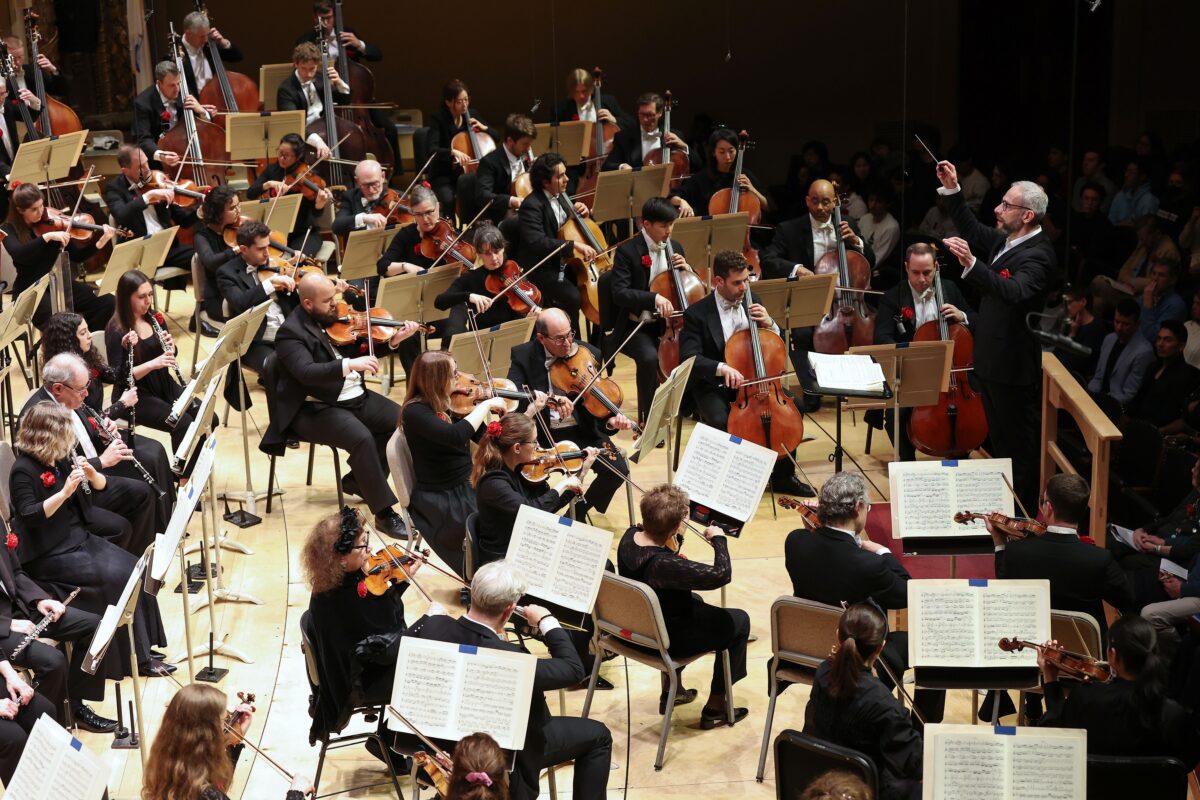
Photo by Winslow Townson
Much ink has been spilled on local Boston music blogs and newspapers on the affair. While the New York Times somewhat abrasively called Nelsons’s “fall from grace” a “cautionary tale,” the Latvian conductor is still very much in demand, currently recording a Mahler cycle with the Wiener Philharmoniker. The BSO will likely take some time before naming its next MD. Finnish conductors Esa-Pekka Salonen and Susanna Mälkki have been floated online as possible successors. Their compatriot Slobodeniouk might even be an outside contender, given he has been one of the most-scheduled guest conductors in recent BSO seasons. Unverified rumors speculate another Finn, Santtu-Matias Rouvali, will be Cleveland’s next MD, while Klaus Mäkelä will be starting in Chicago next year, though the BSO may very well go in an entirely different direction altogether.
Salonen and BSO CEO Chad Smith will be discussing at Tanglewood this summer the “future of orchestras.” Orchestral innovation and reform are more pressing issues than ever in a shifting cultural and political landscape, not to mention an increasingly dire attention economy. The acrimonious saga in Boston is itself a “cautionary tale,” though not necessarily for Nelsons himself but rather the arts writ large. The squabbles over the merits and faults of one Grammy-winning conductor risk missing the bigger picture, namely the tangible threat to all cultural institutions. A first symbolic step, perhaps, would be to heed Beethoven’s call for “more joyful song” in the face of crisis.
Montagu James
Montagu James is a PhD student at Brown University studying modern European political and cultural history. He also enjoys composing and conducting.
-
People: André Schuen, Andrea Carroll, Andrew Haji, Andris Nelsons, Augustin Hadelich, Boston Symphony Orchestra, Dima Slobodeniouk, Emily Dickinson, Esa-Pekka Salonen, Friedrich Schiller, Herbert Blomstedt, John Adams, Klaus Mäkelä, Morris Robinson, Others mentioned: Andrè Schuen, Santtu-Matias Rouvali, Susanna Mälkki, Zoie Reams
-
Works: Nixon in China, Violin Concerto
-
Places & Organizations: Boston Symphony Orchestra, Carnegie Hall, Tanglewood, Tanglewood Festival Chorus, Wiener Philharmoniker