The night is dark and full of terrors
Opera Baltimore concludes its season with a piercing semi-staged production of Pelléas et Mélisande.
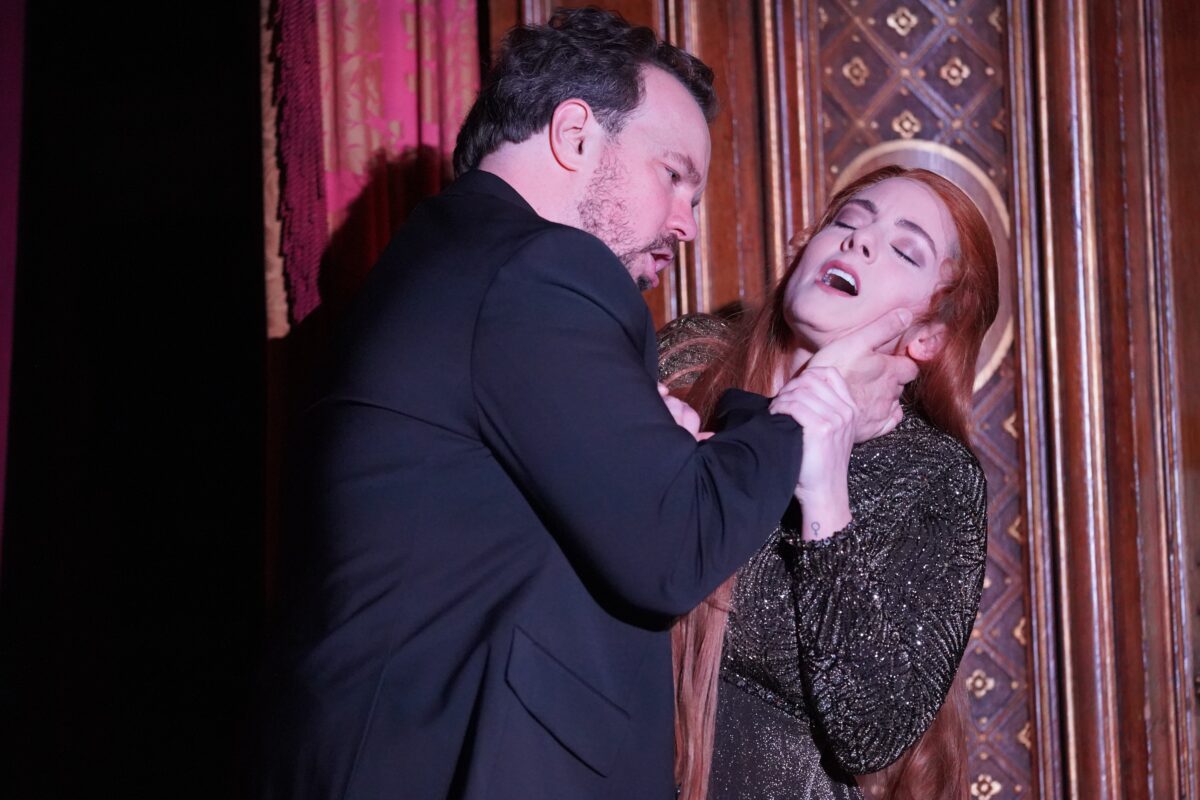
Photo by Bart Debicki
On Wednesday night, Opera Baltimore concluded its season with a semi-staged production of Claude Debussy’s Pelléas et Mélisande at the Engineer’s Club in Mount Vernon, Baltimore. I was skeptical whether Debussy’s score, which, in full orchestra, shimmers like sunlight on a lake, would come off in piano reduction. I couldn’t have been more mistaken. Pianist-conductor Husan Chun-Novak’s playing was an achievement in a night filled with them, startling in its immediacy, filling the space with grave, restless tones. Throughout the show, I felt as though I were possessed by a nightmare, tossing and turning, transfixed, bewildered, and, ultimately, profoundly moved. Opera Baltimore’s version mostly eschewed Debussy’s musical interludes, compressing the action to diamantine intensity. Scenes unfold with the terrible velocity of the domestic drama from which the opera is adapted. The night – to paraphrase Game of Thrones’s Red Priestess, Melisandre – was dark and full of terrors, indeed.
We opened on Chun-Novak bathed in a stark, white spotlight. Golaud is alone on a hunt, wandering through the woods – in this production, simply a darkened stage – looking for his wounded quarry. Instead, he chances on a nearly catatonic young woman, who reveals herself as the mysterious Mélisande. (The circumstances of this meeting, as Dr. Aaron Ziegel noted in one of his excellent pre-show lectures, suggests that Mélisande may even be one of Duke Bluebeard’s wives from Bartók’s Bluebeard’s Castle.) Golaud persuades her to come back with him to his father, the King of Allemande’s castle. Six months pass; Golaud and Mélisande are married. In Act II, Pelléas – Golaud’s younger half-brother – and Mélisande are at a well. Mélisande, tossing her wedding ring up in the air over and over, drops the ring into the water. Pelléas encourages her to tell Goulad the truth. Simultaneously, Golaud is thrown from his horse and sustains an injury. Golaud notices her missing ring and, in a rage, orders her to find it, ironically sending her back into the company of Pelléas.
Daniel Scofield’s performance as Golaud, filled with menacing desperation, was a standout of the night, and it began with this scene. Singing with hurt, frustration, and domineering love – “like my heart was torn apart,” he says, speaking at once about his injury and the love dissipating between him and Mélisande – he tees up the drama that honors Maeterlinck’s literary naturalism without sacrificing Debussy’s close-fitting musical setting. I was astounded by Scofield’s combination of musical sensitivity and practicality; his Golaud is a barely restrained roar, subdued until bursts of rage surface, filling the Engineer’s Club with raw vocal power. Muscular-voiced and brooding, one hopes for the day he fills Iago’s Machiavellian shoes.
Even now, the chemistry between the love triangle – Golaud, Pelléas, and Mélisande – gives me goosebumps. Gina Perregrino had the difficult task of conveying Mélisande’s stoic hopelessness, resilience, and strength, while also giving us an idea of her character’s youthful immaturity, and she did so with grace, poise, and a lovely, soft-petaled mezzo. Her Mélisande leans heavily on confusion, a sense of loss and deracination, of hanging on by fingernails to reality and individuality. Her performance is bewitching, sensual, intoxicating. In Act IV, for example, she takes Golaud’s abuses with stout resistance as he drags her by the hair, roaring “Absalom! Absalom!”, while, in the final act, her tender forgiveness is touching beyond belief.
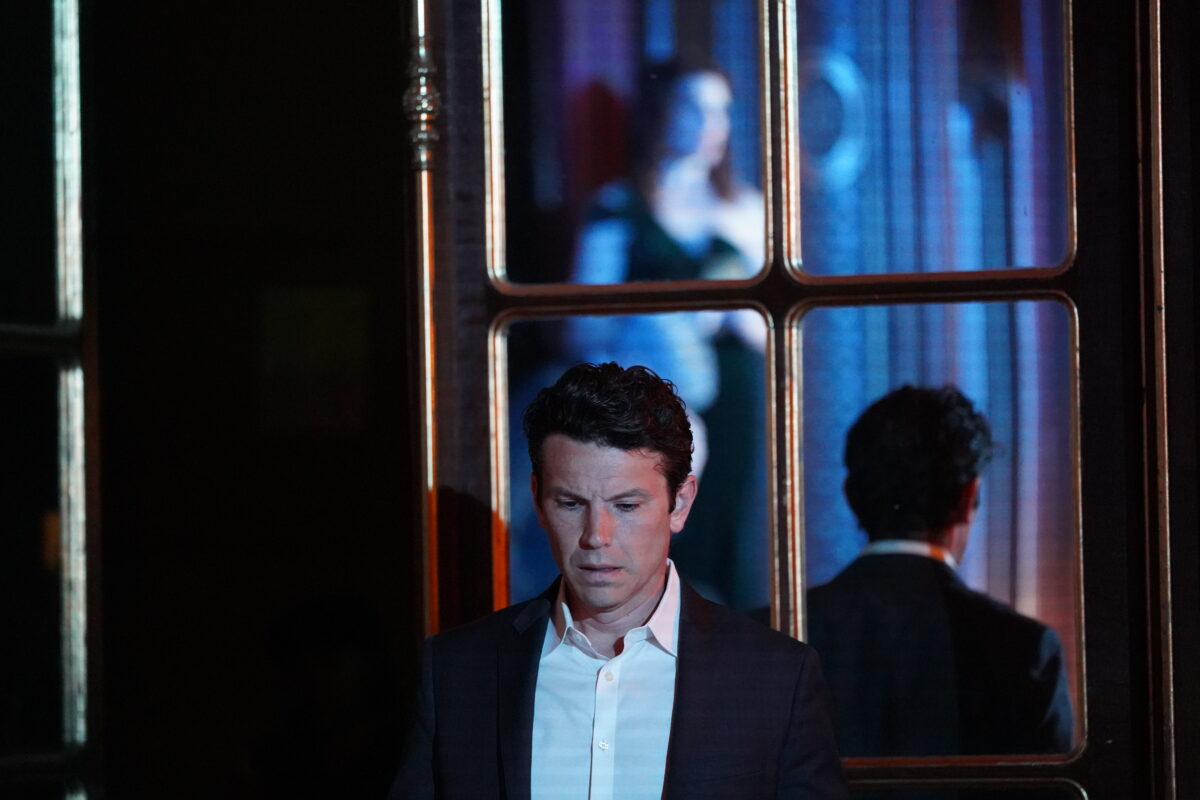
Photo by Bart Debicki
In Act III, John Viscardi’s Pelléas, in a startling scene of naked intimacy, induces erotic frisson as he plays with Mélisande’s hair, tousling it on his face, his throat, bathing in it, telling the ecstatic Mélisande what he’s going to do with it – meanwhile, the piano seesaws uneasily underneath, refusing to capitulate totally to the rush of sensuousness. This duality – this sense of continuity of life, from the infant in the last scene to the decrepit king in the second, is paralleled throughout the show with the inevitability of loss, heartbreak, and death. The effect is brutal and unrelenting drama. Rounding out the strong cast were Amanda Sheriff as the little Yniold, played with, by turns, exuberant pluck and humor and credible shock and horror at Golaud’s behavior; Eric Delagrange, who lent gravity as the aged King Arkel; and Sarah Heltzel, as Genevieve, the King’s daughter.
Sometimes more is more. Previously, I wrote about Opera Baltimore’s production of Lucrezia Borgia, which suffered from a lack of production design and dry stage direction. From breaking the frame and striking out past the proscenium to low-budget, high-impact design choices, smaller companies are finding ways to immerse audiences in the drama without breaking the bank. This time, however, less really was more. The creative team, led by stage director Claire Choquette, kept props and set at an absolute, semi-staged minimum – I counted three props: Mélisande’s wig, a chair and chaise longue, and Golaud’s sword. Water was simulated with a bright blue light, lending an aura of surreality. All of this helped showcase the vocal and dramatic talent on display. The final tableaux, too, was unforgettable – a dark, black-purple painting of static figures, fading into eternity.
The evening proved that a piano and a few voices can suck the breath away, raise an arm’s length of goosebumps, stab with a desolate, fatal knowingness, pull with the gravity of a slow-moving disaster, hurtling towards a preordained conclusion. As life sometimes is. As life, perhaps, always is.

Brendan Latimer
Brendan Latimer is a writer and urban planner based in Baltimore, MD. He invented the dark chocolate with orange juice combo. You can find him on Instagram at @b_lat_ and @operanoises.
-
Topics: Review
-
People: Aaron Siegel, Amanda Sheriff, Amanda Sherriff, Claire Choquette, Claude Debussy, Daniel Scofield, Dr. Aaron Siegel, Eric Delagrange, Gina Perregrino, Husan Chun-Novak, Jessica Harika, John Viscardi, Maurice Maeterlink
-
Works: Lucrezia Borgia, Pelléas et Mélisande
-
Places & Organizations: Opera Baltimore, Opera Baltimore