Bach to Bach
An invigorating double bill at the San Francisco Symphony challenges how Bach “should” be performed.
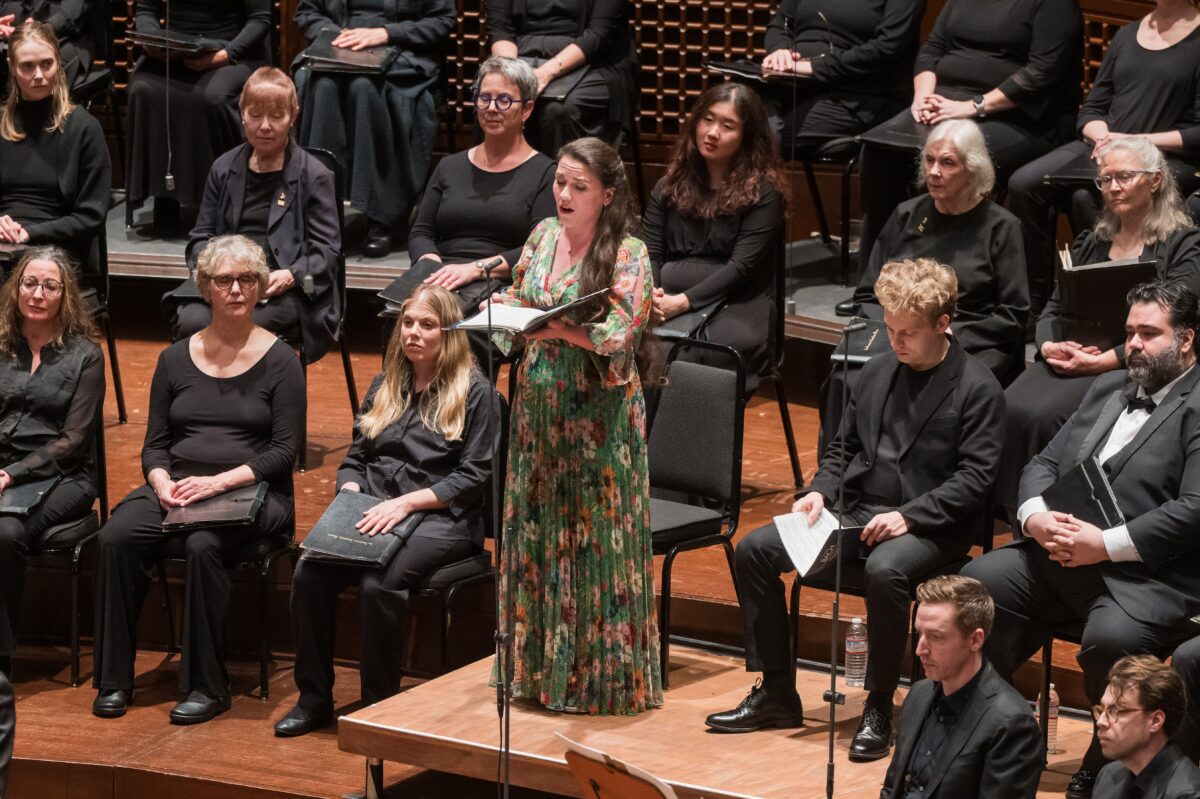
Photo by Brandon Patoc
Johann Sebastian Bach was an inveterate reviser and self-borrower. He was also someone who was interested in musical innovations. In the early 1730s, scholars believe that Bach attended the opera in Dresden, where he hoped to break into the musical world of a court very much devoted to opera. It is not entirely clear what Bach saw, but it’s likely he saw works by Johann Adolph Hasse, a well-traveled composer very popular in his day but largely lost to history. There is no confusing Bach’s and Hasse’s music; Hasse’s music is lovely but not especially memorable. However, Hasse’s textbook examples of opera seria (dramatic operas on historical and mythological subjects) may have given Bach a bit of permission to take the liturgical vocal works he was writing and “operafy” them.
Such may have been the case with the Easter Oratorio, which anchored the San Francisco Symphony’s latest subscription concert at Davies Symphony Hall under the baton of Canadian early music specialist Bernard Labadie. A frequent presence on the podium at Davies and founding music director of the Quebec-based Les Violins du Roy, Labadie led an energizing all-Bach program, a sort of wrap-up to the Easter season. The orchestra was joined by the ever-brilliant San Francisco Symphony Chorus.
The program opened with the longest work, a compelling performance of the Easter Oratorio. In a hall as big as Davies, and with an orchestra and chorus as large as Labadie assembled, almost anything would have taken on operatic proportions. Yet the scale of the ensemble certainly gave Bach an operatic feel.
In this oratorio, Bach actually assigned characters to the soloists, not usually the case with his liturgical music outside the Passion settings. Unlike his other sacred cantatas, this meant that the Easter Oratorio was a theatrical work of a liturgical setting. This is in keeping with the very rebirth of theatre itself after the fall of Rome, when monks took on roles in Easter reenactments or when Hildegard of Bingen wrote her groundbreaking liturgical dramas. Bach’s reputation as a thorough-going Lutheran who avoided composing opera crowds out his keen awareness of the history of theatrical practice and his eye on what was happening in Italy and the works being composed there.
The Easter Oratorio premiered in 1725. In the previous Easter season, Bach debuted his St. John Passion. The opening to that work is weighted with grief from the opening chords. By contrast, the Easter Oratorio opens with the Sinfonia, a standalone overture written in Bach’s trademark jaunty 3/8 time signature (or in some editions 3/4). It reveals the end of the story at the beginning. Christ will triumph through his resurrection, make no mistake. Bach alludes to the St. John Passion with the more contemplative Adagio, a sort of second overture that reminds us that before the Resurrection, there has to be Christ’s death.
The first voice we hear is that of the chorus, and it came blazing through as prepared by choral director Jenny Wong. The first words are “Come! Hurry! Run fleetingly feet/to reach the tomb” as the apostles Peter and John head to the tomb to eventually find it empty, confirming Christ’s divinity. It’s entirely believable that the sheer energy of those assembled voices could have pushed two men to run as fast as they could to discover the miracle. I cannot recall hearing German so crisp and clear without it being overly fussy. The sheer size of the chorus probably would annoy an early music partisan (and Bach would have probably fallen over at hearing the sound), but the size of the chorus gave those opening measures an electricity that more prim takes on Bach can never offer. This was a consistent theme. With each pristine yet bold entrance (credit to Labadie and his conducting here), the chorus made Bach’s writing sound like a clarion calling together—and an admonition to buckle up and enjoy the ride. I mustn’t fail to mention the consistently superb San Francisco brass section, who gave Bach’s music the sound of heavenly thunder all evening.
The first extended solo goes to Mary Cleopas, one of the three Marys who travel to the tomb in the Gospel According to John. This Mary was sung by the American soprano Joélle Harvey. One of the operatic influences that Bach embraced was the da capo aria, where there are multiple repeats. This gives the singer the chance to find the subtle nuances in the character and show off their vocal ability. Bach’s repeats are less about vocal showing off as they are about allowing the character an extended meditation, in this case, on the healing of the soul. Mary’s aria clocks in at about 11 minutes (almost a quarter of the work’s entire length). Only Bach would let something so muted go on for so long. The result was almost meta-theatrical, putting the audience in a meditative state. Harvey’s lush and flexible soprano lent the aria a sense of life and vigor, with pitch-perfect ornamentation. This was not a stately museum-artifact Bach, but a life-affirming embrace of the grief of Christ’s death but the hope that from it comes something good.
A welcome development in Bach performance over the decades is the removal the patina of leaden stateliness, making Bach’s music less “important” and more vibrant. Harvey embodied that. Principal flutist Yubeem Kim’s work also deserves mention. He spun out Bach’s music, both the long extended phrases and the filigree trills, creating essentially a duet for flute and soprano, a Bachism that always makes for enjoyable listening.
The next set aria assigned to Peter the Apostle stayed with this theme of healing, treating sorrow as something “refreshing”. In perhaps the most striking performance of the evening, Canadian tenor Andrew Haji (in his San Francisco Symphony debit) sang Peter with as enjoyable a tenor as I can remember ever hearing in concert. I say enjoyable because to hear a voice so secure and capable meant I could listen to Bach being interpreted and not to a singer reaching for notes. To be fair, all of the soloists were in this class, but Haji produced a sound so focused, yet free of affect, that he could have been reading a letter Bach wrote to his lawyer, and I would have been hanging on every word. Haji’s ability to mix his sound, blending the chest and head voice, meant that like Harvey, he made Peter believably alive, not just declamatory. The different vocal colors created a true character, where Peter had both a heart and a mind.
I was also struck by Bach’s scoring for this aria. He scores it for violins, recorders, organ, and cello (in continuo), all of which are playing in the lower parts of their ranges. While it may not be necessarily unusual for Bach, it creates a much more modern atmospheric rumble underneath the tenor, reminiscent of the French composers like Saint-Saens and Debussy, who were such admirers of Bach. When Peter sings “May death’s grief be gentle…and comfortingly wipe from my cheeks/the tears of pain,” that instrumental rumble both unsettles and comforts Peter, an analogue to how the pain of the Passion is set alongside the joy of the Resurrection.
English countertenor Hugh Cutting, also making his debut at Davies, sang Mary Magdalene. Her aria “Saget, saget mir geschwinde” (“Tell me, tell me quickly”) is Mary’s extroverted searching and yearning for Christ’s love. It’s where the oratorio starts to turn away from meditation and grief and towards its life-affirming ending. Though a somewhat smaller voice, Cutting’s is a darker and more rounded sound, giving Mary a somewhat more matronly presence. Perhaps I shouldn’t quibble with Bach, but it was a choice I wondered about. Labadie’s brisk tempo, playing up the character’s youthful impetuosity, propelled the aria forward to such a degree that it clearly challenged Cutting to keep up, though his ornamentation was precise and intonation solid.
It’s true that Labadie did not let any moss grow on Bach’s score. Even in the more contemplative sections (which certainly were not rushed), his tendency was to push the drama forward, never allowing the work the chance to turn maudlin or precious. This balance allowed the soloists and chorus to be understood without turning a vibrant work of music theatre into an exercise in German diction. It also treated the Easter Oratorio as theatre instead of purely liturgical music and highlighted the theatricality of Bach’s approach. The work actually began life as a birthday cantata written for a nobleman. Bach took that cantata and created the Easter Oratorio. After its 1725 premiere and after his exposure to opera in Dresden, Bach further revised it. Labadie’s approach seems to align with the more operatic Dresden Bach.
Two years before the Easter Oratorio, Bach premiered his Magificat also in Leipzig, as part of the Christmas Vespers in 1723. He later revised it and changed the key from E-flat major to the D-major in which it is most often performed today. The Magnificat is a purely liturgical work that sets to music the Canticle of Mary from the Gospel According to Luke. The text describes Mary as she visits her cousin Elizabeth, who is pregnant with John the Baptist. Mary has just learned from the angel Gabriel that she will bear Christ. Elizabeth greets her with “Blessed are you among women,” and Mary’s response is the Magnificat — “Magnificat anima mea Dominum” (“My soul doth magnify the Lord”).
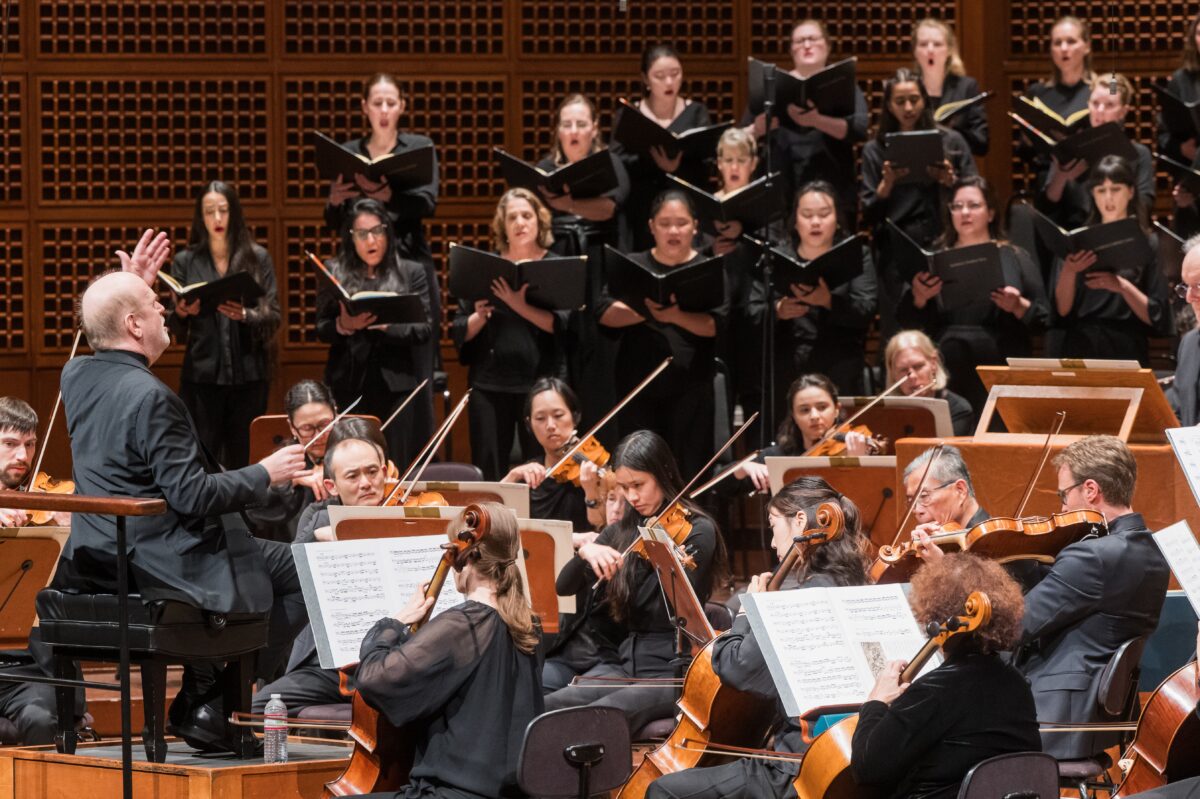
Photo by Brandon Patoc
Unlike in the Easter work, here the soloists are not assigned characters but different verses of the Canticle. Once again, we’re met at the top with a joyful trumpet-adorned opening section (the “Magnificat” of the title) and again excitingly dispatched by the San Francisco Symphony Chorus. It’s in the choral sections that we can hear the Handel that Bach copied out by hand in Leipzig. While the music in the Magnificat still sounds like Bach, there is definitely Handel’s influence in the uptempo choral numbers (Bach’s “Omnes generationes” sounding eerily similar to Handel’s “Dixit dominus”).
A standout was baritone Joshua Hopkins, whose rendition of “Quia fecit mihi magna” (“For the Mighty One has done…”) was, in a cadre of excellent soloists, perhaps the most sublime performance of the evening. A regular visitor to Davies, Hopkins’ approach was faithful to Bach in that he respected Bach’s heavily accented vocal line. But there was an Italianate elegance that gave a moment of gratitude for God’s grace a sort of vulnerability. Hopkins got as close to legato phrasing as one can get in Bach’s German, and it was beautiful. He returns to San Francisco this summer to sing the title character in San Francisco Opera’s production of The Barber of Seville. When I read that, I almost wondered if his voice is too pretty for Rossini. What a happy problem to have.
The group of soloists that Labadie and the San Francisco Symphony assembled, plus the strength of the orchestra and chorus (no shock there), made me kick myself for avoiding Baroque music at Davies Symphony Hall. Bach was willing to give opera a chance in Dresden. Looks like I need to give Bach a chance at Davies.
Matthew Travisano
Matthew is a San Francisco-based educator and actor. He has taught and lectured on the performing arts for more than two decades. He has trained a generation of actors in the greater Bay Area at both Oakland School for the Arts and Ruth Asawa School of the Arts, where he has also taught literature, composition, literary theory, and aesthetics. He holds a BA in English from UC Berkeley and a Master's in Teaching (MAT) from San Diego State University.
-
People: Andrew Haji, Bernard Labadie, Camille Saint-Saëns, Claude Debussy, Hugh Cutting, Jenny Wong, Joélle Harvey, Johann Adolph Hasse, Johann Sebastian Bach, Joshua Hopkins
-
Works: Il barbiere di Siviglia
-
Places & Organizations: Davies Symphony Hall, Les Violons du Roy, San Francisco Opera, San Francisco Symphony